Protective Case Knowledge Center
Nine clusters covering product, technical, material, foam, sealing, procurement and logistics knowledge. Written for the engineer who specifies the case and the purchasing manager who has to defend the choice — not for a blog roll.
Nine knowledge clusters
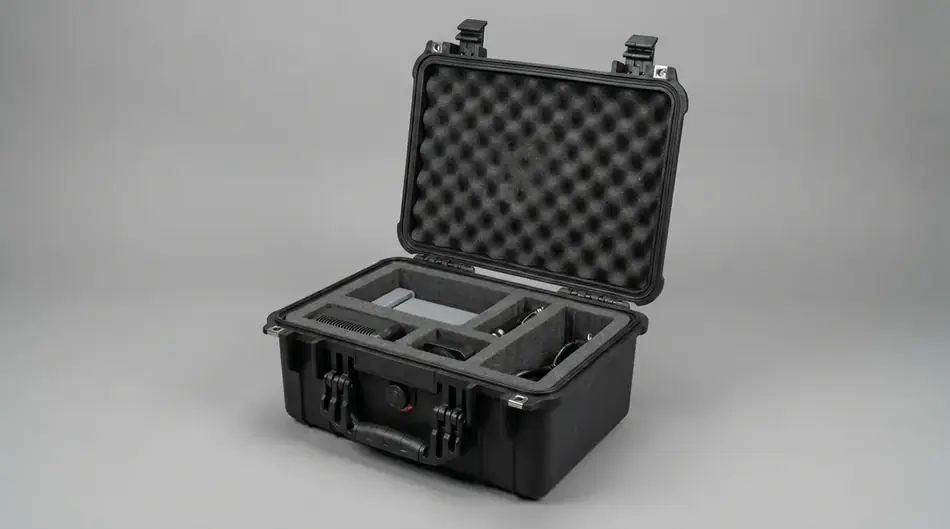
Protective Case Basics
What a protective case is, how it is built, and which numbers actually decide whether it protects the equipment inside…
Military Case Guide
Specifying cases for military and defence equipment: series, sizes, foam, hardware and the last fifty metres.…
Firearm & Long Equipment Transport Cases
The packaging problem of long, rigid equipment: internal length, clearance, lid-to-base split and closure layout.…
Storage & Transport Box Guide
Stackable boxes as an inventory system: volume, stacking behaviour, closure and packing data.…
Foam Insert Guide
The interior is the product: foam types, density, layering, cleanability and how thickness is chosen.…
Waterproof & Dustproof Guide
How a case actually keeps water and dust out, and what an IP rating does and does not tell you.…
Material Guide
PP, engineering PP and ABS compared on the properties that decide a case: impact, stiffness, chemistry, finish and cos…
Procurement Guide
How to buy cases from a manufacturer: RFQ content, MOQ, tooling economics, factory verification and lead time.…
Logistics & Packing Guide
Internal versus external dimensions, pallet fit, carton data and container loading.…
Start with these
How To Choose A Protective Case: The Seven Numbers That Decide It
Choose a protective case in this order: the internal envelope of the equipment plus clearance, the packed mass and how f…
What A Protective Case Is Made Of: Shell, Seal, Hardware And Foam
A protective case is four systems working together: a moulded thermoplastic shell that carries impact and stacking load;…
What Is A Military Protective Case?
A military protective case is a reusable, hard-shell container designed to store and transport equipment while reducing …
Military Equipment Case Selection: Series, Size And Carrying Method
Select by internal volume band first, then by carrying method, then by interior. In the KeXin range, accessory and ammun…
Firearm & Long Equipment Transport Case Guide
A long item inside a long case behaves as a beam. When the case is carried at the ends the shell flexes in the middle, a…
Ammunition & Inventory Storage Box Guide
A storage box is bought as a system, not as an object. The four numbers that decide whether it works are internal volume…
Foam Inserts For Protective Cases: Types, Layers And Selection
A foam insert is chosen by three independent decisions: how it is made (pluck, die-cut or CNC-cut), what it is made of (…
How Foam Thickness And Density Are Chosen
Thickness sets the stopping distance and therefore the peak force transmitted during an impact. Density and grade set ho…
How Waterproof Cases Actually Work
A waterproof case compresses a gasket between the lid and the base along a continuous, uninterrupted rim, using enough l…
How this library is written
Structure of every article
Direct answer first, then key points, then the detailed explanation, a comparison where one is useful, a selection guide, applications, customisation and procurement notes, then FAQ. The same order every time, so a reader — or a machine — knows where to look.
What we will not do
No invented certifications, no fabricated test data, no anonymous industry experts, and no claim to be the world's best anything. Where a figure has not been measured, the article says so.
One intent per page
Product, application, technical, procurement, OEM, manufacturing and case-study pages each serve a distinct search intent. We do not publish three pages competing for the same keyword.