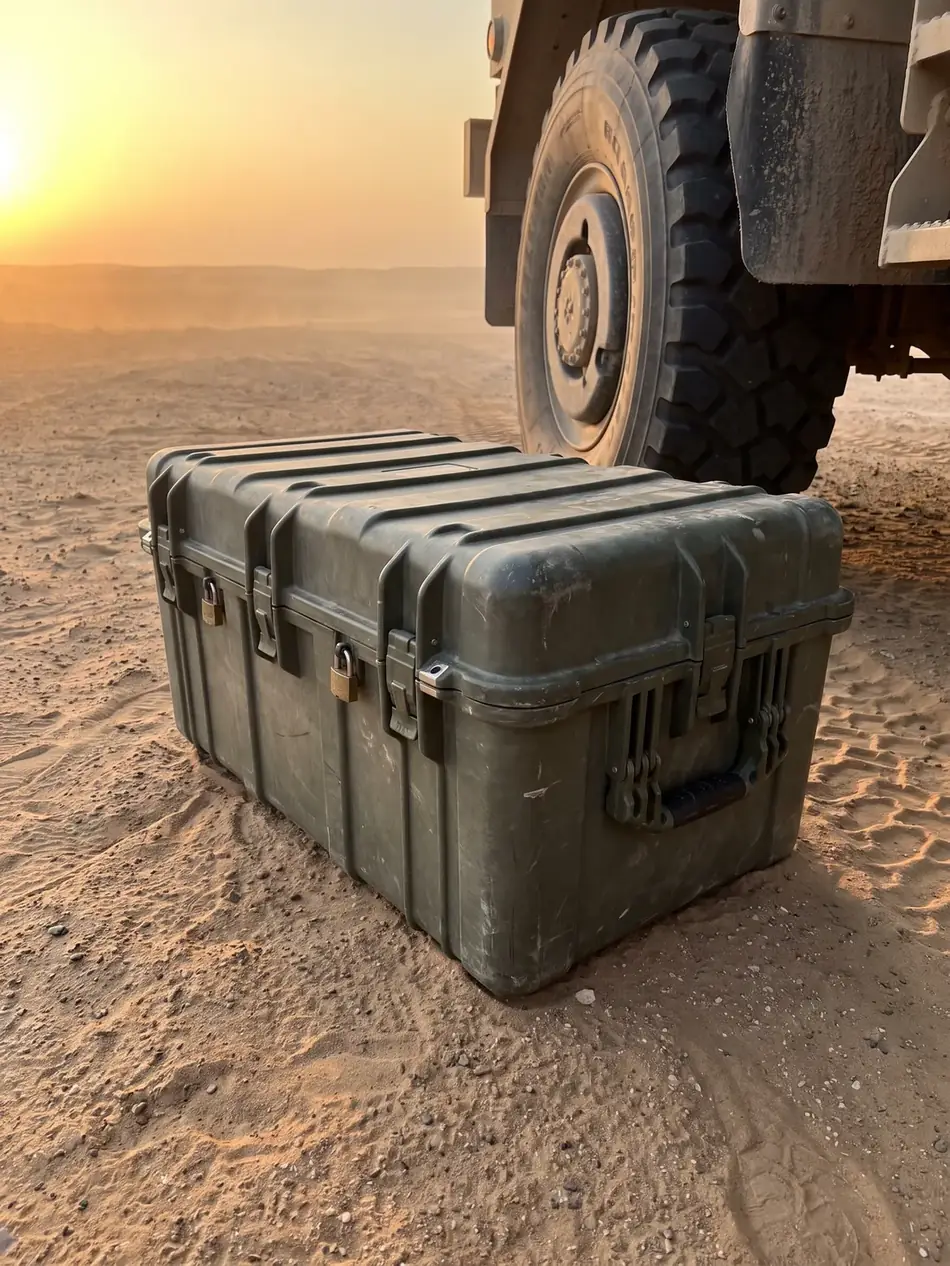
Military Equipment Case Selection
Select by internal volume band first, then by carrying method, then by interior. In the KeXin range, accessory and ammunition kits sit in the 0 and 1 series, instrument and radio kits in the 6 and 7 series, complete systems in the 8 and 9 series, and anything above roughly 12 kg packed belongs in the T series with wheels.
Key points
- Volume band narrows the field faster than any other single number.
- Carrying method decides the series more often than the equipment does.
- The external footprint has to be checked against the vehicle or rack before the internal volume is optimised.
Selection by internal volume
| Band | Use | Series |
|---|---|---|
| 0.3-3 L | Accessories, pistol kits, small arms consumables, spare parts | 0 / 1 |
| 3-15 L | Handheld radios, optics, small medical kits, tool sets | 6 / 7 |
| 15-40 L | Transceivers, test sets, trauma kits, drone kits | 7 / 8 |
| 40-90 L | Complete field systems, masts, medical equipment | 8 / 9 |
| 90-139 L | Deployed infrastructure, large ground stations | 9 / T |
Two questions that resolve most cases
Can one person carry the packed case over the distance it must be carried? If not, the answer is a T-series shell or two smaller cases, and no amount of shell quality will change that.
Does the kit change between deployments? If yes, a fixed CNC cut will be wrong within a year, and the correct answer is a pluck-foam top layer over a fixed base.
Applications
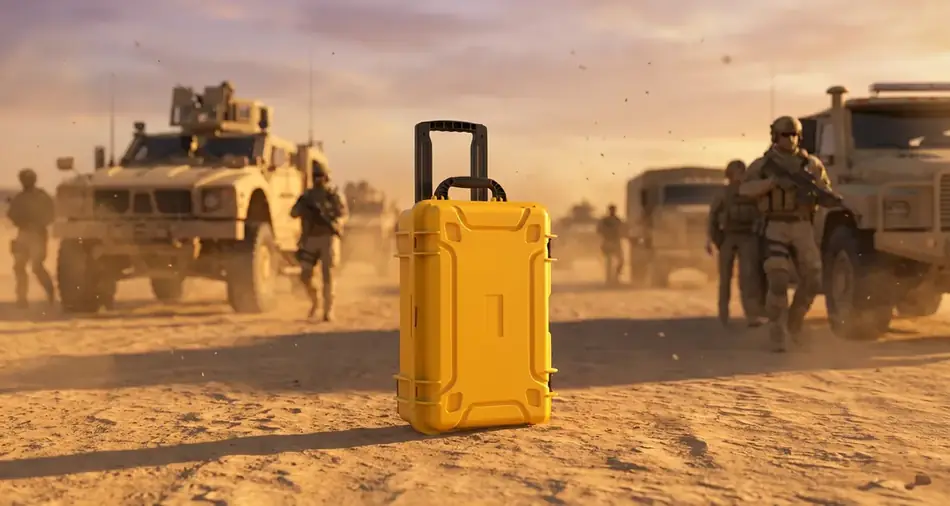
This matters most where the case is part of a movement chain rather than shelf packaging. In military and field & deployment the same shell is specified differently because the handling, the environment and the verification requirement differ.
- Military — Military equipment moves through a chain of handlers, none of whom own the equipment and all of …
- Field & Deployment — Field deployment removes every assumption a depot specification makes: no forklift, no dry stora…
Customisation
Everything described above is configurable on a standard shell: interior layout (pick-and-pluck, die-cut or CNC-cut), foam grade and thickness, colour, logo method, latch and lock count, pressure-equalisation valve, cable ports, document holder and identification plate. A bespoke exterior geometry requires a new mould — 125 days, from 3,000 units per moulded component.
Procurement considerations
| Question | What to send us |
|---|---|
| Which shell fits? | Equipment L × W × H as packed, plus required clearance per axis |
| What does it cost? | Order quantity and estimated annual quantity — the two drive different answers |
| Is tooling needed? | Whether an existing shell clears the envelope with usable foam depth |
| Lead time? | Your required delivery date, not just the order date |
| Certification? | The exact standard your tender names — we will say whether we can test to it |
| Freight? | Destination and preferred terms; carton and pallet data supplied with the quotation |
Comparison and selection guide
The tables on this page exist because a protective case is chosen by comparing three things: the envelope, the environment and the handling chain. Where no table applies, the rule below is.
| Situation | What To Do |
|---|---|
| Start from the equipment, not the case | Measure the tallest, widest and longest points of the packed equipment including antennas, handles and connectors. Add 20 mm minimum clearance per axis before selecting a shell. |
| Then choose the carrying method | Under 8 kg, a fixed handle is lighter and cheaper. Over 12 kg or any journey over 30 m, specify the T series with telescopic handle and wheels. |
| Then decide the interior | Pick-and-pluck for kits that change. Die-cut or CNC-cut for fixed layouts that must be auditable at a glance. |
- Size on internal dimensions plus clearance, never on a product name.
- Choose the carrying method before the shell: it changes the series, not just the price.
- Specify the interior last, and decide up front whether the end user will reconfigure it.
Military Equipment Case Selection relates to Military Case Guide. Related families: Military Protective Cases / Military Transport Cases / Rolling Cases. Related sectors: Military / Field & Deployment. Continue in the Military Case Guide cluster.
This page is written from our own production data. If your requirement differs, send the dimensions and we will tell you which of the 155 models fits, or whether a custom route is needed.