What size military equipment case should you choose?
You choose a military equipment case size from the internal envelope you need, then check that its external footprint still fits where the case will travel and stand. The right method runs in a fixed order: measure the item at its widest, longest and tallest points; add clearance on every face for the protective interior you intend; and match that figure to the published internal dimensions of a real model, never to the external box size, because wall thickness and the lid-to-base split take several centimetres out of the interior on each axis. Then work outward: the external length and width must fit the vehicle rack, shelf bay or pallet grid, and a model with wheels or a telescopic handle stands taller and takes more floor space than the same shell without them. Because our range keeps many depths on one footprint, the usual question is not length and width but how much height the contents actually need, and that is where a size family saves you from an over-wide case. Published internal and external dimensions, wall thickness and empty mass are per model across the range, so the final size is read off a datasheet rather than estimated. A case is sized by the equipment plus its interior, not by the outside of the box you see on a shelf.
Key points
- Size from published internal dimensions plus interior clearance, never from the external box you can see.
- Wall thickness and the lid-to-base split remove centimetres from the interior on every axis; that is the usual sizing mistake.
- The external footprint has to fit the rack, shelf bay or pallet grid, and wheels or a handle make a case taller.
- Depth, not length and width, is what you normally choose; size families repeat one footprint at several heights.
- Confirm the narrow internal width when a shell tapers, or a case that looks big enough on paper will not take the item.
The order you should size in, and why it matters
Getting a military equipment case to fit is a sequence problem as much as a measurement problem, and people run the steps backwards. The safe order is: measure the item; add clearance for the protective interior; select on internal dimensions; then check the external footprint against the transport and storage envelope. Skip the second step and you pick a case that swallows the bare item but not the item nested in foam; skip the last step and you buy a case that protects the contents perfectly but will not go in the vehicle bay it has to live in. The reason this trips buyers is that internal and external are different numbers on the same product, and the datasheet shows both. A case that reads four hundred millimetres long on the outside may only offer three hundred and ninety inside once the walls and the closing flange are accounted for. So the size you quote to a supplier is the internal envelope, and the size you check against a rack is the external one; they are not interchangeable, and a purchase decided on one of them alone will be wrong.
How wall thickness and the lid-to-base split shrink the interior
The gap between external and internal size is not slack; it is material. Wall thickness, published per model and across this range commonly sitting between about 2.5 mm and 6.0 mm depending on series and depth, is what lets a shell carry a load and, in a deeper box, hold its shape in a stack. That thickness is taken off on all four sides, so a thick-walled box loses roughly its wall allowance twice over in length and again in width before you even think about height. Height is governed by a second figure, the lid-to-base split: how the total internal depth is shared between the base you stand the item in and the lid that closes over it. A shallow-lid, deep-base box suits an item that must stand down in the base with the lid merely covering it; an even split suits contents that lie flat. When you choose a size, read the internal dimensions as the real working envelope and treat the external as the shipping and storage envelope. If a model tapers to a narrower internal width than its widest point, that narrow figure is the one your item has to clear.
Choosing depth on a fixed footprint
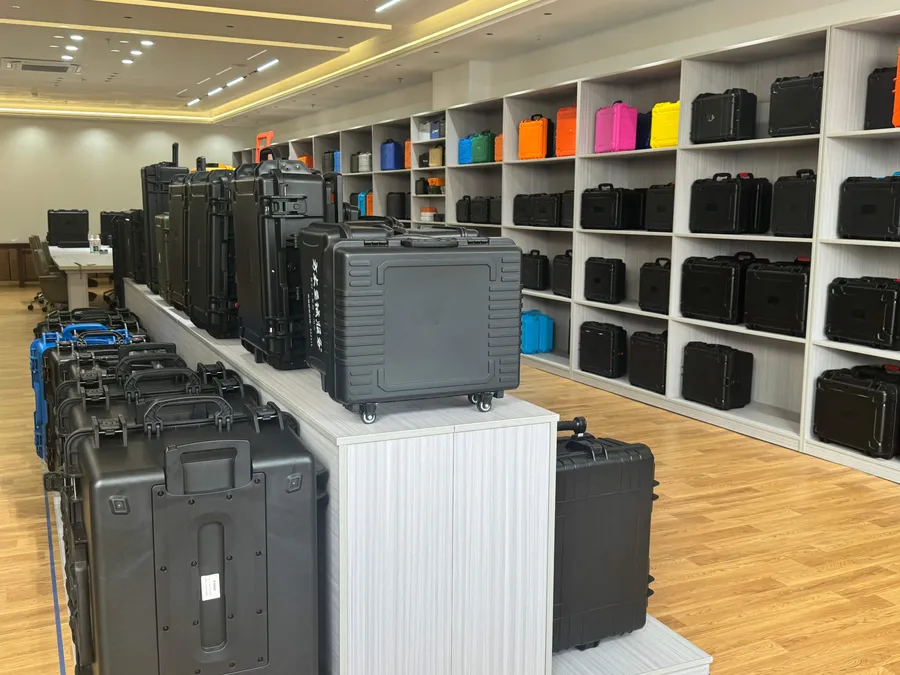
Most of our moulded shells keep one external footprint and offer it at several internal depths, so the practical sizing decision is usually height, not length and width. The example family below holds a 405 by 325 millimetre external footprint across six models and grows only in depth, from a shallow box to a tall one; the internal volume column is computed from each model's published internal dimensions. Pick the shortest depth that clears the item plus its interior, and you save mass, shelf height and freight without giving up any floor space. The wall thickness is published per model and stays comparable across the family; empty mass is published on the datasheet of the exact unit.
| Model | External Mm | Internal Mm | Approx Internal L | Wall Mm |
|---|---|---|---|---|
| KX-84113 | 405 x 325 x 130 | 380 x 267 x 115 | 11.7 | 3.4 |
| KX-84117 | 405 x 325 x 180 | 380 x 267 x 165 | 16.7 | 3.4 |
| KX-84121 | 405 x 325 x 210 | 380 x 267 x 195 | 19.8 | 3.4 |
| KX-84123 | 405 x 325 x 230 | 380 x 267 x 215 | 21.8 | 3.4 |
When wheels and a handle change the size you can use
A case that has to be pulled across an airfield or a compound is a different sizing problem from one that is carried or shelved, because running gear is added to the outside of the envelope. Wheels and a telescopic handle increase the external height and footprint and add real mass to the empty case, so the model you can load into a fixed bay is smaller once it can roll, and heavier before you put anything inside it. The spread below moves from compact carried boxes to large wheeled transport boxes and is drawn from individual datasheets to show the shape of the range, not to claim a general limit; internal dimensions, wall thickness, empty mass and wheel fitment are published per model. The sizing rule is unchanged: pick the internal envelope the contents need, then decide whether the external growth from wheels is acceptable in the space the case must occupy. Where a trolley size is genuinely required, a handled model is usually chosen one internal depth shorter than the carried equivalent, so the whole thing still fits the vehicle.
A worked sizing method you can run on any item
Treat sizing as arithmetic against a datasheet rather than an estimate against a photograph. First measure the item at its maximum length, width and height as it will actually be packed, not as it sits on a bench. Second add an interior allowance on every face, typically a centimetre or two of direct-contact foam on the walls and more on any fragile or heavy corner, then round up to the next published internal figure. Third confirm the narrow internal width if the shell tapers, because that is the width the item has to clear at its tightest point, not the widest. Fourth compare the external footprint against your rack, case bay or pallet grid and, if it must roll, against the handled external height. Fifth confirm the empty mass and carton packing against your order quantity, since a bigger box usually ships fewer per carton and it is the carton, not the single case, that sets freight. Work the six depth variants of a footprint family rather than jumping up a whole footprint, and you will most often find a case that fits the item and the transport envelope at the same time. If a supplier cannot show you internal and external figures, the wall thickness and the narrow internal width for a specific model, the size is guesswork.
Typical equipment and the size band it tends to need
Sizing becomes concrete once it is tied to what actually gets packed. Handheld radios, optics, meters and small sensor sets sit comfortably in the compact and shallow part of the range, where a short depth keeps the load light and several cases share a shelf bay. Rifle scopes, drones and mid-sized electronics fall in the middle band, where a footprint family in a taller depth or a deeper base with a shallow lid lets the item stand in the base with the cover simply closing over it. Long or awkward items, tripod and mast sections, and multi-weapon loads push toward dedicated deep or elongated shells, and here the external length is the binding constraint, because it is the item, not the box, that sets the footprint. Heavy field systems and kits that must be pulled rather than carried move into the handled part of the range, where the trade-off is between internal volume and the added external height and mass of wheels. The consistent point is that each band is chosen from a datasheet of the exact model, not from a category average, and where a sealing gasket is offered it is a per-model option rather than an assumed feature of every box in the size.
Custom sizes and OEM tooling
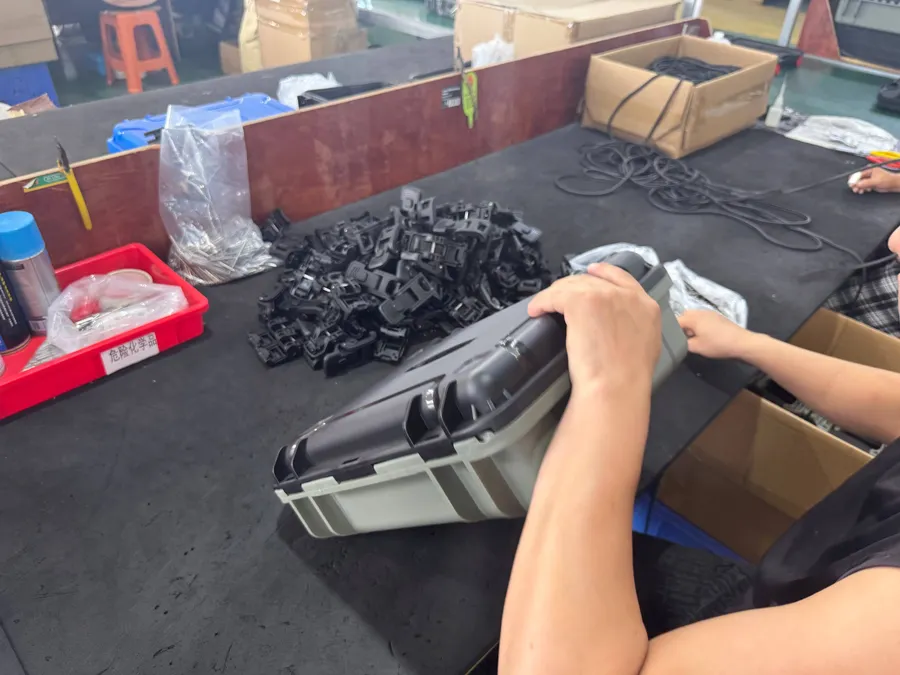
When no catalogue depth clears an awkward item, the route is a change to the interior or a new shell rather than forcing the item into a box one footprint too large. On an existing tool we add value inside the envelope: a cut or pluck foam layer tuned to the item so a centimetre of wall does the work of a whole size step, dividers and a shallow removable tray for small parts, a lid-to-base split matched to how the equipment lies down, and colour or a moulded marking so units are identified at a glance. When the footprint or height genuinely has to change, that is a new mould, and the published business terms apply: about 45 days to a first OEM sample, about 125 days to a new tool, a 30 percent deposit on the tooling, and production quoted on EXW or FOB terms. As a wholesale and OEM supplier we build the size your system needs instead of asking your system to fit the catalogue.
Notes before you buy
We sell to distributors, integrators and OEM programmes on wholesale terms and do not retail single units; quotations are EXW or FOB, and we do not offer DDP or hold stock in an overseas warehouse, so plan freight and customs clearance yourself. Size against the datasheet of the exact model, because internal and external dimensions, wall thickness, the narrow internal width and empty mass all differ across the range. Two checks prevent most wrong-size orders: confirm the internal envelope against the item plus its interior, and confirm the external footprint against the rack, pallet or vehicle bay, including the extra height a wheeled model adds. On protection we keep the same narrow position used across this site: we publish measured physical figures per model, and where a sealing gasket or an ingress property is not tested and stated on that specific case we do not claim a rating for it. A size is only correct for the configuration it was measured in, so order and verify by model number.
Buyer searches on case dimensions, answered with published model data
The rows below continue the sizing method above in the exact words buyers type into a search box, and each one is answered only with figures this site publishes for a named model. The catalogue holds 155 injection-moulded cases. Of those, 113 records carry the Military Protective Cases listing, 115 carry Instrument Cases and 59 carry Drone & UAV Cases, and a single model can sit under several of them at once because the same shell serves several trades. Wall thickness is published on 148 records and runs 2.0 to 6.0 mm; empty mass is published on 93 of the 155, so the figure you size against is the datasheet of the exact unit rather than a family average.
Nothing in this table is a rating or a laboratory result. Our product records store waterproofing, dust resistance, ultraviolet exposure, temperature range, stacking load and payload capacity as not measured, and where one of those decides your project we quote accredited third-party testing for that configuration instead of printing a number we do not hold. Internal and external dimensions, the narrow internal width, the lid and base depths and the carton packing are measured physical figures and are what these rows rely on.
| Search | What We Publish |
|---|---|
| how to choose military case dimensions | Work outward from the internal envelope of the item plus its interior, then check the external footprint against the bay, rack or pallet. Of the 113 records listed under Military Protective Cases, 37 publish an internal depth of 200 mm or more and 8 publish an internal longest side of 700 mm or more, which is where long and flat loads force a dedicated shell. KX 86830 publishes an internal 595 x 460 x 255 mm on a 677 x 535 x 304 mm outside, a 4.8 mm wall and 10,160 g empty, with wheels and a published handle height of 310 mm. KX 88015 publishes an internal 725 x 350 x 140 mm on an 800 x 408 x 153 mm outside with a 5.0 mm wall. The longest published internal figure in the catalogue is 1,280 mm. |
| how to choose instrument case size | Instruments are usually a depth decision, not a footprint decision. The 115 records listed under Instrument Cases publish internal volumes from 5.8 to 44.0 L, and the shallowest published internal depths step 60, 70, 72, 76, 80 and 84 mm, so most meters, transducers and probe sets never need a tall shell. Two models on one 460 x 367 mm external footprint show where the choice lands: KX 4610 publishes an internal 455 x 338 x 84 mm (11.1 L usable) at 1,115 g with a 42 plus 42 mm lid-to-base split, and KX 4616 publishes an internal 455 x 338 x 148 mm (19.6 L usable) at 1,395 g with a 74 plus 74 mm split, both on a 3.0 mm wall. Both also publish a narrow internal width of 302 mm, which is the width a tapered shell has to clear. |
| how to choose a drone case size | A folded airframe lies down, so height and the lid-to-base split bind before length does. The 59 records listed under Drone & UAV Cases publish internal depths from 150 to 305 mm and internal volumes from 17.2 to 69.8 L, and 14 of the 59 are published with wheels. Compare two published splits: KX 83821 gives 155 mm of lid over 35 mm of base on an internal 350 x 300 x 190 mm, while KX 6621 gives 43 mm of lid over 149 mm of base on an internal 587 x 434 x 192 mm with a 6.0 mm wall and 6,420 g empty. On one 463 x 370 mm external footprint, five drone models repeat at internal depths of 164, 180, 180, 214 and 230 mm (KX 84818, KX 84820, KX 84823, KX 84824 and KX 85022), which is how the same payload bay takes several builds. |
| does a wheeled case change the size I can use | It changes the outside before it changes the inside. On the same 677 x 535 mm external footprint, KX 86823 is published as a carried box 225 mm tall with an internal 595 x 460 x 205 mm and is marked stackable, while the trolley KX 86830 is published 304 mm tall with an internal 595 x 460 x 255 mm, 10,160 g empty and is marked not stackable. Nineteen records in the catalogue publish wheels with a telescopic handle, and where that field is filled in the handle height reads 240 to 485 mm above the shell, so a rack or vehicle bay has to be measured against the closed case, not the box in the photograph. |
| how much extra interior space to allow before ordering | Allow for the interior you order, then round up to the next published internal figure rather than the next footprint. Cut or pluck foam is quoted from 1 set with no tooling; logo, colour and OEM work start from 300 pieces and a new mould from 3,000, which are published order terms on every record. Stepping depth inside one family is the cheapest way to buy that clearance: on the 405 x 325 mm external footprint the depth ladder runs from KX 84113 with an internal 380 x 267 x 115 mm (10.1 L usable) to KX 84123 with an internal 380 x 267 x 215 mm (18.7 L usable), both on a 3.4 mm wall, so about 25 mm of height is one size step and the shelf bay never changes. |
| is the case size the same as the shipping size | No, and freight follows the carton. Sixty-four of the 155 records publish a carton size and a pieces-per-carton figure, and the published counts run from 1 to 40 units per carton. KX 64117, internal 393 x 280 x 156 mm, publishes 8 units in a 705 x 430 x 735 mm carton; KX 6621, internal 587 x 434 x 192 mm, publishes 3 units in a 665 x 500 x 650 mm carton; the trolley KX 97227 publishes 1 unit in a 715 x 515 x 280 mm carton. Pallet and container figures are recorded as not measured in the product data and are worked out from the carton footprint against your pallet size when we quote. |
The three published fields that decide a size once the tape measure is done
First is the narrow internal width. Thirty-six records publish it, and it is the figure that catches buyers who sized on the widest point: KX 1204 publishes an internal 115 x 78 x 32 mm with a narrow internal width of 70 mm, and the instrument pair KX 4610 and KX 4616 both publish 338 mm of internal width against 302 mm at the narrow. If your item has a hard shoulder rather than a tapered one, the narrow figure is the one it has to clear. Second is the lid-to-base split, published as separate lid and base depths on the records where it matters. Two cases with the same internal depth can hold very different contents: 155 mm of lid over 35 mm of base lets a folded airframe or a standing instrument sit up in the lid space, while 43 mm of lid over 149 mm of base keeps the same load down in a deep tray. Third is empty mass, published on 93 records and left blank on the rest; where it is blank we supply the weighed figure for the exact model with the quotation rather than estimating it from a neighbour in the size family.
What we do not state about size, protection or performance
A published dimension is a moulded-shell measurement, not a promise about what happens to your equipment in transit. We do not print an ingress-protection rating, a shock level, a stacking load, a payload limit or a temperature range for a model unless that property was measured on that model, and in our product data those fields sit in the records as not measured today. Sealing is published as a per-model option on 124 of the 155 records and as not offered on the remaining 31; a gasket in a moulded channel is a physical feature we can describe, and water or dust resistance is a result we would only quote from accredited third-party testing of the configuration you order, which we arrange and bill per project on request.
Commercially this is a wholesale and OEM operation. We do not sell single units at retail; quotations are EXW or FOB, and we do not offer DDP or hold stock in an overseas warehouse, so land freight and customs clearance sit with the buyer. Existing-tool OEM work runs about 45 days to a first sample, a new mould about 125 days, with a 30 percent deposit on tooling. Order any size by model number, because internal and external dimensions, wall thickness, the narrow internal width and empty mass all differ between neighbours in the same family, and a size that is right for one record is not automatically right for the next.
Customisation
Everything described above is configurable on a standard shell: interior layout (pick-and-pluck, die-cut or CNC-cut), foam grade and thickness, colour, logo method, latch and lock count, pressure-equalisation valve, cable ports, document holder and identification plate. A bespoke exterior geometry requires a new mould — 125 days, from 3,000 units per moulded component.
Procurement considerations
| Question | What to send us |
|---|---|
| Which shell fits? | Equipment L × W × H as packed, plus required clearance per axis |
| What does it cost? | Order quantity and estimated annual quantity — the two drive different answers |
| Is tooling needed? | Whether an existing shell clears the envelope with usable foam depth |
| Lead time? | Your required delivery date, not just the order date |
| Certification? | The exact standard your tender names — we will say whether we can test to it |
| Freight? | Destination and preferred terms; carton and pallet data supplied with the quotation |
Comparison and selection guide
The tables on this page exist because a protective case is chosen by comparing three things: the envelope, the environment and the handling chain. Where no table applies, the rule below is.
| Situation | What To Do |
|---|---|
| Start from the equipment, not the case | Measure the tallest, widest and longest points of the packed equipment including antennas, handles and connectors. Add 20 mm minimum clearance per axis before selecting a shell. |
| Then choose the carrying method | Under 8 kg, a fixed handle is lighter and cheaper. Over 12 kg or any journey over 30 m, specify the T series with telescopic handle and wheels. |
| Then decide the interior | Pick-and-pluck for kits that change. Die-cut or CNC-cut for fixed layouts that must be auditable at a glance. |
- Size on internal dimensions plus clearance, never on a product name.
- Choose the carrying method before the shell: it changes the series, not just the price.
- Specify the interior last, and decide up front whether the end user will reconfigure it.
What size military equipment case should you choose? relates to Military Case Guide. Related families: Military Protective Cases / Military Equipment Cases / Field Equipment Cases / Defense Equipment Cases. Related sectors: field and industrial equipment. Continue in the Military Case Guide cluster.
This page is written from our own production data. If your requirement differs, send the dimensions and we will tell you which of the 155 models fits, or whether a custom route is needed.

