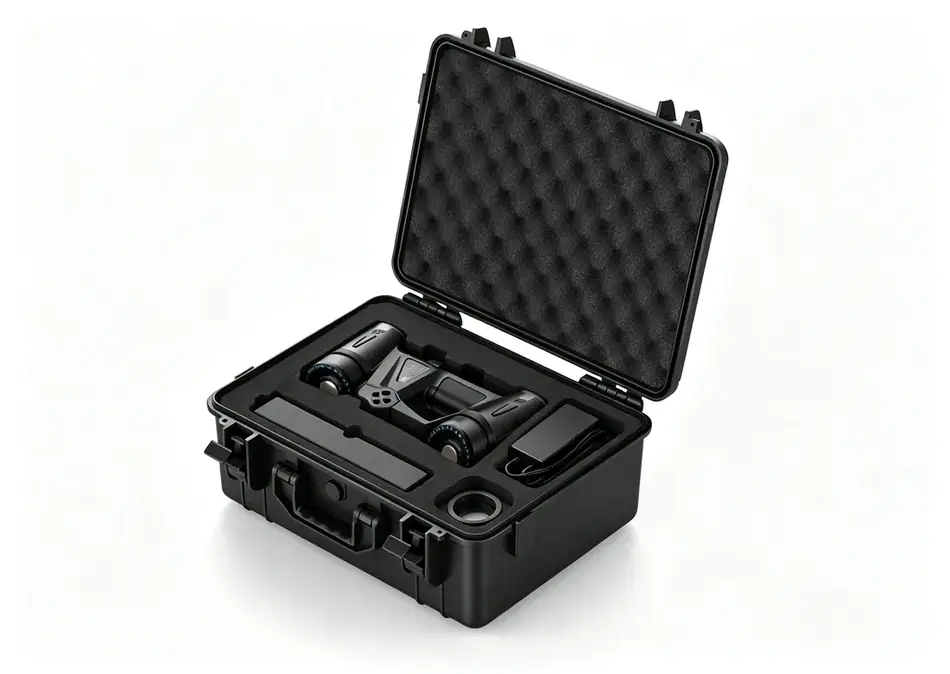
Can optical equipment cases be custom designed?
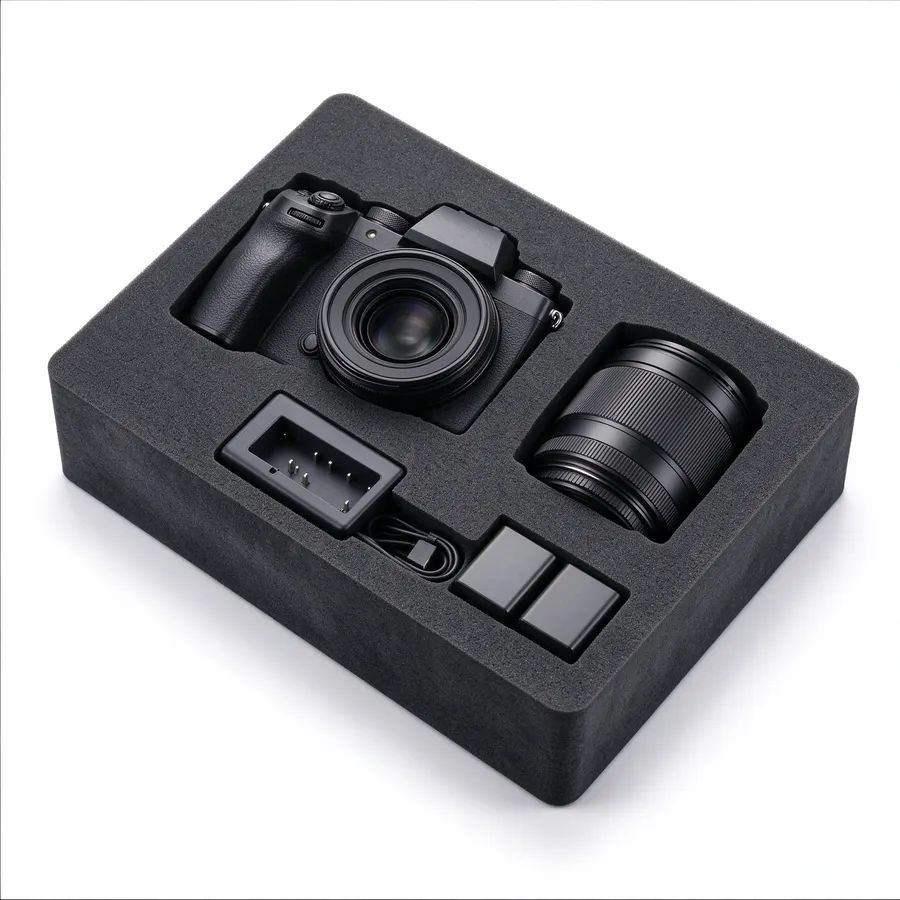
Yes, and the work is split into three levels with very different costs. The interior of an optical case can be custom designed from one set, machined from a drawing, a photograph of the packed kit or a physical sample, in PE, EPE or EVA foam. Colour, printed logo, packaging and hardware changes are custom too, but they start at 300 pieces because they touch production on an existing mould. Only a change to the shell geometry itself needs a new mould, which runs to 125 days and a minimum of 3,000 pieces per component. Most optical buyers finish the job at the first two levels, because 155 published shell sizes already cover internal volumes from 0.3 to 111.6 litres, and a machined interior is what actually fits a lens, a rangefinder or a surveying instrument to its box.
Key points
- Custom design for optics is three separate decisions: interior layout, external finish and marking, and shell geometry, each with its own minimum order.
- A machined interior starts at one set, so a prototype layout for a single instrument is normal business here rather than a special project.
- Logo, colour and packaging changes need 300 pieces; only a new shell shape needs 3,000 pieces per component and a 125-day tooling programme.
- Send a drawing, a photograph of the packed kit, or a physical sample: all three are accepted input, and the sample is fastest for irregular bodies.
- Our 45 optical-tagged models publish internal heights from 140 mm to 364 mm, which decides how much foam thickness a layout can actually use.
- A bespoke shell is a freight decision as much as a fit decision, because external dimensions drive pallet and container quantities before foam does.
What custom designed means for a case, in three levels
Buyers usually ask the question as one yes or no, but a case is made of three independently changeable layers, and the answer is different for each. The first layer is the interior: the foam block in the base, the face layer under the lid, the pockets, the walls between items and any accessory trays. This layer is cut, not moulded, which is why it can be changed for one set without tooling. The second is everything applied to a standard shell: colour, a printed or embossed marking, the label, the packaging, and the hardware fitted at assembly such as latches, handles, feet, a padlock boss or an optional valve. The third is the shell itself: its external and internal outline, wall section, parting line and rim geometry.
The distinction matters commercially because the cost of a change falls on the party who asks for the deepest one. Interior work is charged as cutting and design time. Finish and hardware work is charged at the minimum order of the production line that applies the change, which for us is 300 pieces. Shell work is charged as tooling, which is why it needs 3,000 pieces per component to make sense, and why the lead time is measured in months rather than weeks. A well-run optical case project usually spends its effort on the interior and leaves the shell standard.
Level one: designing the interior around the instrument
This is where a custom optical case is genuinely made, and it is the level with the least friction. Every model page in our catalogue lists custom foam, custom thickness and custom shape as available, with both CNC machining and die cutting offered, and the minimum order for a custom interior is one set. We work from three interchangeable inputs: a drawing that gives the outline and mass of each item, a photograph of the kit as it is currently packed, or the physical sample itself. Where an instrument has a hood, an eyepiece, a tripod foot, a laser module or any other protrusion, a sample beats a drawing, because we copy the layout instead of guessing clearances at the rim.
The material and structure vocabulary is fixed and published so that quotes are comparable: PE, EPE and EVA foams, built as pick-and-pluck, die-cut or CNC-cut, arranged as a base layer, a top layer, a convoluted egg-crate face, a custom cut, or a layered combination of those. A typical optical layout we produce is a firm machined PE base that carries the mass and a smoother face layer under the lid, with the objective end supported and the mounting ring relieved. Depth is the real constraint: internal height is shared between the instrument and every foam layer, so the shell is chosen with the foam budget in mind rather than after it.
Level two: colour, marking, packaging and hardware
On an existing mould, the shell can be produced in a custom colour, printed with a customer logo or supplied unmarked for private label, and packed to your own carton and labelling specification. Each of those routes carries a minimum order of 300 pieces, and an OEM build on an existing mould runs to a 45-day lead time including the interior. Custom hardware is listed as available on the same basis: latch count is specified per configuration, and a shoulder strap, a pressure equalisation valve or an internal document holder are offered as options on shells where they can be fitted rather than as standard equipment on every model.
Two details matter more than they look for optical kit. The first is the seal: on 41 of our 45 models tagged for optical equipment, a compressible gasket in a continuous moulded channel is published as a shell feature, and four shells are listed without one, so if your specification calls for a gasketed shell it has to be chosen at the model stage, not added afterwards. The second is the carry system: 17 of the 45 offer wheels and 28 are published as stackable, and those two attributes are almost mutually exclusive in our catalogue, because a wheeled T Series body is shaped to roll and does not stack flat. Deciding how the case travels tells you which family of shells you may customise at all.
Level three: a bespoke shell and when it is justified
A new mould changes the outline of the case: its footprint, its internal depth, the position of the rim, the wall section, the number of latches and the stacking geometry. It is available, and we quote it as a defined programme of 125 days from approval with a minimum of 3,000 pieces per component, but for optical kit it is justified by only a few situations. The clearest is an instrument whose length or diameter makes every standard shell carry wasted volume, so that freight is paid for air. The second is a product line that will run for years and where a moulded-in feature, such as a specific mounting boss or a fixed divider, removes a foam operation on every unit. The third is a brand programme where the shell silhouette is itself the asset.
What a new mould does not do is improve protection. Our published wall thicknesses for the optical family already range from 3.3 mm on KX-4822 to 6.0 mm on KX-97227, and shell materials from polypropylene through engineering polypropylene to ABS, so strength is selected from what exists rather than invented in tooling. On the shock side we are explicit: shock and impact protection are listed on model pages as construction options that depend on the interior you specify, and we publish no drop height for them.
Comparison: what you want to change against route, quantity and time
Read the table as an escalation ladder: every row is available, and the row you need is decided by how deep the change goes, not by how important the change feels to the end user. The quantities and lead times are the published business parameters on our model pages, and the interior options on the first row are listed on all 155 of them.
| Change | Route | Tooling | Minimum Order | Lead Time | You Send |
|---|---|---|---|---|---|
| Foam pockets and layout | Cut from drawing, photo or sample | None | 1 set | Inside the order | Outline and mass of each item |
| Printed logo or private label | Print on an existing shell | None | 300 pieces | 45 days OEM on existing mould | Artwork and placement |
| Custom shell colour | Colour compound, existing mould | None | 300 pieces | 45 days OEM on existing mould | Colour reference |
| Latch count, handle, valve, strap | Hardware specified at assembly | None | Per configuration | 45 days OEM on existing mould | Hardware schedule |
| Shell outline, depth, rim | New mould | Yes, per component | 3,000 pieces per component | 125 days from approval | Application and volume forecast |
Choosing the route: a short decision sequence
Start with the payload, not the catalogue. Measure the instrument with caps, hoods and batteries fitted, weigh it, and list every accessory that must travel in the same box. Add 20 to 25 mm to each face for a foam allowance and see what internal size that produces; our optical-tagged shells give internal heights from 140 mm on KX-814641, a 1280 x 350 mm long shell, to 364 mm on KX-88442, a 740 x 518 mm body, with 25.6 to 111.6 litres of usable interior between them. If a standard shell contains that outline with reasonable waste, the project stops at level one or two.
Then decide how it travels, because that removes families before you spend any design time. Stackable, handle-only shells suit palletised depot storage and shared containers. Wheeled bodies suit a single heavy instrument moved by one person over short distances but do not stack flat. Only after both answers are settled should you look at colour, marking and hardware, and only if the waste in freight is genuinely large should a new mould be discussed at all.
Where customised optical cases go
The bulk of this work is defence and survey kit: monoculars and thermal imaging units, spotting scopes, rangefinders, and the measurement instruments that are moved between stations and whose calibration is the value being protected. The same three-level process covers camera and photography distribution, where a lens set with bodies and filters is a classic mixed-geometry payload, and the case is often branded, which puts the project at level two for the printing minimum. Industrial metrology and laboratory buyers specify a machined interior for a bench instrument that is transported intact but must be unpacked on a flat surface every time.
A fourth group is private-label distribution: the shell is one of our standard models, the interior is machined for the customer's own product, and the marking, carton and label are theirs. That combination is why OEM and private label are both listed as available on every model page, and why a custom interior at one set is commercially useful: a distributor can prove a layout on a small order before committing to the 300-piece printing minimum.
What we need from a buyer to start a custom optical project
One message is enough if it carries six items: the instrument outline and mass with everything fitted that stays on the unit; the accessory list that shares the box; the number of items per case; how the case travels, meaning stacked, carried, or rolled; whether a gasketed shell is required; and the target quantity and market. From that we return a shell recommendation with the interior sketch, the applicable minimum order for any marking or colour, and the lead time for the route chosen. If you can send a sample, do it alongside the specification rather than instead of it, because the sample fixes the layout while the specification fixes the volume and the freight assumption.
For buyers working to a tender that names a standard, note where our documentation stops and where testing begins. We publish measured values from our own production and incoming-material data, we mark a feature as a configuration option when the figure depends on what you order, and we state plainly when no test record exists for a model and configuration. Accredited testing can be commissioned as a separate work package, which is a normal addition to a custom programme and should be quoted before the tooling decision, not after it.
Purchasing notes before a custom order is placed
Our commercial basis is wholesale and OEM on EXW or FOB terms. We do not sell single units at retail, we do not quote DDP landed prices, and we hold no overseas warehouse stock, so the freight and clearance plan belongs to the buyer and should be settled before a mould decision is made, since external dimensions drive pallet and container quantities. New OEM orders are taken on a 30 per cent deposit, with a first sample on an existing mould at 45 days and a new mould programme at 125 days from approval. If your plan assumes a warehouse closer to your market, build that assumption into your own costs rather than ours.
Three specification habits prevent disputes. Do not carry a foam thickness quoted for one shell over to another, because internal height, rim depth and lid depth differ per model and the published figures are per model, not catalogue-wide. Do not treat an interior as a protection rating; a machined pocket improves location, and we state shock and impact as configuration-dependent. And fix the marking artwork before the colour run, because a 300-piece colour order and a 300-piece print order are the same line twice if the artwork arrives late.
Related reading on this site
The transport risks a custom interior has to survive are covered in our article on how optical equipment should be protected during transport, and the interior choices themselves in what type of foam is suitable for optical equipment. For the cost side of the tooling question see MOQ, tooling and unit cost, how MOQ affects custom box pricing, and what affects the MOQ of custom protective cases. Specification inputs are covered under how to measure equipment for a case and internal versus external dimensions, and the manufacturing routes under OEM, ODM and private label.
Customisation
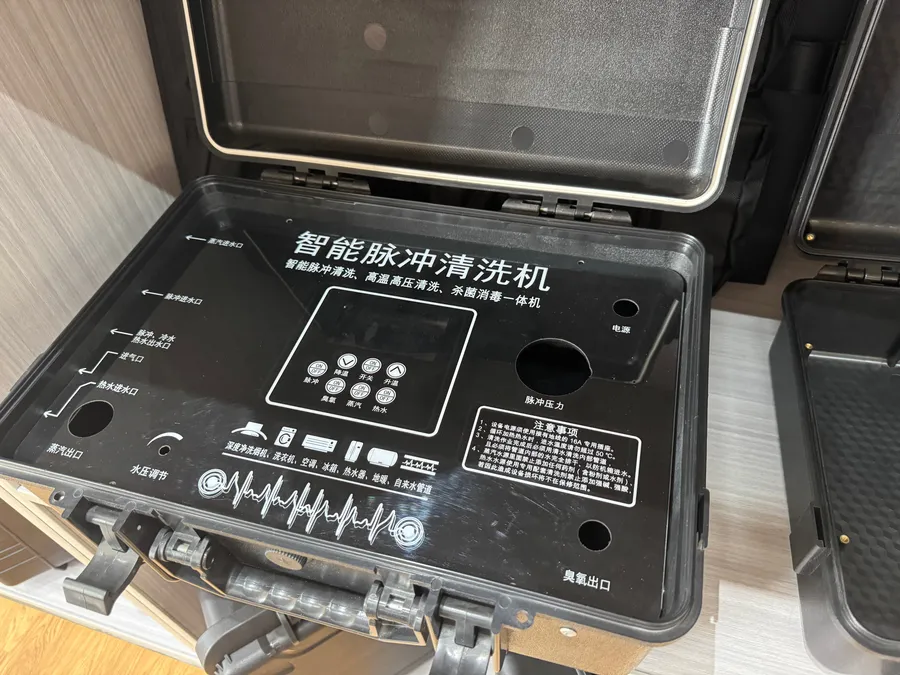
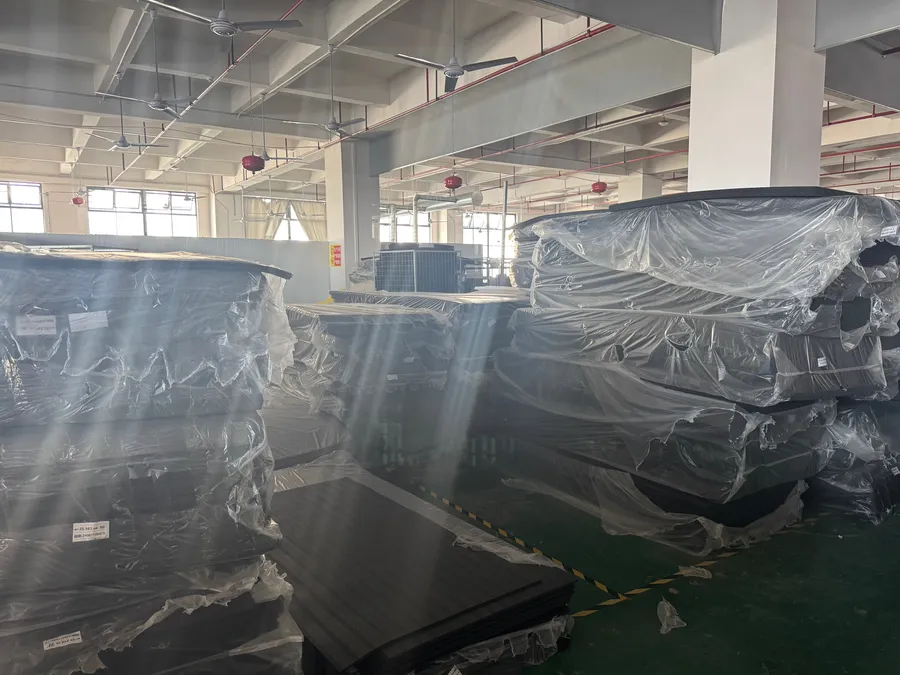
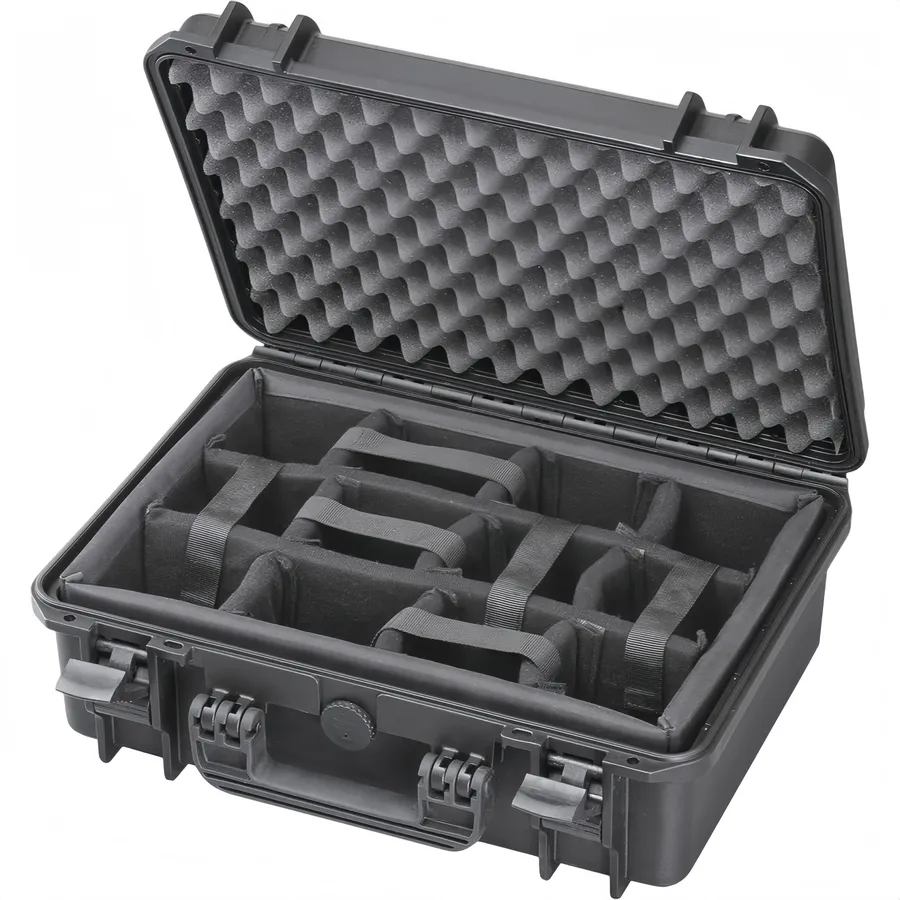
Everything described above is configurable on a standard shell: interior layout (pick-and-pluck, die-cut or CNC-cut), foam grade and thickness, colour, logo method, latch and lock count, pressure-equalisation valve, cable ports, document holder and identification plate. A bespoke exterior geometry requires a new mould — 125 days, from 3,000 units per moulded component.
Procurement considerations
| Question | What to send us |
|---|---|
| Which shell fits? | Equipment L × W × H as packed, plus required clearance per axis |
| What does it cost? | Order quantity and estimated annual quantity — the two drive different answers |
| Is tooling needed? | Whether an existing shell clears the envelope with usable foam depth |
| Lead time? | Your required delivery date, not just the order date |
| Certification? | The exact standard your tender names — we will say whether we can test to it |
| Freight? | Destination and preferred terms; carton and pallet data supplied with the quotation |
Comparison and selection guide
The tables on this page exist because a protective case is chosen by comparing three things: the envelope, the environment and the handling chain. Where no table applies, the rule below is.
| Situation | What To Do |
|---|---|
| Bare optic | Suspended body, both ends clear, soft contact layer. |
| Mounted system | Carrier under the mount, optic unloaded, tripod in a separate channel. |
| Night operations | Silent foam surface and a layout that can be opened without looking. |
- Size on internal dimensions plus clearance, never on a product name.
- Choose the carrying method before the shell: it changes the series, not just the price.
- Specify the interior last, and decide up front whether the end user will reconfigure it.
Can optical equipment cases be custom designed? relates to Military Case Guide. Related families: Optical Equipment Cases / Custom Protective Cases / Military Protective Cases / Camera & Photography Cases / Instrument & Equipment Cases. Related sectors: field and industrial equipment. Continue in the Military Case Guide cluster.
This page is written from our own production data. If your requirement differs, send the dimensions and we will tell you which of the 155 models fits, or whether a custom route is needed.