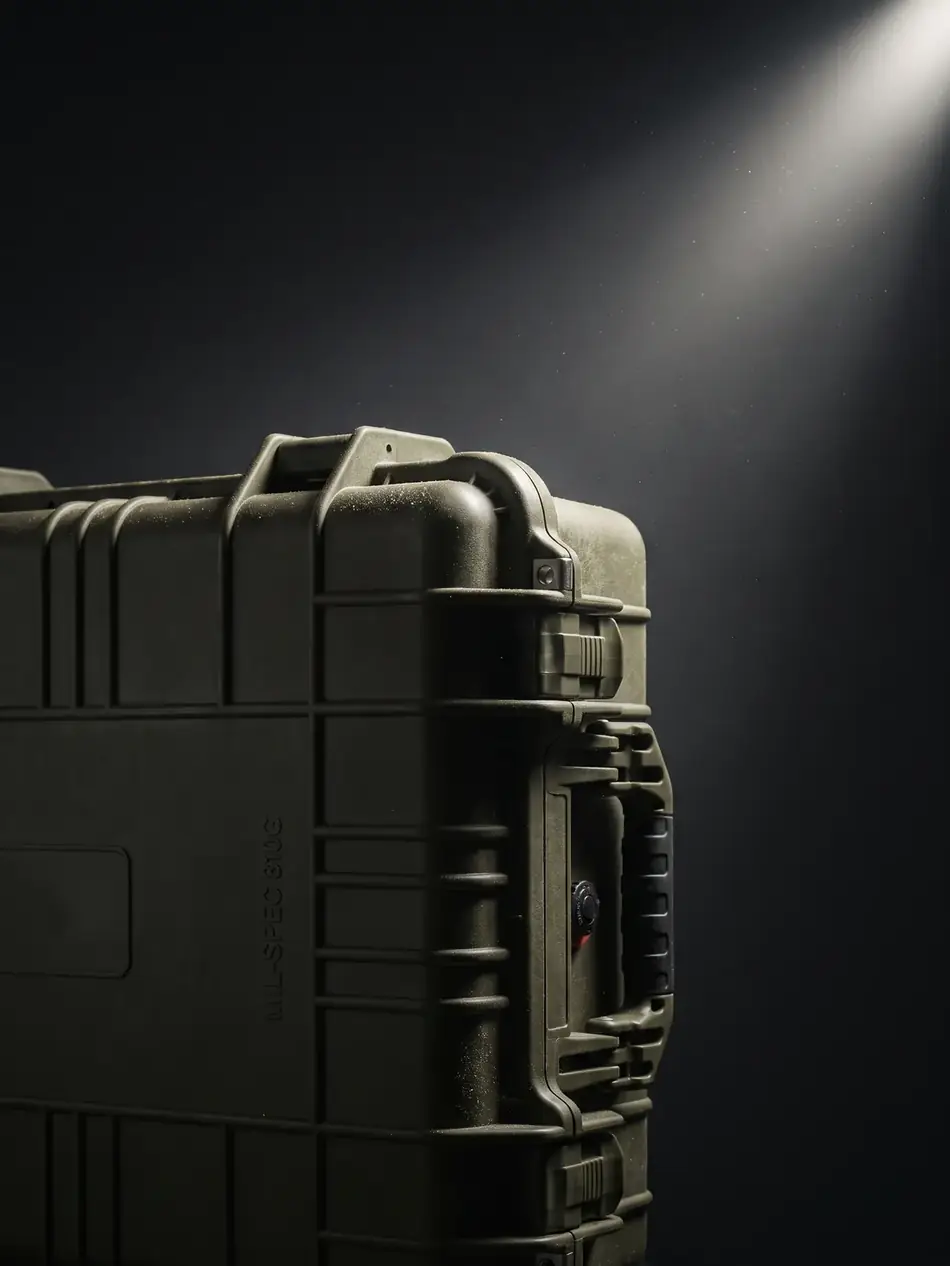
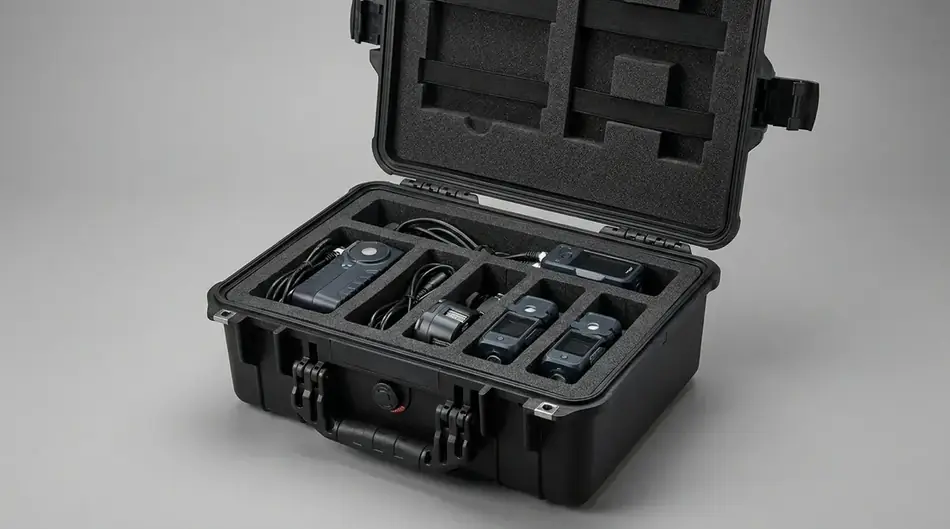
What equipment can be stored in a military protective case?
A military protective case stores almost any mission item that must survive handling, stacking and a change of hands: radio and signal sets, hand-held and vehicle communications accessories, optical and observation instruments, drones and controllers, medical and resupply kits, calibration and field-test tools, and long rigid equipment such as tripods, masts and barrels. What a case can hold is decided by its published internal envelope, its wall thickness and closure, not by the word military on the lid. Compact sealed shells take small electronics and instruments; deep stackable boxes carry consumables; trolley-class shells hold 700 mm-plus kits; and long shells in the 880 to 1,280 mm range hold rigid gear laid flat. The rule is simple: match the equipment family to the storage duty, then size the shell on the internal dimensions we publish per model.
Key points
- Sort equipment by storage duty, not by catalogue name, before choosing a shell.
- Size every shell on published internal dimensions, then add clearance on each axis.
- Wall thickness, not a product photo, is what lets loaded cases stack safely.
- A gasket-and-latch closure is offered on some models and not others; we publish it per model.
- Long rigid gear needs a flat internal length, so measure folded length as it will rest.
- Trolley shells carry the heaviest field kits; check net mass and external footprint for the rack.
What genuinely stores well
A military protective case is, at heart, a reusable hard shell with a defined interior, a closure and a carry method, so the honest answer is that it stores any item that fits the interior and is worth protecting through handling. In practice the loads fall into a handful of families that recur across our order book: radios and signal equipment, communications accessories, optical and observation instruments, unmanned-aircraft kits with controllers and battery sets, medical and resupply packages, test and calibration tools, and long rigid items such as tripods, antenna masts and barrels. Bulk consumables such as ammunition-box-class stores also sit inside the same family of shells when they need stacking.
Nothing about the word military changes what fits. It changes the tolerance for damage and the expectation that the case will be stacked, carried by hand and transferred between people who do not own the contents. If an item needs that kind of handling protection, a hard thermoplastic case is the right storage class, and the model is chosen from the published numbers rather than from a label.
Group equipment by protection duty
The most reliable way to plan storage is to group items by the harm you are protecting them from, because that group maps to a case feature. Sensitive electronics and instruments want a stable interior with foam and, where the duty calls for it, a sealed closure. Optical items want depth so a lens stack never touches the lid. Comms kits want a shallow, wide footprint so handset, cables and power bricks can be laid out and counted at a glance. Medical and resupply sets want a repeatable layout so a packer can verify contents without opening each pocket. Long rigid equipment wants an internal length that the item fits flat when folded to its transport shape.
Once the duty group is set, the model is a lookup: pick the published internal envelope that clears the item, then confirm the closure and wall thickness match how the loaded case will be stored and moved.
Reference models and their published figures
Every figure above is a published per-model value from our 155-model catalogue, not a range claim applied across the line. A model that is not listed here may be sealed or unsealed, heavier or lighter; you check the specific sheet, and we will send it.
| Equipment Family | Case Characteristic | Published Example |
|---|---|---|
| Small electronics and instruments | Compact sealed shell | KX-1905 internal 180 x 160 x 40 mm, wall 3.0 mm, net 250 g |
| Hand-held comms and headsets | Narrow, sealed, light | KX-62209 internal 200 x 98 x 78 mm, wall 3.5 mm, net 410 g |
| Field electronics and kits | Mid shallow shell | KX-62810 internal 253 x 182 x 86 mm, wall 4.0 mm, net 900 g |
| Tools, test and resupply | Stackable box | KX-82812 internal 219 x 160 x 100 mm, wall 3.4 mm |
| Heavier field kits | Trolley class, sealed | KX-85835 internal 500 x 400 x 305 mm, wall 5.0 mm, net 8,520 g |
| Long rigid gear | Flat long shell | KX-89616 internal 880 x 350 x 140 mm, wall 5.0 mm |
| Largest long loads | Flat long shell | KX-814641 internal 1,280 x 350 x 140 mm, wall 5.0 mm |
| Bulky multi-item kits | Trolley class, sealed | KX-88442 internal 740 x 518 x 364 mm, net 15,320 g |
Size the shell from the internal envelope
Size on the internal dimensions, never on the exterior or on a photograph. Measure the longest, widest and tallest points of the item in the shape it will rest in, with antennas folded, handles stowed and cables coiled as they will sit, then add clearance on each axis so foam and hands have room. The clearance matters twice over: it lets you cut a foam bed that the item actually drops into, and it stops a rigid corner pressing on the shell wall where a stacked load would otherwise transfer force.
Our published sheets separate internal from external dimensions precisely so this step is arithmetic, not guesswork. If two models bracket your item, choose on the interior, then confirm the exterior still fits the shelf, rack or vehicle bay where the case will live.
Sealed, vented or plain closure
Closure is what decides the storage environment, so treat it as a specification line rather than a default. Some shells carry a gasket-and-latch closure and are published as sealed; others in the same size class are plain carry boxes without that closure. We state the option per model and do not generalise it. Where condensation, dust on a store shelf, or an occasional splash is the realistic risk, a sealed closure with even latch pressure is the feature to select; where the case lives indoors and is opened daily, a plain lid is lighter, cheaper and easier to service.
For items that see altitude or temperature swings, an equalisation route may be discussed at quotation stage; it is not a claim we attach to an arbitrary shell, only to models engineered for it.
Stacking, footprint and where the case lives
Where the loaded case is stored decides the wall thickness and the carry method. A shell that will be stacked four or five high in a store needs thicker walls than one that sits on a single bench; wall thickness, not branding, governs how the stack behaves. Our heavier field and trolley models are published at wall thickness around 4.5 to 6.0 mm, while compact carry shells sit nearer 2 to 3.5 mm, and both are legitimate for their duty. Match the thickness to the load you intend to pile on top.
The external footprint is the second storage constraint: it must sit inside the rack, pallet grid or vehicle bay without overhang. Trolley-class shells such as the 843 x 592 mm external examples are built to be wheeled and stood, so verify that footprint against the store, and use net mass to keep a single-person lift realistic.
Customising the interior for a known load
A known equipment list turns a generic shell into a checking tool. We cut foam beds to the item profile so contents are verifiable without unpacking, add pluck or routed layers where the load varies between deployments, and locate handles, cable channels and small-part pockets so a packer follows the same order each time. This is specification work on top of the published shell, priced as part of the order, and it is where a case earns its keep in daily storage rather than only in transit.
For first samples we plan 45 days; a new tool where no shell exists is planned at 125 days, on a 30 percent deposit. These are business parameters, not performance claims.
Before you place a storage order
Send the equipment list with its folded dimensions, the intended stack height, the storage environment and the shelf or vehicle footprint, and we will return candidate models with the exact published internal dimensions, wall thickness, closure option and net mass for each. We sell wholesale and OEM on EXW or FOB terms only; we do not run retail, DDP or overseas warehousing, so the order is between your purchasing and our factory.
That single exchange replaces a lot of assumptions: it fixes which models actually store your items safely, which need a foam bed, and which simply do not belong in the size class you first had in mind.
One more buyer search phrase, answered from the figures we publish per model
The phrase military equipment protective case describes a very large group rather than one shell, so the honest answer is a set of published numbers plus a shortlisting method, not a single product name. Buyers who use it are usually at the step where an equipment list has to become a cavity size, which is exactly what our model sheets are arranged to support.
Everything in this row comes from the same source used elsewhere on the page: 155 active thermoplastic shells, each published with internal and external dimensions, internal and usable interior volume, and, where the field exists for that model, wall thickness, lid-over-base depth split, empty mass and carton data. Properties that have never been measured on these shells are written as not measured instead of being inferred from a resin name or from a photograph of a closed lid.
| Search | What We Publish |
|---|---|
| military equipment protective case | 113 of the 155 active models are listed under the military-protective-cases category and 45 of those also under military-equipment-cases, so a search for a military equipment protective case resolves to a size decision spread over several series rather than to one SKU. The published internal length runs from 115 mm to 1,280 mm, internal width from 78 mm to 545 mm and internal depth from 32 mm to 364 mm, with usable interior volume from 0.3 litres on KX-1204 to 111.6 litres on KX-88442. 129 models publish an internal length of 300 mm or more and 35 publish 500 mm or more, while only 4 fall below 200 mm, so long and bulky loads are the majority of this group rather than an edge case. The 8 Series heavy-duty line holds 62 models and the T Series rolling line holds 19; every model in that rolling group is published with wheels, a telescopic handle and stackable set to false, which makes a rolling kit a single-deep rack load instead of a column. Water and dust performance, stack load and load capacity are all recorded as not measured on the full 155, so no figure in this row is an ingress or crush value. |
The published fields that turn the phrase into a shortlist
What we do not claim on this page
No number in this row is a performance qualification. We publish no ingress figure, no fall height, no stack load, no load capacity, no ultraviolet value and no temperature range for any of the 155 shells, and we do not extend one model's cavity or wall thickness across the rest of the catalogue. Where a purchasing document asks for one of those values, the route we can actually offer is a measured datasheet for the exact SKU plus accredited third-party testing against the standard your project names, quoted and scheduled as a separate work package. A pressure equalisation valve is listed as a configuration option rather than a fitted feature on every model, for the same reason.
Two further limits are worth stating because the phrase invites them. These shells are supplied as equipment packaging; none of them is offered as regulated dangerous-goods transport packaging, and ammunition-adjacent loads are planned against your own handling rules rather than against anything on our sheet. And contents keep their maker's own specification once packed: a radio, a battery set or a lens assembly is protected by an interior, a closure and a carry method, not by a label on the lid.
Commercial terms behind the answer
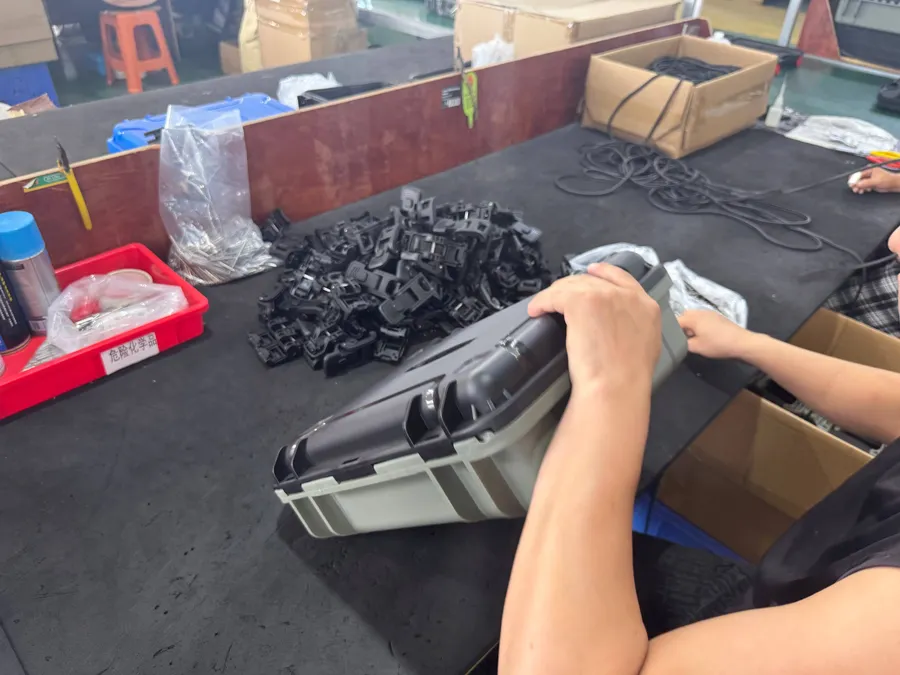
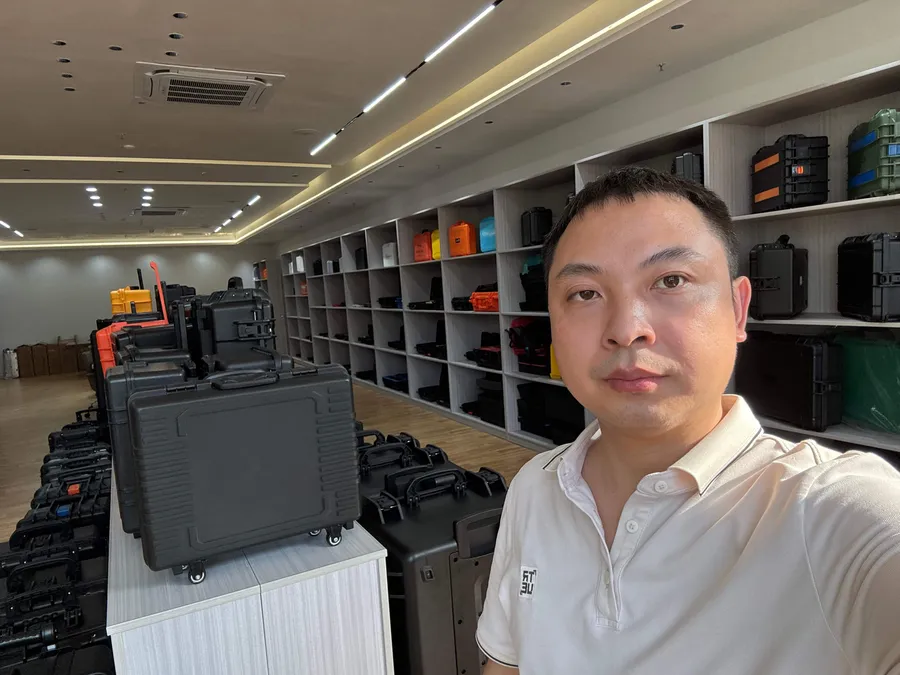
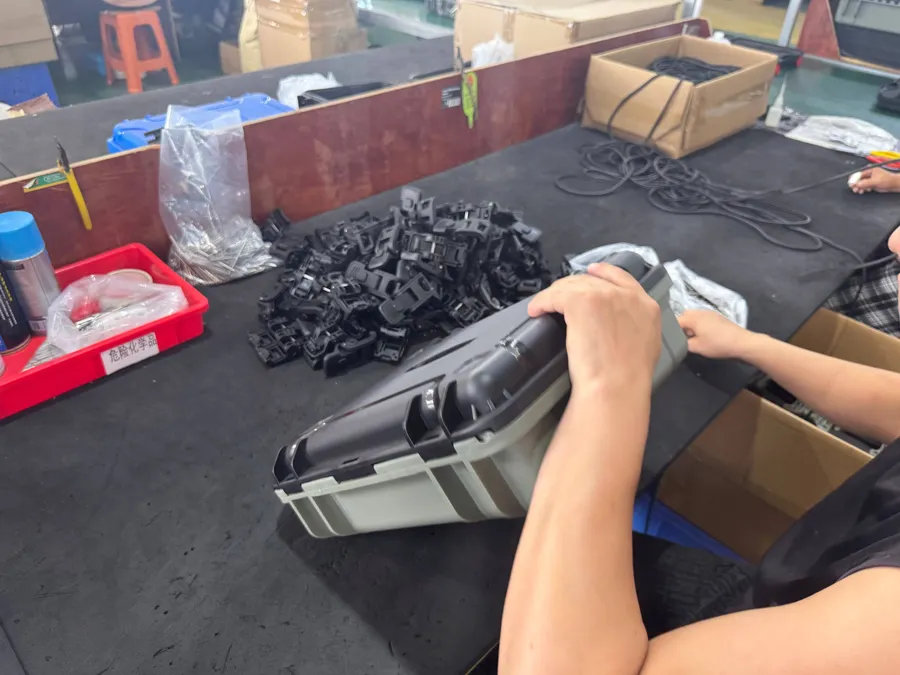
KeXin New Materials (Guangdong) Co., Ltd. moulds and supplies these shells to wholesale and OEM or ODM buyers only, quoted EXW or FOB, with no retail sales, no delivered-duty-paid pricing and no overseas warehouse stock, so landed cost is the FOB figure plus your own freight and clearance. Minimum order follows what you change: a standard shell or a custom foam and divider layout from 1 unit, colour, logo, identification marking and OEM hardware from 300 units per SKU, and a bespoke shell geometry from a new mould at 3,000 units per component. An OEM first sample on an approved existing mould is quoted at 45 days and a new mould at 125 days, on a 30 percent deposit with the balance settled after inspection and before container loading; third-party factory inspection is welcome.
Send the equipment list with folded dimensions, the intended stack height and the storage footprint, and Fred Zhao or the KeXin Sales Team returns candidate SKUs with the published internal envelope, wall thickness, lid and base split, gasket status and empty mass against each one. Foam is cut from a drawing, a photograph of the packed kit or a physical sample, so the shortlist comes back as checkable arithmetic rather than as a recommendation.
Customisation
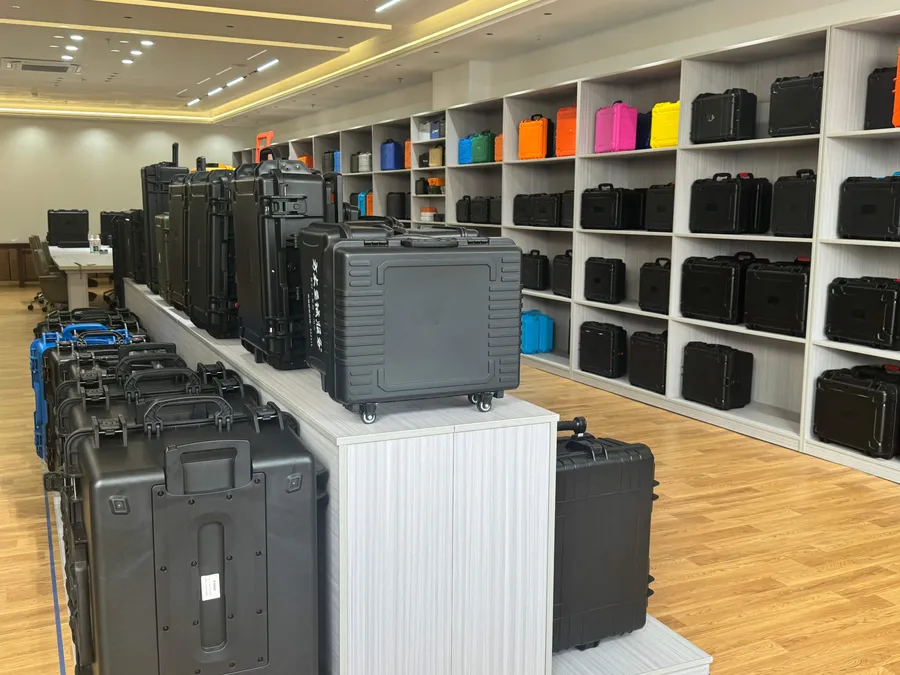
Everything described above is configurable on a standard shell: interior layout (pick-and-pluck, die-cut or CNC-cut), foam grade and thickness, colour, logo method, latch and lock count, pressure-equalisation valve, cable ports, document holder and identification plate. A bespoke exterior geometry requires a new mould — 125 days, from 3,000 units per moulded component.
Procurement considerations
| Question | What to send us |
|---|---|
| Which shell fits? | Equipment L × W × H as packed, plus required clearance per axis |
| What does it cost? | Order quantity and estimated annual quantity — the two drive different answers |
| Is tooling needed? | Whether an existing shell clears the envelope with usable foam depth |
| Lead time? | Your required delivery date, not just the order date |
| Certification? | The exact standard your tender names — we will say whether we can test to it |
| Freight? | Destination and preferred terms; carton and pallet data supplied with the quotation |
Comparison and selection guide
The tables on this page exist because a protective case is chosen by comparing three things: the envelope, the environment and the handling chain. Where no table applies, the rule below is.
| Situation | What To Do |
|---|---|
| Start from the equipment, not the case | Measure the tallest, widest and longest points of the packed equipment including antennas, handles and connectors. Add 20 mm minimum clearance per axis before selecting a shell. |
| Then choose the carrying method | Under 8 kg, a fixed handle is lighter and cheaper. Over 12 kg or any journey over 30 m, specify the T series with telescopic handle and wheels. |
| Then decide the interior | Pick-and-pluck for kits that change. Die-cut or CNC-cut for fixed layouts that must be auditable at a glance. |
- Size on internal dimensions plus clearance, never on a product name.
- Choose the carrying method before the shell: it changes the series, not just the price.
- Specify the interior last, and decide up front whether the end user will reconfigure it.
What equipment can be stored in a military protective case? relates to Military Case Guide. Related families: Military Protective Cases / Defense Equipment Cases / Communication Equipment Cases / Instrument & Equipment Cases / Medical Equipment Cases / Optical Equipment Cases / Long Equipment Cases / Ammunition Storage & Transport Boxes / Tool Cases / Tactical Equipment Cases. Related sectors: field and industrial equipment. Continue in the Military Case Guide cluster.
This page is written from our own production data. If your requirement differs, send the dimensions and we will tell you which of the 155 models fits, or whether a custom route is needed.