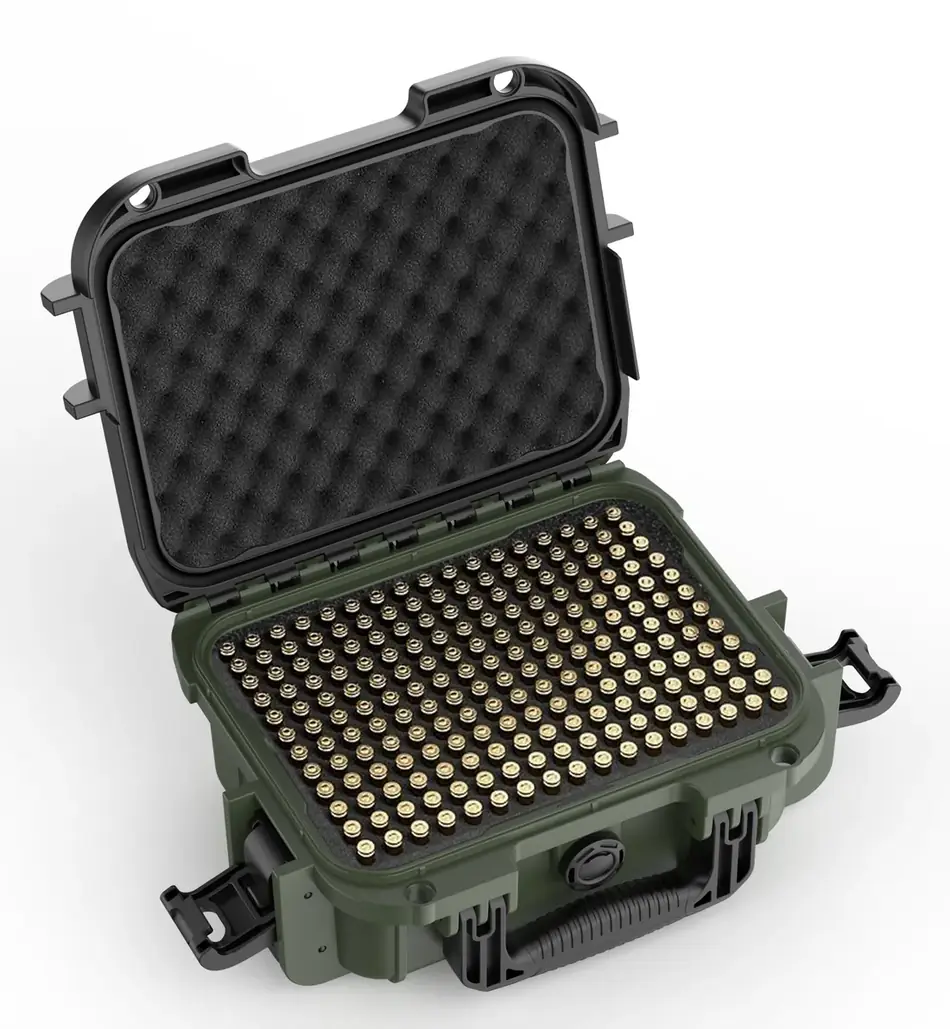
How are military equipment cases used in field logistics?
In field logistics a military equipment case is used as the object that is issued, counted, moved and recovered - not only as a box that protects an item. It leaves a stock point packed with a known kit, travels on a pallet or in a vehicle bay as one handled unit, is verified at every handover by closure, seal, label and contents silhouette instead of by unpacking, is pushed forward in the same shell, and comes back for re-issue or for repair. Because one shell repeats through that cycle, the numbers that matter are published per model rather than estimated: external dimensions that grid on racks and bays, wall thickness between 2.0 and 6.0 mm, a stackable flag on 136 of the 155 catalogue models, net mass, carton dimensions and pieces per carton for the 64 models where packing data is published.
Key points
- Plan the case fleet by the link of the chain it serves - shelf issue, storage, line-haul, handover, forward redistribution, recovery - because each link asks for a different published property.
- A footprint family lets one rack hold several depths: KX-3207, KX-3213 and KX-3218 share a 315 x 260 mm external box at 4.5, 8.4 and 12.2 litres internal.
- Counting without opening is what makes a case useful in logistics: cut-out interiors, a padlockable latch body and a document holder replace an unpack-and-inspect routine.
- Stack behaviour is published per model, so build stack and pallet columns from the datasheet; 136 of the 155 catalogue models carry a stackable designation.
- Freight is paid on cartons, not cases: KX-3218 ships 12 to a 645 x 530 x 550 mm carton while KX-3207 ships 24 to a 645 x 530 x 430 mm carton.
- The last leg decides wheels: 19 catalogue models publish wheels plus a telescopic handle, with empty mass from 4.91 kg to 15.32 kg before anything is packed.
The cycle a case actually runs
Field logistics is a cycle, not a journey: issue from a stock point, line-haul on a pallet or in a vehicle, redistribution forward, use at the position, recovery, and return for re-issue or repair. A case is used differently at every one of those links. On the shelf it is a labelled, stackable volume. In a vehicle it is a shape that must grid without overhang. At a handover it is the thing that gets counted, so closure and marking matter more than interior. In use it is opened and closed repeatedly, sometimes in the wet, and the lid must keep its own contents list honest. Recovery is where a shell earns or loses its cost, because a case that can be re-issued without re-engineering its pack removes the largest hidden item in a support budget, which is repack labour.
That is why a practical specification starts from the number of handovers rather than from the item inside. Count them, then decide which published property answers each one: net mass and handle position for a lift, external geometry for a stack, latch count and padlock provision for custody, and the cut of the interior for a contents check that takes seconds rather than ten minutes. The contents still decide the internal envelope; the chain of moves decides almost everything else about how the case is used.
Issue and small-quantity draws: the compact shells
The first link is the item issued one or two at a time - a radio set, an optical sight, a technician kit, a spares parcel. Here the case works as a dispensing unit: small, identical each time, and packed in cartons of twenty to forty so a stock point can replenish without breaking a bulk pallet. The compact shells in the catalogue carry that job. KX-2005 measures 190 x 135 x 40 mm internal at 175 g empty, ships 40 pieces to a 410 x 360 x 495 mm carton and is published as stackable. KX-2805 gives 270 x 190 x 46 mm internal at 340 g empty and packs 32 to a 570 x 470 x 435 mm carton. KX-2405 sits between them at 220 x 162 x 49 mm internal, 293 g and 20 pieces per carton. Because the empty mass and the carton quantity are both on the record, an issuing point can staff and train the task against real weight and real case counts instead of against a photograph.
The useful habit at this link is to treat the small shell as one member of a family rather than as a one-off purchase. Same handle style, same lid-to-base split, same marking position, and a store writes one rack rule for twenty line items instead of twenty rules.
Consumables and inventory: boxes that are counted without opening
Where the contents are consumable, the case is used as an inventory container and the priority shifts from protection-first to count-first. What makes counting work is a repeated external box around a fixed internal envelope. The catalogue's 315 x 260 mm family is a clean illustration: KX-3207 gives 308 x 230 x 64 mm internal and 4.5 litres, KX-3213 gives 308 x 230 x 118 mm internal and 8.4 litres, and KX-3218 gives 308 x 230 x 172 mm internal and 12.2 litres - the same external footprint and the same 3.0 mm published wall thickness in three depths. A stock line can change depth to follow demand without changing floor space, and a stack column stays valid when the item inside changes.
Two further properties decide whether a box can be audited as intact rather than opened. A compressible gasket is offered as a configuration option on 124 of the 155 models, the latch body is published as accepting a standard padlock, and latch count is set per configuration, so a signed box can be verified by its closure. Inside, a cut-out layout presents a missing item as a visible empty silhouette, which turns an inspection into a glance rather than a re-pack.
Systems and kits: the deep-body cases
One-lift ability, not size, is the reason deep-body cases exist. They are used when a system with its power supply, cabling and accessories has to travel and be opened as a single object. The catalogue builds them as footprint ladders rather than as scattered sizes. On a 405 x 325 mm external box the 8 Series runs internal depths from 115 mm to 215 mm: 11.7 litres in KX-84113, 14.2 litres in KX-84115, 16.7 litres in KX-84117, 19.8 litres in KX-84121 and 21.8 litres in KX-84123, each at a 3.4 mm published wall thickness. On a wider 410 x 370 mm box the same ladder reaches 24.7 litres in KX-84122. The big KX-88421 marks the other end of the range: 740 x 518 x 189 mm internal, 72.4 litres, an 843 x 592 mm external box and a published stackable designation with no wheels.
The logistics consequence is that a fleet is assembled by fixing the footprint to the infrastructure first - rack bay, vehicle interior, pallet grid - and then reading down the ladder for the depth that fits the kit. Changing depth between orders then costs nothing in re-racking, because the external box the store was built around does not move.
What each link asks of the case
Read the middle column as the demand the chain creates and the right column as the evidence that closes it. A logistics plan breaks wherever it has to rely on an assumption instead of a published figure, so each recurring move should be matched to a property that can be read off a model page or a datasheet before the first order is placed.
| Logistics Link | What The Link Asks | Where The Answer Is Published |
|---|---|---|
| Shelf issue and replenishment | Identical small units, low empty mass, carton quantities that match how stock is drawn | Net mass and carton data per model: KX-2005 at 175 g empty, 40 pieces per 410 x 360 x 495 mm carton |
| Storage and stacking | Repeated external geometry, feet, a lid that takes the column above it | Stackable designation per model on 136 of 155 shells; wall thickness 2.0 to 6.0 mm by model |
| Vehicle line-haul | A footprint that grids on a bay or pallet without overhang or gaps | External dimensions per model, for example one 315 x 260 mm box offered in three depths |
| Handover and custody | Lockable closure, a seal that shows tampering, a marking surface, paperwork carrier | Padlock provision and latch count per configuration; gasket offered on 124 models; document holder optional |
| Forward redistribution over rough ground | Movement by the crew that actually exists, without a second trip | 19 models publish wheels plus a telescopic handle; handle travel is listed from 240 mm to 485 mm |
| Recovery and re-issue | A shell and liner that survive repeat cycles and can be re-issued as they are | Zone-graded foam layouts and replaceable carriers; OEM on an existing mould is scheduled at 45 days |
The last leg: wheels, handles and mass
Most of the catalogue is built to be carried or stacked; nineteen models are built to be rolled, and rolling is the answer to the leg where field logistics usually fails, which is the ground between the parked vehicle and the working position. Those models publish wheel count, handle travel and empty mass, and those three figures are what decide crew size. The smallest is the 22.1-litre KX-85021 at 4.91 kg empty; the largest is the 139.5-litre KX-88442 at 15.32 kg empty, with KX-88434 between them at 108.9 litres and 14.03 kg. On the models where handle travel is published it runs from 240 mm to 485 mm, so the pull angle can be matched to the people doing the pulling.
The flags also record the trade that has to be made. The flat KX-88421 is published as stackable and carries no wheels, while the two deep trolley versions of a comparable footprint - KX-88434 and KX-88442 - are published with wheels and without a stackable designation. Neither is the better case in the abstract. The stackable shell buys density in the depot; the trolley buys one-person handling over the last hundred metres; a working fleet normally holds a deliberate mix of both on one external geometry so racks, bays and pallet grids stay shared.
Choosing the pattern for each link
Work in this order. First fix the external box against the fixed infrastructure, because that constraint is expensive to change later: shelf grids, rack bays, vehicle interiors and the pallet standard in the destination market. Second, assign a handling pattern to each link - hand-carry, flat-stack, roll - and hold the footprint constant while you do it, so a change of pattern does not force a change of racking. Third, check mass against the crew you actually have: an empty shell plus a known load tells you whether a link is one-person or two-person work, and two-person work quietly doubles labour and halves throughput.
Fourth, specify the closure at the order rather than assuming it: gasketed rim, latch count, padlock provision and a pressure-equalisation valve on suitable models where altitude or temperature swings are part of the route. Fifth, engineer the interior as a verification device, because that is what makes the case usable at a handover. Finally, count the cycles the shell is expected to survive and buy to that number; a case re-issued twelve times amortises differently from one shipped once and abandoned.
Where these patterns are applied
The dominant defence and field pattern is rotation: the same equipment cycles between depot, transport and use many times across its service life, and the case is the one constant through every cycle. Standard shells shorten the support tail because shells, lids and liners stay interchangeable across the fleet, and a damaged unit is swapped without re-engineering the pack. Where the load is a communications suite, an optics set or a field medical kit, the interior is specified item by item while the external box stays inside the fleet's footprint rules.
In wholesale distribution the case finishes its first journey before its working life begins. Orders move in cartons, cartons grid onto pallets sized to the buyer's market, and container builds are calculated from published packing data and supplied with the quotation. Because supply is on EXW or FOB factory terms, the importer's freight planner works from the same carton figures the factory uses - which is the point of publishing them: landed cost is built from real packing data, and the first delivery and the tenth remain comparable.
Customising a case for a supply cycle
Fleet customisation is mostly interior work. The published options cover pick-and-pluck, die-cut and CNC-cut layouts in PE, EPE and EVA foams, assembled as base foam, top foam, layered or egg-crate structures and graded by zone where the item needs it, so one shell can serve several roles inside a programme. Custom foam on an existing mould starts from a single unit, which means a layout can be proven on one case before a fleet order is committed. Colour matching and a moulded or printed logo sit one step up and carry an order floor of 300 units, with an OEM first sample on an existing mould scheduled at 45 days. A genuinely new shell size is a tooling project: about 125 days and from 3,000 units per component, with a 30 percent deposit starting production.
Notes before you order
KeXin New Materials (Guangdong) Co., Ltd. supplies wholesale and OEM programmes only: we do not sell single units at retail, quotations are issued on EXW or FOB factory terms, and we do not offer door-to-door delivery or hold stock in an overseas warehouse, so freight and clearance belong in your own plan.
Ask for the datasheet of the exact model you intend to order, because wall thickness, internal and external dimensions, lid-to-base depth split, net mass and carton quantity are all published per model and vary across the range. Pallet quantities are not a fixed figure on a page, because they depend on the pallet standard you use; they are calculated from carton footprint against your pallet, and container figures for 20 ft, 40 ft and high-cube boxes are supplied with the quotation. On protection language we hold the same line everywhere: measured construction values are published, and where a protection property has not been tested on a model and configuration we do not state it - documented testing can be commissioned as a separate work package when a tender requires it.
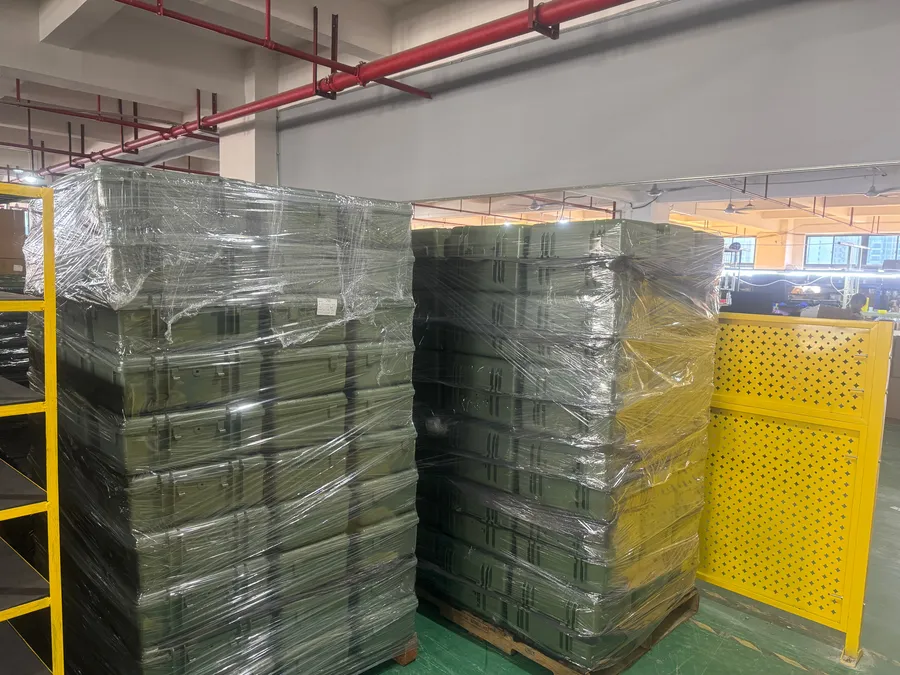
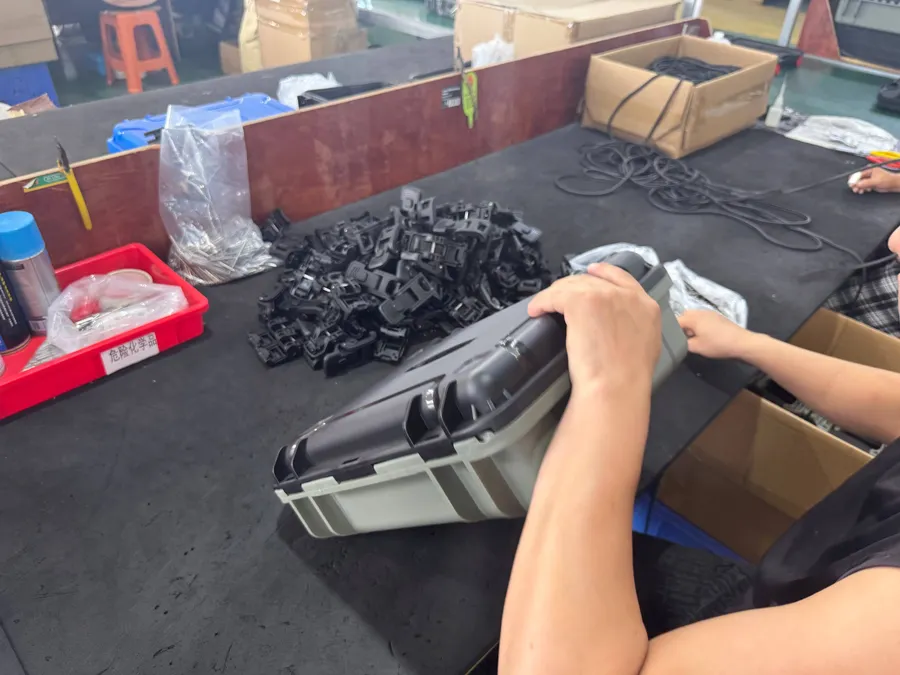
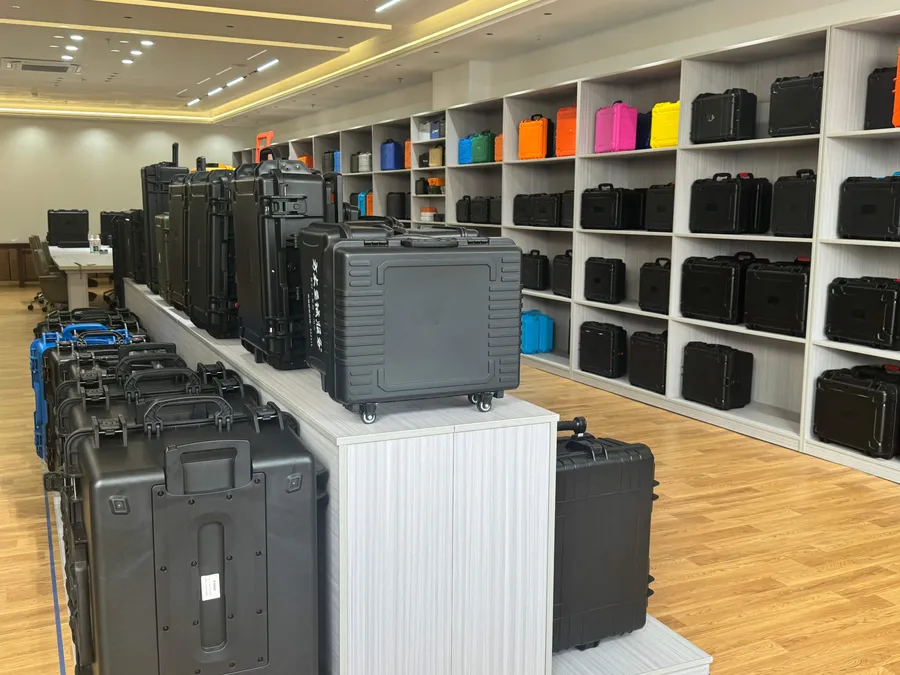
Customisation
Everything described above is configurable on a standard shell: interior layout (pick-and-pluck, die-cut or CNC-cut), foam grade and thickness, colour, logo method, latch and lock count, pressure-equalisation valve, cable ports, document holder and identification plate. A bespoke exterior geometry requires a new mould — 125 days, from 3,000 units per moulded component.
Procurement considerations
| Question | What to send us |
|---|---|
| Which shell fits? | Equipment L × W × H as packed, plus required clearance per axis |
| What does it cost? | Order quantity and estimated annual quantity — the two drive different answers |
| Is tooling needed? | Whether an existing shell clears the envelope with usable foam depth |
| Lead time? | Your required delivery date, not just the order date |
| Certification? | The exact standard your tender names — we will say whether we can test to it |
| Freight? | Destination and preferred terms; carton and pallet data supplied with the quotation |
Comparison and selection guide
The tables on this page exist because a protective case is chosen by comparing three things: the envelope, the environment and the handling chain. Where no table applies, the rule below is.
| Situation | What To Do |
|---|---|
| Start from the equipment, not the case | Measure the tallest, widest and longest points of the packed equipment including antennas, handles and connectors. Add 20 mm minimum clearance per axis before selecting a shell. |
| Then choose the carrying method | Under 8 kg, a fixed handle is lighter and cheaper. Over 12 kg or any journey over 30 m, specify the T series with telescopic handle and wheels. |
| Then decide the interior | Pick-and-pluck for kits that change. Die-cut or CNC-cut for fixed layouts that must be auditable at a glance. |
- Size on internal dimensions plus clearance, never on a product name.
- Choose the carrying method before the shell: it changes the series, not just the price.
- Specify the interior last, and decide up front whether the end user will reconfigure it.
How are military equipment cases used in field logistics? relates to Military Case Guide. Related families: Military Protective Cases / Military Equipment Cases / Ammunition Storage & Transport Boxes / Field Equipment Cases / Military Transport Cases. Related sectors: field and industrial equipment. Continue in the Military Case Guide cluster.
This page is written from our own production data. If your requirement differs, send the dimensions and we will tell you which of the 155 models fits, or whether a custom route is needed.