What is a field equipment case?
A field equipment case is a reusable, hard-shell container specified to hold a mission loadout, the equipment plus its power, cabling and accessories, and to be carried, stacked and transferred in field conditions rather than left on a shelf. It is defined by a working feature set, not by a sticker: an injection-moulded thermoplastic shell with a published wall thickness, a lid-to-base closure that may be sealed on some models, an internal layout that makes contents verifiable, and a carry method and external footprint matched to how far and where it will be moved. Sizes run from compact carry shells to deep trolley-class boxes whose published interiors reach 740 x 518 x 364 mm, with long flat shells for rigid gear. Everything below unpacks that definition and shows how a field equipment case is specified against real, published model numbers.
Key points
- A field equipment case is defined by its duty: carried, stacked and handed over in the field.
- The shell is injection-moulded thermoplastic with a published wall thickness, not a generic box.
- A gasket-and-latch sealed closure is offered on some models and omitted on others, per published sheet.
- Size it on the published internal envelope, then confirm the external footprint against the rack or vehicle.
- Carry method follows packed mass: fixed handle for light loads, wheels and telescopic handle for the heaviest.
- It is specified like a product class, so two names can cover the same duty and one should be dropped.
The working definition
In plain terms, a field equipment case is a hard reusable shell that carries a mission loadout through transport and into use, and is designed to survive being handled, stacked and passed between people who do not own what is inside. The defining idea is the word field: the case is expected to leave a controlled environment and operate somewhere it cannot be babied. That separates it from a storage box that never leaves a bench and from a single-use shipping container.
The definition is functional, not decorative. If a shell is sized on a published interior, closes securely, can be carried at its packed mass and stacks without collapsing, it is behaving as a field equipment case whatever label sits on the lid.
How it differs from a general protective case
The two overlap heavily: every field equipment case is a protective case, and many protective cases are good enough to field. The distinction is which stresses you design for. A general protective case is usually sized for one item on one shelf; a field equipment case is sized for a kit, a journey, a stack and a handover, and those extra conditions are what push the wall thickness, the carry method and the interior layout.
| Attribute | General Protective Case | Field Equipment Case |
|---|---|---|
| Where it lives | Often shelf or bench storage | Carried and deployed outdoors, then returned |
| Wall thickness | Chosen for the item | Chosen so loaded cases can stack |
| Carry system | Fixed handle typical | Handle, or wheels and telescopic handle at high mass |
| Internal layout | Simple foam or empty | Routed or pluck bed so contents verify fast |
| Closure | Lid and catches | Sealed closure on models engineered for it |
The feature set that makes it field-ready
Five features carry most of the definition. First, an injection-moulded thermoplastic shell, usually polypropylene or engineering polypropylene with ABS used where its properties suit the part, giving a wall we can publish a thickness for. Second, a lid-to-base closure: some models are offered with a gasket-and-latch sealed closure and some without, and we state which per model rather than assuming. Third, an interior that can be foamed to the load so a packer confirms contents without opening every pocket. Fourth, a carry method matched to packed mass. Fifth, an external footprint that fits the vehicle bay, pallet grid or rack the case will actually travel in.
None of these is a marketing adjective; each is a number or an option on a published sheet, and a field equipment case is assembled by choosing them deliberately.
Size classes you can specify against
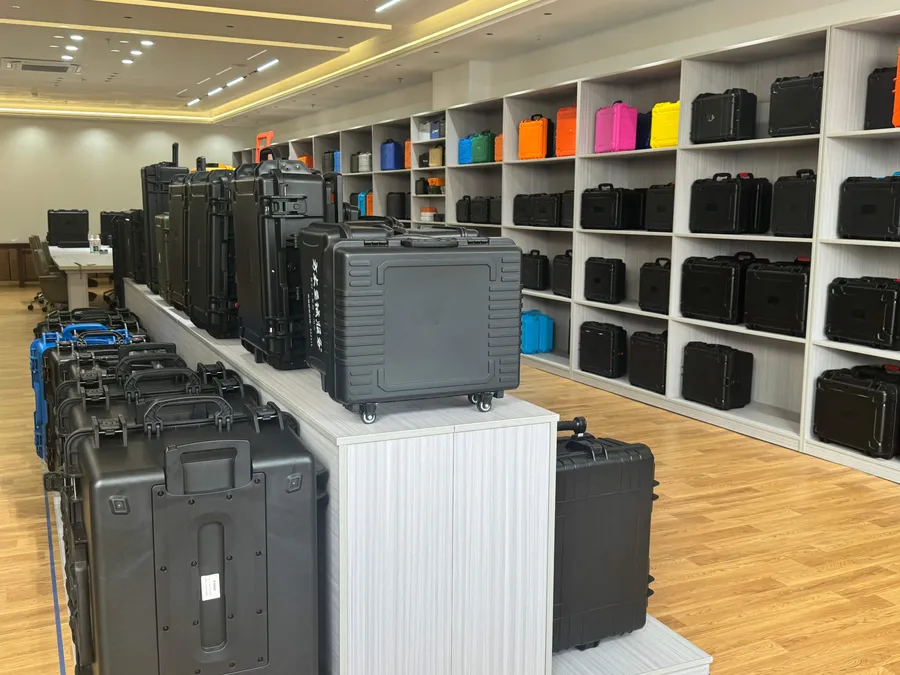
Field equipment cases span a wide but well-defined size range in our catalogue, and the honest way to describe it is by pointing at published interiors rather than by inventing tiers. At the light end, compact shells such as KX-1905 give an internal 180 x 160 x 40 mm at 250 g net, enough for a handset, a small instrument or a spares set. In the middle, shells like KX-62810 reach an internal 253 x 182 x 86 mm at about 900 g, and deeper boxes such as KX-82812 give 219 x 160 x 100 mm for tools and resupply.
At the heavy end, trolley-class boxes carry the big kits: KX-85835 offers an internal 500 x 400 x 305 mm at 8,520 g, KX-88434 an internal 740 x 518 x 284 mm, and KX-88442 an internal 740 x 518 x 364 mm at 15,320 g with wheels and a telescopic handle. Long rigid loads are laid flat in shells such as KX-89616 with an 880 x 350 x 140 mm interior and the 1,280 mm-longer class beyond it. Every one of these is a per-model figure, not a class average.
Reference field sizes (published per model)
These five are trolley-class field shells drawn directly from the catalogue sheet. Net mass and external footprint are the two numbers to read before committing: they decide whether one person can lift the loaded case and whether it stands in the space you have.
| Model | Internal Mm | Wall Mm | Net G | Carry |
|---|---|---|---|---|
| KX-85827 | 500 x 400 x 220 | 5.0 | 7,800 | Wheels + telescopic |
| KX-85835 | 500 x 400 x 305 | 5.0 | 8,520 | Wheels + telescopic |
| KX-86830 | 595 x 460 x 255 | 4.8 | 10,160 | Wheels + telescopic |
| KX-88434 | 740 x 518 x 284 | 5.0 | 14,030 | Wheels + telescopic |
| KX-88442 | 740 x 518 x 364 | 5.0 | 15,320 | Wheels + telescopic |
Materials and how the shell is made
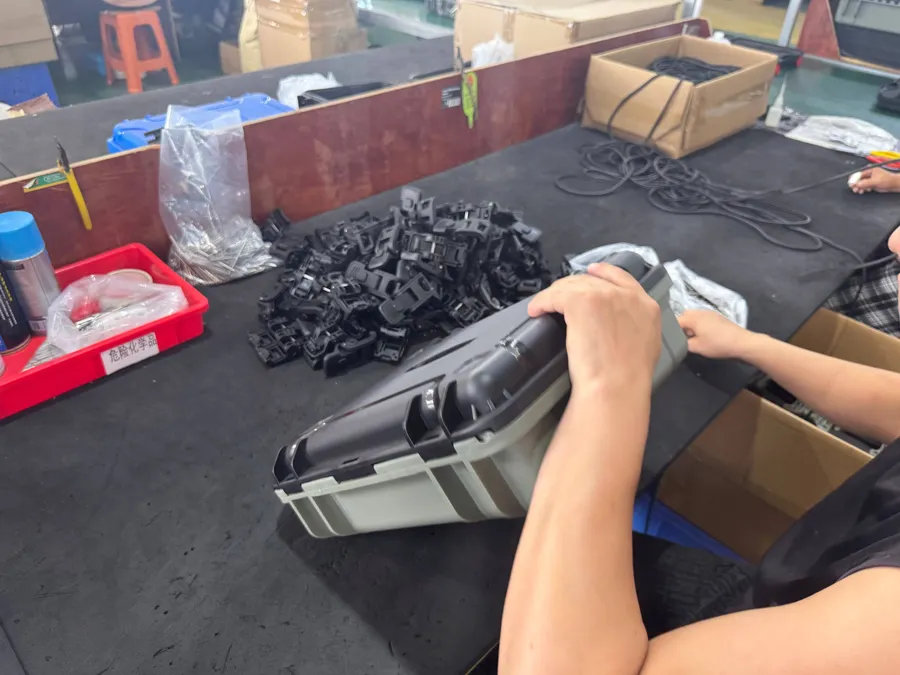
Most field equipment cases are injection-moulded from thermoplastic. Polypropylene gives a tough, repair-tolerant shell that takes the wall thickness a stack needs; engineering polypropylene is used where stiffness and temperature behaviour matter more; ABS appears where its surface and impact character suit the part. The shell is a lid and a base that close on each other, with latches, a gasket where the model is specified sealed, hinges and handles fitted as hardware rather than moulded into the body. Sealed and unsealed versions can share a footprint, which is why the closure option is read per model.
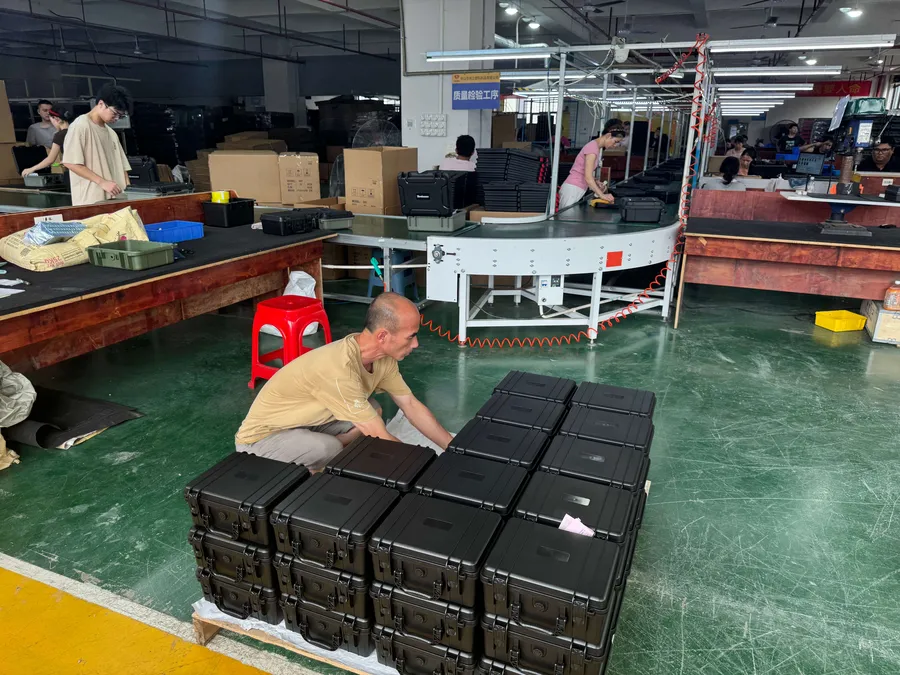
Because the shell is moulded, a genuinely new size means a new tool. That is why we quote first samples at 45 days and a new tool at 125 days on a 30 percent deposit: the timeline is about the mould, not the paperwork.
Typical duties and load families
A field equipment case is normally specified around a duty rather than a single object: a communications set with batteries and cabling, a drone and controller kit with a battery set, an observation or optics package, a medical or resupply kit, a field-test and calibration toolset, or long rigid gear such as a tripod or mast. The duty sets the interior and the closure; the packed mass sets the carry method; the destination vehicle or rack sets the external footprint. The same three inputs, read in that order, will usually narrow 155 models to two or three candidates.
Where a load recurs across a unit, the interior is cut so contents are verifiable at a glance, which is the practical difference between a field case and a box with foam in it.
Before you order a field equipment case
Send the loadout with its folded dimensions, the packed mass you expect, whether the case must seal, and the footprint of the space it will travel in, and we will return candidate models with the exact published internal dimensions, wall thickness, closure option and net mass for each. We manufacture for wholesale and OEM buyers only, on EXW or FOB terms; we do not run retail, do not offer DDP and keep no overseas warehouse.
If you are weighing a field equipment case against a general protective case for the same item, note that they cover one search intent, so choose the label by the duty you actually expect and let the numbers pick the model. That avoids two near-identical pages fighting over the same buyer question.
Field mission, testing and survey case searches, answered with published model data
The rows below take the buyer phrases people actually type when they are specifying a case for work away from a bench, and answer each one with figures published for a named model rather than with adjectives. The catalogue holds 155 injection-moulded shells; 68 of them are listed under the Field Equipment Cases family, 19 are published with wheels and a telescopic handle, and 124 carry a gasket-and-latch sealed closure as an available configuration. Every answer here comes from those model records. Ingress protection, stacking load, payload capacity and temperature range are stored as not measured across all 155 models, so where one of those values decides your project we quote accredited third-party testing for the configured case instead of printing a code on the lid.
| Search | What We Publish |
|---|---|
| field mission equipment case | A mission load is a set plus its power and cabling, so it is sized on the whole kit rather than on the main unit. KX 9-7227 publishes an internal 590 x 435 x 210 mm cavity (53.9 L internal, 43.1 L usable) with a 6.0 mm wall at 10000 g empty, a 168 mm base under a 42 mm lid, two wheels and a telescopic handle listed at 485 mm; KX 8-6830 gives an internal 595 x 460 x 255 mm (69.8 L internal, 55.8 L usable) at 10160 g when a battery set and a cable reel join the load. Both are published with a sealed closure available. How either shell behaves against rain, dust or a knocked corner is recorded as not measured, so a mission specification should name the test if the number matters. |
| field testing equipment case | Test sets travel with leads, adapters and a power brick, and they are the loads most often damaged by a shallow lid rather than by the journey. Read the published depth split before the footprint: KX 5321 lists an internal 481 x 373 x 192 mm with a 149 mm base and a 43 mm lid at 4810 g and a 5.8 mm wall, which keeps an instrument in the deeper half where the wall section is continuous; KX 6-5522 is an ABS shell with an internal 507 x 385 x 190 mm at 4860 g and a 5.3 mm wall; KX 8-4421 is a lighter handheld class at an internal 410 x 280 x 198 mm with 140 mm of lid over a 58 mm base. Whether a calibrated instrument still holds its calibration after transit is not something we measure or claim; that stays with your own check procedure. |
| field survey equipment case | Tripods, ranging poles, rods and mast sections are long rigid loads that are laid flat rather than stood up, and the flat class is published for exactly that duty: KX 8-6216 gives an internal 582 x 300 x 130 mm at a 3.3 mm wall with a 100 mm lid over a 30 mm base, while KX 8-8015 at an internal 725 x 350 x 140 mm, KX 8-9616 at 880 x 350 x 140 mm and KX 8-14641 at 1280 x 350 x 140 mm are each published with a 5.0 mm wall and a sealed closure available. An instrument with its tribrach and a small prism set sits better in a deeper box such as KX 6-3416 at an internal 310 x 255 x 138 mm and 1800 g empty. Vibration exposure during a vehicle transit is recorded as not measured, so specify the foam layout rather than trusting the shell. |
| field equipment case with wheels and telescopic handle | Wheels change two published attributes at once, and both are worth reading before you commit a stowage plan. All 19 wheeled records in the catalogue are published as not stackable, while all 136 carry-box records are published as stackable, so a trolley shell that rides in a vehicle deck cannot also be the bottom of a stack. Telescopic handle heights are published at 240, 295, 310, 385 and 485 mm depending on model, and empty mass runs from 4912 g on the smaller rolling boxes to 15320 g on KX 8-8442 with an internal 740 x 518 x 364 mm. Wheel and caster performance on rough ground is not measured. |
| how field cases are packed and shipped | Packing is published per model as a carton footprint and a pieces-per-carton count, and those two numbers are what your freight quote is built from: KX 5321 ships 3 pieces in a 530 x 440 x 635 mm carton, KX 6-2810 ships 10 in 480 x 293 x 550 mm, KX 712 ships 16 in 635 x 585 x 455 mm, and KX 9-7227 ships single in a 715 x 515 x 280 mm carton. Pallet quantity is recorded as not measured because it is calculated from the carton footprint against your pallet size. Work is wholesale and OEM on EXW or FOB with a 30 percent deposit; there is no retail channel, no DDP and no overseas warehouse. |
| customising a field case for a specific loadout | Interior work is the cheapest change in the catalogue and it starts from 1 set: base foam, top foam, egg-crate or convoluted lid, custom cut and layered builds, in Pick & Pluck, die-cut, CNC-cut, EVA, PE or EPE stock, drawn from a drawing, a photograph of the packed kit or a physical sample. Colour, logo and OEM branding start from 300 pieces with a first sample on an existing mould in about 45 days, and only a genuinely new shell size needs a tool at 3,000 pieces per component with the standing 125-day window. Hardware options published on the records include a pressure-equalisation valve, cable ports, document holder and identification plate. |
Three ways a field case goes wrong in service, and the published number that prevents each one
The first is a carry method chosen after the shell instead of before it. Empty mass is published for most models, and it is the number that decides whether one person can lift the loaded case into a vehicle: 250 g on the compact KX 1905 with an internal 180 x 160 x 40 mm, 1800 g on KX 6-3416, 4810 g on KX 5321, 10160 g on KX 8-6830 and 15320 g on KX 8-8442. A 10 kg shell plus a 15 kg load is a two-person or wheels-only lift, and the wheeled class is published with two wheels plus a telescopic handle precisely for that reason.
The second is a stack that was never in the record. Stackability is published per model, and the split is clean in our data: carry-box shells are marked stackable, the 19 wheeled shells are not. Wall section is the other half of that story, from 2.5 mm on thin compact shells to 6.0 mm on KX 6621 and KX 9-7227, because a loaded stack transfers its weight through the corners of the box underneath, not through the label on the lid. What we do not publish is a stack load in kilograms or a compression figure: stack_load_kg is stored as not measured on every model, so a stowage plan that depends on a number should have that number tested for the configured case.
The third is a case that arrives and cannot be verified. In the field the check is whether everything is inside, and that is an interior decision rather than a shell one: a shaped cavity per item makes an empty slot visible in two seconds, while loose pluck foam hides a missing battery or lead. Every model record lists the cut structures we offer, and the practical rule we work to is to specify the interior last, after the shell and the carry method are fixed, and to decide up front whether the end user will reconfigure it between deployments.
What we do not claim about field equipment cases
The protection block on each model record is deliberately sparse. Waterproofing, dust resistance, an overall protection rating, ultraviolet resistance, stacking load, payload capacity and temperature range are all recorded as not measured across the 155 models, and we do not print an ingress code on a shell or a datasheet to fill that gap. Impact resistance is described by the wall section published for that model and by the specified foam layout, with the plain statement that a shell on its own is not a shock rating and that no fall height is claimed without a test. If your tender names a standard or a level, send us the exact clause and we will tell you what we can have tested at an accredited laboratory and what belongs in your own qualification file; a result enters the record only after it exists.
What we do stand behind is geometry, material, construction and process, plus a signed interior layout that becomes the reorder standard so the second order matches the first. Send the loadout with its folded dimensions, the packed mass you expect, whether the case must seal and the footprint of the space it travels in, and the factory returns candidate models with the published internal dimensions, wall thickness, closure option and net mass for each. Fred Zhao or the KeXin Sales Team handles the enquiry, WhatsApp +86 135 3588 0002, and third-party factory inspection is welcome before the balance is paid. KeXin New Materials (Guangdong) Co., Ltd.

Customisation
Everything described above is configurable on a standard shell: interior layout (pick-and-pluck, die-cut or CNC-cut), foam grade and thickness, colour, logo method, latch and lock count, pressure-equalisation valve, cable ports, document holder and identification plate. A bespoke exterior geometry requires a new mould — 125 days, from 3,000 units per moulded component.
Procurement considerations
| Question | What to send us |
|---|---|
| Which shell fits? | Equipment L × W × H as packed, plus required clearance per axis |
| What does it cost? | Order quantity and estimated annual quantity — the two drive different answers |
| Is tooling needed? | Whether an existing shell clears the envelope with usable foam depth |
| Lead time? | Your required delivery date, not just the order date |
| Certification? | The exact standard your tender names — we will say whether we can test to it |
| Freight? | Destination and preferred terms; carton and pallet data supplied with the quotation |
Comparison and selection guide
The tables on this page exist because a protective case is chosen by comparing three things: the envelope, the environment and the handling chain. Where no table applies, the rule below is.
| Situation | What To Do |
|---|---|
| Dust | Continuous rim plus enough latches to hold it closed over a temperature cycle. |
| Cold | PP shells retain toughness better than ABS at low temperature. |
| Service life | Ask for a spares kit of latches, hinges and gaskets with the first order. |
- Size on internal dimensions plus clearance, never on a product name.
- Choose the carrying method before the shell: it changes the series, not just the price.
- Specify the interior last, and decide up front whether the end user will reconfigure it.
What is a field equipment case? relates to Military Case Guide. Related families: Field Equipment Cases / Military Protective Cases / Equipment Transport Cases / Military Equipment Cases / Defense Equipment Cases. Related sectors: field and industrial equipment. Continue in the Military Case Guide cluster.
This page is written from our own production data. If your requirement differs, send the dimensions and we will tell you which of the 155 models fits, or whether a custom route is needed.


