How should heavy equipment be packed inside a transport case?
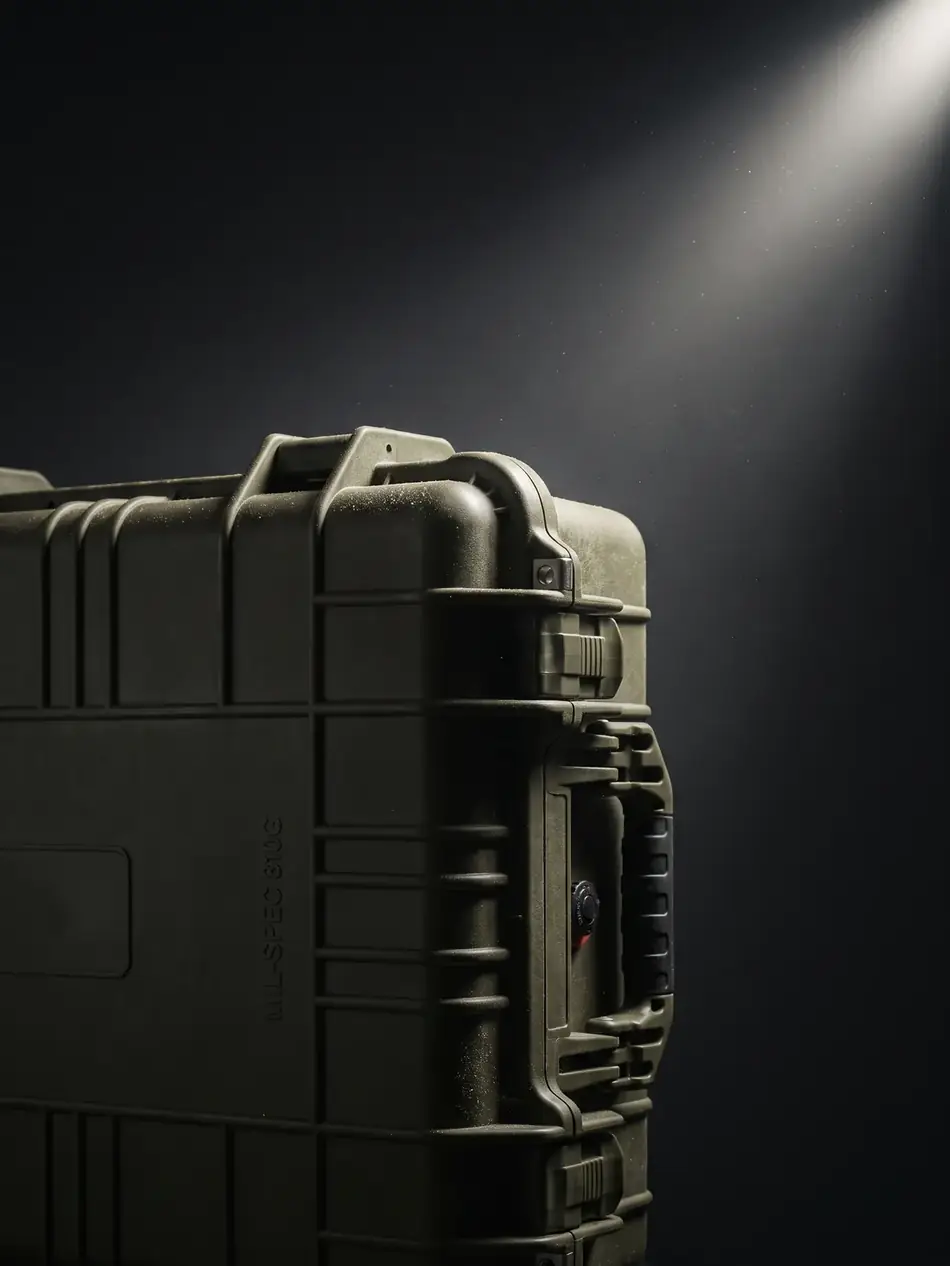
Pack heavy equipment so the weight is supported through its strongest geometry, kept low, and prevented from moving. The rule of thumb is a wide base, a low centre of gravity, and no overhang on the foam or shell wall. Choose a thick-wall shell so a corner knock on a loaded case does not deform the shell inward; select an internal envelope where the item rests on its own structural ribs or feet rather than on plastic parts; add blocking and bracing that surrounds the mass rather than pressing on it; and split the load across a layered foam stack when the accessories weigh enough to add their own inertia. KeXin publishes internal dimensions, wall thickness and net weight per SKU so a heavy load can be planned from real numbers, and where a stack or drop figure is not measured on that SKU it is left as not measured rather than extrapolated.
Key points
- Support the item on its strongest geometry, not on plastic covers or protrusions, and let the foam take only light items.
- Keep the centre of gravity low so the case is less likely to tip when carried and less shock reaches the load.
- Thicker shell walls matter on a heavy-load route because the case itself carries additional inertia in a drop.
- Use blocking and bracing that surrounds the mass instead of pressing on the item; that is how a heavy load is prevented from shifting.
- Split a mixed kit with dense items on a firm base and lighter accessories in a pluck or convoluted top layer.
- Plan wheels or a team lift before you commit to a case, because the packing strategy follows the handling strategy.
Distribute the load through the item's own structure
A heavy item does not get packed the way a light one does. The right contact points are the item's structural members: the frame, the baseplate, the machined feet or the housing ribs. Everything fragile, from a control panel to a connector face to a lens, is then held clear of the load path. That means the cavity shape follows the item's structural outline rather than its outer silhouette, and the foam supports the mass instead of squeezing it. This is why heavy-item layouts are usually drawn from a physical sample or an exploded drawing rather than a photograph; the shape of the load path is what matters.
Match the shell wall to the extra inertia
A heavy load multiplies the force on a shell corner when the case is dropped or knocked, because the contents keep moving once the shell stops. That is why the models suited to dense gear tend to publish thicker walls. KeXin's heavy-duty shells list walls around 5 to 6 millimetres: KX-6621 is an engineering-PP shell at 6.0 millimetres with an internal 587 x 434 x 192 mm and a 48.9 litre internal volume; KX-97227 is an engineering-PP shell at 6.0 millimetres with 53.9 litres of internal volume and wheels for ground movement; KX-5321 is an engineering-PP shell at 5.8 millimetres with 34.4 litres. Choose from the published figure rather than assuming a heavier material alone is enough; the wall is what keeps the shell from deforming under the load in transit.
Keep the centre of gravity low
A case is easier to carry, safer to stack and less likely to tip if the heavy item sits at the bottom of the envelope and the lighter accessories go above it. In practice, that means a dense base layer of firm closed-cell PE or EVA foam shaped to the item's structural outline, and a pluck or convoluted top layer that only holds tools, cables, spares and small parts. A shallow case naturally enforces this order; a deep case can quietly invite a heavy item into the top layer if the packing is not planned. Confirm the item's resting height and the lid depth on the datasheet so a dense load stays below the fold of the shell.
Block and brace instead of pressing
Light items can be held by pressing foam against them; a heavy item should be surrounded by firm foam so the mass cannot translate or rotate. In a CNC-cut layout this appears as a tight pocket with clear vertical and horizontal walls that stop the item moving in any direction, with the lid applying a gentle retention force rather than a load. Where the item has protrusions, the cavity adds relief pockets so the block and brace never press on a fragile point. On very heavy items the cavity is combined with a base plate or a fixed cradle so the mass sits on a solid plane and the foam only handles vibration and lateral movement.
Reference shells by load profile
| Load Profile | Reference Model | Wall Mm | Handling Signal |
|---|---|---|---|
| Compact dense instrument | KX-5321, internal 481 x 373 x 192 mm | 5.8 engineering PP | 34.4 litre usable envelope, stackable |
| Mid-size dense kit with cables | KX-6621, internal 587 x 434 x 192 mm | 6.0 engineering PP | 48.9 litre envelope, stackable |
| Deep dense item needing wheels | KX-97227, internal 590 x 435 x 210 mm | 6.0 engineering PP | 53.9 litre envelope, wheels |
| Two-layer dense kit with accessories | KX-66232, internal 507 x 385 x 290 mm | 5.3 ABS | 56.6 litre envelope, wheels |
Decide carry versus wheels first
How a loaded case is moved changes the interior you should design. A case that is lifted by one operator can be sized so the total weight is bearable, and it uses a fixed folding handle and moulded feet so the case can be set down cleanly on a bench or a shelf. A case that is moved by two operators or across a flight line usually wants a wheeled shell such as KX-97227 or KX-66232, with the packing strategy built around tipping and curb-drop events rather than shoulder-height drops. Choose the handling pattern before the shell, because wheels and pull change the case's own mass and stackability, and the interior layout follows from that decision.
Foam density and layering for dense loads
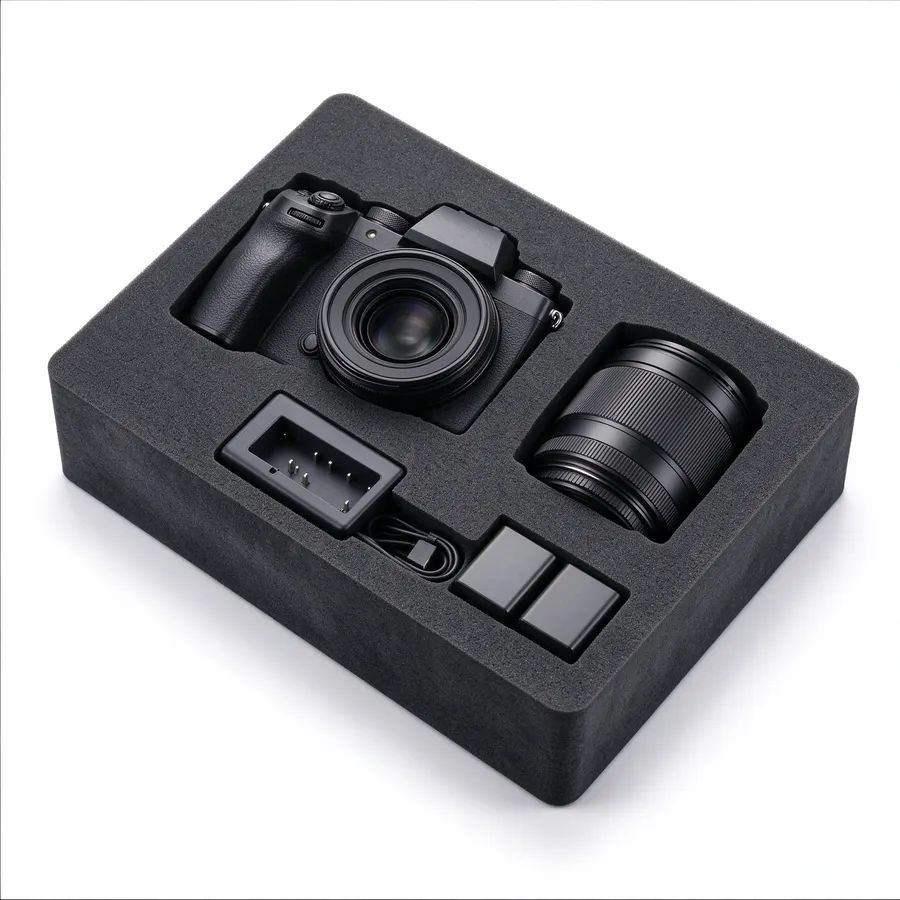
The foam type is a functional choice once the load is heavy. Closed-cell PE is the general workhorse and holds shape well under a static mass. EVA gives a firmer block for tight pockets and is often used where the layout must resist deformation across many years of service. EPE is softer and better suited to light accessories or a convoluted lid that must not press on a dense base. A common heavy-load configuration is a firm die-cut base in PE or EVA holding the primary item, a middle pluck or cut layer for cable and tool trays, and a light EPE or convoluted top layer that closes without adding force on the load path. Custom foam thickness and shape are available on the OEM route.
Procurement notes for heavy packing
Send the physical item or an exploded drawing with clear centre-of-gravity marks so the load path is understood, and confirm the case SKU before the layout is drawn. Read the datasheet for the model: internal dimensions, published wall thickness, seal type, stackable flag and case net weight, and treat any field marked not measured as unknown rather than assumed. Describe the transport route and the handling method so the factory can recommend a stackable shell or a wheeled one. Orders run wholesale and OEM on EXW or FOB terms with a 30 percent deposit against the proforma, and there is no retail, DDP or overseas-warehouse arrangement.
Customisation
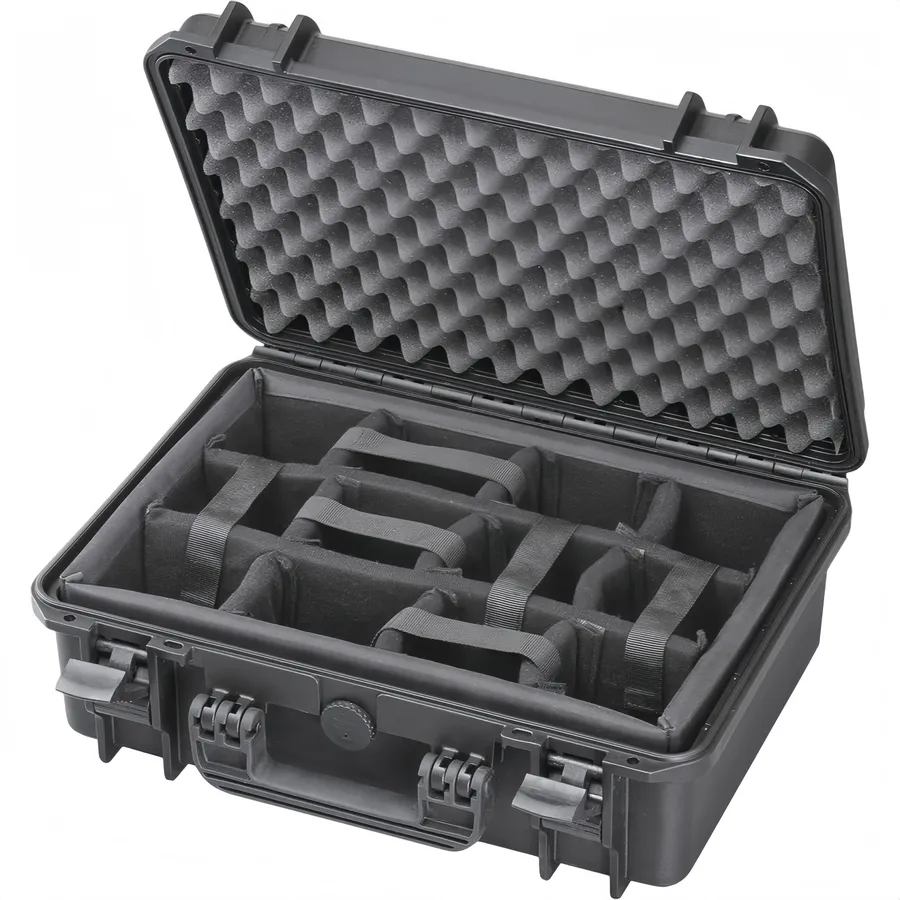
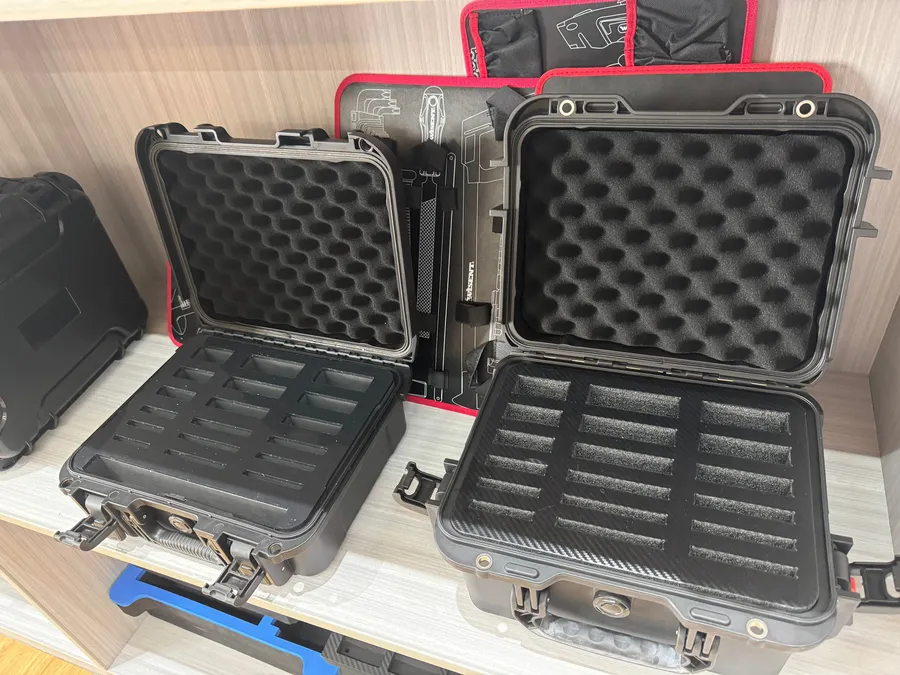
Everything described above is configurable on a standard shell: interior layout (pick-and-pluck, die-cut or CNC-cut), foam grade and thickness, colour, logo method, latch and lock count, pressure-equalisation valve, cable ports, document holder and identification plate. A bespoke exterior geometry requires a new mould — 125 days, from 3,000 units per moulded component.
Procurement considerations
| Question | What to send us |
|---|---|
| Which shell fits? | Equipment L × W × H as packed, plus required clearance per axis |
| What does it cost? | Order quantity and estimated annual quantity — the two drive different answers |
| Is tooling needed? | Whether an existing shell clears the envelope with usable foam depth |
| Lead time? | Your required delivery date, not just the order date |
| Certification? | The exact standard your tender names — we will say whether we can test to it |
| Freight? | Destination and preferred terms; carton and pallet data supplied with the quotation |
Comparison and selection guide
The tables on this page exist because a protective case is chosen by comparing three things: the envelope, the environment and the handling chain. Where no table applies, the rule below is.
| Situation | What To Do |
|---|---|
| Start from the equipment, not the case | Measure the tallest, widest and longest points of the packed equipment including antennas, handles and connectors. Add 20 mm minimum clearance per axis before selecting a shell. |
| Then choose the carrying method | Under 8 kg, a fixed handle is lighter and cheaper. Over 12 kg or any journey over 30 m, specify the T series with telescopic handle and wheels. |
| Then decide the interior | Pick-and-pluck for kits that change. Die-cut or CNC-cut for fixed layouts that must be auditable at a glance. |
- Size on internal dimensions plus clearance, never on a product name.
- Choose the carrying method before the shell: it changes the series, not just the price.
- Specify the interior last, and decide up front whether the end user will reconfigure it.
How should heavy equipment be packed inside a transport case? relates to Military Case Guide. Related families: Military Protective Cases / Equipment Transport Cases / Defense Equipment Cases / Military Transport Cases. Related sectors: field and industrial equipment. Continue in the Military Case Guide cluster.
This page is written from our own production data. If your requirement differs, send the dimensions and we will tell you which of the 155 models fits, or whether a custom route is needed.