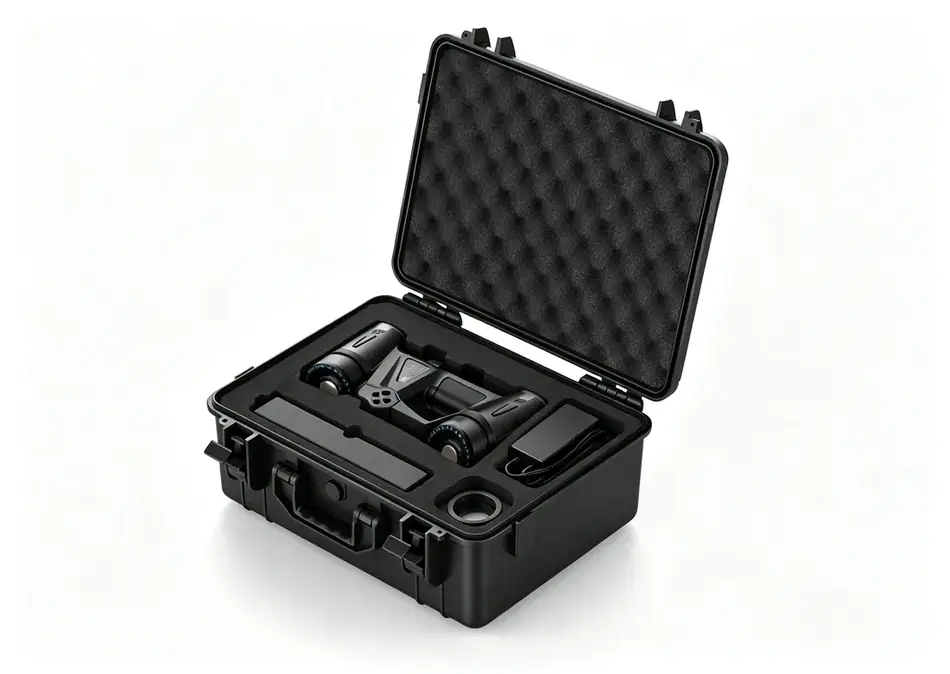
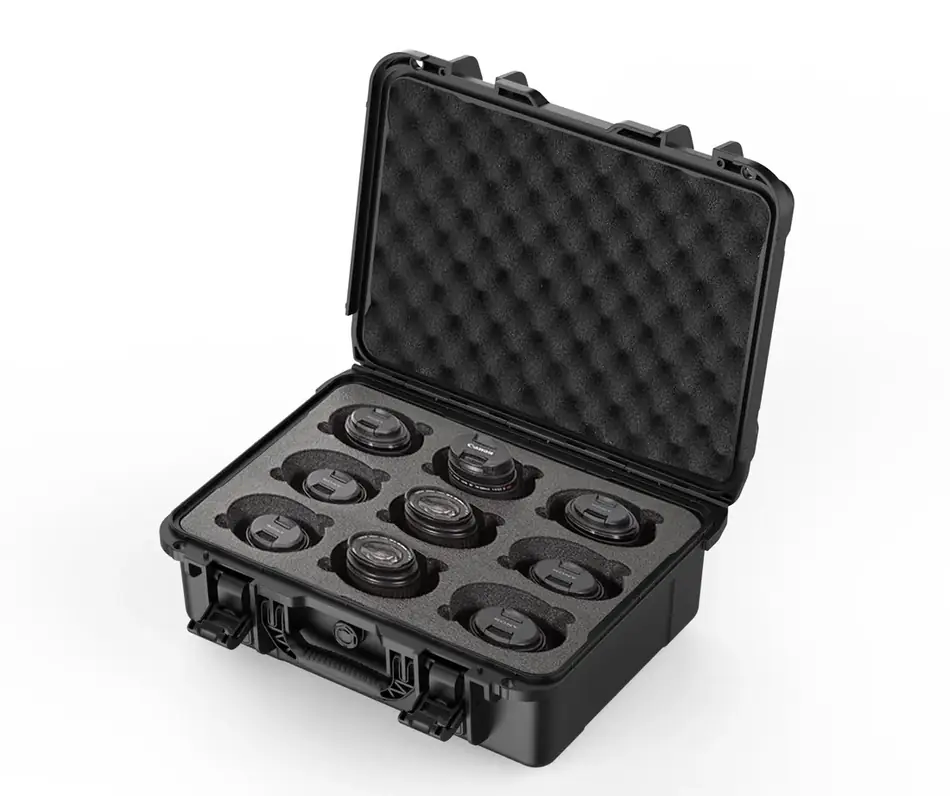
How should optical equipment be protected during transport?
Optical equipment is damaged in transit by three things, and only one of them is the bump itself: shock and vibration reaching the glass and the mechanical zero, abrasive grit reaching lenses and coatings, and the instrument moving inside the container so that every small knock becomes a fresh impact. A rigid shell solves none of that on its own. The case protects the instrument through an interior that immobilises it, a seal that keeps contamination out, and a closure that keeps the two halves aligned. In our published range the models we tag for optical equipment run from about 31 to about 139 litres of internal volume, with wall thickness published per model between 3.3 mm and 6.0 mm and a compressible gasket available on most shells.
Key points
- Protect optics by controlling shock, contamination and internal movement; the shell alone does none of that work.
- Immobilise the instrument with a snug cut interior; transmitted force is set by the foam stopping distance, not by the case wall.
- A compressible gasket in a continuous moulded channel resists dust and splash; we publish it per model and state no ingress code that was not tested.
- Size on the whole kit — body, optics, batteries and accessories — then read internal length, width and height against it.
- Point loads damage barrels and reticles, so a firm carrier with a soft contact layer beats one blanket of soft foam.
The three failure modes that matter for optics
An optical instrument fails in transport in a small number of predictable ways, and each one points at a different part of the case. The first is mechanical: a shock or a sustained vibration travels through the shell into the optics, and in an instrument with a reticle, a gimbal or a calibrated mount the result is not a crack but a drift — the zero that was true when the case was loaded is no longer true when it is opened. The second is surface: fine grit, sand or dust finds its way onto a lens or a coated element, and the next wipe turns that grit into an abrasive. The third is movement: an item that is not held sits loose inside a rigid box, so the box survives the drop but the instrument does not, because every knock becomes a fresh impact against a wall.
Those three modes are why a case for optics has to be specified as a system. The shell resists the environment and carries stacking load; the interior decides the force the instrument actually feels and whether it moves; the seal decides whether contamination reaches the glass. Change one and you change the protection the buyer is really paying for.
Immobilise first, then cushion
The order matters. Before you choose foam thickness you choose fit: the instrument should sit in a cut that touches it on its strongest faces and leaves it nowhere to travel. A snug interior is more protective than a thick one, because a thick layer around a loose item simply lets the item accelerate through the soft foam and hit the far wall with more energy. Where an optical set has a long body or a tube — a spotting scope, a monocular, a sensor with a lens barrel — the carrier under it should be firm enough to spread the load along the tube rather than concentrating it at one or two points, while the surface against the glass and the finish stays soft.
That is why we quote optics interiors as a layered build rather than a single density: a firm CNC-cut carrier that carries the structural load, with a softer pluck-foam or convoluted top layer for the parts and accessories that change between trips. The firm layer controls where the item stops; the soft layer protects the surface and the sight. Shock protection is a property of that interior layout, not of the shell, and we say so plainly — the case body on its own is not a shock rating.
Keep contamination off the glass
Optics are unusually sensitive to what gets inside the box. A lens with a speck of sand on it is damaged by the act of cleaning it, so the goal is to stop the sand reaching the glass in the first place. Two published features do most of that work: a compressible gasket set in a continuous moulded channel around the base rim, which the lid presses closed, and a foam that does not shed particles onto the contents. Both are physical constructions we can show you per model, and neither is a marketing label. We do not publish an ingress protection code for these shells because that testing has not been carried out; we would rather you rely on the measured construction than on a number nobody measured.
The practical instructions we give buyers are unglamorous and effective: keep grit out of the case, store the instrument with its caps on, and choose a closed-cell interior that can be wiped rather than a crumbly open-cell foam that adds debris every time the lid is opened.
The published sizes that fit optical payloads
| Model | Internal Mm | Internal Volume L | Wall Mm | Empty Mass Kg | Mobility |
|---|---|---|---|---|---|
| KX-4822 | 460 x 330 x 210 | 31.9 | 3.3 | 2.71 | Fixed handle |
| KX-5321 | 481 x 373 x 192 | 34.4 | 5.8 | 4.81 | Fixed handle, deep base |
| KX-85726 | 520 x 296 x 210 | 32.3 | 4.2 | 5.60 | Wheels + telescopic |
| KX-96027 | 502 x 337 x 214 | 36.2 | 5.0 | 6.11 | Wheels + telescopic |
| KX-85827 | 500 x 400 x 220 | 44.0 | 5.0 | 7.80 | Wheels + telescopic |
| KX-97227 | 590 x 435 x 210 | 53.9 | 6.0 | 10.00 | Wheels + telescopic |
| KX-86836 | 595 x 460 x 315 | 86.2 | 4.8 | 10.60 | Wheels + telescopic |
Choosing the right shell by payload
Start from the assembled kit, not the catalogue name. Lay the instrument out with its batteries, its cable, its cleaning kit and any mount exactly as it will be packed, measure the longest, widest and tallest points, add a working clearance on every axis, and only then read across the table for a shell whose internal length, width and height all exceed that figure. For a single body-worn optic a light hand-carry box in the low thirties of litres is enough and keeps the loaded mass down; for a survey instrument or a thermal unit with a head and accessories, move toward the forties and fifties and take the wheeled option so the crew is not making two trips.
The decision that separates a good fit from a bad one is rarely the volume. It is the internal height and the lid-to-base split, because a shallow lid over a tall assembled item leaves the instrument bridging the two halves. Then fix the mobility rule against the packed mass and the ground it crosses: below roughly five kilograms empty a fixed handle is lighter and cheaper, and once the loaded case is heavy enough or the route rough enough that a hand carry needs two people, wheels and a telescopic handle stop being a comfort feature.
Where optical cases are used
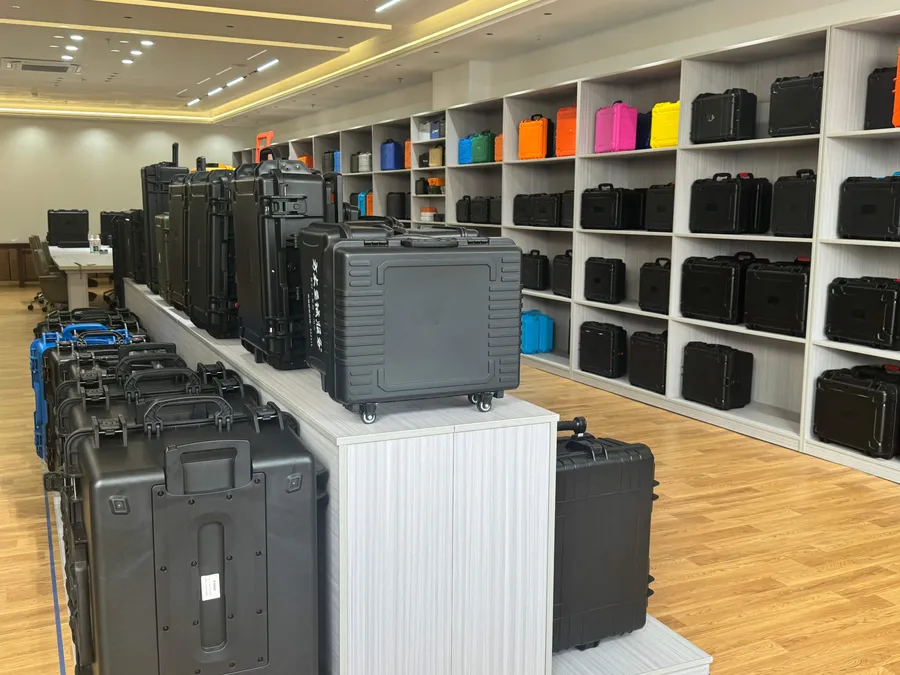
The payloads are survey and measurement instruments, observation optics such as spotting scopes, monoculars and binoculars, imaging bodies with interchangeable lenses, and thermal or low-light units with their batteries and mounting hardware. Each shares the same brief: a calibrated, coating-sensitive instrument carried by a known number of people over gravel, sand, tarmac or a vehicle bay, then opened and used in the field without a second trip for parts. That is also why these cases are rarely ordered one at a time — a unit or an integrator specifies a matched family so the same footprint repeats predictably in a rack or a vehicle, which makes external dimensions and packing data matter as much as the internal volume.
Customising a case for one instrument
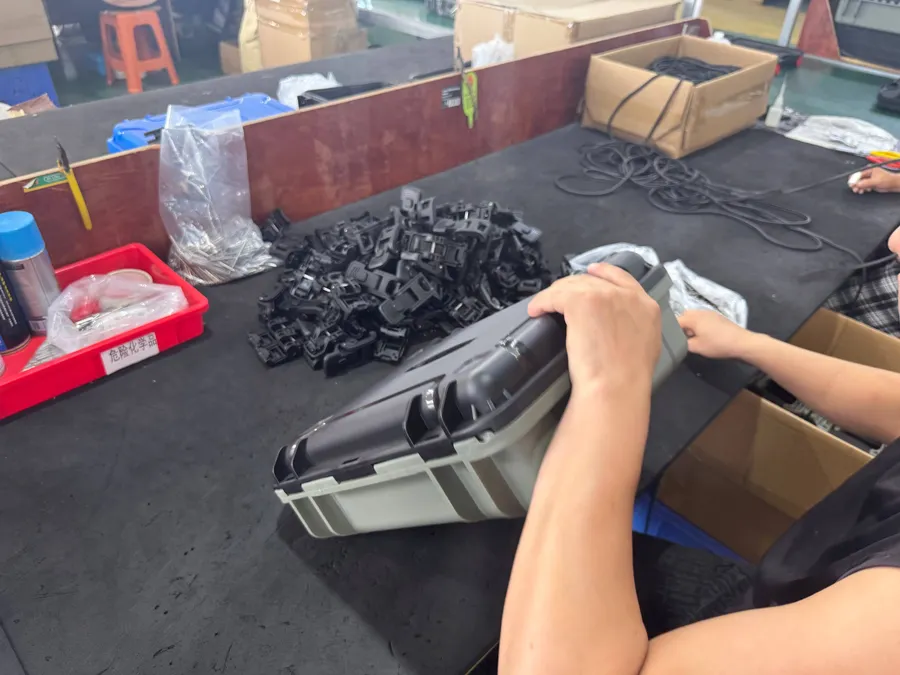
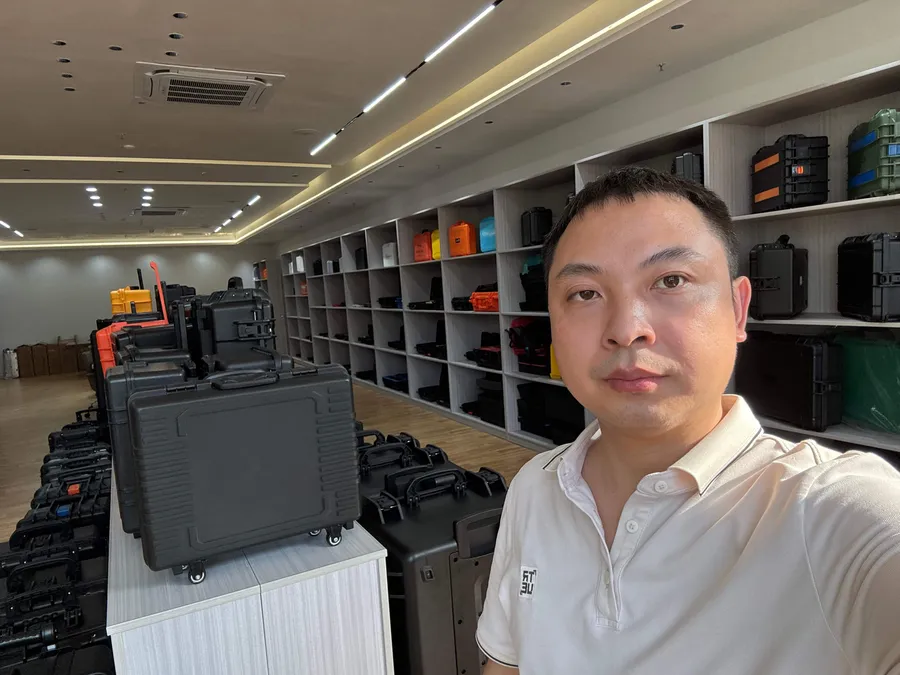
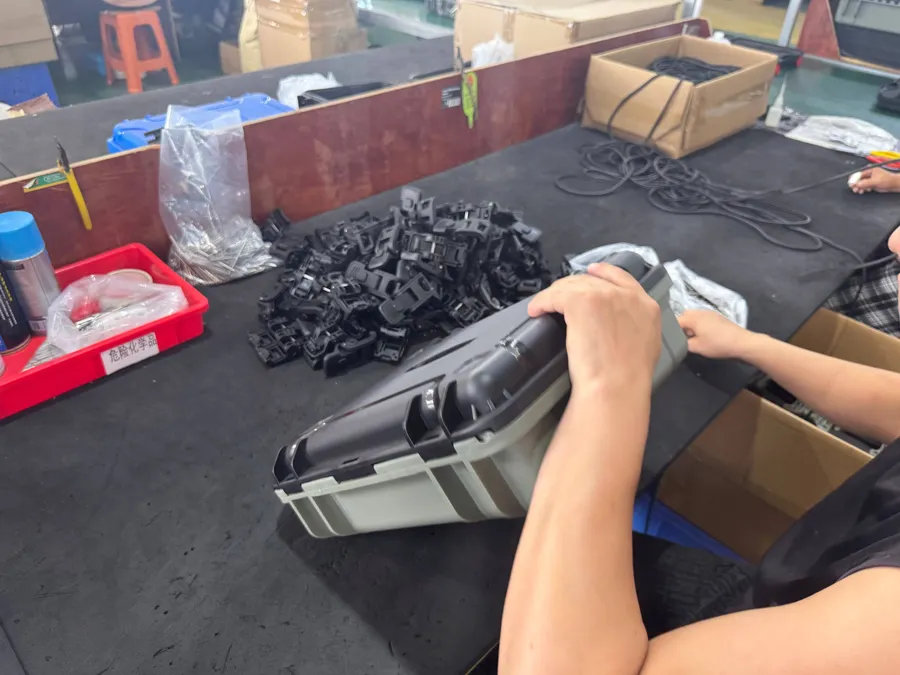
As a wholesale and OEM supplier we cut the interior to your device rather than to a catalogue label. The standard answer for an optics family is a fixed CNC carrier for the body under the structural load, with a pluck-foam top layer for whatever changes between trips; we quote foam by contact pressure rather than a single blanket density. Colour matching and a moulded or printed logo are available on OEM programmes. The published business parameters apply on a new tool: a first OEM sample in about 45 days, a new mould in about 125 days, and a 30 percent deposit on the tooling, with production on EXW or FOB terms.
Notes before you buy
We work with distributors, integrators and OEM programmes on wholesale terms and do not sell single units at retail; quotations are EXW or FOB, we do not offer DDP, and we hold no overseas warehouse stock, so plan your own freight and clearance into the schedule. Ask for the datasheet of the exact model you intend to order, because wall thickness, internal dimensions, empty mass and the lid-to-base split are published per model and vary across the range. Where a protection property such as an ingress code, a drop height or a stack load has not been measured on a model, we do not state it; you get the tested physical figures for the unit you buy, and accredited testing can be commissioned as a separate work package if your programme needs a specific rating.
Customisation
Everything described above is configurable on a standard shell: interior layout (pick-and-pluck, die-cut or CNC-cut), foam grade and thickness, colour, logo method, latch and lock count, pressure-equalisation valve, cable ports, document holder and identification plate. A bespoke exterior geometry requires a new mould — 125 days, from 3,000 units per moulded component.
Procurement considerations
| Question | What to send us |
|---|---|
| Which shell fits? | Equipment L × W × H as packed, plus required clearance per axis |
| What does it cost? | Order quantity and estimated annual quantity — the two drive different answers |
| Is tooling needed? | Whether an existing shell clears the envelope with usable foam depth |
| Lead time? | Your required delivery date, not just the order date |
| Certification? | The exact standard your tender names — we will say whether we can test to it |
| Freight? | Destination and preferred terms; carton and pallet data supplied with the quotation |
Comparison and selection guide
The tables on this page exist because a protective case is chosen by comparing three things: the envelope, the environment and the handling chain. Where no table applies, the rule below is.
| Situation | What To Do |
|---|---|
| Bare optic | Suspended body, both ends clear, soft contact layer. |
| Mounted system | Carrier under the mount, optic unloaded, tripod in a separate channel. |
| Night operations | Silent foam surface and a layout that can be opened without looking. |
- Size on internal dimensions plus clearance, never on a product name.
- Choose the carrying method before the shell: it changes the series, not just the price.
- Specify the interior last, and decide up front whether the end user will reconfigure it.
How should optical equipment be protected during transport? relates to Military Case Guide. Related families: Optical Equipment Cases / Camera & Photography Cases / Instrument & Equipment Cases / Military Protective Cases / Military Equipment Cases / Defense Equipment Cases. Related sectors: field and industrial equipment. Continue in the Military Case Guide cluster.
This page is written from our own production data. If your requirement differs, send the dimensions and we will tell you which of the 155 models fits, or whether a custom route is needed.