How do wheels affect military transport case selection?
Wheels decide how a case is moved and what the shell has to give up in order to do it. In our catalogue 19 of 155 models publish wheels, and all 19 are telescopic T-series shells: two wheels each, a telescopic handle fitted alongside a fixed folding handle, and a non-stackable status - while every one of the 136 wheel-free models is published as stackable. A wheeled shell returns 54.9 to 67.4 percent of its external volume as usable interior, against a 70.9 percent median for wheel-free shells of the same construction. Wheels are therefore a trade, not an upgrade: easier movement across hard, flat, unobstructed ground, paid for in interior volume, in stacking freedom and in 4.912 to 15.32 kg of empty-case mass that someone still has to lift when the ground runs out.
Key points
- Every wheeled model we publish is also marked non-stackable; if stacked storage or column loading matters, a wheel-free shell is the only published option.
- Wheels and their housing cost interior volume: 54.9 to 67.4 percent of the external envelope is usable on the T series, against a 70.9 percent median elsewhere.
- Tare weight across the 19 wheeled models runs from 4.912 kg to 15.32 kg, and the published wheel count is two on every one of them.
- Telescopic handle height is measured on only 11 of the 19 models, at 240, 295, 310, 385 or 485 mm; a blank field means unmeasured, not short.
- Wheels pay off on hard, flat ground. On gravel, snow, mud or a vehicle step the same mass becomes something to lift rather than roll.
- The five largest internal volumes in the catalogue are all T series shells, so big kits push you toward wheels whether or not you asked for them.
- 18 of the 19 wheeled models publish a gasket option, so rolling and sealed are not mutually exclusive choices on our range.
What a wheel actually changes in the selection decision
A wheel is not a handle with castors bolted on. It moves the case from a carried load to a towed one, which changes the human effort equation completely: a carried 12 kg case is a two-hand, two-person-or-one-strong-person problem over any distance, while the same case on wheels is a one-hand problem on smooth concrete and still a lifting problem on every surface that is not smooth concrete. Selection therefore starts with the route, not the catalogue. Measure the longest stretch between the vehicle and the working position, note the surface, and note whether there are steps, curbs, cables, mud or snow anywhere along it.
The second change is structural. Wheel axles, the bosses that hold them and the housing that shields them have to be moulded into the shell, and the handle channel has to run through one wall of that shell. Both consume envelope that would otherwise be interior space, and both disturb the rim geometry that lets a box sit safely on top of another box. That is why wheel choice and stacking behaviour are decided in the same moment, even though buyers usually treat them as two separate line items.
What our published data actually says about the wheeled range
Of 155 active models, 19 carry wheels in the data, and the whole group sits in one series: the T series, described in our own catalogue note as the telescopic rolling range. Each of those 19 publishes a wheel count of two and a handle entry of telescopic plus fixed folding, which means the folding handle stays available when the telescopic one is stowed or when the case has to be carried two-handed. Shell wall thickness across the group runs from 4.2 to 6.0 mm, 14 of the 19 publish separate lid and base depths, and 18 of the 19 list a gasket configuration. Materials are engineering PP or PP on 18 models and ABS on one, KX-66232.
The gaps in the data matter as much as the values. Telescopic handle height is measured on 11 of the 19 models, and the figures are 240, 295, 310, 385 and 485 mm. For the other eight, our product data leaves the field empty rather than guessing. We publish no wheel diameter, no axle specification and no load rating for any model, so nobody should read a rolling case in this range as having a tested weight limit - the number simply has not been measured here, and an accredited test can be quoted against a specific model and configuration when a programme requires one.
The volume a wheeled shell gives back
Multiply external dimensions by internal dimensions across the catalogue and the pattern is consistent. T-series shells convert 54.9 to 67.4 percent of their external volume into interior space. Wheel-free shells in the same catalogue have a median of 70.9 percent and reach 87.0 percent on the best-shaped boxes. The spread is not a quality difference; it is the arithmetic of hardware. A wheel housing at one end, an axle line across the base and a handle channel down one wall all occupy the corners that a plain shell would give back to the customer.
On a single model the effect is easy to see. KX-88442 measures 843 by 592 by 415 mm outside and 740 by 518 by 364 mm inside, which is 139.5 litres of usable interior - the largest figure published anywhere in our range. The internal height is 51 mm less than the external height and the length is 103 mm less, which is where the wheels, the handle channel and a 5.0 mm wall live. If the interior envelope is the binding constraint, buying a wheeled shell means accepting that roughly a third of the space your case occupies is not storage.
Stacking, storage and vehicle floors
Stacking is where wheels cost the most. Every one of the 19 T-series models is marked non-stackable in our data, and all 136 wheel-free models are marked stackable. That is a catalogue-wide line, not a per-model exception: the wheel housing and the handle recess break the continuous rim that a stacking lid needs to bear on. Practically, a rolling case stored in a rack sits on the floor of that rack, and a fleet of them cannot be columned in a container corner or in a store room.
The knock-on is volumetric rather than physical. If ten cases cannot stack, they occupy ten floor footprints instead of one. For a depot or a vehicle with a fixed floor area, a wheeled case can therefore be the more expensive choice in freight and storage even though it is the cheaper choice in labour. The comparison that decides it is straightforward: how much floor area do you have, and how many man-hours per move does the wheel save you?
Side by side: T-series shells against wheel-free comparables
| Model | Wheels | External Mm | Internal Mm | Usable L | Net Kg | Telescopic Mm | Stackable | Gasket |
|---|---|---|---|---|---|---|---|---|
| KX-85021 | 2 (T series) | 495 x 370 x 210 | 437 x 308 x 164 | 22.1 | 4.912 | not published | No | Yes |
| KX-85827 | 2 (T series) | 588 x 475 x 267 | 500 x 400 x 220 | 44.0 | 7.800 | 295 | No | Yes |
| KX-86836 | 2 (T series) | 677 x 535 x 364 | 595 x 460 x 315 | 86.2 | 10.600 | 310 | No | Yes |
| KX-97227 | 2 (T series) | 720 x 500 x 270 | 590 x 435 x 210 | 53.9 | 10.000 | 485 | No | Yes |
| KX-88442 | 2 (T series) | 843 x 592 x 415 | 740 x 518 x 364 | 139.5 | 15.320 | 295 | No | Yes |
| KX-88421 (wheel-free) | 0 | 843 x 592 x 212 | 740 x 518 x 189 | 72.4 | not published | n/a | Yes | Yes |
| KX-87323 (wheel-free) | 0 | 733 x 505 x 230 | 650 x 430 x 210 | 58.7 | not published | n/a | Yes | Yes |
Selection rule: decide by the last stretch of the route
Our working rule is to specify wheels only where the last leg is genuinely rollable and genuinely long. Say the vehicle parks 60 to 200 m from the working position on concrete, asphalt, a warehouse floor or a paved yard, and the case is moved more than a couple of times a day: the telescopic handle wins on labour and on the number of hands tied up per move. Now say that same distance is gravel, grass, mud, snow, a tailgate lip or a stairwell. The wheel stops helping, the non-stackable shell still cannot be columned on return, and the extra height of a housing at the base makes the case harder to lift into a rack.
The second filter is payload growth. A kit that weighs 18 kg packed into a 7.8 kg shell is comfortable to carry today and uncomfortable at 30 kg in two years, and the shell does not change when the contents do. Where the loaded weight is likely to cross roughly the 20 to 25 kg band at any point in the equipment life, take the wheeled shell at the outset or pick a wheel-free shell that a two-person lift stays honest with. The published tare weights, not the marketing picture of a rolling case, should decide it.
Where the rolling range earns its place
In military and defence work, the T series tends to land on the sustainment side rather than the dismount side: depot-to-vehicle movement of test sets, ground support equipment, communications racks, optics cases and medical or veterinary kits moved around a base, a hangar, an aid station or a maintenance bay. Those are hard flat surfaces with repeat distances, which is exactly where two wheels and a telescopic handle remove the most labour, and the non-stackable penalty is small because the storage there is floor-level racking.
The same logic transfers to industrial service, telecoms installation, film and survey crews, and to drone or UAV field kits where the case travels by road to a launch point and then a short distance on level ground. It does not transfer to anything foot-mobile. For that end of the workload, a wheel-free shell of the same internal envelope, with a padded carry handle and a shoulder strap as a configuration option, is the better fit - and it stacks on the way home.
Customising wheels, handles and the rest of the hardware
Wheels, handles, latches and seals are all listed as customisable hardware on every model in the range. That covers handle style and position, latch count, which is specified per configuration rather than fixed per shell, shoulder strap fitting, document holders, feet and padlockable latch bodies - the latch on our shells accepts a standard padlock, which is a measured feature rather than an option. What it does not cover is adding wheels to a shell that was not tooled for them: the axle bosses, the wheel housing and the handle channel are moulding geometry, so a change of that kind is a new tool, quoted at 125 days and an MOQ from 3,000 pieces per component. A modification on an existing tool - different handle, more latches, a colour, a logo, a custom foam cut - runs from 45 days, with logo, colour and OEM MOQs at 300 pieces and standard stock at a single piece.
Commercial terms are worth stating plainly at this point because they constrain what we can do with a hardware change: we supply wholesale and OEM only, on EXW or FOB, with no retail, no DDP and no overseas warehouse stock. A buyer who wants 40 rolling cases delivered to a forward location is not a bad fit for the product, but they are a bad fit for our shipping terms, and it is better to find that out before a specification is written around our catalogue.
What to verify before you commit
Before a wheeled model is signed off, four published fields should be checked rather than assumed. Confirm the internal envelope against the equipment with clearance at each face, because the internal height on a T-series shell is where the wheel housing takes its share. Confirm the stacking decision separately - all 19 are published non-stackable, so a store layout built on columns is a design error, not a supplier failure. Confirm which telescopic height applies to your operator's comfortable pulling posture, and note that eight models leave the figure unmeasured. And confirm whether a gasket configuration is being ordered, because the shell supports it on 18 of the 19 while one, KX-5126, states plainly that no seal is offered.
Finally, ask for the numbers you need as measurements rather than accepting ours by analogy. Wall thickness, internal and external dimensions, net weight and lid/base depth are published per model; wheel diameter, axle specification, rolling load limit and any ingress code are not. Where a programme needs a tested figure, we arrange accredited testing against the exact model and configuration and the report goes to the buyer. Anything else is a guess wearing a specification sheet, and a guess does not survive an incident review.
Customisation
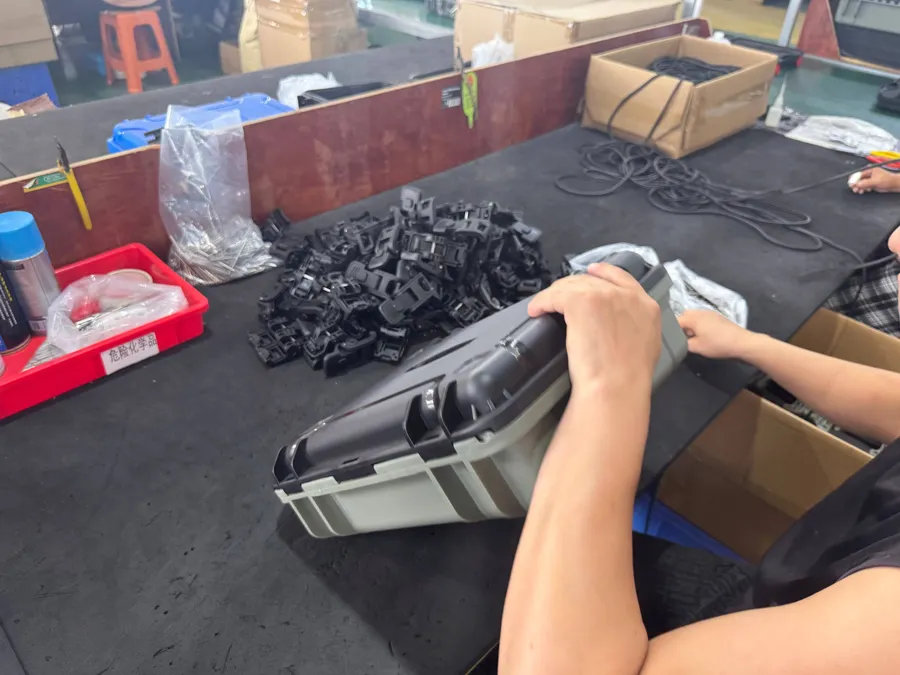
Everything described above is configurable on a standard shell: interior layout (pick-and-pluck, die-cut or CNC-cut), foam grade and thickness, colour, logo method, latch and lock count, pressure-equalisation valve, cable ports, document holder and identification plate. A bespoke exterior geometry requires a new mould — 125 days, from 3,000 units per moulded component.
Procurement considerations
| Question | What to send us |
|---|---|
| Which shell fits? | Equipment L × W × H as packed, plus required clearance per axis |
| What does it cost? | Order quantity and estimated annual quantity — the two drive different answers |
| Is tooling needed? | Whether an existing shell clears the envelope with usable foam depth |
| Lead time? | Your required delivery date, not just the order date |
| Certification? | The exact standard your tender names — we will say whether we can test to it |
| Freight? | Destination and preferred terms; carton and pallet data supplied with the quotation |
Comparison and selection guide
The tables on this page exist because a protective case is chosen by comparing three things: the envelope, the environment and the handling chain. Where no table applies, the rule below is.
| Situation | What To Do |
|---|---|
| Airport and road transfer | Check the external dimensions against cabin and boot constraints, not just the internal volume. |
| Rough ground | Larger wheels and a wider track matter more than shell volume. |
| Stored upright | Confirm the case can stand on its base with the handle retracted in your racking. |
- Size on internal dimensions plus clearance, never on a product name.
- Choose the carrying method before the shell: it changes the series, not just the price.
- Specify the interior last, and decide up front whether the end user will reconfigure it.
How do wheels affect military transport case selection? relates to Military Case Guide. Related families: Rolling Cases / Military Transport Cases / Military Protective Cases / Equipment Transport Cases / Field Equipment Cases. Related sectors: field and industrial equipment. Continue in the Military Case Guide cluster.
This page is written from our own production data. If your requirement differs, send the dimensions and we will tell you which of the 155 models fits, or whether a custom route is needed.