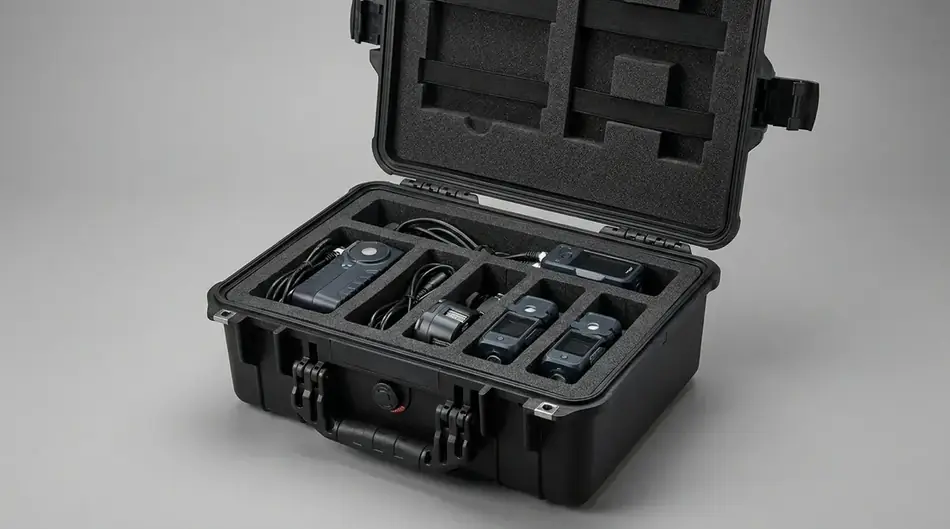
What case dimensions should be considered for communication equipment?
Size a communication case from six published dimensions, not one. The internal length, width and height tell you whether the device fits; the narrow internal width tells you whether a coiled cable or a stiff connector clears the side walls; the lid and base depth on either side of the parting line tell you whether a tall item can sit below the line where it is supported; wall thickness tells you how much of the external box is not usable; and usable internal volume tells you how much room is left once the insert is in. External dimensions do a different job again: they set the footprint that must grid onto a pallet. Do not match a radio to a generic number. Read each dimension against the tallest, longest, heaviest and stiffest item in the kit, and ask the supplier to publish the value for the exact model rather than the range.
Key points
- Check internal size, narrow internal width and the parting line before the box length.
- External dimensions set the pallet footprint; internal dimensions set whether the gear fits.
- Wall thickness is lost volume: WL6-5522 measures 545 by 440 by 215 mm outside and 507 by 385 by 190 mm inside.
- Compare gross internal volume with usable volume; the gap is the foam that holds the load.
- Choose a family that shares a footprint and varies only in height to keep a fleet stackable.
- Ask for published dimensions per SKU; we do not generalize one model's figures across the range.
The six dimensions that actually decide whether communication gear fits
A datasheet lists a dozen numbers, but six of them govern fit for communication equipment. First the internal length, width and height, which are the obvious envelope for a transceiver, terminal or router. Second the narrow internal width, because the usable slot between side features is often smaller than the internal length and it is what a wound cable or a connector must clear. Third the lid and base depth on either side of the parting line, because a tall component has to sit below that line to be supported, and a shallow-base shell cannot hold it there. Fourth wall thickness, which is the difference between the box you ship and the box you pack. Fifth usable internal volume, which is the gross cavity minus the insert. Treat these as a checklist and a mis-sized case stops being a surprise.
Internal versus external dimensions do two different jobs
Buyers quote one number and get both wrong. Internal dimensions answer 'will it fit'; external dimensions answer 'will it ship and stack'. Take the same shell measured both ways: WL4010 is 400 by 360 by 100 mm outside and 390 by 315 by 88 mm inside, so about 10 mm of length, 45 mm of width and 12 mm of height are walls and closure, not packing space. WL6-5522 is 545 by 440 by 215 mm outside and 507 by 385 by 190 mm inside, a wider gap because it is a thicker-walled ABS shell. Plan the device against the internal figure and the pallet against the external figure, and never size a cavity from the box dimensions printed on a shipping label. Our guide to internal versus external dimensions works through exactly this trade for a mixed load.
Narrow internal width and the parting line are the two hidden limits
Two published values decide fit more often than the headline size. The narrow internal width is the tightest clear dimension across the cavity, and it governs a coiled feedline, a mic boom or a connector that will not bend: WL4010 lists a 282 mm narrow width and WL3218 a 205 mm narrow width even though both look roomy on length. The parting line splits the cavity into lid depth and base depth, and a heavy or tall item belongs in the base where its mass is supported. WL4613 is a good example of an asymmetric split, a 74 mm lid over a 42 mm base, which lets a dense power supply bed low while a longer cable runs in the shallow lid; WL4616 closes that same footprint with a 74 mm lid over a 74 mm base for taller contents. When a supplier will not publish these two numbers, you are guessing.
Compare footprints and heights across a communication range
| Model | External Mm | Internal Mm | Narrow Internal Mm | Lid Over Base Mm | Wall Mm | Empty G |
|---|---|---|---|---|---|---|
| WL4010 | 400 x 360 x 100 | 390 x 315 x 88 | 282 | 44 / 44 | 3.0 | 1015 |
| WL4610 | 460 x 367 x 95 | 455 x 338 x 84 | 302 | 42 / 42 | 3.0 | 1115 |
| WL4613 | 460 x 367 x 126 | 455 x 338 x 116 | 302 | 74 / 42 | 3.0 | 1370 |
| WL4616 | 460 x 367 x 155 | 455 x 338 x 148 | 302 | 74 / 74 | 3.0 | 1395 |
| WL6-4114 | 405 x 362 x 135 | 378 x 307 x 120 | not published | not published | 4.0 | 2100 |
| WL6-5522 | 545 x 440 x 215 | 507 x 385 x 190 | not published | not published | 5.3 | 4860 |
One footprint, several heights: how a fleet stays stackable
The cleanest dimension decision in a communication program is to standardize the footprint and vary only the height. The WL4610, WL4613 and WL4616 shells share a 460 by 367 mm external footprint and a 302 mm narrow internal width, and differ only in height, 95, 126 and 155 mm external with 84, 116 and 148 mm internal. Because the base is identical, the three stack and grid onto one pallet pattern, so a mixed fleet of shallow handset cases and deeper radio-plus-supply cases still behaves like one system on the shelf and in the vehicle. A collection of one-off footprints does not, and the handling cost of that mistake lasts for the life of the equipment. Where you need a different class, WL4010 at 400 by 360 mm and WL6-4114 at 405 by 362 mm form a second, smaller family.
Gross internal volume is not the room you can pack
Volume is the number that hides the insert. Each model lists a gross internal volume and a smaller usable volume, and the difference is the foam that keeps the load still, which you are paying for with space. WL4010 lists 10.8 L gross internal and 9.3 L usable; WL4613 lists 17.8 L gross and 15.3 L usable; WL6-5522 lists 37.1 L gross and 29.7 L usable, a larger absolute gap because a big ABS shell takes a thicker keyed insert. Size the device and the cable set against the usable figure, and reserve the gross-to-usable difference for the walls of foam that stop a connector travelling across a board. Our notes on how case size affects logistics efficiency cover the same idea from the pallet side.
Selection guidance: a dimension checklist for a communication kit
Run the kit down a checklist before you pick a shell. Record the tallest, longest and heaviest device and the stiffest cable in each class. Match the device to internal length, width and height, then match the cable to the narrow internal width. Decide whether any component must sit below the parting line, and read the lid and base depth against that. Confirm the external footprint grids onto your pallet standard, because the count that reaches a pallet is driven by carton data as much as by the shell: WL6-3416 ships 8 to a 675 by 365 by 360 mm carton, WL6-4114 ships 8 in 755 by 425 by 580 mm, and WL6-5522 ships 3 in 565 by 450 by 665 mm. Finally check empty mass against the carry leg. We supply pallet and container loading calculated against your stated pallet standard at quotation, because a figure derived from the wrong pallet is worse than none.
Applications: sizing dimensions by equipment class
Handsets, heads and small terminals are light but many, so a shallow shell such as WL4010, 390 by 315 by 88 mm internal with a 282 mm narrow width, keeps each unit flat in one plane. A transceiver with its power supply is mixed mass and wants a deep lid over a shallow base, which is exactly WL4613, a 74 mm lid over a 42 mm base. A full field kit with jumpers, headsets and spares suits WL4616 at 455 by 338 by 148 mm internal, whose twin 74 mm halves close over a wound bundle. A dense spares or battery sub-kit earns a thick-wall ABS shell such as WL6-4114 at 4.0 mm wall, and a single-station ground element moves to WL6-5522, 507 by 385 by 190 mm internal. In each case we quote wholesale or OEM production on EXW or FOB terms against your dimension list; we do not run a retail single-unit channel, do not quote under DDP and hold no overseas warehouse, so plan inbound freight and lead time around manufacturing rather than stock.
Custom and OEM: when to go outside published dimensions
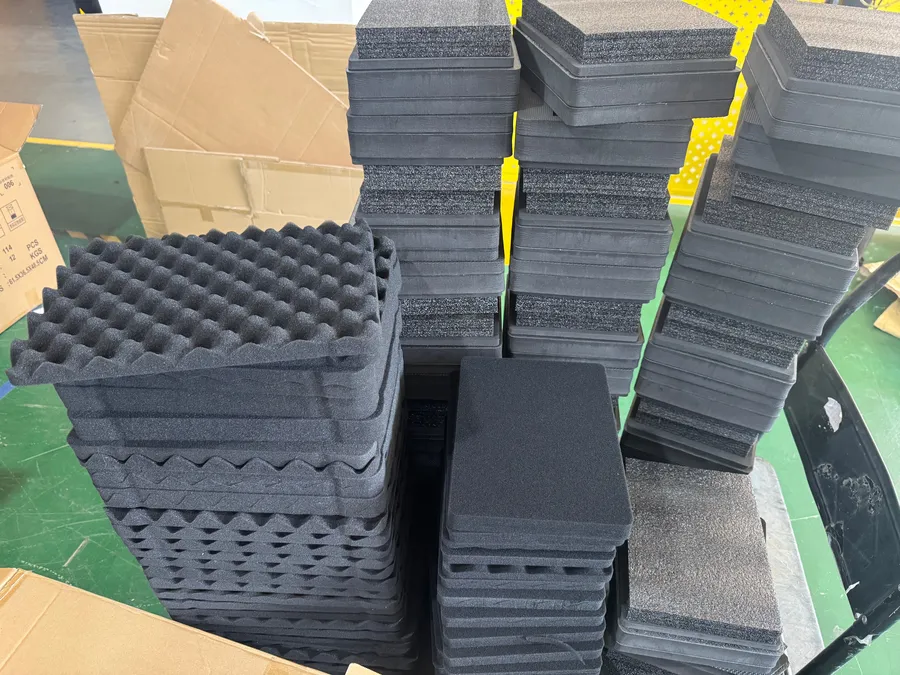
Go outside the published range only when no existing envelope clears your load, because the improvements that matter usually sit inside a standard shell plus a cut insert. On existing moulds we offer interiors in pick-and-pluck, die-cut, CNC-cut, layered and egg-crate foam in cross-linked PE or EVA by zone, with custom thickness and custom shapes cut from a drawing, a packed-kit photograph or a physical sample, plus colour, logo and packaging changes. Minimum quantities follow the type of change: custom foam starts from a single unit for a first sample, while logo, colour and OEM programmes begin at 300 pieces and a bespoke mould at 3,000 per component. Published lead time is about 45 days for a first OEM sample on an existing mould and about 125 days for a new tool, with a 30 percent deposit on production. A new mould earns its cost only when your tallest, longest and stiffest item clears every published internal figure.
Procurement notes before you order on dimensions
Put the real numbers on the purchase order, not a nominal size. Ask for internal and external dimensions, narrow internal width, lid and base depth, wall thickness, empty mass, usable volume and carton data per model, and record which are published and which are not. We publish dimensions per model and do not attach an ingress-protection rating, a temperature range or a drop height to a shell that has not been tested, so request the datasheet for the exact SKU rather than accepting a range claim. Confirm the pallet standard the footprint will grid to, order the interior as a revision-controlled drawing so a reorder in eighteen months reproduces the same fit, and take carton and pallet figures with the quotation. Send us the dimension list per equipment class and we will return the shell, the insert and the footprint proposal built around it.
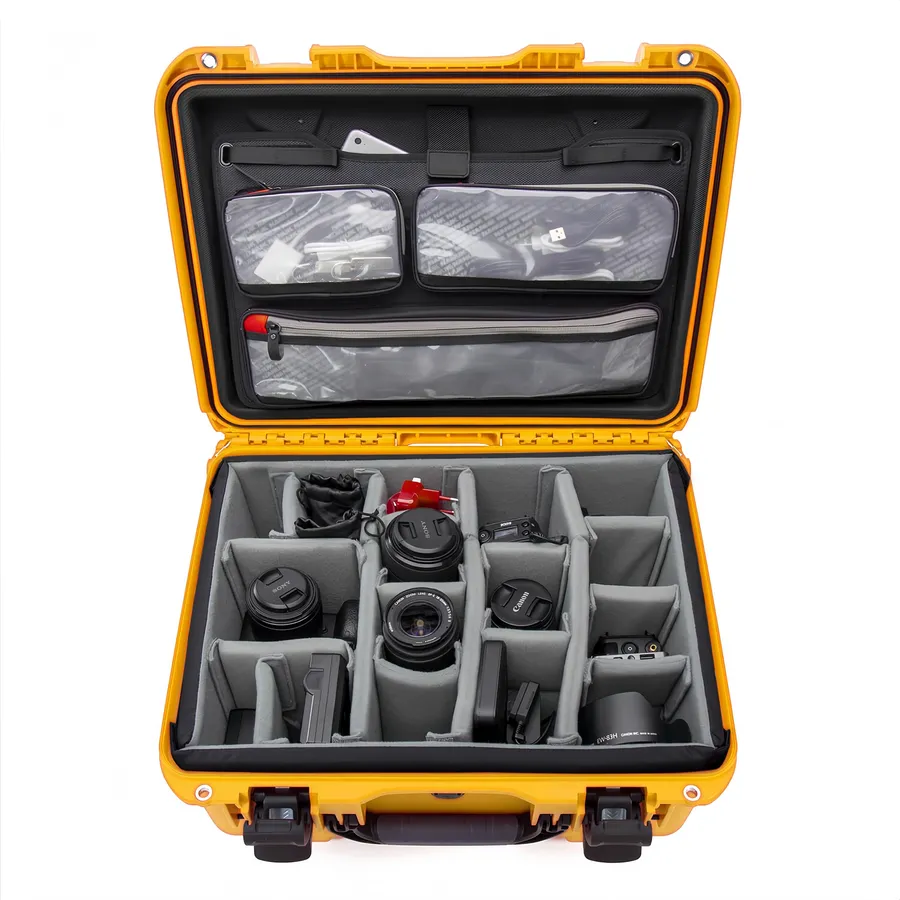
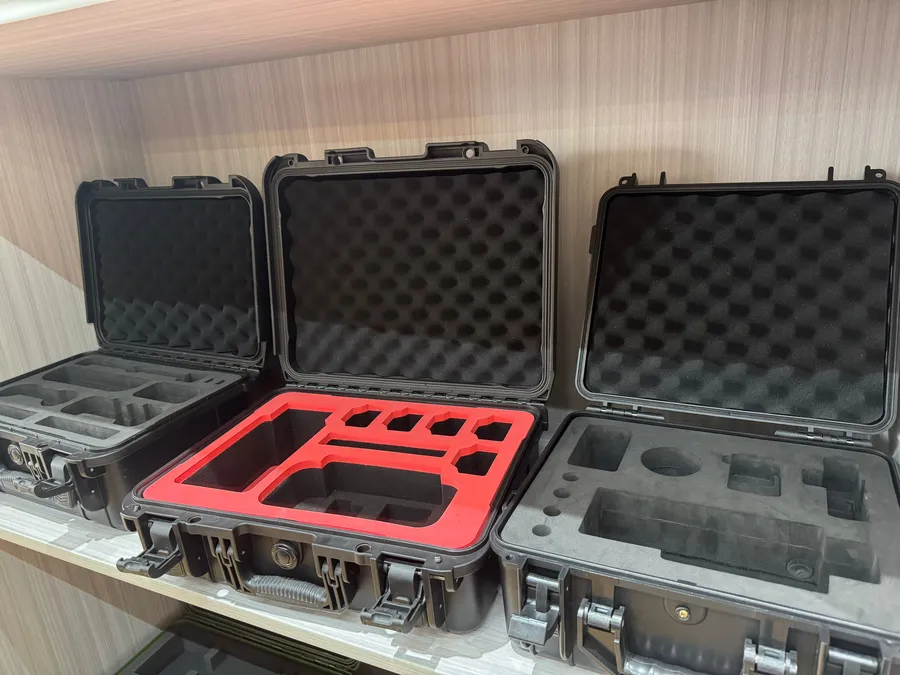
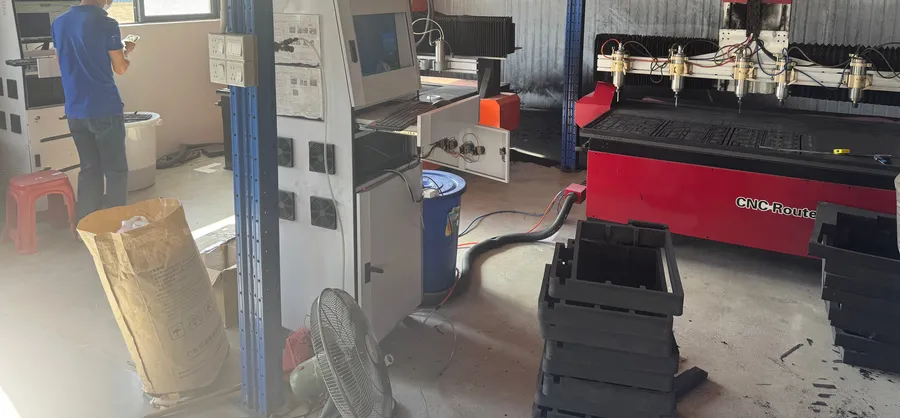
Customisation
Everything described above is configurable on a standard shell: interior layout (pick-and-pluck, die-cut or CNC-cut), foam grade and thickness, colour, logo method, latch and lock count, pressure-equalisation valve, cable ports, document holder and identification plate. A bespoke exterior geometry requires a new mould — 125 days, from 3,000 units per moulded component.
Procurement considerations
| Question | What to send us |
|---|---|
| Which shell fits? | Equipment L × W × H as packed, plus required clearance per axis |
| What does it cost? | Order quantity and estimated annual quantity — the two drive different answers |
| Is tooling needed? | Whether an existing shell clears the envelope with usable foam depth |
| Lead time? | Your required delivery date, not just the order date |
| Certification? | The exact standard your tender names — we will say whether we can test to it |
| Freight? | Destination and preferred terms; carton and pallet data supplied with the quotation |
Comparison and selection guide
The tables on this page exist because a protective case is chosen by comparing three things: the envelope, the environment and the handling chain. Where no table applies, the rule below is.
| Situation | What To Do |
|---|---|
| Battery isolation | Separate pockets, terminals up, with a physical barrier between cells and connectors. |
| Cable management | Dedicated coiled-cable channels rather than a shared compartment. |
| Field repair | Reserve a small loose compartment for spare fuses, connectors and seals. |
- Size on internal dimensions plus clearance, never on a product name.
- Choose the carrying method before the shell: it changes the series, not just the price.
- Specify the interior last, and decide up front whether the end user will reconfigure it.
What case dimensions should be considered for communication equipment? relates to Military Case Guide. Related families: Communication Equipment Cases / Electronics Cases / Military Protective Cases. Related sectors: field and industrial equipment. Continue in the Military Case Guide cluster.
This page is written from our own production data. If your requirement differs, send the dimensions and we will tell you which of the 155 models fits, or whether a custom route is needed.