How should equipment cases be prepared for international shipping?
Prepare the shipment from the carton, not from the case. Build the export plan on published carton dimensions and pieces per carton, keep the load path through the shell rims rather than the lid, protect protruding latches, hinges, handles and wheels, mark every carton against the purchase-order line it belongs to, control condensation across the temperature swing of the ocean leg, and fix the delivery term before you book anything. Pallet builds are then calculated against your pallet size, and container loading figures come back with the quotation rather than being guessed from a catalogue photo.
Key points
- Plan from carton data: 64 of the 155 catalogue models publish carton dimensions and 58 publish pieces per carton.
- No per-model pallet figure is published because the build depends on your pallet size and the ordered carton mix.
- Protruding hardware, not the shell wall, is what gets damaged: state how latches, handles and wheels are protected.
- 136 models are specified stackable; the 19 wheeled trolley shells are not, and they pack one or a few per carton.
- A container sweats on the inward leg, so specify the liner and desiccant with the carton design instead of after it.
- Fix EXW or FOB before booking: supply is wholesale and OEM, with no DDP delivery and no overseas warehouse.
The preparation sequence that holds up in transit
International preparation is a sequence, and the order matters more than any single step. Establish the carton build first, because it decides the pallet footprint, the stack height and the volumetric figure you will pay freight on. Then protect what protrudes from the shell. Then mark, so that a receiver in another country can reconcile a carton against a purchase-order line without opening it. Then control moisture across the temperature swing of the voyage, then agree the term and the documents, then define what receiving inspection means at the far end.
Skipping steps is what produces the two familiar export failures: a shipment that arrives with crushed latch bosses because the cartons were chosen after the pallet plan, and a shipment that arrives intact but cannot be booked into stock because nothing on the carton matched the order line. Both are packing-design problems, and both are cheap to fix before production rather than after.
Start from the carton, not the case
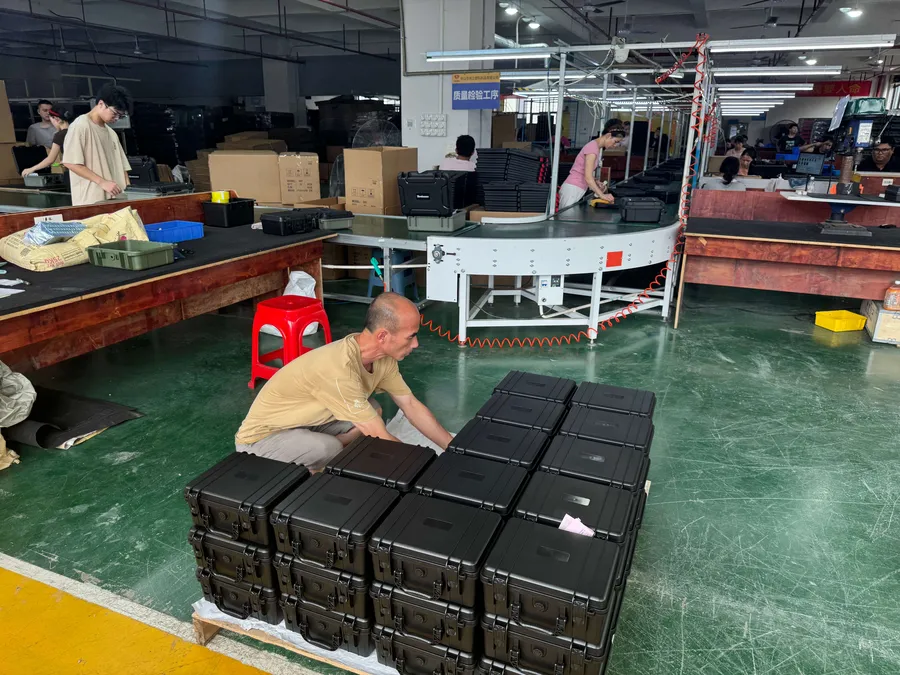
The case dimensions tell you what the customer receives; the carton dimensions tell you what the freight operator moves. Sixty-four of the catalogue's 155 models publish carton dimensions and fifty-eight publish a pieces-per-carton figure, and the published builds run from a single trolley shell in a 580 x 250 x 415 mm carton to forty small utility boxes in one carton - a range of carton volumes from about 43 to 296 litres. Two published examples show the arithmetic: twenty WL2405 shells at 240 x 200 x 53 mm fill a 475 x 415 x 280 mm carton, and ten WL6-4112 shells at 413 x 336 x 123 mm fill a 705 x 430 x 650 mm carton.
Compare the stacked case volume with the carton volume and the packing overhead appears: roughly ten percent on the small utility build and fifteen percent on the mid-size one. That gap is the carton wall, the divider and the clearance that stops the rims scratching each other, and it is the number a freight quotation is really based on. Where an order repeats, adjusting a carton by a few millimetres until it divides cleanly into your pallet is usually worth more than renegotiating the freight rate.
Pallet builds and why no per-model pallet figure is published
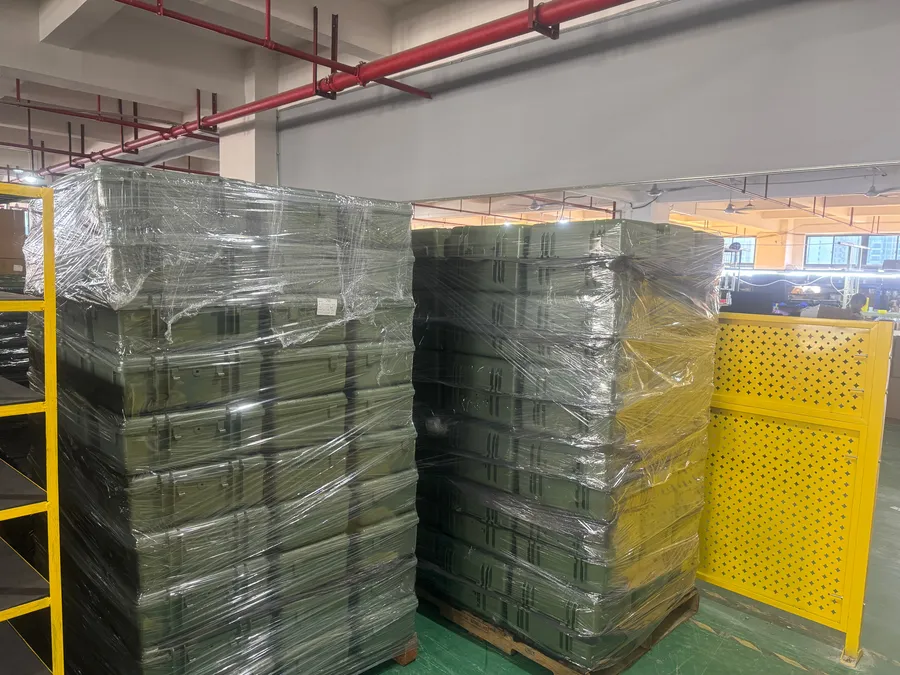
A pallet quantity is not a property of the case; it is a property of the carton against your pallet. The catalogue deliberately leaves the field open with a note that the build is calculated from the carton footprint against the customer's pallet size, because the same carton can grid two-by-two on a 1,200 x 1,000 mm deck, three deep on a 1,200 x 800 mm deck, or overhang by forty millimetres and cost a whole column of the container. Ask for the build for your deck, and check the result for three things: no overhang, a stack height inside the door height of the container, and a column pattern that can be bandit-strapped without leaning on the weakest carton.
Container loading follows the same rule. Twenty-foot, forty-foot and high-cube figures are supplied with the quotation for the actual order, since they depend on the mix of models, whether cartons are stacked two-high where the build allows it, and whether the load is palletised or floor-loaded in cartons. Anyone who quotes you a container quantity from a catalogue photo is estimating, and the estimate is usually optimistic.
Stackability, nesting and the wheeled exception
One hundred and thirty-six of the 155 models are specified stackable, and stackability is what makes an export build economic: empty shells nested or rim-on-rim travel at a fraction of the volume they occupy once they are in service. In a stack the load should travel through the shell walls and the locating rims, not through the lid panel of the case below. Where the geometry lets the upper carton sit partly on a lid, the lid bows and the carton crushes first. That is a reason to state the stack pattern in the order, not to leave it to the packing crew.
The nineteen exceptions are the T Series trolley shells, which carry wheels and a telescopic handle and are therefore not specified for stacking; they travel one or a few per carton, on their side or upright as the packing design requires. Treat them as a separate column in the pallet plan and expect them to set the stack height of the shipment rather than follow it.
Protect what protrudes: latches, hinges, handles and wheels
The shell wall survives; the hardware is what gets reported damaged. Latch bosses, hinge lines, fixed handle mountings, wheel axles and telescopic handle channels all stand proud of the carton's nominal box, and a compression load on a latch ear bends the mounting around it. State in the order how hardware ships: fitted and padded, fitted and detached-and-bagged, or boxed separately below the shell. On a wall thickness published per model between 2.0 and 6.0 mm, the mounting area around a latch is the local weak point, not the flat of the wall.
Wheels are the same problem in a different form. A trolley shell resting on its wheels in a stack concentrates the column load on the axle, so either the packing design puts the shell on its base with the wheels unloaded, or the wheels ship loose. Ask which one you are buying, because both are workable and only one of them arrives undamaged.
Moisture, temperature swing and the ocean leg
A container loaded in a humid Guangdong summer and opened in a cold northern winter sweats on the inside of its own doors, and the first thing that gets wet is the carton surface, then the printed label, then anything cardboard-adjacent. The answer is a design decision taken with the carton, not a sachet thrown in at the dock: a polyethylene liner or shrink hood per pallet, desiccant quantity set by carton volume and transit days, and a pallet build that keeps cartons off the deck so a floor puddle cannot wick upwards.
A seal configuration is available on 124 of the 155 models, and it is worth remembering what that means in transit: a gasketed rim excludes dust and splash only when the latches compress it evenly, so the cases are closed and latched for shipment, not stacked loose-lidded to save height. Where a case is destined for rack storage after arrival, the same even-compression logic decides whether the rim still sits true after six months of static load in a stack.
Marking, labelling and traceability
Marking is the cheapest part of preparation and the most frequently skipped. Every carton should carry the purchase-order number, the line it satisfies, the model code, the quantity, the interior configuration if an insert is fitted, and net and gross mass - the last two supplied by the packing list rather than taken from the case datasheet, since gross mass is a function of the build. Two opposite side labels mean a pallet can be read without breaking a band, and a carton-level barcode beats a pallet-level one the moment a mixed shipment has to be split at a forward base.
For OEM programmes, add the cutting-file or insert reference to the marking scheme at the time of order. Reordering a machined layout two years later is straightforward when the reference is on the carton and on the packing list, and expensive when the only surviving record is a photograph of a sample.
Preparation decisions and where each one fails later
Read the middle column as the list of things to state in the order, and the last column as the list of claims that will otherwise be argued about after arrival. Nothing in the table is a manufacturing variable; all of it is decided at the paperwork and packing-design stage.
| Preparation Step | Fix Before Booking | How It Fails Later |
|---|---|---|
| Carton build | Published carton dimensions and pieces per carton for the ordered models | Volumetric weight higher than quoted, columns short by one case |
| Pallet pattern | Your deck size, no overhang, stack height inside door height | A lost container column and crushed bottom cartons |
| Stack order | Which models stack, which ship one per carton | Lid bowing and latch damage reported on arrival |
| Hardware handling | Fitted, padded, detached or boxed separately | Bent latch mounts and loaded wheel axles |
| Moisture control | Liner, desiccant sized to volume and transit days, deck clearance | Wet labels, soft cartons and disputed damage claims |
| Marking scheme | Order, line, model code, quantity, insert reference, masses | Stock that cannot be reconciled without opening cartons |
| Delivery term | EXW or FOB with a named port and your own forwarder | Responsibility gaps at the port and surprise local charges |
Choosing models with the freight footprint in mind
Sizing a fleet of cases by interior envelope alone is how an organisation ends up paying to ship air. Start from the internal dimension you need, then look at what the published external envelope and carton build cost in freight terms per unit received: a 230 x 180 x 45 mm utility shell that travels forty per carton in a 480 x 370 x 470 mm box behaves completely differently in a container than an 843 x 592 x 415 mm trolley shell that publishes no carton data at all and is packed to the order.
Where two candidate models both accept the equipment, prefer the one whose external footprint grids into your pallet without an overhang, whose depth lets two cartons stack if the build allows, and whose stackability is published rather than inferred. For a long-format item, note that the catalogue carries a 1,280 x 350 x 140 mm internal envelope on a 5.0 mm wall shell; long single items break normal pallet patterns first, so plan their column separately and confirm the carton design before the rest of the order is booked.
Documents, responsibility and the term you chose
Under EXW your forwarder takes responsibility at the factory and your import process owns everything from there; under FOB it starts at the named port of loading. KeXin supplies wholesale and OEM orders on those terms with a thirty percent deposit and the balance before shipment, and does not offer retail sale, DDP door delivery or overseas warehouse stock, so the buyer's own broker handles clearance and the inland leg. State the term in the order, then make sure the packing list you receive matches the marks on the cartons, because that match is what your broker inspects and what a damage claim rests on.
Prepare the document set against the commercial invoice and packing list, and ask your broker early what their import process requires for moulded plastic transport cases, since classification and duty treatment are their determination and not something a case datasheet should be read as answering. The datasheet gives you the material, construction and mass data a classification discussion needs; the finished shell dimensions are what prove the goods match the paperwork.
Receiving inspection at the far end
Define the check before the shipment moves, so that a discrepancy is a claim and not a conversation. Photograph pallets and carton faces before breakdown, reconcile carton counts to the packing line by line, then open a sample against the datasheet: internal and external dimensions, wall thickness, unit mass, latch and hinge count, seal configuration where ordered, and the fit of the equipment in its transport configuration with the clearance you specified. Keep one carton unopened as the reference build.
Where a case fails inspection, the useful evidence is the drawing or measurement record you filed with the order, which is also why envelope data and clearance belong in the original enquiry rather than in a message thread. A supplier who published measured values per model and marked untested properties as unmeasured has already given you the baseline for that argument; one who quoted a general protection claim has not.
Frequently asked questions
The questions that come up when a case order turns into an export programme: what the factory publishes, what it calculates for you, and what the buyer has to decide before anything is booked.
Customisation
Everything described above is configurable on a standard shell: interior layout (pick-and-pluck, die-cut or CNC-cut), foam grade and thickness, colour, logo method, latch and lock count, pressure-equalisation valve, cable ports, document holder and identification plate. A bespoke exterior geometry requires a new mould — 125 days, from 3,000 units per moulded component.
Procurement considerations
| Question | What to send us |
|---|---|
| Which shell fits? | Equipment L × W × H as packed, plus required clearance per axis |
| What does it cost? | Order quantity and estimated annual quantity — the two drive different answers |
| Is tooling needed? | Whether an existing shell clears the envelope with usable foam depth |
| Lead time? | Your required delivery date, not just the order date |
| Certification? | The exact standard your tender names — we will say whether we can test to it |
| Freight? | Destination and preferred terms; carton and pallet data supplied with the quotation |
Comparison and selection guide
The tables on this page exist because a protective case is chosen by comparing three things: the envelope, the environment and the handling chain. Where no table applies, the rule below is.
| Situation | What To Do |
|---|---|
| Sea freight | Sealed configuration plus desiccant; salt spray is a handling issue, not a material issue. |
| Air freight | Mass and external dimensions drive cost more than volume. |
| Repeated movement | Replaceable latches, hinges and gaskets; keep a spares kit with the first order. |
- Size on internal dimensions plus clearance, never on a product name.
- Choose the carrying method before the shell: it changes the series, not just the price.
- Specify the interior last, and decide up front whether the end user will reconfigure it.
How should equipment cases be prepared for international shipping? relates to Military Case Guide. Related families: Equipment Transport Cases / Defense Equipment Cases / Military Transport Cases / Military Protective Cases / Optical Equipment Cases. Related sectors: field and industrial equipment. Continue in the Military Case Guide cluster.
This page is written from our own production data. If your requirement differs, send the dimensions and we will tell you which of the 155 models fits, or whether a custom route is needed.