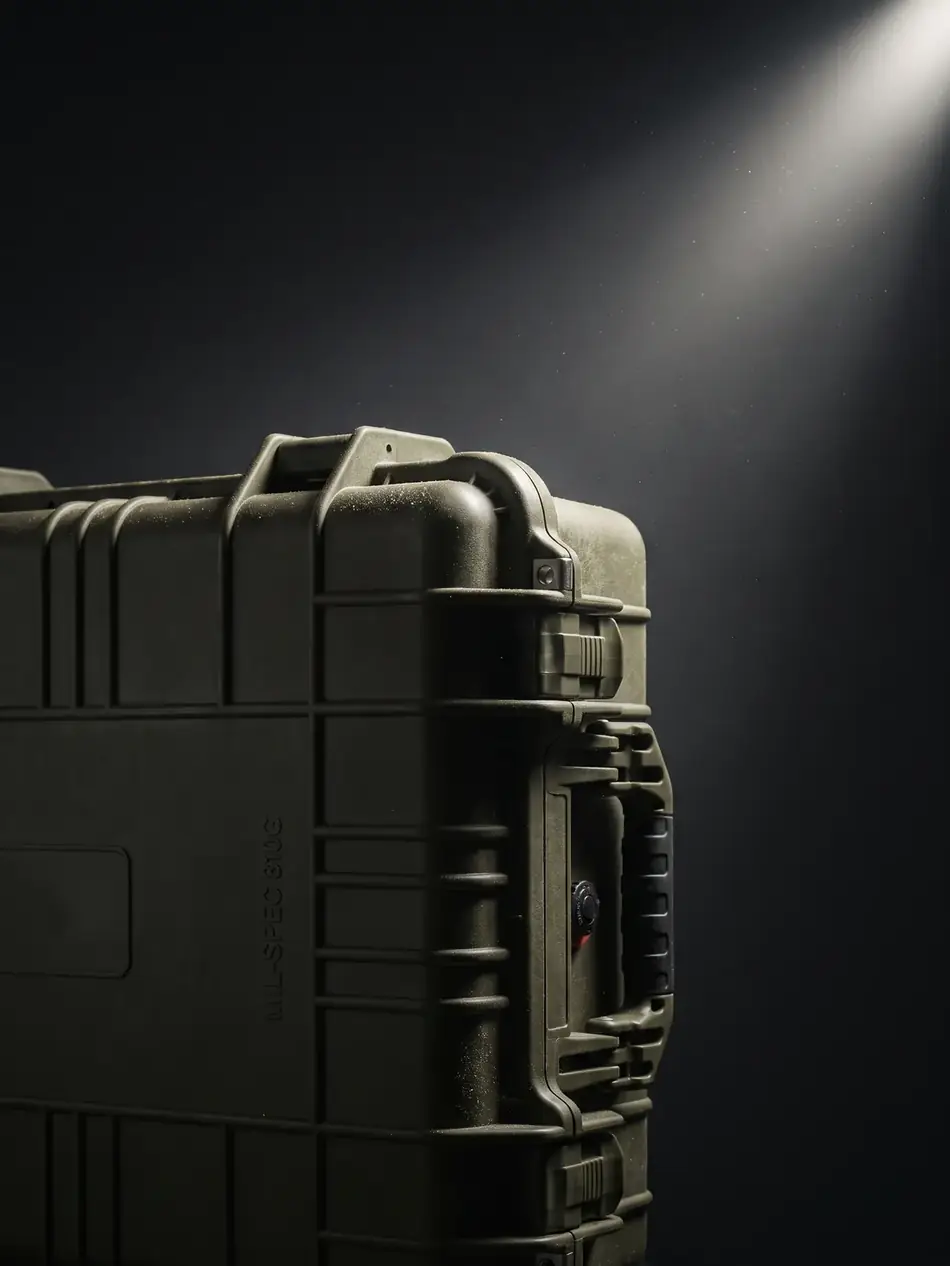
What is a defense equipment protective case?
A defense equipment protective case is a reusable, hard-shell container specified to carry mission equipment — the unit plus its power, cabling and accessories — through a transport chain and into the field, and to be handed between people who do not own what is inside. It combines an injection-moulded thermoplastic shell (polypropylene, engineering polypropylene or ABS), a lid-to-base closure that keeps dust and weather off the contents, hardware that carries the lifting and stacking load, and a shaped foam interior that fixes each item in a known place. What separates it from an ordinary carrying case is that it is engineered around a system and a route rather than a single object on a flat floor. In our published range, forty-five models serve this role, with internal volumes from 31.0 litres up to 139.5 litres and wall thickness published per model between 3.3 mm and 6.0 mm.
Key points
- Specify a defense case around the packed system and the handling chain, not around a colour or a catalogue name.
- Wall thickness is what lets a loaded case stack or rack; it is published per model between 3.3 mm and 6.0 mm.
- Under about eight kilograms a fixed handle is lighter and cheaper; from roughly twelve kilograms up, wheels earn their place.
- The foam interior, not the shell, decides what the equipment actually feels when a loaded case is dropped or rolled.
- Every figure here is a measured value for a named model; where a protection property has not been tested we do not state it.
What actually makes it a defense case
The word defense here describes a use condition, not a material or a colour. A defense equipment protective case is built for equipment that will travel — in a vehicle, on a pallet, through a logistics chain, and finally over the last stretch on a handle or a set of wheels before it is opened and worked from. That assumption changes the whole specification. The case has to survive repeated handling by people who have no particular reason to be gentle with something that is not theirs, it has to stack safely next to identical cases in a store or a load bay, and it has to keep its interior arrangement intact so that whoever opens it finds the equipment and its accessories exactly where the last person packed them.
So the definition is functional. It is a reusable hard shell with a closure, a load path, and an interior layout, treated as one system for moving a defined set of items. Dark plastic alone is not the specification.
How it differs from a general carrying case
A general carrying case protects one object that you carry by hand across a smooth floor. A defense case is asked to do more: to hold a complete system — the main unit plus a power supply, a cable set, a small-parts pouch and any mounted accessories — in a single lift, and to keep that whole arrangement safe when the case is stacked, rolled or left out in weather between uses. That is why the internal layout and the lid-to-base depth split matter so much. A deep base with a shallow lid lets a system sit low over the wheel line or the base rim and closes over the top, whereas an even split can force a tall item to bridge the two halves and take the impact at the parting line. The practical difference you feel is that a defense case is sized and specified as a system container, while a carrying case is sized around a single product.
Sizes and the numbers that matter
The four numbers that decide a defense case are the internal envelope, the internal volume that follows from it, the wall thickness that governs stacking, and the empty mass that sets the carry rule. The table below uses published measured figures for six specific models; it is not a general capability claim, and the model you order is specified from its own datasheet.
| Model | Internal Mm | Internal Volume L | Wall Mm | Empty Mass Kg | Material | Mobility |
|---|---|---|---|---|---|---|
| KX-4822 | 460 x 330 x 210 | 31.9 | 3.3 | 2.71 | Engineering PP | Stack / hand carry |
| KX-5723 | 500 x 340 x 211 | 35.9 | 5.0 | 4.68 | Engineering PP | Stack / hand carry |
| KX-65522 | 507 x 385 x 190 | 37.1 | 5.3 | 4.86 | ABS | Stack / hand carry |
| KX-6621 | 587 x 434 x 192 | 48.9 | 6.0 | 6.42 | Engineering PP | Stack / hand carry |
| KX-86836 | 595 x 460 x 315 | 86.2 | 4.8 | 10.60 | PP | Wheels + telescopic handle |
| KX-88442 | 740 x 518 x 364 | 139.5 | 5.0 | 15.32 | PP | Wheels + telescopic handle |
How these cases are built
The shell is injection-moulded thermoplastic in a lid and a base. Polypropylene is chosen where cold impact resistance and chemical tolerance matter, engineering polypropylene where stiffness and stacking behaviour matter more, and ABS where a rigid structure and a clean printed or moulded finish are wanted. Wall thickness is the number that governs how the case behaves under a stack or a point load, and across this range it is published per model between 3.3 mm and 6.0 mm. A continuous rim between lid and base carries a compressible gasket that closes dust and weather off the interior; how well that closure works depends on latch count and even compression as much as on the gasket itself, so the hardware and the rim are specified together. Handles, hinges, wheels and latches form the load path and are the parts that wear, so a case used daily should be treated as having serviceable hardware rather than a sealed body. On the larger, heavier shells, wheels and a telescopic handle are moulded into the body rather than bolted on, which removes a common failure point where a bracket shears away from the wall. The lid-to-base depth split is a deliberate choice per model, and it is what lets a whole system sit low in the base and close cleanly.
Choosing between models
Start from the packed envelope, not from a product name. Lay the unit, the power supply, the cable set and the small parts out exactly as they will really sit, measure the longest, widest and tallest points, add a working clearance on every axis, and only then read across the range for a shell whose internal length, width and height all exceed that figure. Then decide the mobility rule: under about eight kilograms empty a fixed handle is lighter, cheaper and lower, and stacks more easily on a shelf; from roughly twelve kilograms up, or whenever the loaded case crosses gravel, sand or a yard, wheels and a telescopic handle stop being a comfort feature and become the reason the equipment arrives. Finally confirm the base depth against your tallest assembled item, and check that a loaded case still stands upright and rackable when the handle is retracted. Where several items in a family must be protected the same way but are not identical, the usual answer is one shell with a modular interior: a firm CNC-cut carrier for the fixed core and a pluck-foam layer for what changes between roles.
Where defense equipment cases are used
The typical payloads are field communications and radio kits, sensor and measurement instruments, optics and survey equipment, power distribution and generator sets, and issued maintenance or repair kits. Across all of these the requirement is the same: a system that must travel intact, be opened and worked from without a second trip for parts, and reconcile at the end of the day so that a missing accessory is visible. That is also why these cases are almost never bought as a single unit. Buyers specify a matched family so that a vehicle, a shelf or a container takes a predictable count of the same footprint, which is why the external dimensions and the published packing data matter as much as the internal volume. The same shells serve civilian roles that ask the same questions of a container — test and measurement, medical and veterinary field kit, industrial inspection, and broadcast or survey crews — and the size and construction logic carries across unchanged.
Customising a defense equipment case
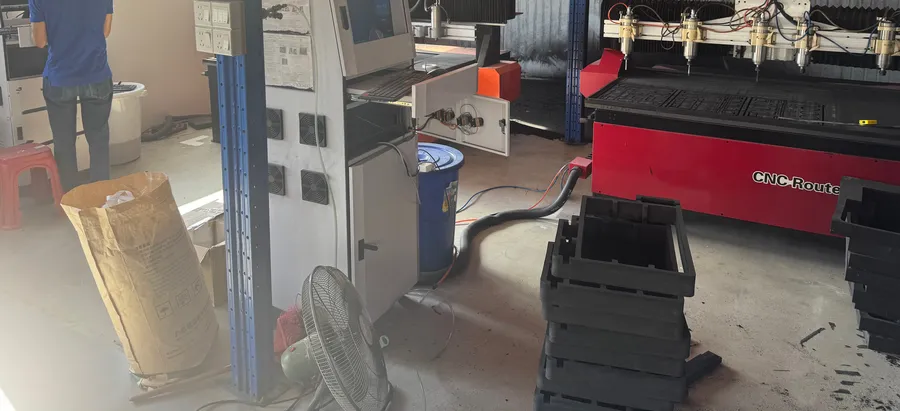
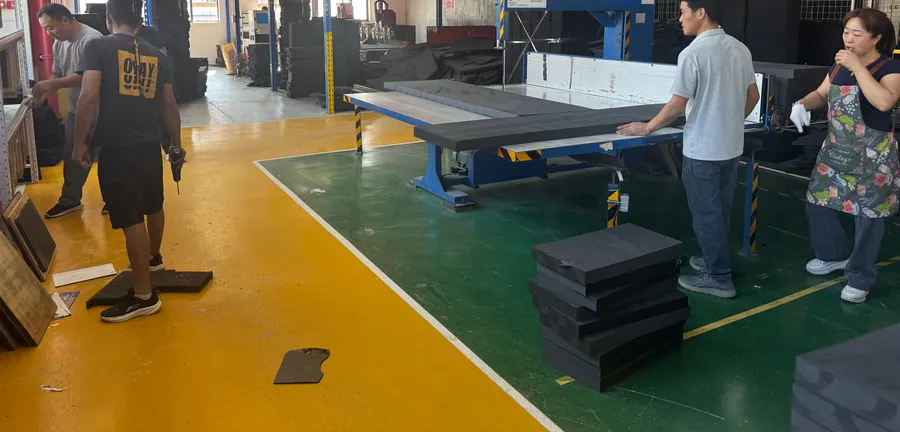
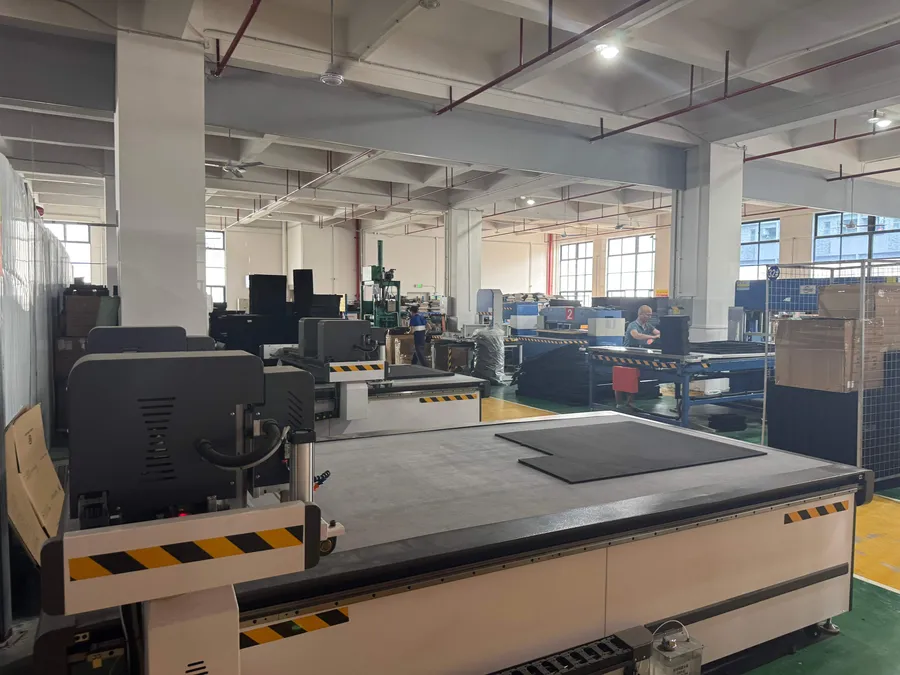
As a wholesale and OEM supplier we build to your system rather than to a catalogue entry. The interior carries most of that work: a CNC-cut base carrier under the structural load with a pluck-foam top layer for parts that rotate is the standard answer for a product family, and we quote foam by contact pressure rather than by one blanket density, because the layer that touches the item and the layer that carries the load have different jobs. Colour matching and a moulded or printed logo are available on OEM programmes so a fleet can be told apart at a glance. On a new tool the published business parameters apply: a first OEM sample in about 45 days, a new mould in about 125 days, and a 30 percent deposit on the tooling, with production on EXW or FOB terms. If you already have a shell and only need the interior, an insert-only programme is usually faster and cheaper than opening new tooling.
Notes before you buy
We work with distributors, integrators and OEM programmes on wholesale terms and do not sell single units at retail. Quotations are EXW or FOB; we do not offer DDP and we do not hold stock in an overseas warehouse, so plan your own freight and clearance into the order. Ask for the datasheet of the exact model you intend to buy, because internal and external dimensions, wall thickness, empty mass, and the lid-to-base depth split are all published per model and vary across the forty-five shells in this range. On protection, our position is deliberately narrow: we publish measured physical figures for the unit you order, and where a specific protection property has not been tested on a model we do not claim it — you specify from tested numbers rather than from a generic marketing statement. That is also the right question to ask any supplier, and it is the one that separates a real specification from a colour swatch.

Customisation
Everything described above is configurable on a standard shell: interior layout (pick-and-pluck, die-cut or CNC-cut), foam grade and thickness, colour, logo method, latch and lock count, pressure-equalisation valve, cable ports, document holder and identification plate. A bespoke exterior geometry requires a new mould — 125 days, from 3,000 units per moulded component.
Procurement considerations
| Question | What to send us |
|---|---|
| Which shell fits? | Equipment L × W × H as packed, plus required clearance per axis |
| What does it cost? | Order quantity and estimated annual quantity — the two drive different answers |
| Is tooling needed? | Whether an existing shell clears the envelope with usable foam depth |
| Lead time? | Your required delivery date, not just the order date |
| Certification? | The exact standard your tender names — we will say whether we can test to it |
| Freight? | Destination and preferred terms; carton and pallet data supplied with the quotation |
Comparison and selection guide
The tables on this page exist because a protective case is chosen by comparing three things: the envelope, the environment and the handling chain. Where no table applies, the rule below is.
| Situation | What To Do |
|---|---|
| Free-drop height | With a 50 mm base foam layer, a 15 kg assembly sees a markedly lower peak deceleration than with 20 mm. Where the case is handled by hand off a vehicle, we specify the deeper base. |
| Stacking | A case that will be shipped stacked needs a wall thickness and rim geometry that carries the load through the shell, not through the lid. |
- Size on internal dimensions plus clearance, never on a product name.
- Choose the carrying method before the shell: it changes the series, not just the price.
- Specify the interior last, and decide up front whether the end user will reconfigure it.
What is a defense equipment protective case? relates to Military Case Guide. Related families: Defense Equipment Cases / Military Equipment Cases / Military Protective Cases / Equipment Transport Cases / Field Equipment Cases. Related sectors: field and industrial equipment. Continue in the Military Case Guide cluster.
This page is written from our own production data. If your requirement differs, send the dimensions and we will tell you which of the 155 models fits, or whether a custom route is needed.