What Equipment Is Commonly Transported In Field Cases?
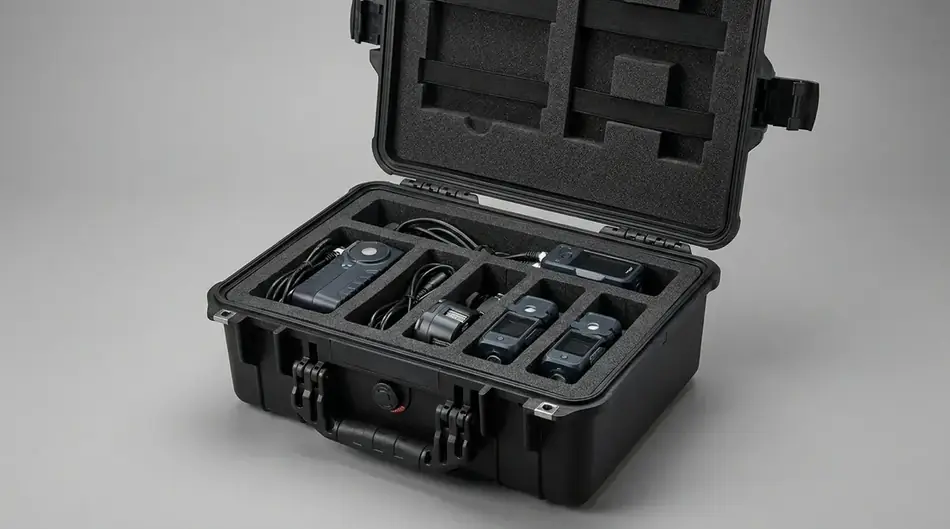
Field cases move five recurring load families: radios and signal equipment, drone and controller kits, optical and observation instruments, medical and resupply sets, and long rigid equipment, with stackable boxes carrying bulk stores underneath the load plan. The equipment list decides the case, not the other way round. A radio set wants a shallow, wide, sealed interior; a drone kit wants deep lid space so the whole set travels as one; an observation instrument wants its mass carried low in layered foam; a rifle or mast section wants internal length before anything else. Every figure below is a published catalogue number from one of the 155 models, so a load plan can be matched against datasheets before anyone commits to an order.
Key points
- Start from the packed equipment list, not from a case size: what travels together decides the interior before any shell is chosen.
- Radios and signal kit suit shallow, wide, sealed interiors; the KX-83715 publishes 340 x 220 x 135 mm internal with 10.1 litres.
- Drone and controller kits want deep lid space: the KX-83818 splits 130 mm into the lid and 35 mm into the base.
- Optics ride with mass below the cut line; the KX-84430 gives 275 mm of internal depth with a 230 mm lid.
- Long equipment is a length problem first: the catalogue reaches 1,280 mm internally in the KX-814641 on a 5.0 mm wall.
- Bulk stores travel in stackable boxes; the KX-88421 holds 72.4 litres on a flat, wheel-free lid that keeps the stack true.
- Where a figure has no test record it is listed as not measured; we do not borrow ratings from a neighbouring model.
What the catalogue's own categories say travels in a field case
A field case is specified against a load, and the load list is not a mystery: it is the equipment that deployment sections actually pack, carry and repack. The KeXin catalogue mirrors that list in its own category tree. Across the 155 published models, 113 carry the military protective cases designation, 99 are listed for communication equipment, 98 for firearm transport, 85 for camera and photography loads, 71 for medical equipment, 68 as ammunition storage and transport boxes, 68 as field equipment cases, 59 for drones and 45 for optical equipment. A buyer asking what goes into field cases is therefore asking a question the catalogue already answers with named models and published dimensions.
Four families dominate: signal and computing kit, observation and optics, medical resupply, and long rigid equipment. Around them sit the utility loads, including tool sets, battery and power distribution, documentation, and the stackable boxes that move consumable stores. The sections below take each family in turn, with one or two published models as the worked example, because a category name is only useful once it is tied to an internal envelope and a depth split.
Radios, power and signal kit: shallow, wide and sealed
Communication equipment tends to be wide and shallow, with connectors on one face and antennas that must not arrive bent. The case therefore needs internal width and an even seal line more than it needs depth. The KX-83715 publishes an interior of 340 x 220 x 135 mm with 10.1 litres of volume and seal availability, on a 3.3 mm polypropylene wall. One step up, the KX-4312 gives 420 x 260 x 104 mm at 11.4 litres, a 3.5 mm wall and a published net weight of 1.17 kg, a figure that matters when a section loads several of them into a vehicle in one go.
The depth split is the detail that turns a fit into a working layout. On the 83715 the published split is a 100 mm lid over a 35 mm base, deep enough that the set rides in the lid half with its connector face clear of the seal line, while the shallow base carries cables and documentation. Shallow formats like these also stack cleanly, which is why the shallow sealed boxes of the 6 and 8 Series are listed as stackable per model.
Drone kits, controllers and battery sets
A drone field pack is rarely one object: an airframe, a controller, batteries, chargers and spare rotors travel as a set, and the set changes shape faster than the aircraft does. Deep lid space is what keeps such a kit in one shell. The KX-83818 publishes 350 x 300 x 165 mm internally with the depth running 130 mm in the lid over a 35 mm base, and 17.3 litres of volume; an ABS alternative in the same class, the KX-64117, gives 393 x 280 x 156 mm at 17.2 litres on a 3.8 mm wall with a published net weight of 2.1 kg.
Batteries are the part of the kit that punishes sloppy packing: cells must be cut so they cannot shift and terminals cannot touch. That is an interior decision, not a shell decision, and it is one reason foam layout is specified separately from the case. One honest boundary: the datasheets publish no temperature rating for these shells, so cold-soak behaviour of batteries in transit is a packing decision, not a claimed specification.
Optics, medical sets and instruments: mass low, depth honest
Observation instruments concentrate mass in a small envelope, and the failure mode is not crushing but shifting. Two published patterns work. The KX-84430 carries 275 mm of internal depth with the split at 230 mm lid over 45 mm base, so the instrument sits low with 32.0 litres of volume around it. The KX-4822, in engineering PP with seal availability, gives 460 x 330 x 210 mm and 31.9 litres on a 3.3 mm wall at a published 2.71 kg, the longer format for spotting scopes or multi-tube kits laid flat.
Medical resupply sets have the opposite profile: bulky, compressible, and organised by access order. The KX-64619 in ABS publishes 430 x 288 x 166 mm at 20.6 litres and 2.84 kg, while the KX-707 in engineering PP gives 465 x 310 x 140 mm at 20.2 litres with no seal listed, an honest dry-duty configuration where the interior does the work and the closure is not claimed to do more. Layered foam with the mass below the cut line is the layout that survives the ramp, whichever family is chosen.
Long equipment: the 700 to 1,280 mm class
Rifles, survey tripods, mast sections and antenna poles turn case selection into a length problem, and length is the one dimension that cannot be negotiated after the mould. The long ladder runs from models like the KX-88015, 725 x 350 x 140 mm internally, 35.5 litres, a 5.0 mm wall and a 100 mm lid over 40 mm base, up to the KX-814641, whose published interior of 1,280 x 350 x 140 mm is the longest in the catalogue at 62.7 litres in the same 5.0 mm wall class.
Where the load is heavy as well as long, wheels earn their cost. The KX-88442 trolley publishes 740 x 518 x 364 mm internally, 139.5 litres, a 15.32 kg shell with a telescopic handle at 295 mm, and it is listed as non-stackable because the wheel base keeps the load off the lid of the case below. The choice between a stackable long box and a wheeled trolley is therefore a route decision, not a preference.
Bulk stores: stackable boxes under the load plan
Under the specialised cases sits the unglamorous half of the load plan: consumable stores, small parts, ammunition boxes and utility sets that move in quantity. These live in stackable boxes with flat lids, of which the KX-88421 is the large published example: 740 x 518 x 189 mm internally, 72.4 litres, seal available, no wheels, and the same 843 x 592 mm external footprint family as the 88442 trolley so the two can share a pallet. At the other end of the ladder, the KX-1204 holds 115 x 78 x 32 mm and 0.3 litres at a published 100 grams, which is what small parts and spares actually weigh. The table below collects one published example per equipment family.
| Equipment | Published Example | Internal Mm | Volume L | Why The Format Fits |
|---|---|---|---|---|
| Radios and signal kit | KX-83715 | 340 x 220 x 135 | 10.1 | Shallow, wide, seal available; 3.3 mm PP wall |
| Radio set, larger | KX-4312 | 420 x 260 x 104 | 11.4 | 3.5 mm wall; 1.17 kg net; stacks in vehicle bays |
| Drone kit | KX-83818 | 350 x 300 x 165 | 17.3 | 130 mm lid over 35 mm base for a one-shell kit |
| Drone kit, ABS | KX-64117 | 393 x 280 x 156 | 17.2 | 3.8 mm ABS wall; 2.1 kg; seal available |
| Optics, deep load | KX-84430 | 395 x 295 x 275 | 32.0 | 230 mm lid; mass carried low |
| Optics, long format | KX-4822 | 460 x 330 x 210 | 31.9 | Engineering PP; seal available; 2.71 kg |
| Medical resupply | KX-64619 | 430 x 288 x 166 | 20.6 | ABS; 2.84 kg; access-order foam layout |
| Long equipment | KX-88015 | 725 x 350 x 140 | 35.5 | 5.0 mm wall; lid 100 mm over base 40 mm |
| Longest internal | KX-814641 | 1,280 x 350 x 140 | 62.7 | Longest published interior; 5.0 mm wall; stackable |
| Bulk stores | KX-88421 | 740 x 518 x 189 | 72.4 | Flat lid; stackable; no wheels; seal available |
| Small utility | KX-1204 | 115 x 78 x 32 | 0.3 | 100 g box for small parts and spares |
Matching an equipment list to a case set
Work the list in one order. First the packed envelope: measure each item in its field configuration, cabled, magazine-fitted or tripod-mounted, and add at least 20 mm of clearance on every axis before a shell is shortlisted. Second the handling: one person across an apron argues for a trolley, two people and a vehicle bay argue for carry cases, and a container or pallet argues for stackable boxes with flat lids. Third the closure: read seal availability per model rather than assuming it. Fourth the interior: foam layout cut to the set, specified last because it depends on everything before it.
The same order is what our selection guides recommend for any protective case, and it scales from a single case to a family: if a section travels with three case types, keeping them in the same series where the footprint allows leaves the pallet grid and the vehicle racking predictable. The measurement method and the clearance rule are written up in our equipment-measuring guide, and the stacking arithmetic in the palletising guide.
Customising interiors around a known load
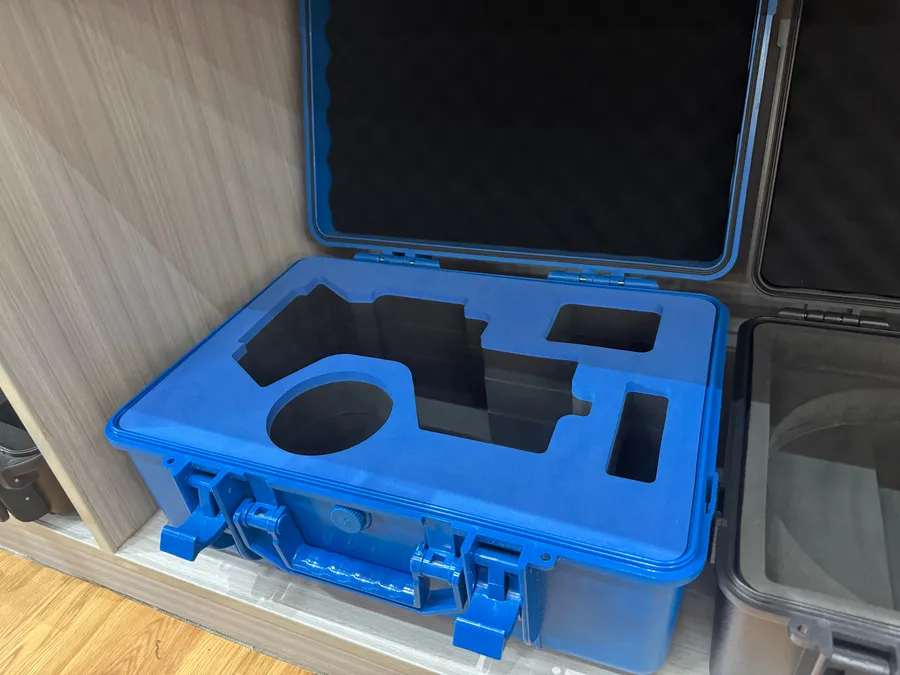
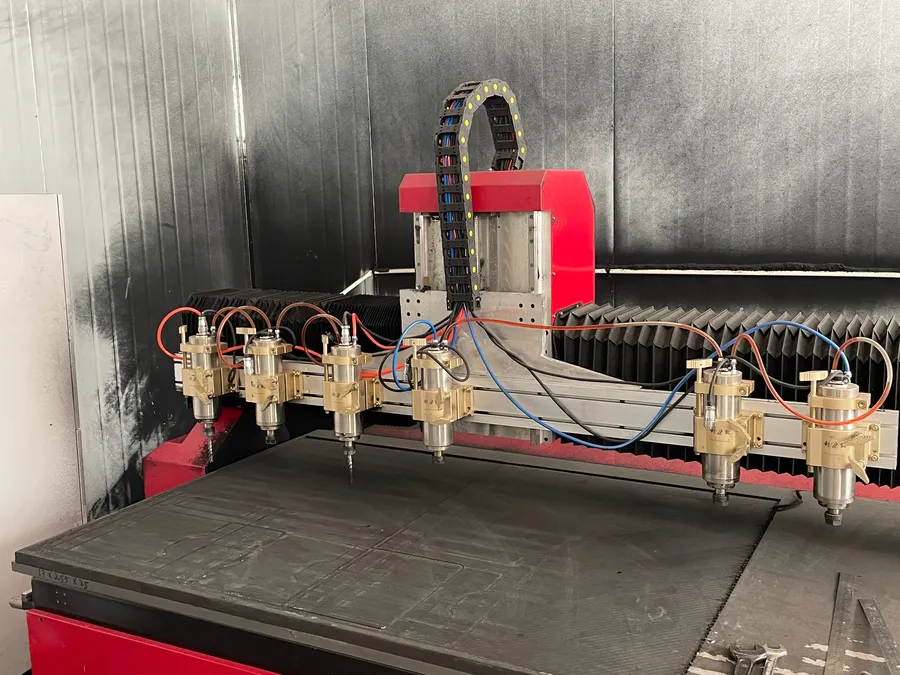
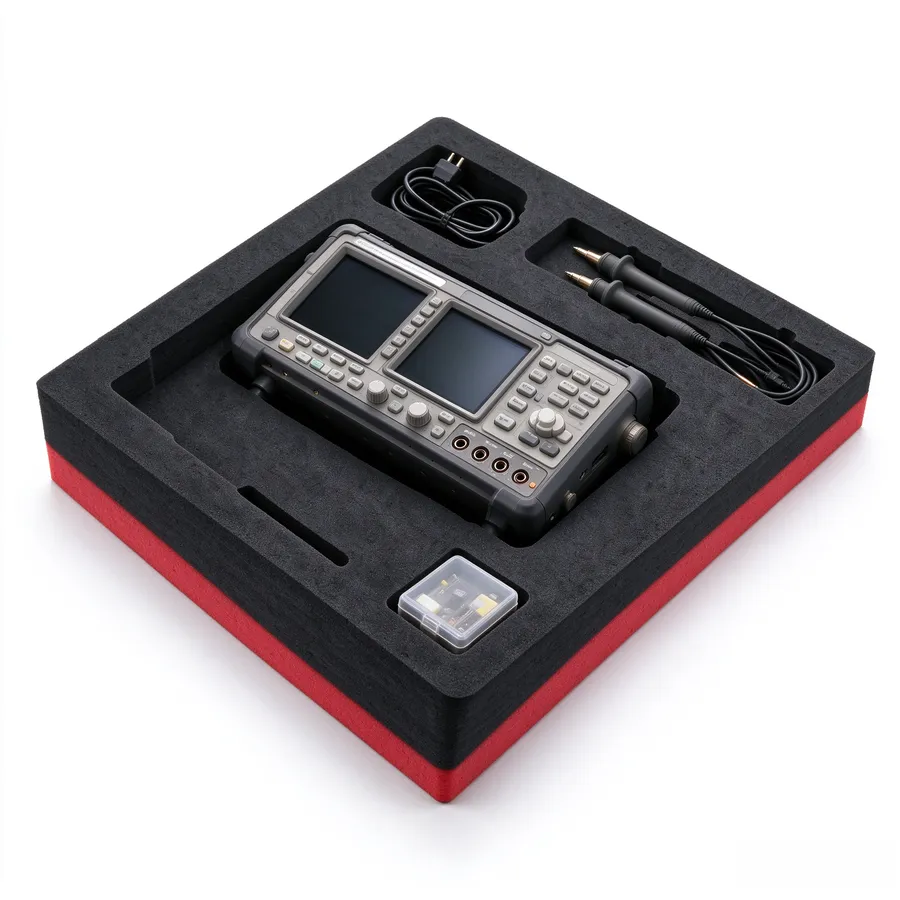
Once the shell is chosen, everything inside it is configuration on existing tooling. Interiors are built as pick-and-pluck, die-cut or CNC-cut foam, in layered or egg-crate structures, with PE, EPE and EVA families available, and custom foam work starts from a single unit once a drawing, a photograph of the packed kit or a physical sample is supplied. Colour, printed or riveted identification, latch and lock points and compartment layouts are quoted from 300 units. A first sample on an existing mould is scheduled at 45 days.
A new shell geometry is a different decision: about 125 days and an MOQ starting at 3,000 per component. That is why we push buyers to exhaust the published size ladder first. For most equipment lists, the 155 models already contain a shell within one clearance step of the ideal, and the money that tooling would have cost buys the foam layout that actually protects the load.
What the RFQ should pin down when the load is known
Send the load, not just the volume: the equipment envelope and mass per set, who carries what and how far, the stacking plan in the vehicle or container, and the environment the closure will see. Then ask the supplier to answer in the same currency: published internal and external dimensions, wall thickness, net weight, packing data, and a clear column showing what is measured, what is a configuration option and what is not claimed. On ingress protection we publish seal availability per model and list untested configurations as not measured rather than inheriting a rating from a neighbouring size.
Commercial terms belong in the same document because they shape the load plan. KeXin sells wholesale and OEM only, quoted EXW or FOB, with a 30 percent deposit to start production; we do not sell retail, do not quote DDP and operate no overseas warehouse, so the freight leg from the port of loading belongs to the buyer's own logistics. Standard stock models ship from one unit, which means a transport trial can start with two cases and one honest route instead of a container and a hope.
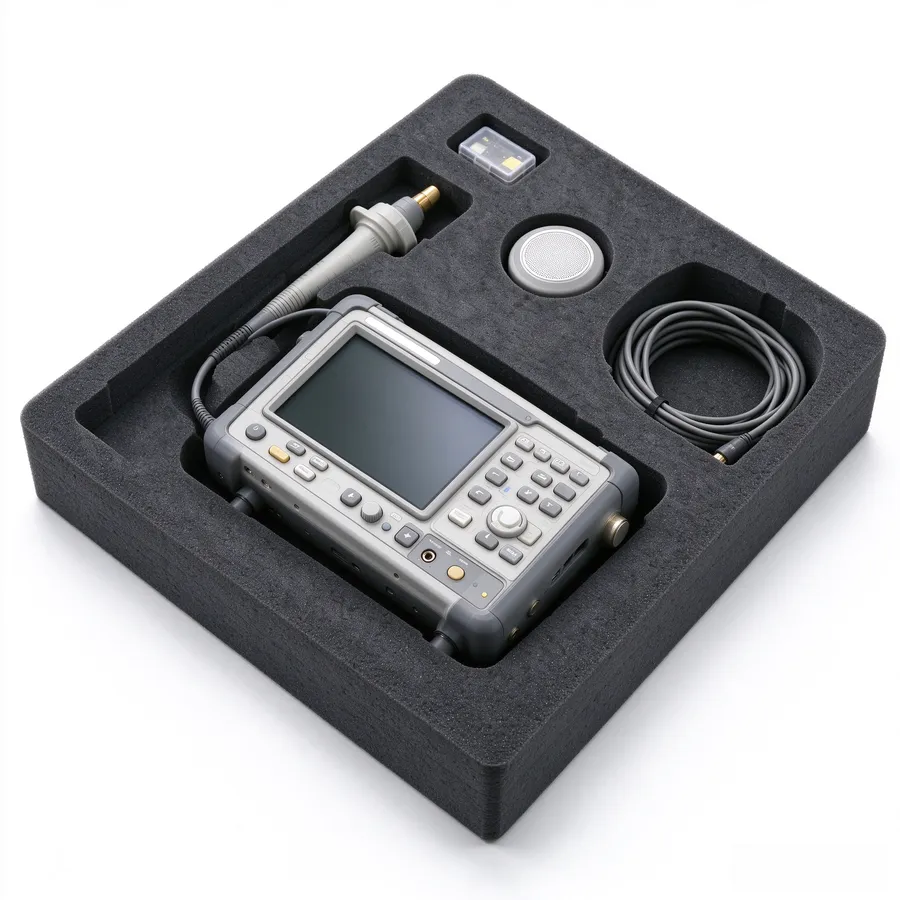
Customisation
Everything described above is configurable on a standard shell: interior layout (pick-and-pluck, die-cut or CNC-cut), foam grade and thickness, colour, logo method, latch and lock count, pressure-equalisation valve, cable ports, document holder and identification plate. A bespoke exterior geometry requires a new mould — 125 days, from 3,000 units per moulded component.
Procurement considerations
| Question | What to send us |
|---|---|
| Which shell fits? | Equipment L × W × H as packed, plus required clearance per axis |
| What does it cost? | Order quantity and estimated annual quantity — the two drive different answers |
| Is tooling needed? | Whether an existing shell clears the envelope with usable foam depth |
| Lead time? | Your required delivery date, not just the order date |
| Certification? | The exact standard your tender names — we will say whether we can test to it |
| Freight? | Destination and preferred terms; carton and pallet data supplied with the quotation |
Comparison and selection guide
The tables on this page exist because a protective case is chosen by comparing three things: the envelope, the environment and the handling chain. Where no table applies, the rule below is.
| Situation | What To Do |
|---|---|
| Dust | Continuous rim plus enough latches to hold it closed over a temperature cycle. |
| Cold | PP shells retain toughness better than ABS at low temperature. |
| Service life | Ask for a spares kit of latches, hinges and gaskets with the first order. |
- Size on internal dimensions plus clearance, never on a product name.
- Choose the carrying method before the shell: it changes the series, not just the price.
- Specify the interior last, and decide up front whether the end user will reconfigure it.
What Equipment Is Commonly Transported In Field Cases? relates to Military Case Guide. Related families: Field Equipment Cases / Military Protective Cases / Communication Equipment Cases / Drone & UAV Cases / Medical Equipment Cases / Optical Equipment Cases / Long Equipment Cases / Ammunition Storage & Transport Boxes. Related sectors: field and industrial equipment. Continue in the Military Case Guide cluster.
This page is written from our own production data. If your requirement differs, send the dimensions and we will tell you which of the 155 models fits, or whether a custom route is needed.