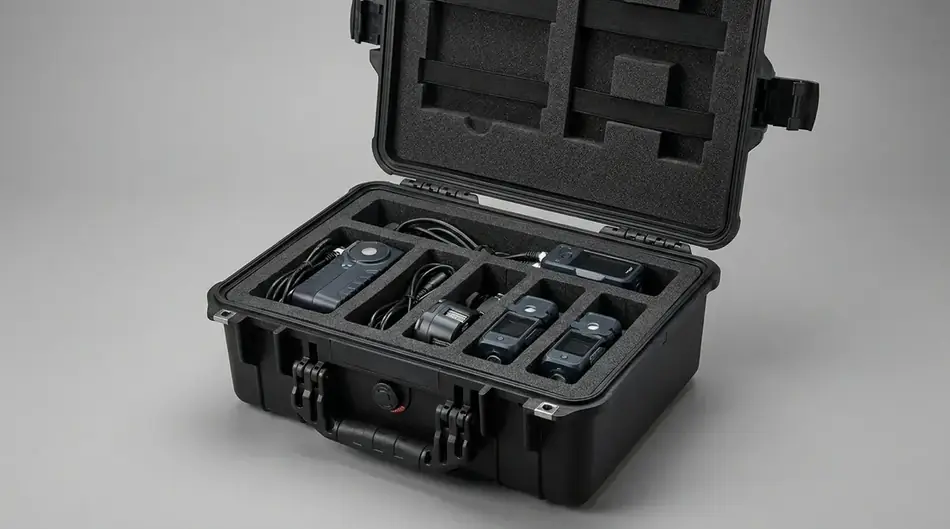
Why is foam important for electronic equipment cases?
Because a bare shell protects against crushing and weather but does almost nothing for the way electronics actually break. An electronic instrument rarely fails from the box being squeezed; it fails from short shocks and constant vibration travelling straight through a hard wall into circuit boards, solder joints, connectors, displays and battery contacts, and from loose items knocking against each other. Foam matters because it is the part that manages that energy. It lengthens the distance over which a shock is stopped, spreads a point load across an area instead of a single component, holds every item exactly where you put it, and keeps one device from striking another or the wall. A case without the right interior is a rigid box around fragile hardware; the foam is what turns it into protection.
Key points
- Foam matters for electronics because transit loads arrive as short shocks and steady vibration; a rigid shell alone passes them into boards, connectors and solder joints.
- A good insert does four jobs at once: absorb energy, spread load across a surface, hold each item still, and stop items touching one another or the wall.
- Stopping distance decides peak force, so a deeper interior with graded foam lowers what reaches a board more than a thicker rigid wall on its own.
- Fixed, separated pockets beat loose packing: die-cut or CNC foam stops boards knocking together, pick-and-pluck suits loads that change between jobs.
- Match the grade to the load: a firm carrier layer under a soft contact layer protects connectors and displays without the item sinking or tipping in transit.
- We publish internal dimensions per model and need a physical reference before cutting; static-dissipative performance is only specified where the foam grade is documented.
Why electronics fail in transit, not on the shelf
An instrument sitting on a bench is almost never the picture of stress. The damage happens on the move: a case dropped onto a tailgate, a trolley rolled over expansion joints, a boot full of boxes vibrating for hours, or a single hard knock that drives one device into another. Electronics are unusually sensitive to exactly these events because the failure points are tiny and brittle. A cracked solder joint, a lifted connector, a hairline in a display or a battery terminal that loses contact is enough to end a device, and none of it needs the shell to be dented. That is the starting point for understanding foam: the box may look untouched while the hardware inside has absorbed a shock it was never meant to take directly.
What the foam actually does: four jobs at once
A well-chosen insert performs four separate functions, and each one maps to a distinct way electronics break. First it absorbs energy, compressing to lengthen the time and distance over which a moving item is brought to rest, so the peak force delivered to a component is lower. Second it spreads load, turning a single hard point, a corner, a connector or a knob, into pressure shared over a wider area. Third it restrains, holding every item in its own pocket so nothing slides, tips or bounces. Fourth it separates, keeping devices, cables and accessories from striking each other or the inner wall. A rigid shell gives you crush strength and weather resistance; the foam is what actually protects against the shock, vibration and contact that damage electronics.
Shock and vibration: stopping distance and load spreading
The physics of a drop is a stopping-distance problem. The faster something has to be decelerated, the higher the force it feels; give the item a little more soft material to compress through and the same fall is spread over a longer deceleration, so the force reaching the circuit board is lower. That is why the usable interior depth matters as much as the foam itself: a shallow lid cannot hold enough compressible thickness to protect a heavy instrument. Vibration is the opposite problem, a steady, lower-amplitude load that works loose screws and fatigues joints over time, and it is best managed by snug restraint that stops a component ringing against its pocket rather than by thick soft foam alone. Good design pairs a firmer layer that arrests movement with a softer contact layer that cushions the blows.
Restraint and separation: the most underrated job
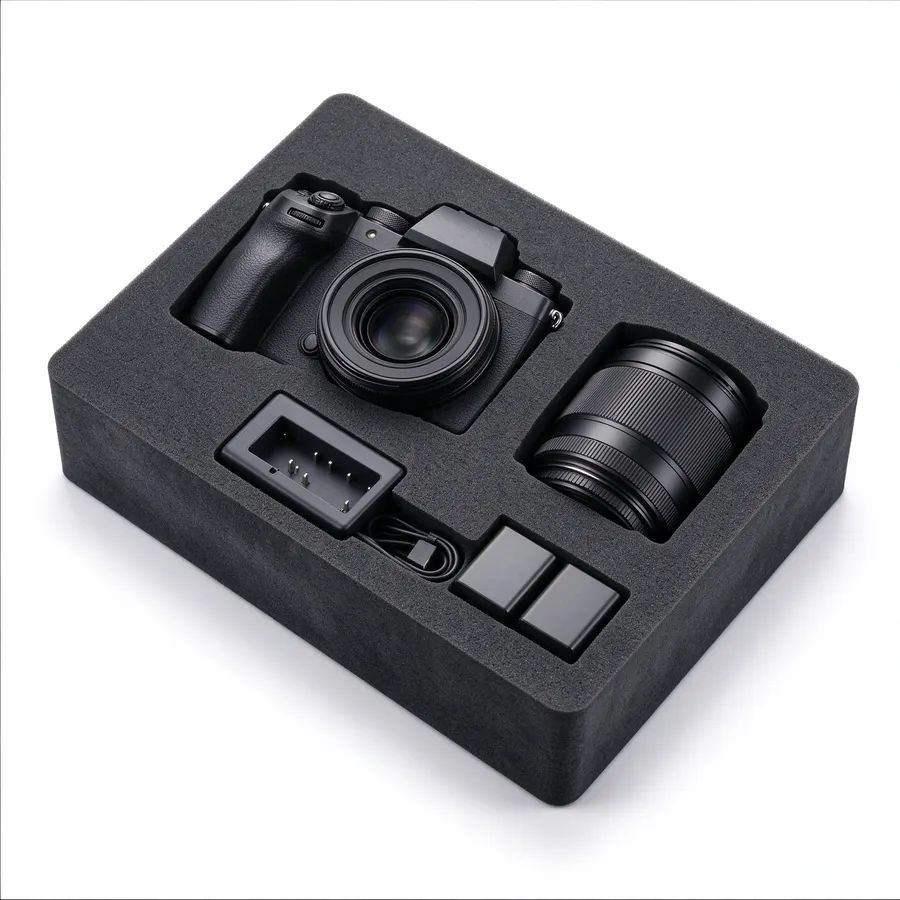
Buyers obsess about cushioning and under-rate restraint, yet for electronics the single most common cause of damage is two hard objects meeting inside a moving case. A loose radio hitting a charger, a probe striking a display, a cable set rubbing a connector, all do more harm over a journey than a well-cushioned direct impact would. Foam cut into fixed, separated pockets removes that contact: each item has its own shape to sit in, walls of foam between neighbours, and a lid layer that presses the load down so nothing climbs out. When the contents are stable and repeated, that restraint is worth more than extra thickness, which is why an accurately cut layout made from a real reference protects better than a thick but empty box of pick-and-pluck.
Foam types compared for electronics
| Foam Type | Best For | How It Holds | Watch Out |
|---|---|---|---|
| Pick & Pluck | Shared stock and field kits that change between jobs | Layered cubes pulled out to trace each item by hand | Coarser pockets; thin parts need a base and top layer |
| Die-cut | Repeated production layouts with fixed items | A tooled profile that locates every part precisely | Needs a stable layout; changes need a new die |
| CNC-cut | Irregular or high-value electronics in their own pockets | Machined from a digital outline, each item separated | Supply an accurate drawing, photo or sample first |
| EVA | Firm support under heavier instruments | Dense, holds shape and resists permanent set | Too firm alone for delicate contacts |
| Cross-linked PE | General cushioning and a soft contact face | Light, recovers after compression | Softer grades let heavy items sink |
| EPE | Cheap filler and wrap between firmer layers | Resilient bead structure, good for void fill | Low density; not a restraint layer on its own |
The interior depth you are really working with
Every figure in this table comes from a published datasheet: internal dimensions in millimetres, wall thickness, empty net weight and internal volume. Read them as the space your foam has to work in. A compact PP shell such as the KX-1905 gives a 180 x 160 x 40 mm interior with a 3.0 mm wall and a 250 g empty weight, enough room for a small device with thin base and top layers, while the deep KX-3218 offers 308 x 230 x 172 mm and the tall-lidded KX-93221 reaches 300 x 200 x 200 mm, which is where a heavy instrument can carry a real cushioning thickness. Choose the internal height to leave at least a compressible layer at the base, around the sides and under the lid, then let the cut follow.
| Model | Material | Internal Mm | Wall Mm | Net Weight | Internal Volume L |
|---|---|---|---|---|---|
| KX-1905 | PP | 180 x 160 x 40 | 3.0 | 250 g | 1.2 |
| KX-62109 | ABS | 195 x 128 x 81 | 3.0 | 470 g | 2.0 |
| KX-4010 | PP | 390 x 315 x 88 | 3.0 | 1015 g | 10.8 |
| KX-3218 | PP | 308 x 230 x 172 | 3.0 | 900 g | 12.2 |
| KX-64114 | ABS | 378 x 307 x 120 | 4.0 | 2100 g | 13.9 |
| KX-93221 | Engineering PP | 300 x 200 x 200 | 5.0 | 1230 g | 12.0 |
Choosing the right foam for an electronics case
Start from the item, not the material catalogue. Weigh it and note its fragile points, its connectors, its display and its centre of gravity, because those decide where cushioning and restraint go. If the layout is fixed and repeated, specify die-cut or CNC pockets so every device returns to the same place; if it changes between jobs, choose pick-and-pluck you can reconfigure by hand. Then build in layers: a firmer grade, such as EVA, as the carrier that holds the shape, and a softer cross-linked PE face where the component sits. Size the case so there is compressible thickness at the base, the sides and under the lid. The honest test is whether a loose hard object could reach another object or the wall during a normal journey; if it can, the layout is wrong however thick the foam is.
Where foam-loaded electronics cases are used
The same principle appears across every electronics-carrying trade. A test-and-measurement house puts instruments and probe sets in die-cut pockets so each part returns labelled. A telecoms integrator ships radios, patch units and power supplies in a case with a base and a top layer to stop connectors taking the load. A field service crew needs an interior that reconfigures between jobs, which favours pick-and-pluck. A survey or imaging team separates lenses, batteries and drives so nothing touches. In all of these the interior is the working part: the shell keeps weather and crushing out, and the foam decides whether the electronics still work when the lid is opened at the far end of the journey.
Customising the interior and what we do not claim
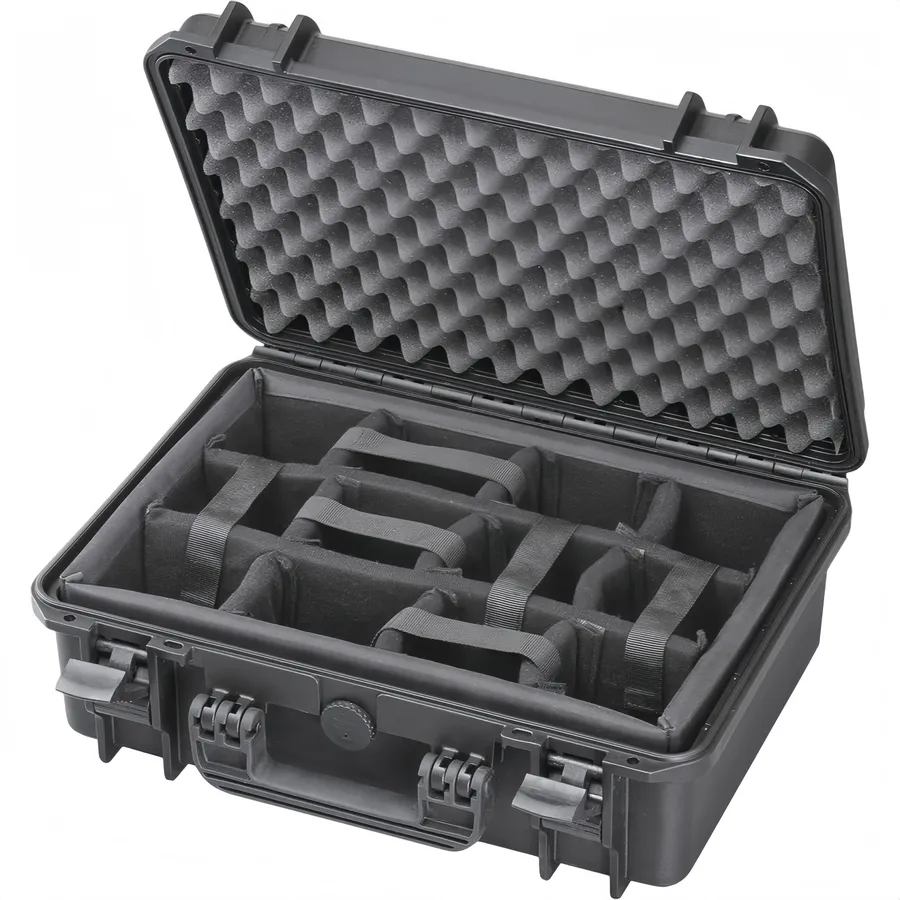
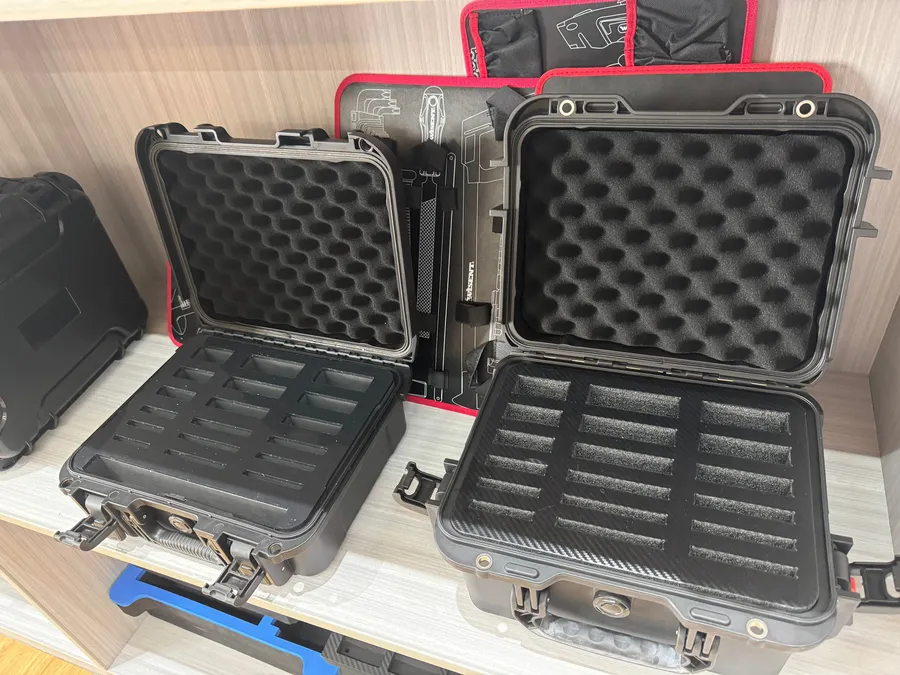
Interiors are supplied as pick-and-pluck, die-cut and CNC-cut profiles in cross-linked PE, EVA and EPE, layered as base, top and egg-crate arrangements, and custom foam carries the lowest order floor, starting from a single unit to build a layout. To cut accurately we need a reference: a drawing, a photograph of the packed kit or a physical sample, because a pocket is only as correct as the item it is traced from. On static sensitivity we are deliberate: a case can be specified with a static-dissipative or conductive foam grade where that grade is documented for the build, but we do not assert a static or ingress rating unless it has actually been measured on that configuration, and we leave untested fields blank rather than fill them with a claim.
Notes before you order
Confirm the internal depth of the model, because the cushioning you need has to fit inside the case you choose. Supply a real reference for the insert rather than a rough description, and approve a first-article sample with the actual equipment seated before the run. Read the commercial terms plainly: this is wholesale and OEM work only, quoted EXW or FOB with a 30% deposit taken up front, and we do not run retail, do not ship DDP and hold no overseas warehouse stock. Anything a listing cannot back with a published measurement should be requested as a documented test against the exact model and foam grade you order, not assumed from a name or a picture of a similar case.
Customisation
Everything described above is configurable on a standard shell: interior layout (pick-and-pluck, die-cut or CNC-cut), foam grade and thickness, colour, logo method, latch and lock count, pressure-equalisation valve, cable ports, document holder and identification plate. A bespoke exterior geometry requires a new mould — 125 days, from 3,000 units per moulded component.
Procurement considerations
| Question | What to send us |
|---|---|
| Which shell fits? | Equipment L × W × H as packed, plus required clearance per axis |
| What does it cost? | Order quantity and estimated annual quantity — the two drive different answers |
| Is tooling needed? | Whether an existing shell clears the envelope with usable foam depth |
| Lead time? | Your required delivery date, not just the order date |
| Certification? | The exact standard your tender names — we will say whether we can test to it |
| Freight? | Destination and preferred terms; carton and pallet data supplied with the quotation |
Comparison and selection guide
The tables on this page exist because a protective case is chosen by comparing three things: the envelope, the environment and the handling chain. Where no table applies, the rule below is.
| Situation | What To Do |
|---|---|
| Shock | Base layer thickness and grade sized to the packed mass. |
| ESD | Anti-static PE, specified by surface resistivity range. |
| Dust | Sealed configuration with a continuous rim. |
- Size on internal dimensions plus clearance, never on a product name.
- Choose the carrying method before the shell: it changes the series, not just the price.
- Specify the interior last, and decide up front whether the end user will reconfigure it.
Why is foam important for electronic equipment cases? relates to Military Case Guide. Related families: Electronics Cases / Military Protective Cases / Communication Equipment Cases / Instrument & Equipment Cases / Custom Protective Cases. Related sectors: field and industrial equipment. Continue in the Military Case Guide cluster.
This page is written from our own production data. If your requirement differs, send the dimensions and we will tell you which of the 155 models fits, or whether a custom route is needed.