Can communication equipment cases be OEM customized?
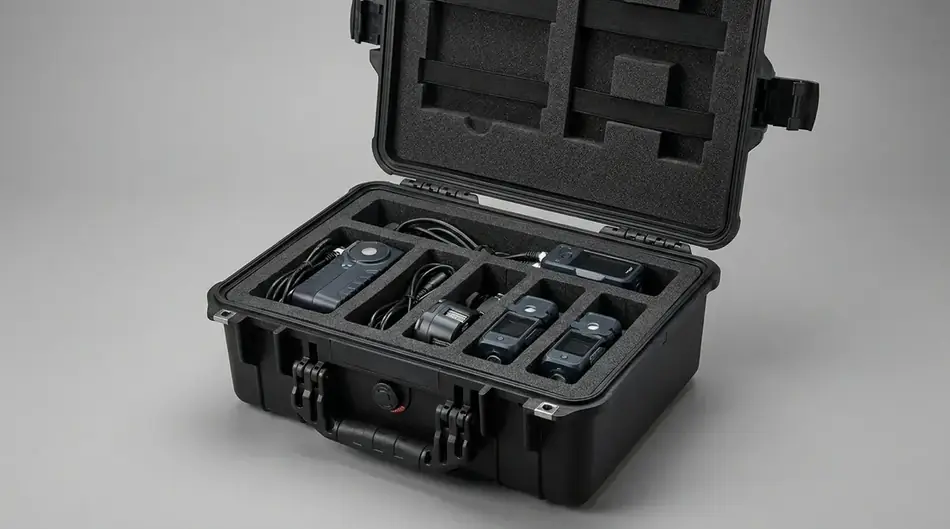
Yes. Communication equipment cases are made as OEM and ODM builds, and almost every layer can be customised: the shell can be taken from an existing body sized to the packed radio, or made on a new mould; the interior can be cut or die-cut around a transceiver, its batteries, handsets and coiled leads; and the hardware, colour, logo, labels and packaging can carry your identity. On an existing mould a first OEM sample runs about 45 days; a new mould about 125 days, in both cases with a 30 percent deposit. Custom foam can start from a single set, while logo, colour and OEM shell runs are quoted against their own minimums, and all supply is wholesale or OEM on EXW or FOB terms rather than retail.
Key points
- Specify an OEM comms case in layers: shell, interior, hardware and branding each have their own minimum and lead time.
- Start from a published body such as KX-4010 or KX-5321 and re-cut the interior before committing to a new mould.
- A new mould buys exact external dimensions but costs tooling time; about 125 days versus roughly 45 on an existing body.
- Branding, colour, labels and packaging are separate OEM options with their own minimums, not an all-or-nothing switch.
- Confirm the gasket and closure configuration on the OEM sample, because a rating depends on the exact build you order.
- Order a sample of the real configuration and fit it to your own kit; that settles most OEM disputes before volume.
What OEM changes on a communication case
OEM means the case is built to your equipment and your identity rather than to a fixed catalogue item. For a radio set the useful layers to change are the shell envelope, the interior layout, the carry and closure hardware, and the visible branding. Each layer is independent: you can keep an existing mould and only re-cut the foam, or you can specify a new shell and add your logo and packaging at the same time. Treating an OEM communication case as a stack of separable decisions, rather than a single yes or no, is what keeps cost and lead time under control and lets a first article be reviewed against the real packed kit.
The shell: adapt a body or open a new mould
The fastest route is to start from a published body and set it to the equipment. KX-4010 gives an internal 390 by 315 by 88 mm at a 3.0 mm wall for a handheld set with spares; KX-4312 offers 420 by 260 by 104 mm at a 3.5 mm wall for a control head or small terminal; KX-5321 reaches 481 by 373 by 192 mm at a 5.8 mm wall and about 4.8 kg for a manpack kit carried with batteries. When none of those envelopes matches the packed footprint, a new mould can be opened to your external and internal dimensions. That is the trade worth being honest about: an existing mould is quicker and cheaper, while a new mould is precise but adds tooling time and a higher component minimum.
The interior, foam and hardware
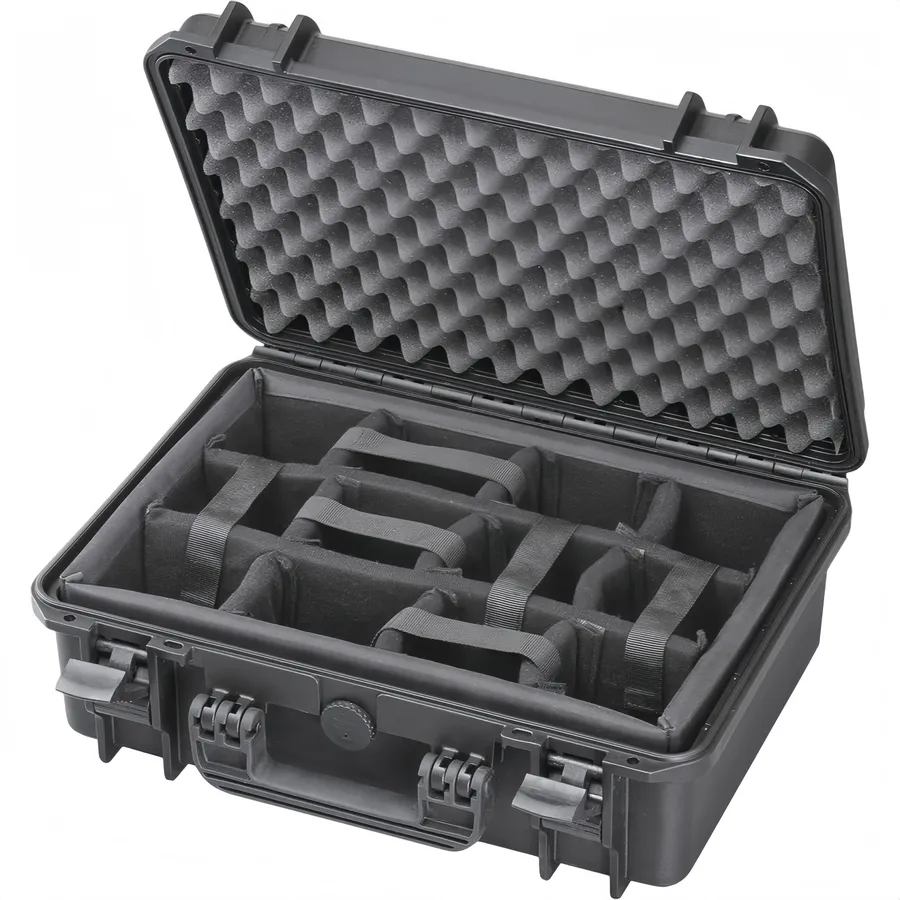
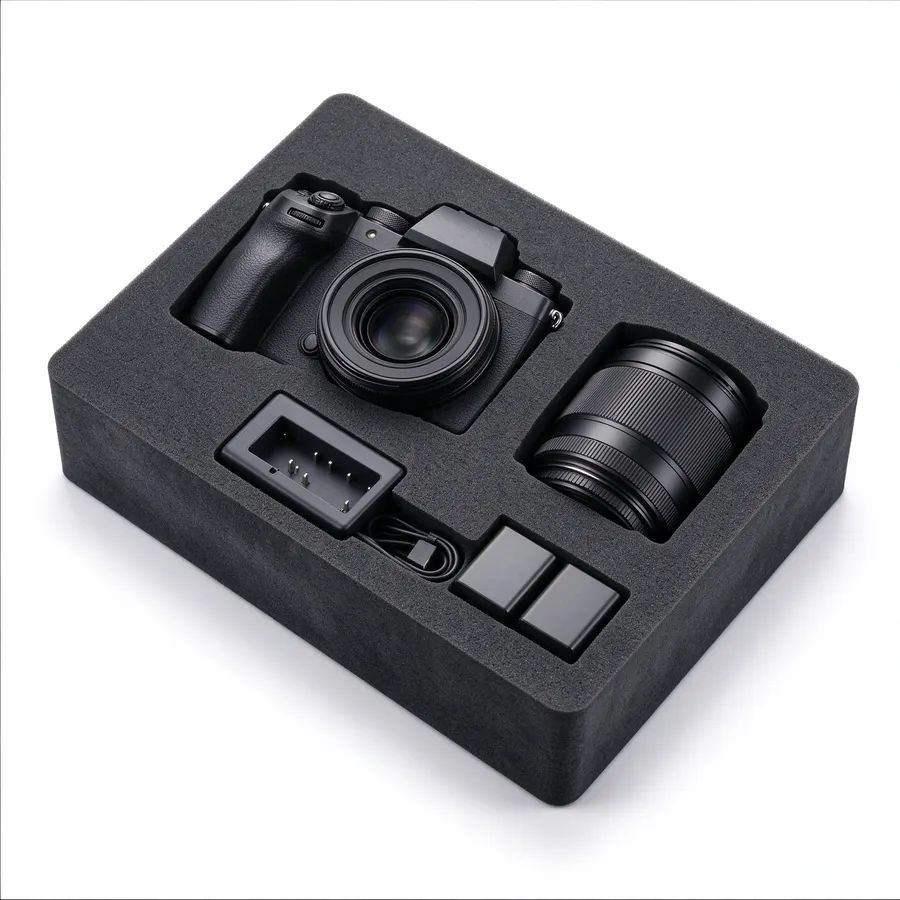
The interior is where an OEM build earns its keep. Cut, die-cut or pick-and-pluck foam is laid around your exact transceiver, battery row, handsets and coiled leads so nothing shifts and no connector face presses the wall, and this can start from a single set because it is tooling-light. Hardware follows: handles, latches, feet, a document holder, a shoulder strap or wheels and a telescopic pull are selected to the route and can be configured to your specification. Where moisture or blowing dust is expected, a compressible gasket and closure are offered as a build option and confirmed on the sample, since the protection depends on the exact configuration rather than a label carried across the whole range.
Branding, colour and private label
A communication case can carry your identity without a structural change. Shell colour, a moulded or printed logo, labels, and custom packaging are each available as OEM options, and a full private-label build is possible where you want the product sold under your own brand. These are separate line items with their own minimums: a logo or colour run is quoted against a different quantity than a new shell mould, so you can brand an existing body economically and reserve the tooling spend for the shell only when the envelope truly requires it.
OEM options, minimums and lead times
| Oem Layer | What Changes | Indicative Minimum | Lead Time |
|---|---|---|---|
| Shell on existing body | Interior re-cut, hardware and colour set to your kit | OEM run from 300 units; custom foam from 1 set | First sample about 45 days |
| New shell mould | Exact external and internal dimensions for the packed set | From 3,000 units per component | About 125 days |
| Logo and colour | Moulded or printed logo, shell colour, labels | From 300 units each | Runs with the shell build |
| Packaging and private label | Custom packaging or full private-label product | Quoted per packaging item | Agreed with the production window |
From enquiry to first article
The path is short and repeatable. Send the packed-state measurements of the radio and its accessories, the expected packed mass, the carry and stacking expectation and the ambient, together with the branding you want. KeXin returns a configuration and a quotation on wholesale and OEM terms with a 30 percent deposit; a first OEM sample is then built on an existing mould in about 45 days, or about 125 days when a new mould is opened. Fit that sample to your own equipment and close the feature questions on the real object before volume, which is far cheaper than resolving them from a specification table after production starts.
Where an OEM communication case is specified
Custom comms cases are usually specified where the equipment is fixed and the case must disappear into a system: a defence or public-safety radio family with a standard accessory kit, an integrator building a field terminal that ships to end customers under its own brand, or a service organisation that needs a repeatable interior so a short-content check works the same way every time. In each case the reason for OEM is the same one that makes an off-the-shelf box awkward: the packed kit has a shape, a mass and a handling cycle of its own, and a case built around those facts protects the set and reads as part of the product.
Procurement and commercial terms
Supply is wholesale and OEM on EXW or FOB terms. KeXin does not sell at retail, does not offer DDP, and holds no overseas warehouse stock, so quantities, tooling and lead times are agreed directly against the equipment specification and the destination, and the minimums shown for each OEM layer are indicative rather than universal. Because protection and fit depend on the exact build, order a sample of the configuration you intend to buy and check it against your own packed kit before committing. Model figures quoted here are published per model and should be confirmed against the specific item you are ordering, since dimensions, wall and mass vary across the range.
Buyer searches for communication cases, answered from published model records
Each phrase below is a search buyers actually run when they are specifying a case for radio kit, and each is answered from the product database instead of from marketing language. The communication group holds 99 of the 155 active models: internal volume runs from 10.1 L to 53.9 L with a median of 22.1 L, usable interior from 8.7 L to 43.3 L with a median of 18.2 L, wall thickness is published on 92 of the 99 from 2.1 mm to 6.0 mm, lid depth on 56 from 38 mm to 230 mm, and net mass on 47 from 830 g to 10000 g. Protection codes are not part of this: water ingress, dust ingress and the protection rating field are recorded as not measured on every model, so nothing below is presented as a rating.
| Search | What We Publish |
|---|---|
| outdoor communication equipment case | Every model in the communication group is double-listed: all 99 also carry the outdoor listing and all 99 carry the military listing, so an outdoor radio case is a configuration question rather than a separate product line. On the records themselves, 86 of the 99 publish a compressible gasket in a continuous moulded channel and 13 publish that no gasket is offered on that shell; a pressure-equalisation component appears as a manufacturer option with no published value, and 90 of the 99 publish as stackable. A representative field format is KX-97227, internal 590 x 435 x 210 mm at a 6.0 mm wall with a 42 mm lid over a 168 mm base and 10000 g. Rain, dust and temperature exposure on these bodies remain not measured, so the build is settled by gasket, rim and latch count and then proved on a sample of the exact configuration. |
| communication testing equipment case | Bench and verification kit usually lands in the smaller published envelopes: KX-4010 lists internal 390 x 315 x 88 mm (10.8 L internal, 9.3 L usable) at a 3.0 mm wall with 44 mm lid and 44 mm base depth at 1015 g, and KX-4312 lists internal 420 x 260 x 104 mm (11.4 L / 9.8 L usable) at a 3.5 mm wall with 52 mm lid and base at 1170 g; a second record on the same WL4010 body publishes 388 x 307 x 90 mm at a 3.4 mm wall, which is why orders are quoted against the SKU, not the mould name. Test sets travel with leads, probes and power supplies, so layered builds - base foam cut per body, egg-crate top foam over it - are recorded on all 155 models. One gap worth stating plainly: no surface-resistance or anti-static grade is published in the foam records, and the six published types (pick and pluck, die-cut, CNC-cut, EVA, PE, EPE) carry no measured electrical property, so ESD is a material specification agreed per order and verified by whichever test the buyer's procedure names. |
| wireless communication equipment case | Handsets, transceivers, battery rows and coiled leads are cut as separate pockets; the group is wide enough that 21 of the 99 communication models also carry the long-equipment listing, which is where masts, whip antennas and cable reels live. KX-86216 publishes internal 582 x 300 x 130 mm (22.7 L / 19.5 L usable) at a 3.3 mm wall with a 100 mm lid over a 30 mm base, and KX-84818 publishes internal 437 x 308 x 164 mm (22.1 L / 17.7 L usable) at a 4.5 mm wall with no published lid or base figure. What we do not publish is any radio-frequency behaviour: no attenuation, insertion loss or antenna-performance figure through a closed shell is measured in our records, and the latch on all 99 is documented only as a latch body that accepts a standard padlock. |
| custom liners for communication equipment cases | A liner is specified with the same three fields the shell carries. Custom foam, custom thickness and custom shape are published as available on all 155 models, six foam types and five structures (top foam, base foam, egg-crate or convoluted, custom cut, layered) are recorded on all 155, and the custom foam minimum order is published at 1 unit, so a liner can be re-cut without opening a mould. The liner lives in the gap between the two published volumes - KX-84818 shows it as 22.1 L internal against 17.7 L usable, and the communication median is 22.1 L against 18.2 L - which is why a bed is designed against the usable figure and then proved on a physical sample. The accepted input published on every record is a drawing, a photograph of the packed kit, or the sample itself; first samples on an existing mould are planned at 45 days. |
| custom communication case factory | KeXin New Materials (Guangdong) Co., Ltd. runs this catalogue as a wholesale and OEM factory, quoting EXW or FOB, with no retail channel, no DDP and no overseas warehouse stock. The published OEM fields are true on all 155 models: OEM and ODM available, custom logo, custom colour, custom hardware, custom packaging, custom foam, private label, and a custom mould recorded at 125 days with a minimum of 3000 units per component. The quantity tiers printed on the records are custom foam from 1 unit and logo, colour and OEM runs from 300 units, with a 30 percent deposit and the balance after inspection, and a first sample on an existing mould planned at 45 days. |
The published envelopes the communication group is built from
These five records cover most of the enquiry pattern in this group - handheld set with spares, control head, compact field terminal, manpack, and trolley-borne system - and they are quoted exactly as the database publishes them.
| Case Record | Published Envelope |
|---|---|
| KX-4010 (WL4010) | Internal 390 x 315 x 88 mm, 10.8 L internal and 9.3 L usable, 3.0 mm wall, 44 mm lid depth over a 44 mm base, 1015 g net, gasket published as a compressible seal in a continuous moulded channel. |
| KX-4312 (WL4312) | Internal 420 x 260 x 104 mm, 11.4 L internal and 9.8 L usable, 3.5 mm wall, 52 mm lid over a 52 mm base, 1170 g net - the usual control-head or small-terminal layout. |
| KX-83715 (WL8-3715) | Internal 340 x 220 x 135 mm, 10.1 L internal and 8.7 L usable, 3.3 mm wall, 100 mm lid over a 35 mm base; net mass is not published on this record, so packing and freight are quoted from the pack data. |
| KX-84818 (WL8-4818) | Internal 437 x 308 x 164 mm, 22.1 L internal and 17.7 L usable, 4.5 mm wall, with lid and base depth unpublished on this record, so a liner is cut against the usable volume and confirmed on a sample. |
| KX-97227 (WL9-7227, trolley) | Internal 590 x 435 x 210 mm, 53.9 L internal and 43.1 L usable, 6.0 mm wall, 42 mm lid over a 168 mm base, 10000 g net, wheels and a telescopic pull; 19 of the 155 models publish wheels, and this one publishes as not stackable. |
What we do not claim on this page
No ingress, temperature, ultraviolet, corrosion-rating or load figure is published for these communication models as a rating: the protection_rating field is recorded as not measured on every model, and waterproof, dust resistant, ultraviolet and temperature range carry the same not measured status, while shock protection and impact resistance are recorded as manufacturer construction options that require a specified foam layout because the shell alone is not a shock rating. Where a tender names a standard, accredited third-party testing is quoted as a separate work package against the exact model, closure state, liner layout and marking being ordered, and the report is issued to the buyer rather than reused from another configuration.
Customisation
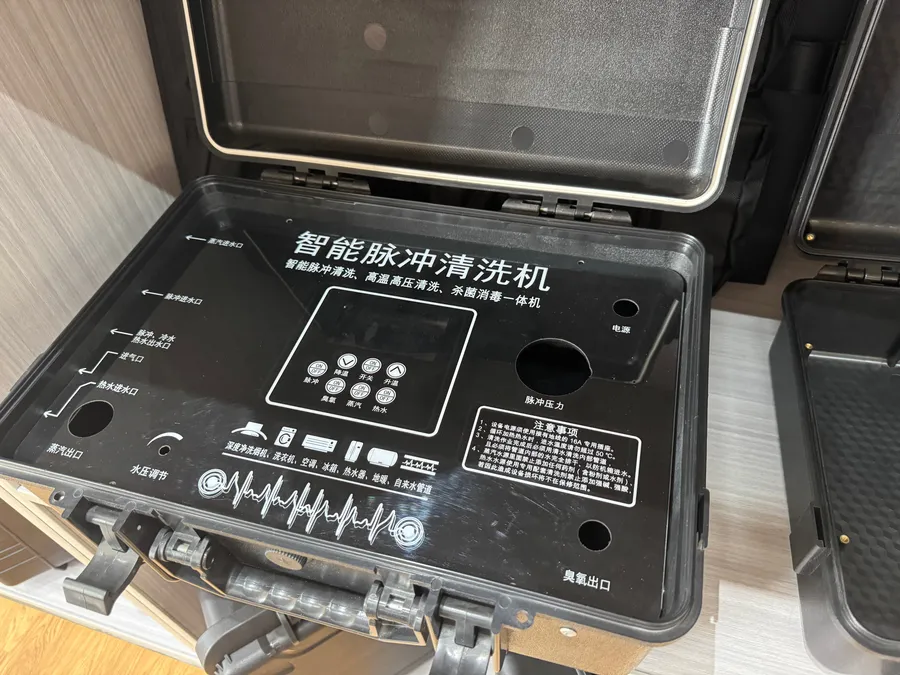
Everything described above is configurable on a standard shell: interior layout (pick-and-pluck, die-cut or CNC-cut), foam grade and thickness, colour, logo method, latch and lock count, pressure-equalisation valve, cable ports, document holder and identification plate. A bespoke exterior geometry requires a new mould — 125 days, from 3,000 units per moulded component.
Procurement considerations
| Question | What to send us |
|---|---|
| Which shell fits? | Equipment L × W × H as packed, plus required clearance per axis |
| What does it cost? | Order quantity and estimated annual quantity — the two drive different answers |
| Is tooling needed? | Whether an existing shell clears the envelope with usable foam depth |
| Lead time? | Your required delivery date, not just the order date |
| Certification? | The exact standard your tender names — we will say whether we can test to it |
| Freight? | Destination and preferred terms; carton and pallet data supplied with the quotation |
Comparison and selection guide
The tables on this page exist because a protective case is chosen by comparing three things: the envelope, the environment and the handling chain. Where no table applies, the rule below is.
| Situation | What To Do |
|---|---|
| Battery isolation | Separate pockets, terminals up, with a physical barrier between cells and connectors. |
| Cable management | Dedicated coiled-cable channels rather than a shared compartment. |
| Field repair | Reserve a small loose compartment for spare fuses, connectors and seals. |
- Size on internal dimensions plus clearance, never on a product name.
- Choose the carrying method before the shell: it changes the series, not just the price.
- Specify the interior last, and decide up front whether the end user will reconfigure it.
Can communication equipment cases be OEM customized? relates to Military Case Guide. Related families: Communication Equipment Cases / Custom Protective Cases / Defense Equipment Cases / Military Protective Cases. Related sectors: field and industrial equipment. Continue in the Military Case Guide cluster.
This page is written from our own production data. If your requirement differs, send the dimensions and we will tell you which of the 155 models fits, or whether a custom route is needed.