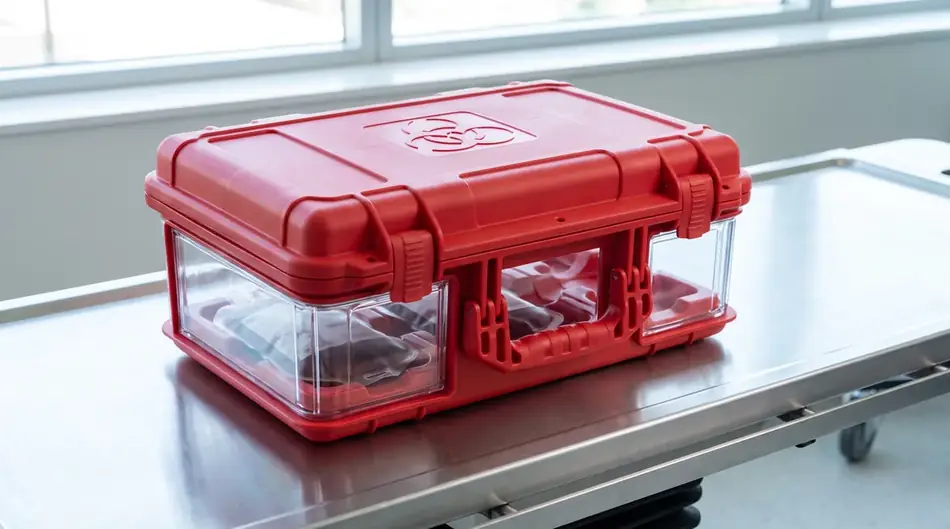
How do medical equipment cases support field logistics?
They turn medical kit into a repeatable unit load. A medical equipment case supports field logistics in four concrete ways: it fixes a repeatable external footprint so the same shell slots into the same vehicle bay, shelf module and pallet tier; it makes the contents verifiable at a glance, so a handover is a look rather than a re-inventory; it absorbs the handling that happens between the two ends of the chain, where most damage actually occurs; and it keeps the resupply cycle short, because a case that can be counted closed is issued, returned and restocked without being emptied. KeXin supplies these shells on a wholesale and OEM basis, EXW or FOB, and publishes measured figures per model instead of series-wide claims.
Key points
- Specify on the internal envelope plus clearance, then check the external size against the rack or vehicle bay.
- A closed-case content check is the difference between a two-minute handover and a full re-inventory.
- Foam consumes volume: a 34.4 litre body lists 27.5 litres usable, so size the interior before the shell.
- Wall thickness is published per model and runs from about 2.0 mm on compact shells to 5.8 mm on the KX-5321.
- Mass decides the carry leg: a 1.395 kg instrument shell and a 15.32 kg wheeled box are different logistics roles.
- Measured values are published per model; unmeasured items are left unlisted rather than described by a standard name.
Why medical kit is a harder logistics problem than most cargo
Medical consignments are small, high-value, multi-owner and time-critical, which is close to the opposite of the pallet-quantity profile that most transport planning assumes. A single case may hold one instrument plus four consumable families that are drawn down at different rates, so the interior is reconfigured far more often than the shell is replaced. The contents also move at irregular hours, which means every handling step should be possible without laying the kit out on a table.
Add the second constraint: several parties touch the same box between the supply line and the point of use. The case then has two designed functions rather than one inherited property. It must survive being issued, returned, restocked and issued again, and it must show a shortfall without being emptied. Both are layout and hardware decisions made before order, not discoveries made in service.
Unit loads: what the case actually standardises
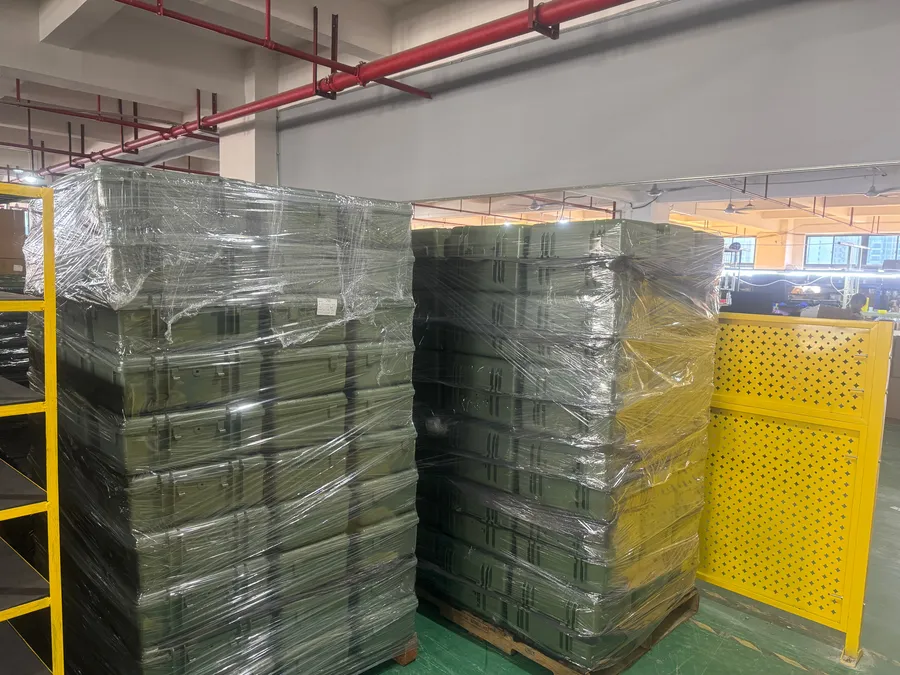
Logistics runs on repeatable shapes. When the shell footprint, the stacked height and the closure position are constant across a fleet, the same box fits the same vehicle bay, the same shelf and the same pallet tier, and the transport plan stops being a list of exceptions. Internal and external dimensions are both published per model, and the difference between them is not a rounding error: the KX-65522 measures 507 by 385 by 190 mm inside and 545 by 440 by 215 mm outside, so a rack sized from a catalogue name alone loses the wall, the latch and the hinge. Where a fleet ships in volume, carton data is what feeds the pallet and container plan. The same KX-65522 packs three units into a 565 by 450 by 665 mm carton, and the ABS KX-64120 packs six into 750 by 425 by 640 mm.
Verification without opening: the short-content check
Every minute saved at handover is recovered later as availability. A die-cut or CNC-cut interior turns a count into a glance, because each pocket has a defined shape, an empty pocket is obvious, and a labelled cut tells the person closing the lid whether the kit is complete. Pick-and-pluck foam is the opposite trade-off: it reconfigures easily as consumables change, but it cannot show a shortfall, so it suits cases that are going to be re-checked anyway. KeXin publishes both structures per model, covering top foam, base foam, convoluted, layered and custom cut in PE, EVA or EPE by zone. For medical kit the practical rule is a fixed carrier for the instrument and a cut layer for everything that gets consumed.
The handling legs between the two ends of the chain
Damage concentrates in the last fifty metres, the transfer from vehicle to shelf, the corridor and the tailgate, rather than in the long haul where the load is restrained. The case is therefore chosen by how it is carried at the point of use. Under a few kilograms a fixed folding handle is lighter and cheaper than a wheel set. At the far end, a crew-served box such as the KX-88442 lists 740 by 518 by 364 mm internal, a 5.0 mm wall, a net mass of about 15.32 kg, two wheels with a telescopic pull, and a 320 mm lid over a 44 mm base so tall items sit in the base instead of bridging the halves. In between, the 1.395 kg PP KX-4616 with a 3.0 mm wall and a 455 by 338 by 148 mm envelope is a hand-carried instrument role, and the 250 g KX-1905 is a consumables shell.
Case roles compared on published figures
| Role | Example | Published Figures | Logistics Effect |
|---|---|---|---|
| Consumables and small sets | KX-1905 | Internal 180 x 160 x 40 mm, 3.0 mm wall, 250 g, gasket offered | One shelf module, counted at a glance |
| Hand-carried instrument | KX-4616 | Internal 455 x 338 x 148 mm, 3.0 mm wall, 1.395 kg, gasket offered | Direct issue to the point of use, carried by one person |
| Bench or diagnostic set | KX-65522 | Internal 507 x 385 x 190 mm, 5.3 mm wall, 4.86 kg, ABS, 3 per carton | Stacks in the store and ships in a known carton count |
| Crew-served resupply | KX-88442 | Internal 740 x 518 x 364 mm, 5.0 mm wall, 15.32 kg, wheels and telescopic handle | Rolled rather than carried across the last leg |
Choosing the pattern for each link in the chain
Match the shell to the decision the case has to support. At the supply end the question is throughput, so stackable bodies with published external sizes and carton counts win, and a thicker wall earns its mass because the fleet is stacked and re-handled; the 5.8 mm KX-5321 and the 5.3 mm KX-65522 sit at that end of the range. At the user end the question is time to first item, so a shallow body with a labelled cut and a strap retainer beats a deep box that has to be emptied on the floor. Resist buying one shape for both: a fleet of a single large shell guarantees that someone hauls 15 kg across a yard to fetch a dressing. Plan three sizes with a defined role each and let the interior absorb the variation between kits.
Where these cases are applied
Typical users are mobile and field medical posts, rescue and veterinary units, clinic-to-clinic equipment transfer, calibration and test sets that travel to the instrument rather than the other way round, and device makers who ship a unit and its accessories as one issue-able package. What these have in common is the logistics requirement, not the clinical one. The case is packaging for the equipment, and no clinical, sterilisation or device-performance claim is made for it. Environmental and shock behaviour is stated per model where it has been measured; where it has not been measured we say so, and the item stays unlisted instead of borrowing a standard name.
Customising a case for a medical kit
Interior work is the fast and inexpensive path, and it is where medical kits differ most between operators: cut layout, pocket depth, labelling, retainers and a dedicated carrier for the primary instrument, all produced on an existing shell with no new tooling. Custom foam starts at one unit, so a layout can be proven on a sample before a fleet is committed. Colour, printed logo and marking are also tooling-free and start at 300 units, which is what makes a per-facility or per-unit identification scheme affordable. Only when no published shell reaches the required footprint does a bespoke mould enter the plan, and that is quoted separately: about 125 days for a new mould against about 45 days for an OEM first sample on an existing mould, with a 30 percent deposit.
Procurement notes before you order
Buy against a specification, not a catalogue photograph. Send the packed-state dimensions of the instrument and of each accessory, the number of cases, the rack or vehicle envelope the shell must fit, the carry distance at the point of use, and which checks must stay possible with the lid closed. Confirm the figures you intend to hold the supplier to: internal and external dimensions, wall thickness, net mass, lid-to-base split and carton packing are published per model, while pallet and container figures are calculated from the carton footprint against your pallet size and supplied with the quotation. KeXin New Materials (Guangdong) Co., Ltd. works on a wholesale and OEM basis, EXW or FOB, with no retail sale, no DDP and no overseas warehouse stock.
Two buyer searches, answered row by row from the published data
These two searches reach this page from different directions, so each one gets its own row instead of a shared paragraph. Every figure below is either a value published for the named model in our specification table, a count taken from that same table across a named group of models, or an explicit statement that the property was never measured. Nothing here generalises one model to a range, and nothing here is a laboratory or regulatory statement.
| Search | What We Publish |
|---|---|
| field medical equipment case | In our catalogue this is a shell listed in both the medical-equipment-cases and the field-equipment-cases categories, and 26 models are published that way. Across those 26 the internal volume runs 20.2 to 28.9 litres with 16.5 to 24.8 litres usable; wall thickness is published for 25 of them, from 2.5 mm to 4.7 mm; empty mass is published for 12, from 1,360 g to 5,012 g. Twenty-four are marked stackable, and the two models published on wheels - KX-85021 and KX-85022 - are the two marked non-stackable. A compressible gasket in a continuous moulded channel is recorded for 23 of the 26; for KX-4716, KX-707 and KX-84823 the table records none offered on that shell. Three publish a narrow internal width - 290 mm on KX-707, 302 mm on KX-4616 and 308 mm on KX-4716 - which is the figure a moulded tray or a reagent insert has to clear at its tightest point. Two worked examples on that ladder: KX-4616 publishes 455 x 338 x 148 mm internal in a 460 x 367 x 155 mm shell, a 3.0 mm wall on a polypropylene body, 1,395 g empty, 22.8 litres internal against 19.6 litres usable, a 74 mm lid over a 74 mm base, and a 755 x 470 x 635 mm export carton. KX-5021 publishes 465 x 315 x 196 mm internal, 495 x 374 x 206 mm external, a 3.7 mm ABS wall, 3,430 g empty, 28.7 litres internal and 24.7 litres usable, with the depth split published as a 134 mm lid over a 62 mm base - the split is what lets a taller instrument be planned into one half instead of bridging both. Interiors are cut to the kit from a drawing, a photograph of the packed case or the unit itself, in Pick and Pluck, die-cut or CNC-cut foam (EVA, PE or EPE), and custom foam starts at 1 piece. |
| aviation ground support equipment case | We do not publish an aviation-specific line, so an aviation ground support equipment case is configured from the general catalogue: 148 of the 155 models list aerospace among their published application contexts, and the shell is chosen against the envelope of the tool rather than against an industry label. What that 148-model group publishes: internal volume from 0.3 to 139.5 litres, wall thickness for 141 models from 2.0 mm to 6.0 mm, empty mass for 87 models from 100 g to 15,320 g, a gasket recorded as offered on 120 and as not offered on the remaining 28, carton data on 59, 129 bodies marked stackable and the 19 wheeled bodies marked non-stackable, with a telescopic pull height published for 11 models at 240, 295, 310, 385 and 485 mm. For long apron items only two shells in that group exceed 800 mm of internal length: KX-814641 at 1,280 x 350 x 140 mm internal, 5.0 mm wall, 62.7 litres internal and 50.2 litres usable, marked stackable, and KX-89616 at 880 x 350 x 140 mm internal, 5.0 mm wall, 43.1 litres internal and 34.5 litres usable, lid published as 100 mm over a 40 mm base; neither of those two publishes an empty mass in the table, so we do not quote one. For wheeled ground tooling, KX-97227 publishes 590 x 435 x 210 mm internal in a 720 x 500 x 270 mm shell, a 6.0 mm engineering-polypropylene wall, 10,000 g empty, 53.9 litres internal and 43.1 litres usable, two wheels and a 485 mm telescopic pull, one unit to a 715 x 515 x 280 mm carton; KX-85835 publishes 500 x 400 x 305 mm internal, a 5.0 mm wall, 8,520 g empty, 61.0 litres internal and 48.8 litres usable with a 295 mm pull. On hardware, the latch body accepting a standard padlock is recorded as measured, latch count is specified per configuration, and a pressure-equalisation valve is listed as an option with no published measured value. No airworthiness, apron-qualification or regulatory statement is made for any of these shells: they are transport packaging for the tool, and the tool keeps its own approval. |
Why the two rows are built from different kinds of data
The medical row is a category question. Those 26 models are already listed against both categories, so a buyer compares published shells with published shells. Eight of the 26 publish an export carton size - KX-4616, KX-4821, KX-5021, KX-64120, KX-64619, KX-64621, KX-707 and KX-85022 - and seven of those also publish a pieces-per-carton figure, which is what a mixed clinic shipment is planned from: KX-707 packs 8 into 735 x 480 x 595 mm, KX-64619 packs 6 into 740 x 485 x 615 mm, KX-64621 packs 6 into 740 x 485 x 685 mm, and KX-85022 ships one unit in 495 x 375 x 245 mm. The shell split inside the group is 10 polypropylene, 10 engineering polypropylene and 6 ABS, and the ABS members publish walls from 3.5 mm to 4.7 mm (KX-64819 at 3.5 mm, KX-64120 at 4.0 mm, KX-64618, KX-64619 and KX-64621 at 4.7 mm).
The ground-support row is an application question, not a category question. An apron kit - torque items, cable sets, test sets, pitot covers, chocks, trolley-mounted tools - differs by shape rather than by industry label, so it is matched to internal length, internal height and the lid-to-base split. Where a published shell is 15 mm too shallow we say so and price the foam instead of the mould. Where no published envelope works, a new mould is quoted at about 125 days with a minimum from 3,000 pieces per component, against about 45 days for a first OEM sample on a mould already in service; custom colour and a printed logo start at 300 units, and a custom foam layout starts at 1 piece.
Carry pattern compared on published figures
| Carry Role | Published Shell | Published Figures | What It Decides |
|---|---|---|---|
| Single-person issue to a medical post | KX-707 | 465 x 310 x 140 mm internal, 470 x 360 x 148 mm external, 2.5 mm wall, 1,360 g empty, 20.2 L internal and 17.4 L usable, 290 mm narrow internal width, no gasket offered, 8 per 735 x 480 x 595 mm carton | The lowest published empty mass in the 26-model field-medical group, and the widest carton count, so it is the restock shell rather than the instrument shell |
| Hand-carried diagnostic or bench set | KX-4616 | 455 x 338 x 148 mm internal, 3.0 mm wall, 1,395 g empty, 22.8 L internal and 19.6 L usable, 302 mm narrow width, gasket recorded, 74 mm lid over 74 mm base | Deep enough for a device lying flat with accessories under the lid, and the narrow width is what a moulded tray is drawn against |
| Deep single-item set | KX-5021 | 465 x 315 x 196 mm internal, 3.7 mm ABS wall, 3,430 g empty, 28.7 L internal and 24.7 L usable, 134 mm lid over 62 mm base, 6 per 765 x 485 x 650 mm carton | The largest published internal height in the field-medical group at under 5 kg empty, so tall kits sit in one half instead of both |
| Wheeled medical resupply | KX-85022 | 437 x 308 x 180 mm internal, 4.5 mm engineering PP wall, 5,012 g empty, 24.2 L internal and 19.4 L usable, two wheels with a telescopic pull whose height is not published, marked non-stackable | Rolls across a yard instead of being carried, and it cannot be stacked, so a fleet of these is planned on floor area |
| Long apron tool | KX-89616 | 880 x 350 x 140 mm internal, 5.0 mm wall, 43.1 L internal and 34.5 L usable, 100 mm lid over 40 mm base, marked stackable, empty mass not published | Carries bars and cable runs in a single plane; the empty mass has to be confirmed on the quotation for this model |
| Heavy trolley-served kit | KX-97227 | 590 x 435 x 210 mm internal, 720 x 500 x 270 mm external, 6.0 mm wall, 10,000 g empty, 53.9 L internal and 43.1 L usable, two wheels, 485 mm telescopic pull, 1 per 715 x 515 x 280 mm carton | It carries the tallest published pull height in the catalogue, 485 mm, against the shortest published 240 mm on KX-87336 and KX-88337, so carry height is a choice between models rather than a fixed property of a wheeled shell |
What neither row above states
The specification table records waterproof, dust resistance, UV resistance, temperature range, stack load, load capacity and protection rating as not measured for all 155 models, so neither search row carries an ingress code, a temperature limit, a stacking figure or a drop height. Impact is described only as the wall thickness published for the named model - 2.5 mm on KX-707, 3.0 mm on KX-4616, 4.7 mm on KX-64621, 5.0 mm on KX-89616, 6.0 mm on KX-97227 - and shock behaviour is a property of the specified foam layout rather than of the shell. Seal type is recorded as measured on 124 models and left unrecorded on 31, which is why the gasket counts above are given per group. Pallet and container figures are calculated from the carton footprint against your pallet size and supplied with the quotation, not published as tested values. For medical kit we state nothing about biological safety, cleanroom suitability, sterilisation compatibility or device registration: the case is packaging, and the device stays its registrant's responsibility. For ground support we state nothing about airworthiness, apron approval or any operator's internal standard. Where a programme specification needs a measured statement, accredited third-party testing against the exact model and configuration can be commissioned as a separate work package; we do not claim a result we have not measured.
Commercial terms are identical for both searches: wholesale and OEM only, EXW or FOB from Guangdong, China, with a 30 per cent deposit and the balance after inspection. There is no retail channel, no DDP quotation and no overseas warehouse. Third-party inspection of finished goods and an audit of the factory are welcome, and KeXin New Materials (Guangdong) Co., Ltd. quotes both rows above against your packed-state dimensions rather than against a catalogue photograph.
Customisation
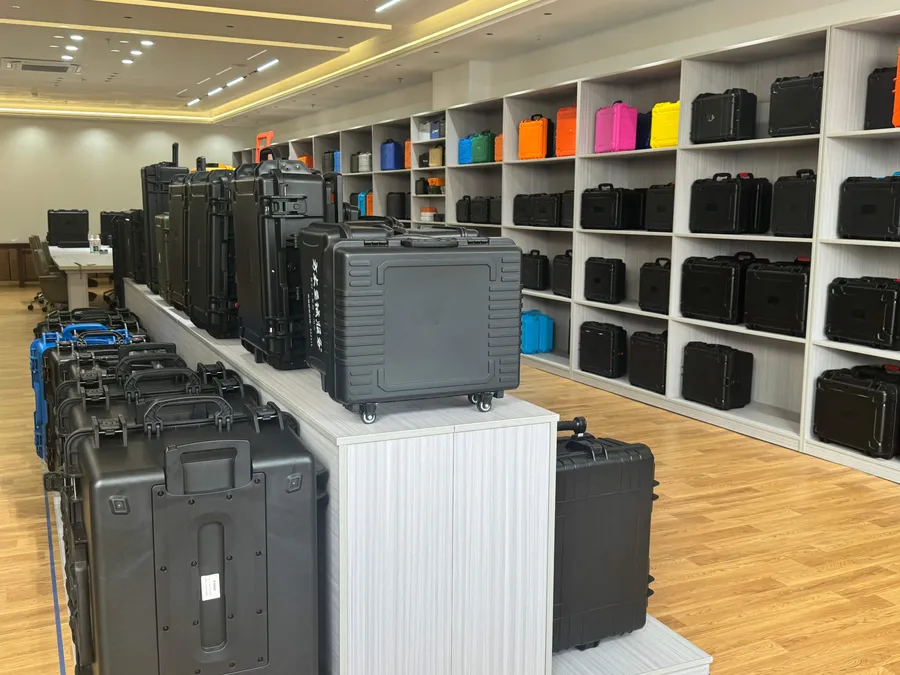
Everything described above is configurable on a standard shell: interior layout (pick-and-pluck, die-cut or CNC-cut), foam grade and thickness, colour, logo method, latch and lock count, pressure-equalisation valve, cable ports, document holder and identification plate. A bespoke exterior geometry requires a new mould — 125 days, from 3,000 units per moulded component.
Procurement considerations
| Question | What to send us |
|---|---|
| Which shell fits? | Equipment L × W × H as packed, plus required clearance per axis |
| What does it cost? | Order quantity and estimated annual quantity — the two drive different answers |
| Is tooling needed? | Whether an existing shell clears the envelope with usable foam depth |
| Lead time? | Your required delivery date, not just the order date |
| Certification? | The exact standard your tender names — we will say whether we can test to it |
| Freight? | Destination and preferred terms; carton and pallet data supplied with the quotation |
Comparison and selection guide
The tables on this page exist because a protective case is chosen by comparing three things: the envelope, the environment and the handling chain. Where no table applies, the rule below is.
| Situation | What To Do |
|---|---|
| Clinical environment | Closed-cell foam or a wipeable tray; no open-cell pluck foam. |
| Emergency use | Latches that open with one hand and a lid that stays up unaided. |
| High-value device | Deeper base foam, a separate transducer zone, and a documented drop test if required. |
- Size on internal dimensions plus clearance, never on a product name.
- Choose the carrying method before the shell: it changes the series, not just the price.
- Specify the interior last, and decide up front whether the end user will reconfigure it.
How do medical equipment cases support field logistics? relates to Military Case Guide. Related families: Medical Equipment Cases / Military Protective Cases / Instrument & Equipment Cases / Field Equipment Cases / Custom Protective Cases. Related sectors: field and industrial equipment. Continue in the Military Case Guide cluster.
This page is written from our own production data. If your requirement differs, send the dimensions and we will tell you which of the 155 models fits, or whether a custom route is needed.