What Materials Are Suitable For Field Equipment Cases?
Three shell materials cover the field-equipment catalogue: polypropylene on 94 of 155 models, engineering PP on 38, and ABS on 22, with one PP/ABS blend model alongside. The choice is a trade among impact behaviour, stiffness, finish and cost, and it should be read from published numbers rather than adjectives. ABS models carry walls of 3.0 to 5.3 mm and all 22 publish seal availability; PP spans walls of 2.0 to 5.0 mm from a 100-gram utility box to a 15.32 kg wheeled trolley; engineering PP reaches 6.0 mm walls where heavy loads need them. Around the shell, the materials that do the day-to-day work are an EPDM-class compressible gasket in the closure line and a foam interior specified in PE, EPE and EVA families.
Key points
- Specify shells by published wall thickness and net weight, not by material marketing: every one of the 155 model datasheets prints both.
- PP suits wide temperature swings and chemical exposure; ABS buys stiffness and a hard finish for printed identification.
- Engineering PP is the same chemistry stepped up: 38 models with walls to 6.0 mm for heavy transport loads.
- Seal availability is a configuration choice: all 22 ABS models list it, while some PP and engineering PP families ship dry-duty.
- The interior, not the shell, fixes the equipment: PE, EPE and EVA foams in layered or egg-crate structures do the daily work.
- Treat every untested value as not measured; ingress, temperature and drop numbers appear only where a test record exists.
The three shells the catalogue actually moulds
Strip the adjectives out and the field-case catalogue is a materials census. Across 155 published models, 94 shells are polypropylene, 38 are engineering PP, 22 are ABS, and a single model pairs PP and ABS in one construction. Every datasheet names its shell material beside wall thickness and net weight, so the comparison below is arithmetic, not opinion. All three are injection-moulded thermoplastics; what differs is the balance each strikes between impact behaviour, stiffness, surface finish and cost, and the size range each is asked to cover.
The blend model, KX-95419, is published as a 35.7-litre, 3.6 kg shell without a seal listing, a reminder that the blend exists but is not the catalogue's answer to any specific duty. The working choice for field equipment is among the three main families, and the rest of this article reads them from the published figures rather than from brochures.
The material spread in published numbers
The aggregates below are computed from the 155-model datasheet set: model counts, wall-thickness ranges, how many models in each material publish seal availability, and the net-weight span each family covers. They are the fastest honest summary of what each material is being asked to do, and every figure in the table can be verified against an individual model page.
| Material | Models | Wall Range Mm | Seal Availability | Stackable | Wheeled | Net Weight Kg |
|---|---|---|---|---|---|---|
| PP | 94 | 2.0 - 5.0 | 75 of 94 models | 80 | 14 | 0.10 - 15.32 |
| Engineering PP | 38 | 2.1 - 6.0 | 27 of 38 models | 34 | 4 | 0.35 - 10.00 |
| ABS | 22 | 3.0 - 5.3 | 22 of 22 models | 21 | 1 | 0.31 - 7.94 |
| PP / ABS blend | 1 | per datasheet | not listed | 1 | 0 | 3.60 |
PP: the default for field duty
Polypropylene carries the widest envelope in the catalogue, and that is the point. PP models run from the KX-1204 utility box, 115 x 78 x 32 mm internally, 0.3 litres, a 2.6 mm wall and a published 100 grams, to the KX-88442 trolley at 740 x 518 x 364 mm, 139.5 litres, a 5.0 mm wall and 15.32 kg with wheels and a telescopic handle. Eighty of the 94 PP models are listed as stackable, because PP's job in this catalogue is volume, stacking and cost control across the sizes a load plan actually uses.
The material reasoning is the one our material guide sets out: PP holds its impact behaviour in cold weather and shrugs off the fuels, lubricants and cleaning agents that field equipment travels with. That is a property argument, not a test record. Where a model carries no measured value for a claim, the datasheet says so, and the shell is chosen on the published wall and weight instead.
Engineering PP: the same chemistry stepped up
Engineering PP is the higher-specification grade family on the PP side of the catalogue: 38 models, walls from 2.1 to 6.0 mm, net weights up to 10 kg. The 6.0 mm walls sit in the 9 Series and T Series, on the KX-6621 and the KX-97227 trolley, where a heavier load or a longer shell needs the extra section. Smaller engineering PP boxes show the other end: the KX-705 family runs a 2.1 mm wall, and those small boxes publish no seal, an honest dry-duty configuration for stores that do not need one.
Where engineering PP is asked to seal, it does: the KX-4822 optical case publishes 460 x 330 x 210 mm internally, 31.9 litres, a 3.3 mm wall at 2.71 kg with seal availability. Reading the family this way, wall and seal per model rather than per material, is the habit this article argues for, because both figures are configuration decisions the factory publishes explicitly.
ABS: stiffness and finish where the load is defined
ABS is the stiffest of the three families and the one that takes the hardest surface finish, which is why it appears on 22 models where printed identification and a rigid panel matter, and why every one of the 22 publishes seal availability. Walls run 3.0 to 5.3 mm, so the family never goes thin, with net weights from 0.31 to 7.94 kg. The KX-63416 gives 310 x 255 x 138 mm internally, 10.9 litres on a 4.8 mm wall at 1.8 kg; the KX-65522 stretches the family to 507 x 385 x 190 mm, 37.1 litres on a 5.3 mm wall at 4.86 kg.
The trade is the other side of that stiffness: ABS costs more per size and covers a narrower size ladder than PP, so it earns its place where the load is defined, the interior is cut once, and the case is identified, stacked and reused on a schedule. Where a set must survive rough handling at low cost in unknown weather, the PP families remain the default, and our PP-versus-ABS guide walks that decision in detail.
The seal line and the hardware around the shell
A field closure is a system of three materials, and only one of them is the shell. The seal line is a compressible gasket, EPDM or an equivalent compound is the published option, seated in a continuous moulded channel between lid and base, and it is listed as a configuration option per model rather than assumed. Hardware is specified as metal or polymer by configuration: hinges, latch bodies, feet, and on the trolleys the telescopic handle and wheels. On models so equipped, the datasheet notes that the latch body accepts a standard padlock, which turns a latch into a security point without custom parts.
Read together, the seal and hardware lines tell a buyer where the closure will and will not be claimed. What they never do is borrow: a sealed model in one size does not upgrade an unsealed model in another, and the datasheets keep those columns separate on purpose.
The interior: foam families that do the daily work
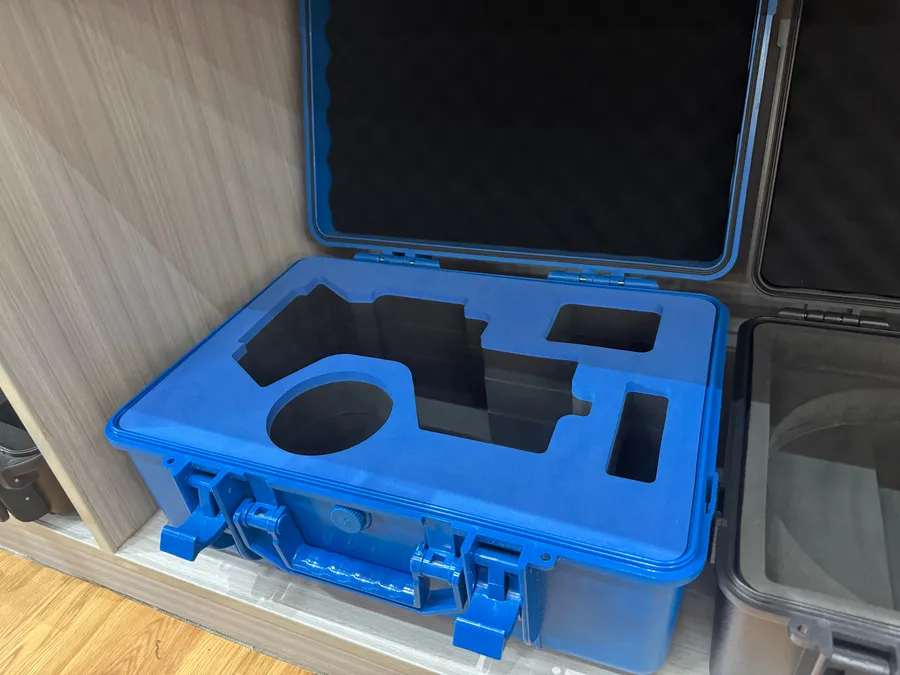
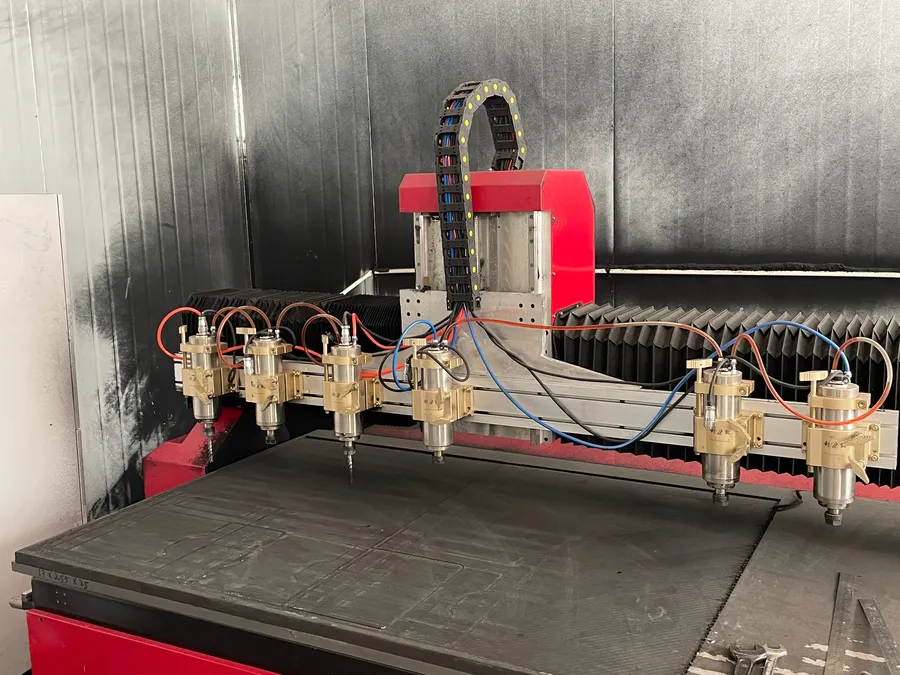
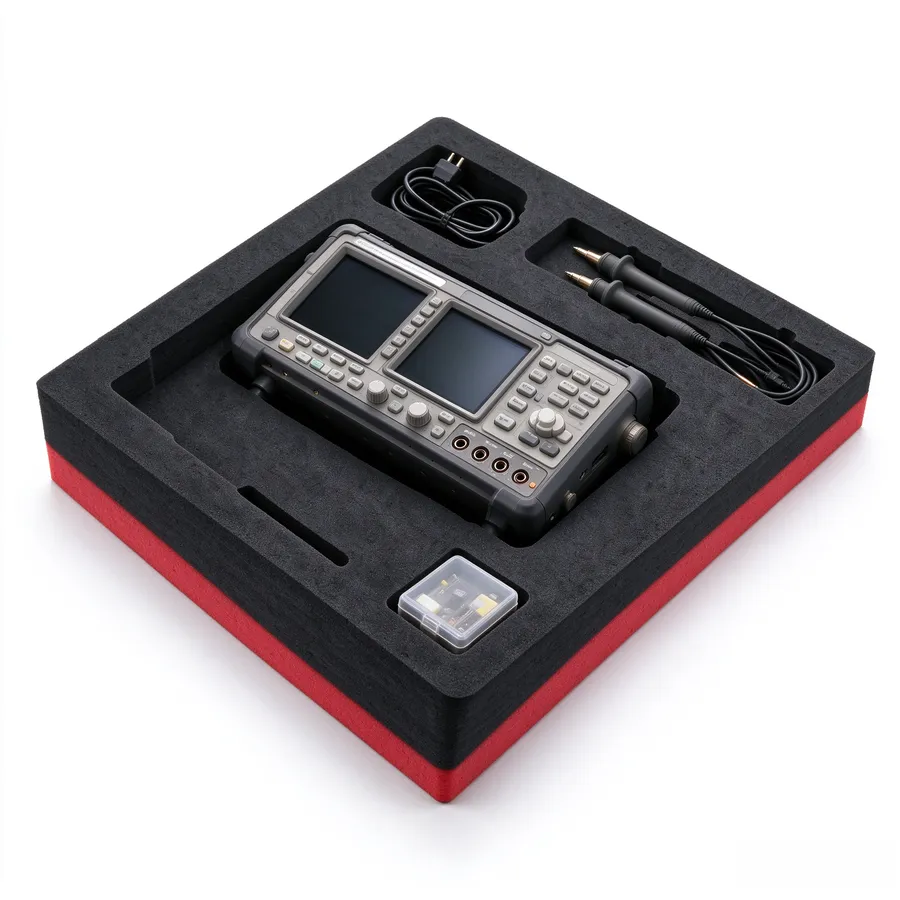
The foam, not the shell, is what the equipment feels, and the catalogue treats it as a specification in its own right. Published foam types are pick-and-pluck, die-cut, CNC-cut, EVA, PE and EPE, arranged as top foam, base foam, layered or egg-crate structures, with custom thickness, custom shape and CNC cutting available per configuration. Custom interiors start from a single unit once a drawing, a photograph of the packed kit or a physical sample is supplied, a measured requirement on the datasheets rather than a sales promise.
Choosing among the foam families is a thickness-and-duty question rather than a materials contest: PE and EPE for the general cushioning layers, EVA where a firmer, more dimensionally stable cut is wanted, pick-and-pluck where a kit changes and the layout must be re-cut in the field. Our foam-thickness guide sets out how thickness, more than density, does most of the transmitted-force work.
Choosing a material for the duty, in order
Decide in the order the load plan forces. First the envelope and mass: a heavy load on a thin wall is a wall problem before it is a material problem. Second the handling: wheels and telescopic handles exist across PP and engineering PP trolleys, so one-person mobility does not have to cost stackability elsewhere in the family. Third the closure: pick the models whose seal line is published for the configuration you actually order. Fourth the interior: foam types and thickness per the load. Fifth the finish: ABS where printed identification is the priority, moulded colour and 300-unit OEM marking where it is not.
Run that order against the table above and the material usually chooses itself: PP for the volume ladder, engineering PP for the heavy end, ABS for defined loads with a hard finish. What never works is choosing the material first and hoping the sizes follow. The 155-model ladder exists precisely so that the numbers lead the decision.
What to confirm with the manufacturer before ordering
Ask for the datasheet columns, not the brochure: shell material, wall thickness, internal and external dimensions, net weight, seal availability and packing data, each marked as measured, a configuration option, or not measured. Where a value has no test record, we publish no figure, and accredited testing can be commissioned as a separate work package. That is the whole claim policy, and it applies to every one of the 155 models the same way.
Then pin the commercial terms, because they decide what the sample actually costs. KeXin sells wholesale and OEM only, quoted EXW or FOB, with a 30 percent deposit to start production; we do not sell retail, do not quote DDP and operate no overseas warehouse. Standard models ship from one unit, custom foam from one unit with drawings, logo and colour options from 300, and a new mould is a 125-day, 3,000-unit-per-component decision, while a first sample on an existing mould runs 45 days, which is why the size ladder gets exhausted first.

Customisation
Everything described above is configurable on a standard shell: interior layout (pick-and-pluck, die-cut or CNC-cut), foam grade and thickness, colour, logo method, latch and lock count, pressure-equalisation valve, cable ports, document holder and identification plate. A bespoke exterior geometry requires a new mould — 125 days, from 3,000 units per moulded component.
Procurement considerations
| Question | What to send us |
|---|---|
| Which shell fits? | Equipment L × W × H as packed, plus required clearance per axis |
| What does it cost? | Order quantity and estimated annual quantity — the two drive different answers |
| Is tooling needed? | Whether an existing shell clears the envelope with usable foam depth |
| Lead time? | Your required delivery date, not just the order date |
| Certification? | The exact standard your tender names — we will say whether we can test to it |
| Freight? | Destination and preferred terms; carton and pallet data supplied with the quotation |
Comparison and selection guide
The tables on this page exist because a protective case is chosen by comparing three things: the envelope, the environment and the handling chain. Where no table applies, the rule below is.
| Situation | What To Do |
|---|---|
| Dust | Continuous rim plus enough latches to hold it closed over a temperature cycle. |
| Cold | PP shells retain toughness better than ABS at low temperature. |
| Service life | Ask for a spares kit of latches, hinges and gaskets with the first order. |
- Size on internal dimensions plus clearance, never on a product name.
- Choose the carrying method before the shell: it changes the series, not just the price.
- Specify the interior last, and decide up front whether the end user will reconfigure it.
What Materials Are Suitable For Field Equipment Cases? relates to Military Case Guide. Related families: Field Equipment Cases / Military Protective Cases / Waterproof Cases / Equipment Transport Cases / Custom Protective Cases. Related sectors: field and industrial equipment. Continue in the Military Case Guide cluster.
This page is written from our own production data. If your requirement differs, send the dimensions and we will tell you which of the 155 models fits, or whether a custom route is needed.


