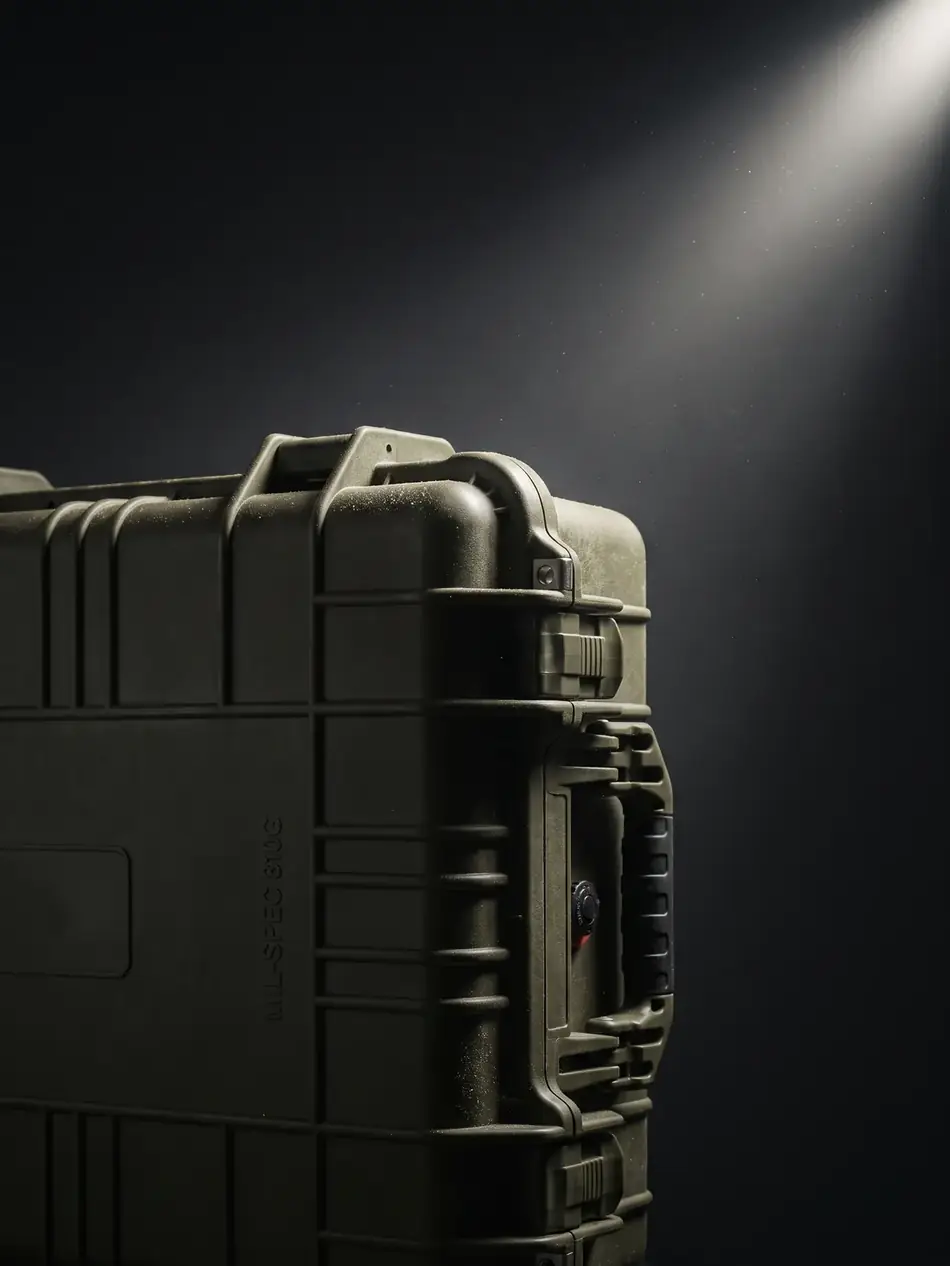
How should sensitive defense equipment be packed?
Pack it by failure mode, not by equipment category. Identify what actually breaks on the item in front of you - a lens cell, a connector shell, a display face, a heavy module cantilevered off a thin board - then give that item its own pocket in a layered foam insert, restrain the assembly so it cannot travel against the shell wall, close the lid so the gasket compresses evenly on all four sides, and only after that work out cartons, stacks and pallets from the packing data we publish per model. Those published numbers are what make the method checkable: internal and external dimensions for all 155 models, wall thickness between 2.0 and 6.0 mm, the narrow internal width wherever the body tapers, net mass on 93 models, carton dimensions on 64, and a seal construction stated on 124 shells. Anything we have not measured stays an honest blank rather than an estimate, which is exactly what a packing specification needs in order to survive an audit.
Key points
- Pack to the fragile subsystem inside the item - optics, connector shells, display faces, cantilevered modules - not to the name on the requisition line.
- Give every item its own pocket: the packing rule for a shared case is set by the most delicate thing inside it, never by the average of the load.
- Leave at least 20 mm of clearance per axis, then check the narrow internal width - 36 of 155 models taper internally by more than 5 mm in width.
- Design against usable interior volume, not gross: 154 of 155 models publish a usable figure below the geometric one after foam, ribs and parting lines.
- A gasket is published on 124 of 155 shells as a compressible seal in a continuous moulded channel; the other 31 state plainly that none is offered.
- Send batteries, cables and spares to separate compartments so an inspection never becomes a search across a protected optical face.
- Plan transport units from real data: three KX-65522 cases fill a 565 x 450 x 665 mm carton, while sixteen KX-3213 cases fill a 645 x 530 x 520 mm one.
Start from the failure mode, not the case
Sensitive equipment does not fail in one place or in one way, and a packing plan that treats it as a single fragile block will protect the wrong thing. Break the item down into the subsystems that actually carry risk: a lens or mirror cell that fails from point indentation and from being pressed sideways into a reticle ring; a connector shell whose plating is damaged by repeated side load; a display or instrument face abraded by its own cable; a heavy transceiver module bolted to a thin board that behaves as a seismic mass under vibration; a calibration document or seal tab that tears because nothing in the layout was reserved for it.
Write the failure modes down before you open a catalogue, because each one maps to a different countermeasure. Indentation needs a softer carrier layer under the item. Sideways travel needs a pocket that locates the body, not just a filler block. Vibration needs the item restrained at its stiffest points rather than at whatever protrudes. Abrasion needs a surface that never sees loose packing material or a neighbour's hardware. If you cannot name the failure mode you are protecting against, you are choosing foam thickness by feel.
One case, one rule: the most delicate item sets the standard
The single most common packing error in defence logistics is combining loads because the volumes add up neatly. A rugged hand radio and a survey-grade optical head can share a case geometrically and still arrive damaged, because the rule that governs the shared box is the rule for the most delicate item in it, applied to everything. Either every item in a case can accept the same handling severity, or the case is compartmented so each item is packed to its own standard inside a shared outer shell.
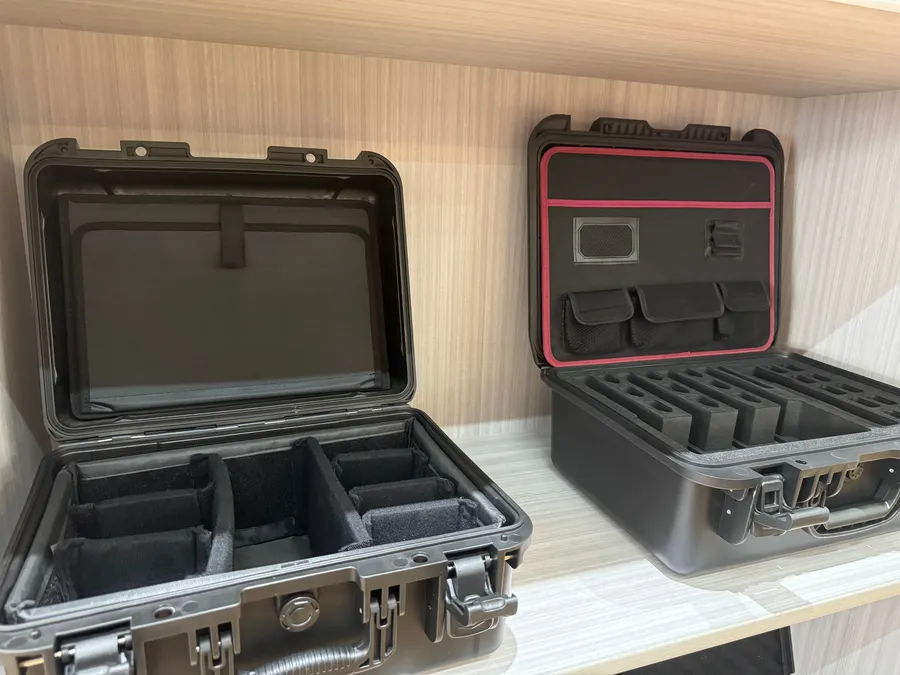
Compartmentation is cheap and it is repeatable. A partition wall in cut foam, a separate carrier tray, or a second inner case each give you an inspectable layout: at a receipt check someone can confirm that everything is present and correctly seated without lifting a single item out. Loose accessory packing saves a few hundred grams on the first shipment and costs you a damaged front lens on the fifth.
Measure the packed configuration, then leave real clearance
Measure the equipment as it will actually travel - handles folded, antennas detached or laid, cables coiled to their service loop, protective caps fitted - and record the longest, widest and tallest points of that state. The sizing guidance applied across this catalogue is at least 20 mm of clearance on each axis between the equipment envelope and the foam surface, so that the insert, not the shell wall, absorbs movement. Under-sizing puts the load path straight through the shell; over-sizing lets the item walk and abrade its own packaging, and both failures look identical on arrival.
Two published numbers stop most clearance arguments before they start. First, the narrow internal width: 36 of the 155 models taper internally by more than 5 mm from the nominal width, so a tray that clears the opening can bind at the narrow point, and the datasheet width is the number to design against. Second, usable interior volume: 154 of 155 models publish a usable figure below the geometric one because foam, ribs and parting lines consume space - KX-65522 is a clear example, at 37.1 litres internal against 29.7 litres usable.
Match the countermeasure to the subsystem
The table below is the working version of the first section: for each common sensitive subsystem, the dominant failure mode, the packing countermeasure we can actually build, and the published number you should check on the datasheet before committing. It is written so a buyer can hand it to a warehouse team and get the same answer twice.
| Sensitive Subsystem | Dominant Failure Mode | Packing Countermeasure | Published Number To Check |
|---|---|---|---|
| Lens, mirror or sensor cell | Point indentation and sideways pressure into the mount | Soft carrier layer under the body, full-depth pocket, nothing stacked above the face | Internal depth and base depth, e.g. KX-62109 interior 195 x 128 x 81 mm |
| Connector and cable set | Side load on the shell, abraded plating and pins | Connectors unloaded, cables coiled to service radius, separate channel or tray | Narrow internal width where the body tapers, published on 36 models |
| Heavy module on a thin board | Seismic mass under vibration and repeated handling shock | Restrain at the stiffest structural points, carrier plate beneath, no foam-only support | Wall thickness per model, published from 2.0 to 6.0 mm |
| Display or instrument face | Abrasion from loose foam crumbs and neighbouring hardware | Face toward the lid in a clean pocket, dedicated compartment for hardware and spares | Lid depth and base depth where published, on 100 models |
| Paper records and seal tabs | Torn, creased or lost documentation at inspection | Reserved document pocket or inner lid holder so paperwork has a fixed home | Document holder is a configuration option across the catalogue |
Build the insert in layers, and specify it with a drawing
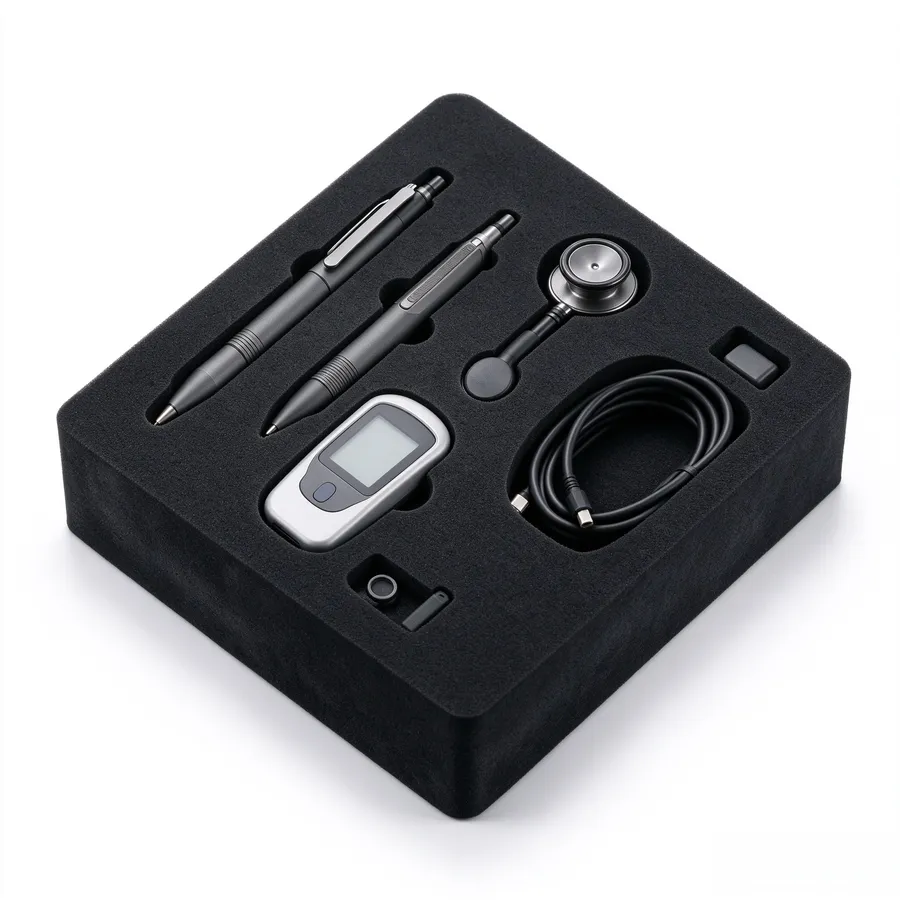
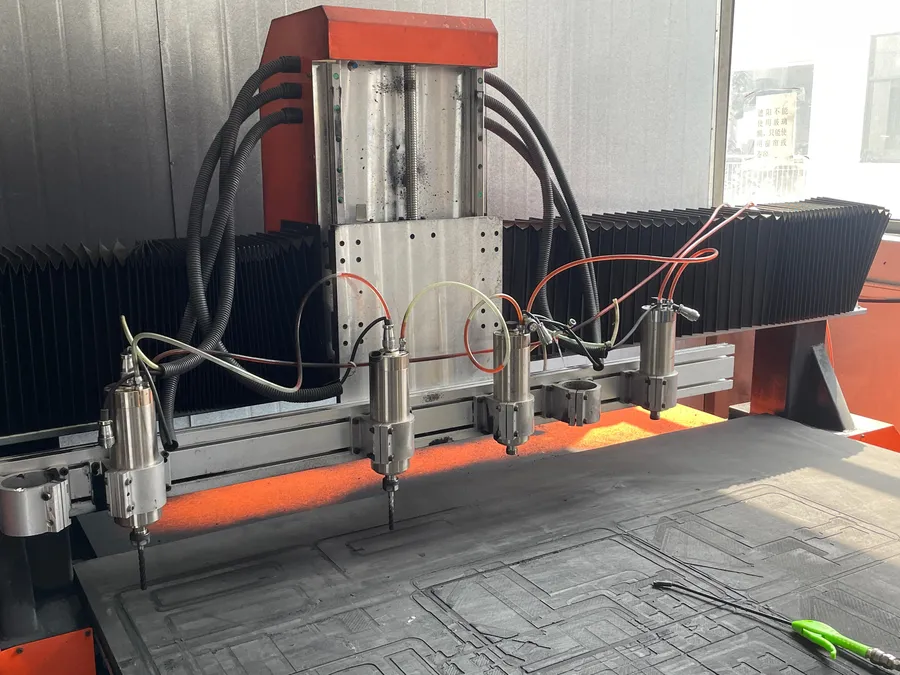
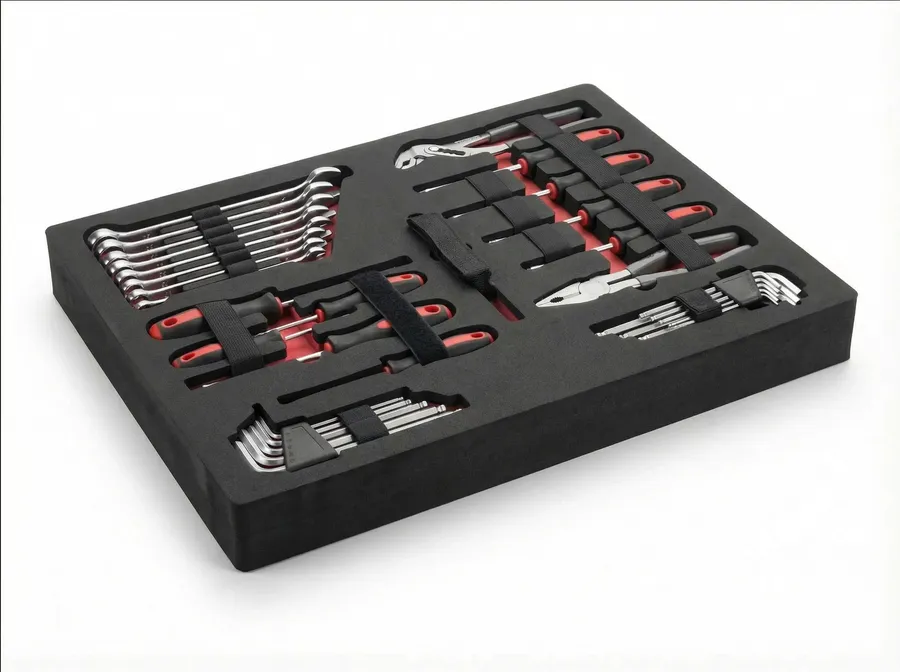
An insert is a load path, not a filler. A firmer carrier layer under the device stops it settling into softer material; a softer contact layer protects finished surfaces; a convoluted or egg-crate top layer keeps light items in place without point loading; a cut-out locates each thing so that a missing item is visible in one second. Every model in this catalogue is offered with custom cut foam - pick-and-pluck, die-cut and CNC-cut builds in PE, EPE and EVA, in top, base, layered and custom-cut structures - and the minimum order for a custom insert is one, because the insert is a machining operation on a shell you already make.
What we need from you is not a poem about fragility but one of three concrete inputs: a drawing of the item in its packed configuration, a photograph of the kit laid out as it should be packed, or a physical sample of the equipment itself. That is the record the foam shop cuts from and the record an incoming inspection can check against later. Specify the pocket, not the wish: item position, orientation, clearance, carrier material and how the item is lifted out of the case with one gloved hand.
Closure: even compression matters more than extra gasket
Where the shell offers one, the published seal construction is a compressible gasket running in a continuous moulded channel, stated on 124 of the 155 models; the remaining 31 say plainly that no seal is offered on that shell, which is a legitimate answer for a dry-storage or short-haul box. The seal material itself - EPDM or an equivalent compressible profile - is a configuration choice rather than a fixed part number, and the number of latches is likewise specified per configuration.
What actually keeps dust out of a sealed box in service is uniform compression around the whole rim. A case closed with one latch hard and the others slack, or dropped on a corner, or packed so an item jams the lid, leaks at the point where the gasket never met its design squeeze. The latch body on every model in this catalogue accepts a standard padlock, which doubles as a tamper indication and as a reason for handlers to close the box properly rather than leaning on it.
Batteries, accessories and the bench questions nobody writes down
Power sources travel separately from the loads they feed wherever the schedule allows: their own compartment, terminals protected, and a layout that makes it obvious if one has swollen in store. Cables, adaptors, caps and spare optics get reserved pockets as well, and a document pocket keeps calibration records with the item they describe. A case packed to be inspected is faster through a depot than a case packed to be full.
The second bench question is condensation. A cold assembly brought into a warm area will pull moisture out of the air on the coldest surface it can find, which is frequently inside a closed box, so items should be allowed to reach the packing room temperature before the lid goes on, and the interior and the item should be clean and dry at closure. Desiccant and barrier bags are consumables supplied by the buyer's own packing programme; we mould and cut the case and insert, and we do not publish a humidity or temperature range for any of the 155 models because no such test record exists. Conditioning and climatic proof are your specification's job, and accredited testing can be commissioned against a configuration as a separate work package.
Carton, stack and pallet arithmetic from published data
The transport unit is where a good packing plan usually dies, so use the numbers we already publish rather than a rule of thumb. Carton dimensions and pieces per carton are published for 64 of the 155 models, and the spread is wide enough that guessing is worse than useless: three KX-65522 cases go into a 565 x 450 x 665 mm carton, three KX-5321 cases into a 530 x 440 x 635 mm carton, sixteen KX-3213 cases into a 645 x 530 x 520 mm carton, and ten KX-62810 cases into a 480 x 293 x 550 mm one. Net mass is published on 93 models, from 250 g for a KX-1905 shell to 10.6 kg for a loaded trolley case, which is what makes a manual-handling limit a calculation instead of an argument.
Stacking behaviour is likewise published per model: 136 of the 155 are specified stackable, and none of the 19 telescopic trolley models is, because the extended handle and wheel set occupy the interface that a stack would otherwise load. Plan the pallet after you know which of those two groups you are shipping, and confirm stack behaviour from the datasheet before the plan is signed, not after the first container is loaded.
Selection guide: choose the shell by handling chain
Once the insert is designed, the shell is chosen by who carries it, how far, and what lands on top of it. The structural series in this catalogue exist precisely because those answers differ, and each series publishes the numbers you need for the decision:
Read the table as a filter, not a shortlist: pick the series by handling, then pick the model by internal envelope, then let the insert do the protecting. A sensitive item that a technician hand-carries two hundred metres and one that rides on a vehicle pallet need completely different shells even when the equipment volume is identical.
| Series | Models | Internal Volume | Wall Thickness | Best Handling Fit |
|---|---|---|---|---|
| 0 and 1 Series | 23 and 7 | 0.3 to 23.7 litres | 2.0 to 3.5 mm | Hand-carried instruments and spares, carton quantities up to 16 pieces |
| 6 Series | 20 | 0.8 to 37.1 litres | 3.0 to 5.3 mm | ABS shells, seal published on all 20 models, bench and vehicle transit |
| 7 Series | 6 | 3.6 to 20.2 litres | 2.1 to 2.8 mm | Light engineering PP bodies, no seal offered on any model |
| 8 and 9 Series | 62 and 18 | 3.5 to 72.4 litres | 2.8 to 6.0 mm | Deep-body cases for stacked and racked loads; 58 and 14 models with seal |
| T Series | 19 | 22.1 to 139.5 litres | 4.2 to 6.0 mm | Telescopic rolling cases, 18 with seal, none specified stackable |
Where this packing method is applied
The same sequence covers a wide band of sensitive loads because the method is about failure modes, not product names. Communications and encryption assemblies travel with connector channels and separate battery compartments. Electro-optical and survey heads travel face-up in a reserved pocket with nothing above them and their accessories in a second zone. Test, measurement and calibration sets travel with their documentation in a fixed holder so a certificate is never loose in the box. Unmanned airframe subassemblies and ground-control units travel compartmented by module, because the mixed mass distribution is the hazard. Field medical and laboratory devices travel by the same rule with an added cleanliness step at closure.
If your load is something else entirely, the four questions still work: what breaks, how does it break, what keeps it from moving, and what number on the datasheet proves the shell can take the handling you are planning. Those four answers turn a vague request into a specification a factory can price.
Customising the package around a sensitive item
Everything that makes a package specific to one item is offered as a wholesale or OEM configuration: custom foam from a quantity of one, custom colour, logo and packaging from 300 pieces, custom hardware, and a private-label programme built on existing tooling. Where an item genuinely needs a new shell geometry, a new mould runs to 125 days with a minimum from 3,000 pieces per component; an OEM first sample on existing tooling runs to 45 days. A 30 percent deposit starts tooling work, and the balance follows the agreed commercial terms.
We supply at wholesale and OEM terms on EXW or FOB basis. We do not sell retail, we do not quote DDP, and we hold no overseas warehouse, so landed-cost questions belong to your own freight arrangement. That boundary is stated early because a packing programme built around a sensitive item is a specification exercise first and a shipment second.
Procurement notes and claims discipline
Ask for the number, not the adjective. For each candidate model the datasheet carries internal and external dimensions, narrow internal width where it applies, wall thickness, lid and base depth where published, usable interior volume, net mass where weighed, and the packing data where cartons exist. Where a property has not been measured for your configuration and model, the field says so; we publish measured values, list configuration options as options, and leave unmeasured items blank instead of filling them with an estimate that a later audit has to unwind.
Two consequences follow for a sensitive-equipment programme. Performance claims that depend on test records - ingress codes, drop heights, climatic ranges, stacking load in kilograms - are not stated for any of the 155 models, and accredited testing can be commissioned against a named configuration as a separate work package with its own scope and report. And protection in transit is bought twice: once in the shell and insert you specify, and once in the handling instructions, closure discipline and inspection routine you write around it. The datasheet covers the first; only your procedure covers the second.
Customisation
Everything described above is configurable on a standard shell: interior layout (pick-and-pluck, die-cut or CNC-cut), foam grade and thickness, colour, logo method, latch and lock count, pressure-equalisation valve, cable ports, document holder and identification plate. A bespoke exterior geometry requires a new mould — 125 days, from 3,000 units per moulded component.
Procurement considerations
| Question | What to send us |
|---|---|
| Which shell fits? | Equipment L × W × H as packed, plus required clearance per axis |
| What does it cost? | Order quantity and estimated annual quantity — the two drive different answers |
| Is tooling needed? | Whether an existing shell clears the envelope with usable foam depth |
| Lead time? | Your required delivery date, not just the order date |
| Certification? | The exact standard your tender names — we will say whether we can test to it |
| Freight? | Destination and preferred terms; carton and pallet data supplied with the quotation |
Comparison and selection guide
The tables on this page exist because a protective case is chosen by comparing three things: the envelope, the environment and the handling chain. Where no table applies, the rule below is.
| Situation | What To Do |
|---|---|
| Free-drop height | With a 50 mm base foam layer, a 15 kg assembly sees a markedly lower peak deceleration than with 20 mm. Where the case is handled by hand off a vehicle, we specify the deeper base. |
| Stacking | A case that will be shipped stacked needs a wall thickness and rim geometry that carries the load through the shell, not through the lid. |
- Size on internal dimensions plus clearance, never on a product name.
- Choose the carrying method before the shell: it changes the series, not just the price.
- Specify the interior last, and decide up front whether the end user will reconfigure it.
How should sensitive defense equipment be packed? relates to Military Case Guide. Related families: Defense Equipment Cases / Military Protective Cases / Instrument & Equipment Cases / Communication Equipment Cases / Optical Equipment Cases. Related sectors: field and industrial equipment. Continue in the Military Case Guide cluster.
This page is written from our own production data. If your requirement differs, send the dimensions and we will tell you which of the 155 models fits, or whether a custom route is needed.