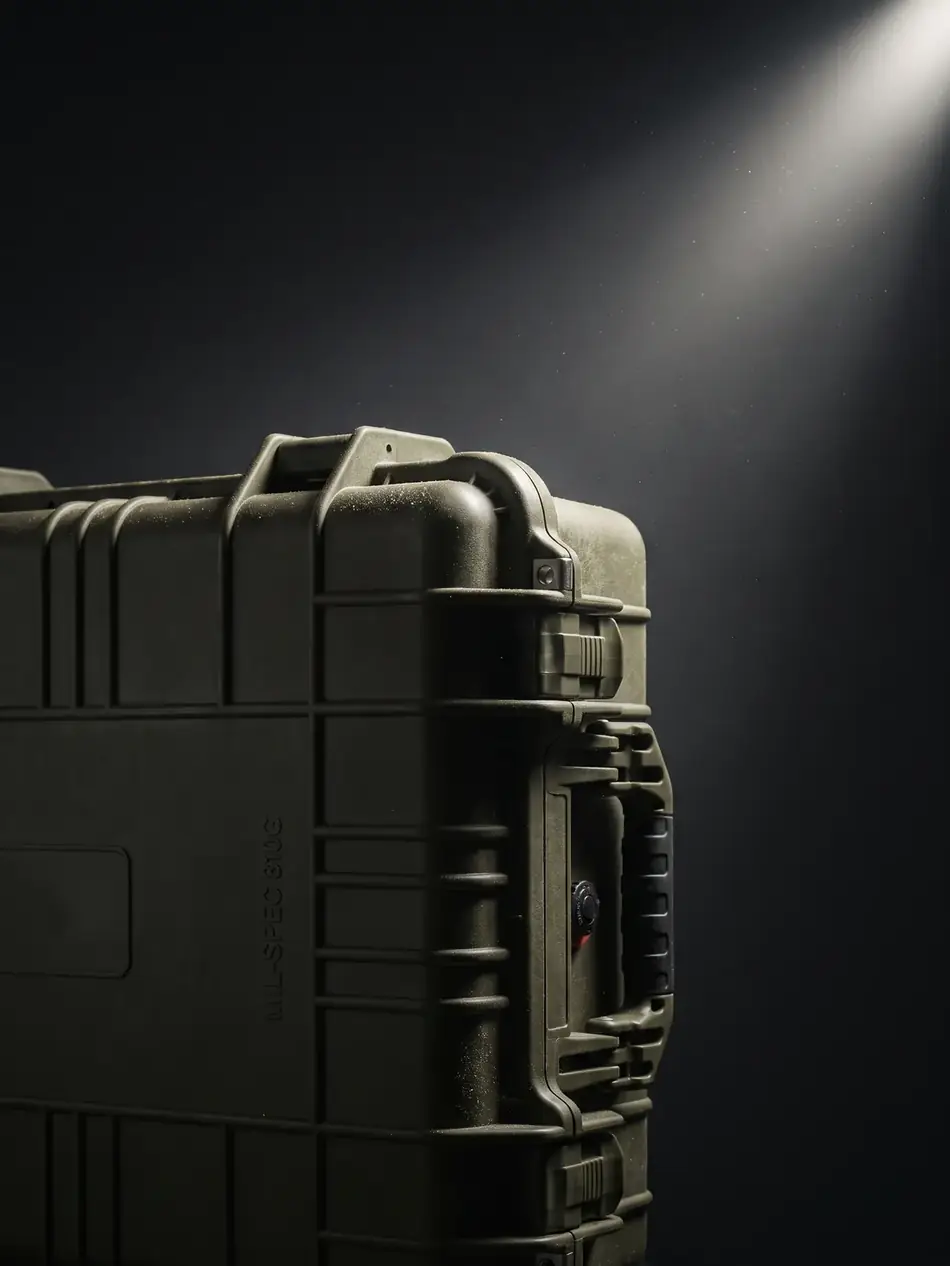
What Role Do Protective Cases Play in Equipment Logistics?
They do four jobs at once. A case converts loose equipment into a single handled unit that one person can lift, carry, load and stow; it provides a standard external footprint that lets loads stack safely in a store, a vehicle bay or a container; it preserves the contents between uses so that planned inspection intervals, rather than transit damage, drive the repair pipeline; and it acts as a control point, because a lockable, markable shell makes custody, handover and accountability part of the move itself. Everything downstream in the chain, from handling time and damage rate to cubic utilisation and replenishment cycles, shifts because those four roles are filled before the goods movement even starts.
Key points
- A case turns loose equipment into one handled unit: a single lift, carry, scan and stow position, instead of a bundle that changes shape at every handoff.
- Standard external footprints are what make stacking plans possible; the KX-88421, KX-88434 and KX-88442 share an 843 x 592 mm footprint in three depths.
- Freight is paid on cartons, not cases: published carton size and pieces per carton decide the volume you pay to move, and are on the model pages for 64 models.
- Flat stacking buys storage density while wheels and a telescopic handle buy one-person handling; the two are different answers to different links of the chain.
- Padlockable latch bodies, document pockets and shell markings turn the case into a custody point, so accountability travels with the goods rather than on paper.
- We publish measured dimensions, wall thickness and net weight per model; pallet and container builds are calculated against your pallet size and issued with the quotation.
The case is a logistics unit before it is a box
In most equipment programmes the case is the only object that travels the entire chain: it is packed at origin, handed over at every intermediate point, opened in the field, closed again, loaded into a vehicle, palletised for a container, de-palletised, re-stocked and eventually returned for refurbishment or disposal. Protection is the job that gets marketed, but logistics is the job that decides whether the equipment is where it is needed when it is needed. A shell that suits the cargo but not the handling chain, too heavy to lift alone, too oddly shaped to grid on a pallet, with nowhere to attach a label, will be worked around by the people moving it, and a worked-around case protects nothing.
That is why case selection in a logistics programme starts from the moves, not the contents. Count the handoffs: how many times will a loaded case be lifted by hand, rolled across ground, pushed into a bay, stacked and re-stacked? Each handoff is an opportunity for a drop, a crush or a mis-delivery, and each one is answered by a different property of the case, namely handle position and mass for lifts, feet and lid geometry for stacks, latch provision and marking surfaces for custody. The contents decide the internal envelope; the chain of moves decides almost everything else.
Unit loads and footprint discipline
A moulded polypropylene case is the closest thing equipment logistics has to a shipping container in miniature. The walls carry the load, the lid adds compression stiffness, and the external geometry repeats exactly, part after part, batch after batch. Where timber crates and wrapped bundles vary by millimetres, a moulded shell is the same box every time, and that repeatability is what makes floor grids, stacking plans and load diagrams possible at all. Stackability is published per model, and inside a footprint family a programme can change depth without changing floor space: the KX-88421, KX-88434 and KX-88442 share an external footprint of 843 x 592 mm while offering internal depths of 189, 284 and 364 mm for different loads.
The same family also shows the trade-off the chain forces. The shallow KX-88421 is published as stackable and carries no wheels; the two deeper versions move comparable goods on two wheels behind a telescopic handle, at about 14.0 and 15.3 kg before loading, and are not published as stackable. Neither answer is universally better. A flat-stack case buys storage density in the depot, a trolley case buys one-person handling over the last hundred metres, and the right answer depends on which link of the chain costs more. Footprint discipline is also what lets a mixed fleet share the same racks and vehicle bays: choose the external dimensions as a system first, then pick the depth for the item.
What each logistics role asks of the case
Read the middle column as the demand and the right column as the evidence. A logistics plan fails where it has to rely on hope instead of a published figure, so every recurring move in the chain should be matched to a property you can read off a model page or a datasheet before the first order, not inferred from a photograph.
| Role | What The Chain Asks For | What The Published Data Shows |
|---|---|---|
| Hand carry between two points | Low empty mass, fixed handle where the hand expects it | Handle type per model; net weight per model, from roughly 0.1 kg to over 10 kg across the catalogue |
| Flat stacking in store and vehicle | Repeated external geometry, feet, lid that takes a stack | Stackable flag per model; wall thickness from 2.0 mm to 6.0 mm by model; lid and base depth split |
| Rolling long distances on wheels | Wheels, telescopic handle, load at the right height | Wheel count and handle type per model, for example two wheels plus telescopic and fixed folding handle on KX-96127 |
| Freight and storage cube | Cartons that grid on pallets without overhang | Carton dimensions and pieces per carton, published for 64 models, e.g. KX-4010 ships 10 to a 710 x 410 x 500 mm carton |
| Preservation between issues | A closure that keeps handling residue out | Gasket availability recorded per model; a pressure relief valve is listed as a configuration option |
| Custody and handover | Locking points, seals, labels, paperwork carrier | Latch body published as accepting a standard padlock; latch count specified per configuration; document holder optional |
Choosing cases for the handling chain
Start from the heaviest routine lift, because it is the constraint nobody forgives. An empty case mass plus the load decides whether a link of the chain is one-person or two-person work, and two-person work quietly doubles labour and halves throughput. Small kit can live in a KX-4010, which publishes 390 x 315 x 88 mm internal at 1.015 kg empty and stacks ten units deep inside one export carton. Dense mid-size equipment moves up to a shell like the ABS-bodied KX-65522, 507 x 385 x 190 mm internal at 4.86 kg empty. Anything that must cross car parks, platforms or depot aprons regularly earns wheels, and the square KX-96127, 545 x 545 x 210 mm internal on two wheels, is built for exactly that leg.
Then size the external box against the fixed infrastructure it must fit: rack bays, shelf grids, vehicle interiors, and the pallet or container plan it will ride on. Work from published external dimensions, not internal ones, and add clearance for the handling reality rather than the ideal. Decide next between the stack-and-store pattern and the roll-and-deliver pattern, because the flags are published per model and mixing them inside one footprint family is legitimate, while mixing footprint families without a plan is what jams a store. Finally fix the hardware: latch count per configuration, padlock provision, marking surfaces and the interior layout, since all of these are configuration choices made at order, not properties you can retrofit blindly.
Applications: where cases meet the chain
In defence and field programmes the dominant pattern is rotation: the same equipment cycles between depot, transport and use many times over its life, and the case is the constant through every cycle. Standard shells cut the support tail, because spares, liners and lids are interchangeable across the fleet, and a damaged unit swaps out without re-engineering the pack. Where the goods are packed for a specific leg, such as sensitive instruments or communication suites, the packing method is a separate discipline from the shell choice, and the two should be specified in the same review.
In wholesale distribution the case ends its first journey before it starts its working life. Orders ship in cartons, cartons grid onto pallets sized to the buyer's market, and container builds for 20 ft, 40 ft and high-cube boxes are calculated from the published packing data and supplied with the quotation. Because terms are EXW or FOB from the factory, the importer's freight planner works from the same carton figures the factory uses, which is the whole point of publishing them: landed cost can be built from real packing data instead of estimates, and the first delivery and the tenth compare cleanly.
Customising a fleet rather than a one-off
Fleet economics come from holding the shell constant and varying the inside. The published interior options cover pick-and-pluck, die-cut and CNC-cut layouts in PE, EPE and EVA foams, assembled as base foam, top foam, layered or egg-crate configurations, with material graded by zone. A single shell can therefore serve several roles across one programme, and because custom foam on an existing shell starts from a single unit, a layout can be proven on one case before the fleet order is committed. The reference we cut from is a drawing, a photograph of the packed kit, or a physical sample.
Programme-level branding sits one step above the interior. A printed logo or matched shell colour carries an order floor of 300 units, the same band as OEM production on an existing mould, with the first sample scheduled at 45 days. A genuinely new shell size is a tooling project, quoted at 125 days and from 3,000 units per component, and it buys the footprint discipline described earlier in its purest form, because the external geometry is then designed around the racks, pallets and vehicles instead of the other way round. A 30 percent deposit starts production once layouts and terms are approved.
Purchasing notes: the figures we give and the figures we do not
Every model page carries measured construction data: internal and external dimensions, the narrow internal width where a shell tapers, lid and base depth split, wall thickness between 2.0 mm and 6.0 mm depending on model, net weight, shell material across PP, engineering PP and ABS, and flags for stackability, wheels and handle type. What we do not publish as a measured property is a pallet quantity for an arbitrary pallet, because it depends on yours: pallet builds are calculated from the carton footprint against the customer's pallet size. Container figures for 20 ft, 40 ft and high-cube boxes are likewise supplied with the quotation rather than guessed on a page.
The same discipline applies to protection language. Shock protection depends on the specified foam layout; the shell alone is not a shock rating, and where a protection value has not been measured on the assembled configuration, our model pages leave the field blank rather than state one. If a tender needs documented figures, accredited testing can be commissioned as a separate work package. Commercially the frame is fixed: wholesale and OEM only, EXW or FOB from Guangdong, no retail sales, no door-to-door delivery service and no overseas warehousing, with the datasheet attached to the quotation so that the logistics plan and the purchase order rest on the same numbers.
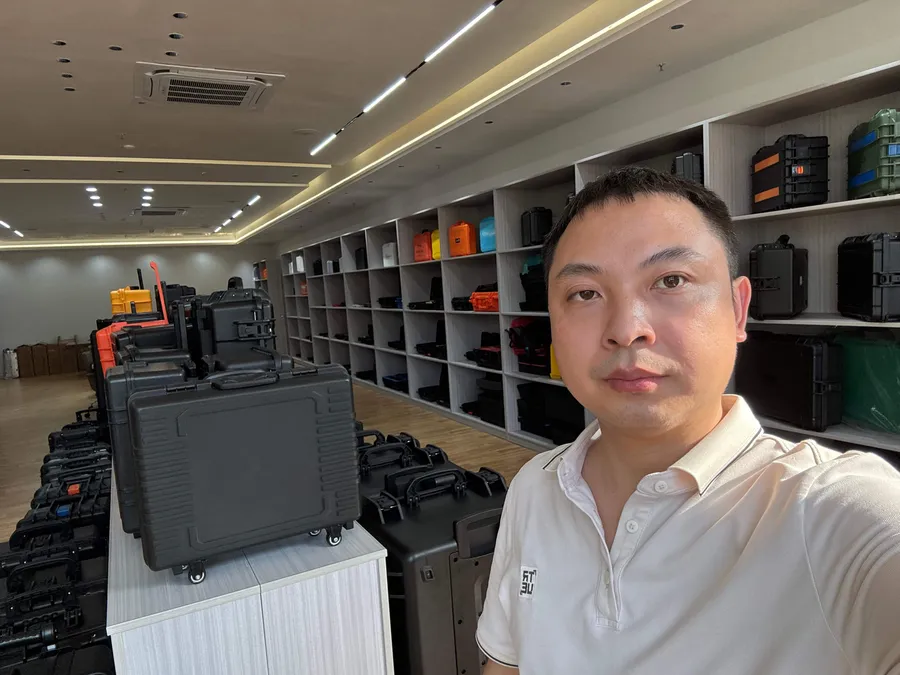
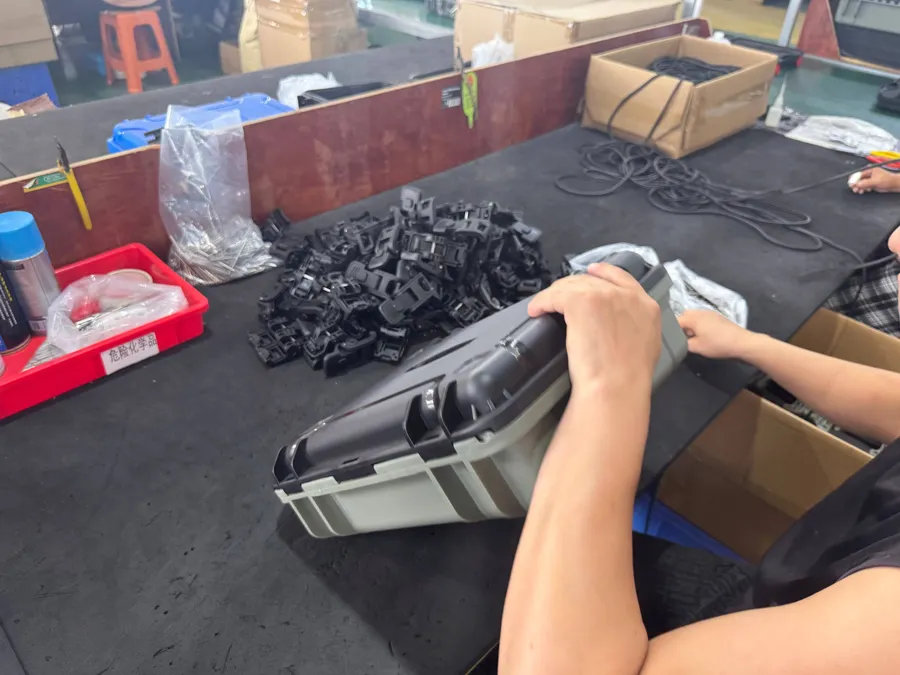
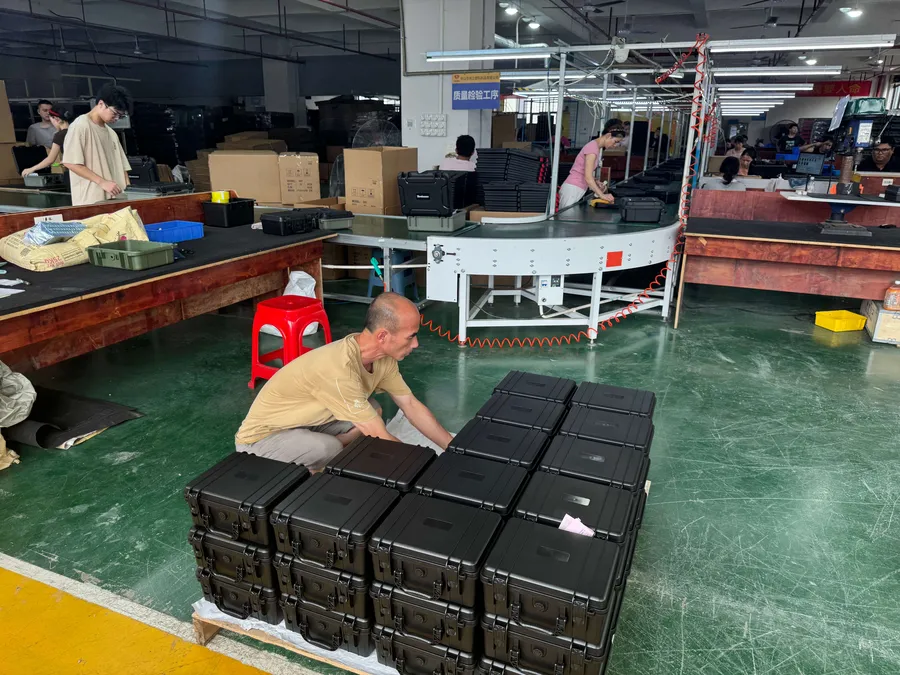
Customisation
Everything described above is configurable on a standard shell: interior layout (pick-and-pluck, die-cut or CNC-cut), foam grade and thickness, colour, logo method, latch and lock count, pressure-equalisation valve, cable ports, document holder and identification plate. A bespoke exterior geometry requires a new mould — 125 days, from 3,000 units per moulded component.
Procurement considerations
| Question | What to send us |
|---|---|
| Which shell fits? | Equipment L × W × H as packed, plus required clearance per axis |
| What does it cost? | Order quantity and estimated annual quantity — the two drive different answers |
| Is tooling needed? | Whether an existing shell clears the envelope with usable foam depth |
| Lead time? | Your required delivery date, not just the order date |
| Certification? | The exact standard your tender names — we will say whether we can test to it |
| Freight? | Destination and preferred terms; carton and pallet data supplied with the quotation |
Comparison and selection guide
The tables on this page exist because a protective case is chosen by comparing three things: the envelope, the environment and the handling chain. Where no table applies, the rule below is.
| Situation | What To Do |
|---|---|
| Start from the equipment, not the case | Measure the tallest, widest and longest points of the packed equipment including antennas, handles and connectors. Add 20 mm minimum clearance per axis before selecting a shell. |
| Then choose the carrying method | Under 8 kg, a fixed handle is lighter and cheaper. Over 12 kg or any journey over 30 m, specify the T series with telescopic handle and wheels. |
| Then decide the interior | Pick-and-pluck for kits that change. Die-cut or CNC-cut for fixed layouts that must be auditable at a glance. |
- Size on internal dimensions plus clearance, never on a product name.
- Choose the carrying method before the shell: it changes the series, not just the price.
- Specify the interior last, and decide up front whether the end user will reconfigure it.
What Role Do Protective Cases Play in Equipment Logistics? relates to Military Case Guide. Related families: Military Protective Cases / Defense Equipment Cases / Equipment Transport Cases / Military Transport Cases. Related sectors: field and industrial equipment. Continue in the Military Case Guide cluster.
This page is written from our own production data. If your requirement differs, send the dimensions and we will tell you which of the 155 models fits, or whether a custom route is needed.