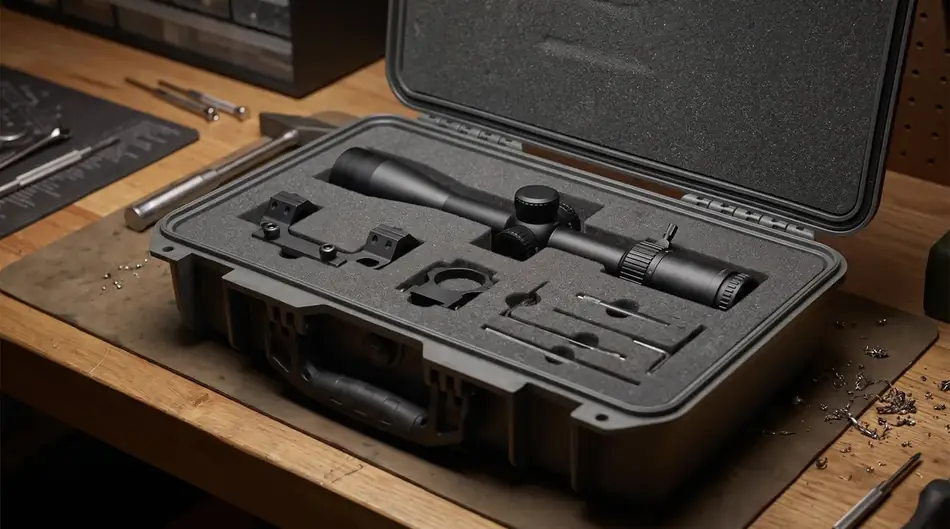
What is a military tool case?
A military tool case is a rigid protective shell issued to a crew or a technician to carry a defined set of hand tools, torque items and small instruments, built so the interior layout makes a missing item obvious at a glance. In unit service the real product is not the plastic but the accountability: the case protects the tools from weather and impact, and the cut foam or tray is what stops a maintenance task from failing because one socket is absent. In our published range, tool cases run from a 0.3 L utility box to a 34.4 L crew case across one hundred and twenty models, with wall thickness published per model between 2.0 mm and 5.8 mm.
Key points
- A military tool case is defined by its interior: the silhouette, not the shell, is what delivers tool accountability.
- The practical crew band sits between roughly 5 L and 20 L; below it is a utility box, above it becomes a rolling kit.
- Wall thickness is published per model at 2.0-5.8 mm and decides whether cases can be racked when loaded.
- Closed-cell cut foam suits oily or field service because it wipes clean; pick-and-pluck suits kits that change.
- Packed carton counts are published per model, so a unit order is planned on cartons and pallets, not single pieces.
What makes a tool case a tool case
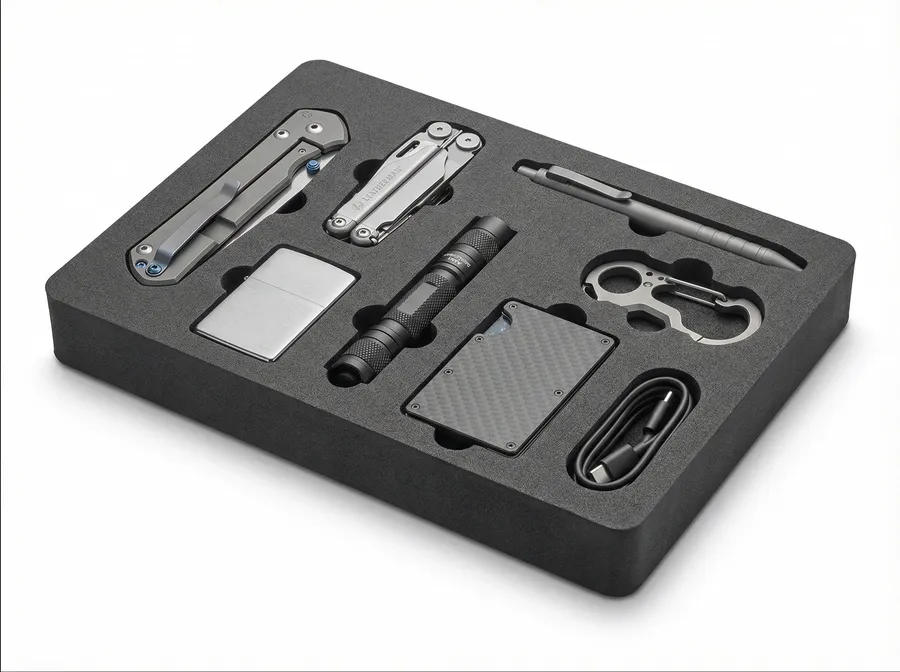
A tool case is distinguished less by the shell and more by the assumption that its contents are a known list that must reconcile. A general carrying case protects one object; a tool case protects many small, sharp, oddly shaped objects that are individually valuable and collectively useless if one is missing. That drives a different design brief: a flat, stable base so tools lie down rather than tumble, dividers or a cut layer so nothing migrates between items, and a lid arrangement that can be opened on a bench with the case staying put. In a military setting the same logic extends to accountability — a visible empty slot is a faster inventory check than a written list at the end of a shift.
Why crews care about the layout more than the plastic
Field maintenance is usually a race against a window of daylight or dark, and against weather. The failure mode is not a crushed case; it is reaching for a torque item that is not there. So the interior is the specification. A die-cut or CNC-cut silhouette holds each tool in a known position and reveals a missing one instantly, while a pluck-foam surface gives flexibility when the kit changes between roles. Many units want both: a firm cut base for the fixed core of the kit and a pluckable upper layer for whatever the current task adds. The shell's job is to keep that layout dry, closed and stackable; the layout's job is to make the crew fast.
Sizes and the numbers that matter
| Model | Internal Volume L | Internal Mm | Wall Mm | Material |
|---|---|---|---|---|
| KX-3308 | 5.8 | 325 x 236 x 76 | 2.3 | PP |
| KX-712 | 7.4 | 308 x 250 x 96 | 2.8 | Engineering PP |
| KX-3213 | 8.4 | 308 x 230 x 118 | 3.0 | PP |
| KX-63413 | 8.4 | 310 x 255 x 106 | 4.8 | ABS |
| KX-92817 | 6.9 | 253 x 180 x 152 | 5.0 | Engineering PP |
| KX-4010-2 | 10.7 | 388 x 307 x 90 | 3.4 | Engineering PP |
How they are built
The shells are injection-moulded thermoplastic — polypropylene, engineering polypropylene or ABS — in a lid and a base, and wall thickness is published per model across the tool range from 2.0 mm to 5.8 mm; the thicker ABS and engineering-PP boxes are the ones buyers rack or stack when full, because stiffness there is what stops a loaded case from bulging the lid and breaking the seal line. Handles, hinges and latches form the load path and are the parts that wear, so a tool case used daily should be treated as having serviceable hardware rather than a sealed body. The internal height, and the split between lid depth and base depth, decide whether a case carries a flat spread of spanners or a taller item such as a powered driver or a small instrument.
Choosing the right tool case
Size to the full tool list plus a margin for the small parts that always grow — consumables, tape, a multimeter that gets added later. Below about 5 L you are usually choosing a utility box for a narrow set; the working crew band sits between roughly 5 L and 20 L where a technician or a vehicle kit fits in one case; above 20 L the load becomes heavy enough that you should look at a handled case instead of a hand-carry. Then pick the interior by contact pressure and cleanability: closed-cell cut foam wipes clean after oily service and resists soaking, while open-cell or pluck foam flexes as the kit changes. Confirm wall thickness and net mass against how the case will be stored, because a thin single-user box and a racked unit kit are different orders.
Where military tool cases are used
Common users are vehicle and armourer maintenance crews, combat engineers, communications technicians working a repair kit, and medics carrying an instrument set. The pattern across all of them is a defined kit that must travel intact, open on a bench or a hood, and reconcile at the end of a shift. That is why tool cases are ordered by the unit or the fleet rather than as one-offs: the external footprint and the published carton packing let a buyer work out how many complete kits fit a pallet, a container shelf or a vehicle rack, which matters far more than the shape of any single box.
Customising for a crew kit
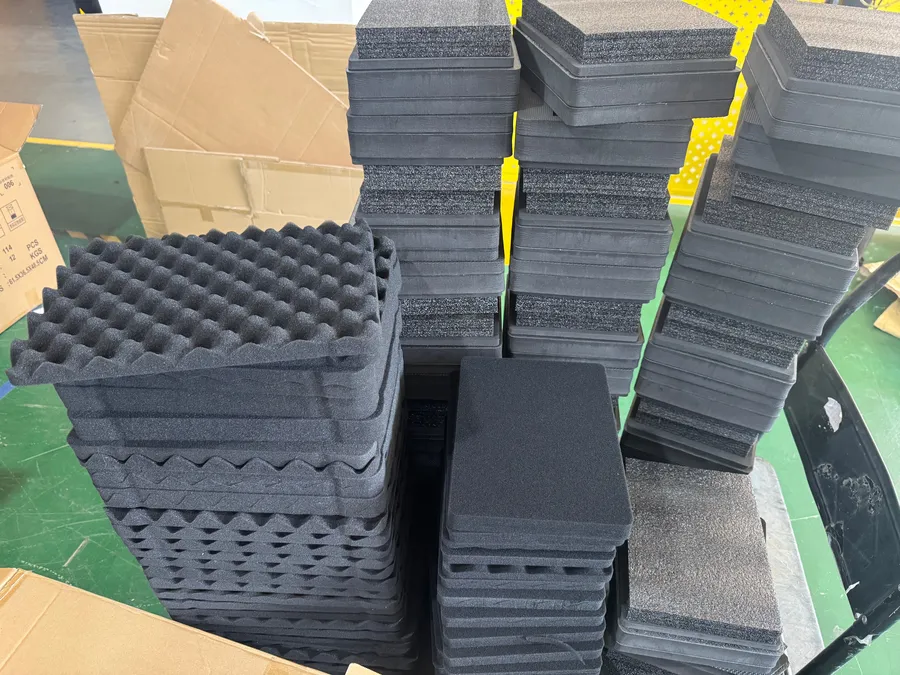
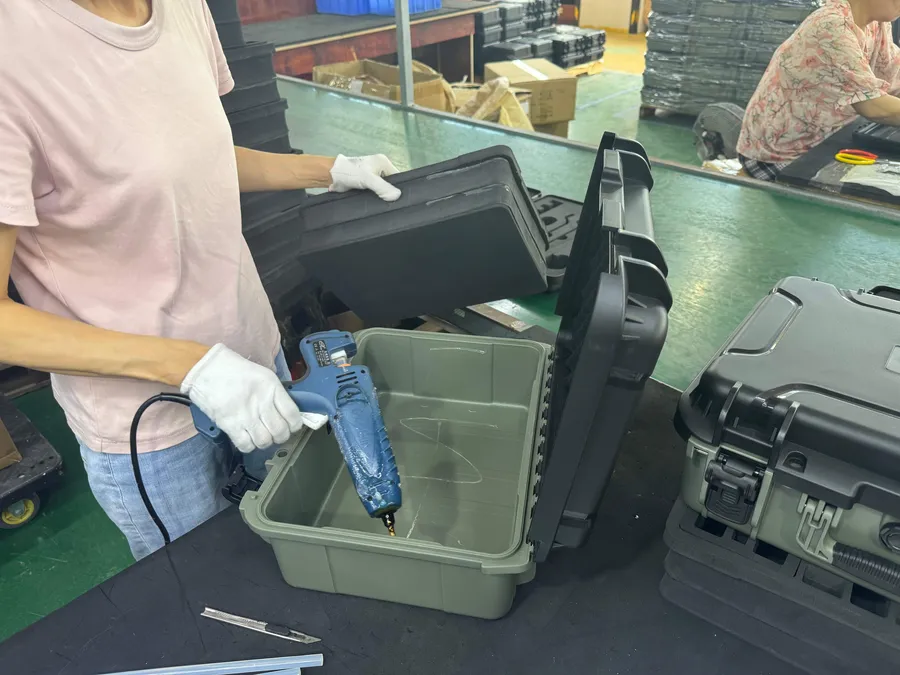
As a wholesale and OEM supplier we cut the interior to your tool list. The usual build is a CNC-cut base carrier for the fixed core with a pluckable upper layer for items that rotate between roles, and a shallow removable tray for pins, screws and small parts so they never sit loose in the foam. Branded colour and a printed or moulded logo are standard on OEM programmes so a fleet can be told apart at a glance. On a new mould the published terms apply: about 45 days to a first OEM sample, about 125 days to a new tool, a 30 percent tooling deposit, and production on EXW or FOB.
Notes before you buy
We sell to distributors, integrators and OEM programmes on wholesale terms and do not retail single units; quotations are EXW or FOB and we do not offer DDP or store stock in an overseas warehouse, so plan freight and clearance yourself. Order against the datasheet of the exact model, because internal dimensions, wall thickness, net mass and pieces-per-carton are published per model and differ across the range. Where a protection property has not been measured on a model we do not claim it; you specify from tested figures for the case you buy.
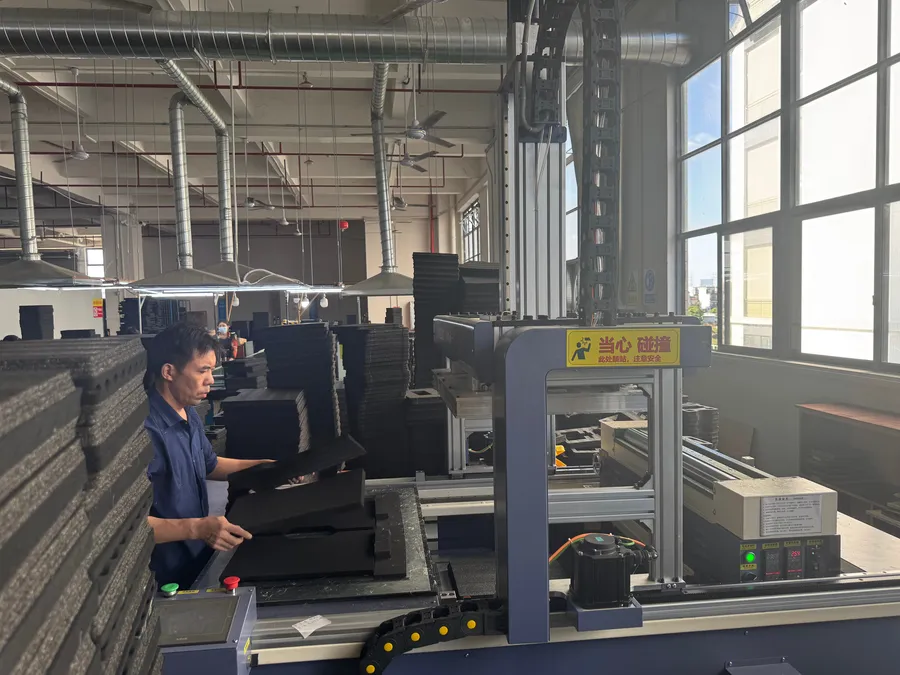
Customisation
Everything described above is configurable on a standard shell: interior layout (pick-and-pluck, die-cut or CNC-cut), foam grade and thickness, colour, logo method, latch and lock count, pressure-equalisation valve, cable ports, document holder and identification plate. A bespoke exterior geometry requires a new mould — 125 days, from 3,000 units per moulded component.
Procurement considerations
| Question | What to send us |
|---|---|
| Which shell fits? | Equipment L × W × H as packed, plus required clearance per axis |
| What does it cost? | Order quantity and estimated annual quantity — the two drive different answers |
| Is tooling needed? | Whether an existing shell clears the envelope with usable foam depth |
| Lead time? | Your required delivery date, not just the order date |
| Certification? | The exact standard your tender names — we will say whether we can test to it |
| Freight? | Destination and preferred terms; carton and pallet data supplied with the quotation |
Comparison and selection guide
The tables on this page exist because a protective case is chosen by comparing three things: the envelope, the environment and the handling chain. Where no table applies, the rule below is.
| Situation | What To Do |
|---|---|
| Fixed inventory | CNC or die-cut silhouette with part numbers printed on the foam. |
| Variable kit | Pluck foam plus a loose tray. |
| Bench work | Removable trays that lift out square so the case doubles as a stand. |
- Size on internal dimensions plus clearance, never on a product name.
- Choose the carrying method before the shell: it changes the series, not just the price.
- Specify the interior last, and decide up front whether the end user will reconfigure it.
What is a military tool case? relates to Military Case Guide. Related families: Tool Cases / Tactical Equipment Cases / Military Equipment Cases / Field Equipment Cases. Related sectors: field and industrial equipment. Continue in the Military Case Guide cluster.
This page is written from our own production data. If your requirement differs, send the dimensions and we will tell you which of the 155 models fits, or whether a custom route is needed.