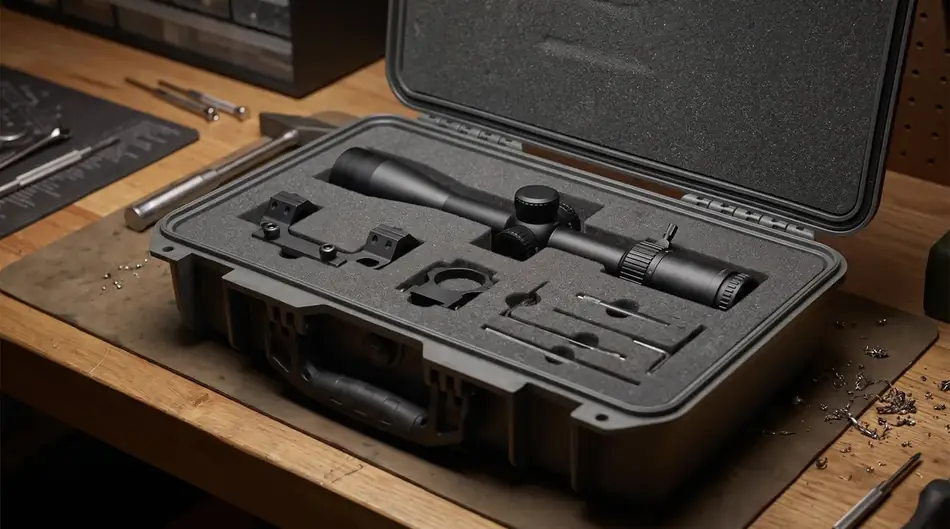
What factors affect the durability of military tool cases?
Durability in a military tool case is decided by five factors working together, and only one of them is the shell. Wall thickness and shell material set what the case can take as a structure, running from 2.0 mm to 5.8 mm across the tool-case models we publish; hardware such as latches, hinges and handle stays usually wears out long before a sound shell does; the seal line decides whether grit and moisture reach the interior, and is offered on 91 of the 120 tool-case models in our range; interior fit decides how much force your tools transfer in a knock; and stacking and handling discipline decides what the case survives between uses. No single number captures all five, which is why we publish a datasheet per model, leave unmeasured fields blank instead of claiming them, and put any decisive rating in writing before production starts.
Key points
- Judge durability as a system: shell, hardware, seal, foam fit and handling; a thick wall cannot save a worn latch.
- Wall thickness is a per-model figure on our datasheets, 2.0 mm to 5.8 mm across the published tool-case range, never a range-wide claim.
- Latches, hinges and handle stays take the daily abuse; ask which parts are replaceable and whether spares are stocked before you order.
- A gasketed seal is available on 91 of the 120 published tool-case models; keep the seal line clean or its function is theoretical.
- Cut the foam so tools cannot shift; a loose load multiplies shock and scuffs both the kit and the case interior.
- We publish measured values per model and leave untested fields blank; put any decisive rating in the contract, not in a brochure claim.
Durability is a system property, not a shell property
When buyers ask how long a military tool case lasts, they are really asking where the weakest part of the system sits, because a case in service fails at its weakest subsystem, not at its average one. The shell is the part people inspect first, and it is rarely the part that gives out: hinges loosen, latches lose tension, a gasket collects grit, or a loose load hammers the interior until the shell looks fine but the kit no longer travels safely. Our published range runs to 155 models, and the discipline is the same across all of them: durability is specified per model, per part and per measured value, never as a single slogan. This article walks through the five factors in the order they actually fail, so a buyer can inspect a sample, read a datasheet and write a specification that matches how the case will really be used.
Wall thickness and shell material
The shell is the structure, and its two published numbers are wall thickness and material. Across the 120 tool-case models in our range, walls run from 2.0 mm on the small utility shells to 5.8 mm on the biggest: the WL4010 carries a 3.0 mm wall at 1,015 g empty, the WL4312 a 3.5 mm wall at 1,170 g, the WL5021 3.7 mm at 3,430 g, and the WL5321 5.8 mm at 4,810 g with 481 x 373 x 192 mm of interior. Material is polypropylene on 68 of those models, engineering polypropylene on 32 and ABS on 20, and each choice trades weight, stiffness and cost differently per model rather than better-versus-worse. What matters for service life is that the numbers are published per model: a buyer who knows the wall and the material can reason about point loads, stacking and handling instead of trusting a category label. Where a shell thickness looks thin for your load, the honest fix is a different model, not optimism.
Where a tool case wears out, and what to check
The table turns the five factors into an inspection routine you can run on a sample before an order, and again at each service interval.
| Part | What Wears It | What To Check | What We Publish |
|---|---|---|---|
| Shell | Point loads, corner knocks, UV and temperature where the datasheet has no measured field | Cracks around hinge and latch bosses, warpage that breaks lid register | Wall thickness and material per model; unmeasured properties stay blank |
| Hardware | Every opening cycle, plus grit working into the hinge line | Latch tension, hinge screw torque, handle play under load | Hardware specification per model; padlockable latch bodies on the models that list them |
| Seal line | Abrasives carried on the gasket, storage with the latch relaxed | Gasket continuity around the lid, seating after closing | Seal availability per model, offered on 91 of 120 tool-case models |
| Interior | Contents shifting in transport, wrong foam layout for the load | Pockets still grip, egg-crate intact, no permanent set | Foam types and structures available per model, from pick-and-pluck to CNC |
| Stacking interface | Off-centre loads, stacking beyond the agreed pattern | Feet and lid registers aligned, lower cases not deforming | Stackable flag per model, true on 115 of 120 tool-case models |
Hardware wears before the shell does
On any case opened daily, the moving parts accumulate more cycles than everything else combined. Latches lose spring tension, hinge screws work loose under vibration, and a handle stay that was never specced for the packed mass will announce itself at the worst moment. This is why our datasheets carry the hardware line per model and why the latch bodies on the models that list it accept a standard padlock, so security hardware is a fit you can source rather than a sealed secret. When you compare suppliers, ask three questions the catalogue rarely answers: which wearing parts are designed to be replaced, whether spares are stocked against the models you are buying, and whether the handle is matched to the packed weight of your kit rather than to the empty shell. A case whose hardware can be maintained in the field will outlive a marginally thicker shell whose latch cannot be repaired, every time.
The seal line and the lid interface
A gasketed seal is what separates the interior from dust and water in transit, and it only works while the lid interface holds its geometry: the gasket stays continuous, the hinges keep both halves in register, and enough latches pinch the line evenly along its length. In our published range, a seal is offered on 91 of the 120 tool-case models, and a pressure-relief fitting is a supplied option on the models that support one, which matters when a sealed case is air-freighted or moved between climates. Service life of the seal is mostly a handling question: grit carried on the gasket abrades it, and a case stored latched for years takes a set. Our separate article on what an IP rating does not tell you makes a point that applies here: a rating printed on a shell says nothing about the gasket in front of you, so inspect the seal line as a part, not as a label.
Interior fit: what the contents do to the case
The foam layout decides the force the equipment sees, and it also decides what the case itself endures. A loose load doubles the violence of every knock, because the tool gains momentum inside the case before it strikes a wall, and a shifting load abrades the interior and works fittings loose. We build interiors as pick-and-pluck for kits that change between jobs, die-cut pockets for repeatable service sets, and CNC profiles when every item must sit fixed, with EVA, PE and EPE as the working materials and top, base, egg-crate or layered structures as the build-up. Thickness is chosen against the mass and fragility of the load rather than by habit, which is why our foam thickness guide starts from the kit and not from the catalogue. A well-fitted interior protects both directions at once: the tools from the journey, and the case from its contents.
Stacking, transport and handling discipline
Between uses, a tool case lives as a stackable box, and that is a durability factor buyers forget to specify. 115 of the 120 tool-case models we publish are flagged stackable, which means the feet and lid registers are designed to hand load down into the case below; it does not mean every stack height is approved, and our stack-load fields stay blank per model until a value is measured. The discipline that preserves a fleet is unglamorous: heavy kits low in the stack, the stacking pattern agreed before palletising, and off-centre loads corrected rather than tolerated. Our articles on stack selection and on what affects the stability of stacked cases cover the geometry in detail. In practice, more cases are ruined by a forklift operator solving a space problem than by any property of the polymer, so the stacking rule belongs in the delivery specification, next to the datasheet.
Environment: heat, cold, sunlight and chemicals
The honest position on environmental durability is that we publish what we have measured and leave the rest blank. Ultraviolet resistance and operating temperature ranges are unmeasured fields on most of our models, which means a datasheet blank, not a rating; thermoplastic shells have no ferrous corrosion path, which is a real advantage over metal hardware ecosystems, but it is not a claim about sunlight or temperature extremes we have not tested. If your programme stores cases on an open flight line, ships them through a tropical port or wipes them down with solvents, name those conditions at the quotation stage so the material choice and any test requirement are agreed in writing, and treat any supplier who fills those blanks with confident numbers and no test record as a risk rather than a bargain.
Specifying durability in a purchase
Durability becomes enforceable the moment it is written down per model. Read the datasheet of each shortlisted shell for wall thickness, material, hardware, seal availability and empty weight, and read every blank field as untested rather than poor. If a property is decisive for your programme, put it in the quotation as a requirement with a test method, so it is agreed before production instead of argued after delivery. We manufacture and sell wholesale and OEM only, on EXW or FOB terms with a 30% deposit and no retail channel, no DDP and no overseas warehouse, which keeps the specification conversation between the buyer and the factory that pours the moulds. For military and defence programmes, we also recommend treating the packing list, the approved foam layout and the per-model datasheet as deliverables alongside the cases, because the record of what was agreed is what keeps a fleet consistent across repeat orders.
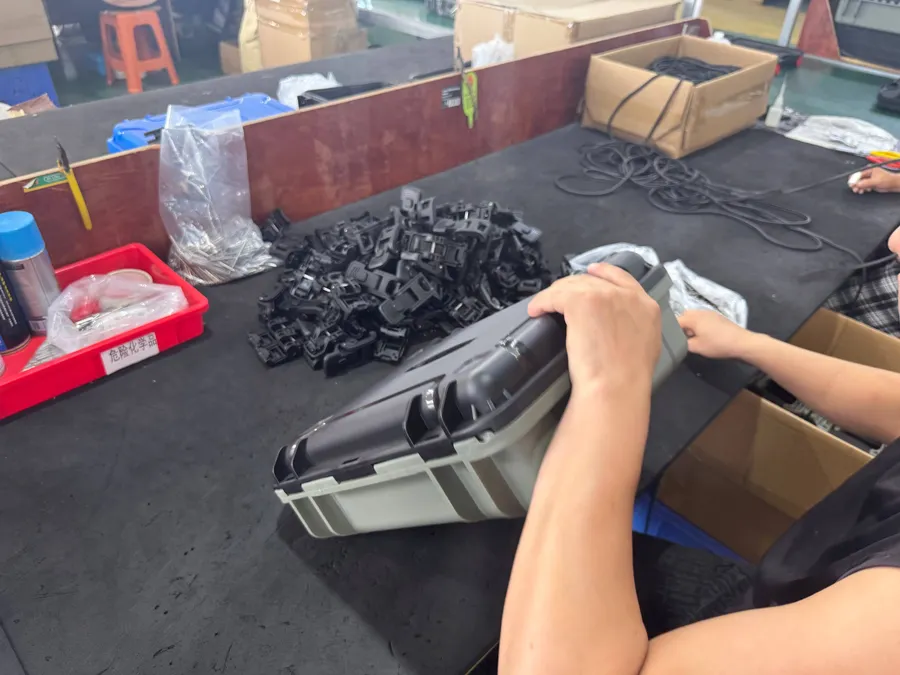
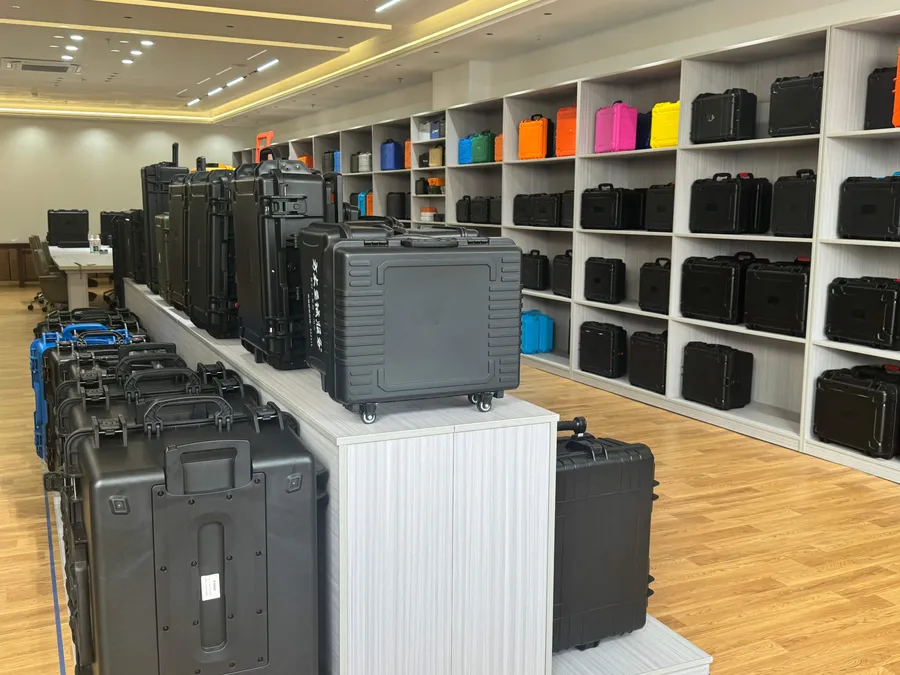
Customisation
Everything described above is configurable on a standard shell: interior layout (pick-and-pluck, die-cut or CNC-cut), foam grade and thickness, colour, logo method, latch and lock count, pressure-equalisation valve, cable ports, document holder and identification plate. A bespoke exterior geometry requires a new mould — 125 days, from 3,000 units per moulded component.
Procurement considerations
| Question | What to send us |
|---|---|
| Which shell fits? | Equipment L × W × H as packed, plus required clearance per axis |
| What does it cost? | Order quantity and estimated annual quantity — the two drive different answers |
| Is tooling needed? | Whether an existing shell clears the envelope with usable foam depth |
| Lead time? | Your required delivery date, not just the order date |
| Certification? | The exact standard your tender names — we will say whether we can test to it |
| Freight? | Destination and preferred terms; carton and pallet data supplied with the quotation |
Comparison and selection guide
The tables on this page exist because a protective case is chosen by comparing three things: the envelope, the environment and the handling chain. Where no table applies, the rule below is.
| Situation | What To Do |
|---|---|
| Start from the equipment, not the case | Measure the tallest, widest and longest points of the packed equipment including antennas, handles and connectors. Add 20 mm minimum clearance per axis before selecting a shell. |
| Then choose the carrying method | Under 8 kg, a fixed handle is lighter and cheaper. Over 12 kg or any journey over 30 m, specify the T series with telescopic handle and wheels. |
| Then decide the interior | Pick-and-pluck for kits that change. Die-cut or CNC-cut for fixed layouts that must be auditable at a glance. |
- Size on internal dimensions plus clearance, never on a product name.
- Choose the carrying method before the shell: it changes the series, not just the price.
- Specify the interior last, and decide up front whether the end user will reconfigure it.
What factors affect the durability of military tool cases? relates to Military Case Guide. Related families: Military Protective Cases / Tool Cases / Military Equipment Cases / Field Equipment Cases. Related sectors: field and industrial equipment. Continue in the Military Case Guide cluster.
This page is written from our own production data. If your requirement differs, send the dimensions and we will tell you which of the 155 models fits, or whether a custom route is needed.