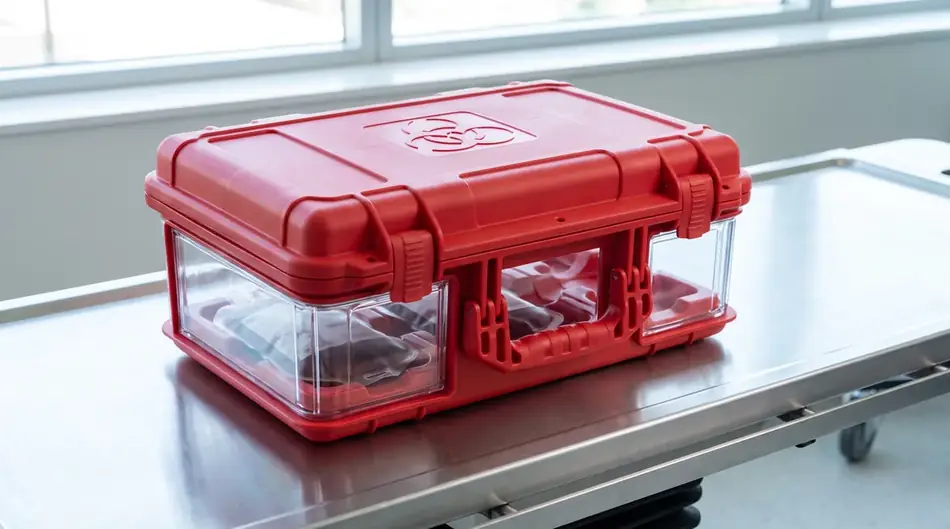
How should medical equipment be protected during transportation?
Medical equipment is protected in transportation by the same physics as any precision payload — control shock, control movement, control contamination — with one extra demand: the contents have to stay clean and have to be findable in seconds. A rigid thermoplastic shell carries the stacking and the knocks, but the protection the device actually feels comes from an interior that immobilises it, a seal that keeps splashes and dust out, and a layout that makes a missing instrument obvious the moment the lid opens. In our published range the models we tag for medical equipment run from about 20 to about 139 litres of internal volume, with wall thickness published per model between 3.3 mm and 6.0 mm, and a compressible gasket available on most shells.
Key points
- A medical case must cushion, keep contamination out, and let a crew verify the contents at a glance — all three, not just the shell.
- Immobilise every item in a cut interior; a loose device inside a rigid box turns each small knock into a fresh impact.
- Choose closed-cell foam for medical use because it does not absorb spills and wipes clean; open-cell foam adds debris.
- We publish gasket construction per model but state no ingress, sterilisation or clinical rating that has not been tested.
- For a loaded response kit, wheels and a telescopic handle decide whether one person can move it over the last distance.
What transportation does to medical equipment
A field medical case is exposed to the same sequence as any rugged payload: it is lifted, stacked under unknown loads, dragged by a handle, driven over uneven ground, splashed, and opened somewhere that is not a clinic. Precision devices inside — monitors, analysers, powered treatment equipment and instrument sets — react to that sequence in two ways. Mechanically, vibration and shock shift calibration and stress soldered and glued joints. Hygienically, the danger is not the drop but the contamination that rides in on it: dust, spray and the residue of a boot on an open lid. A case designed for this payload is judged on three things at once — how much force reaches the device, whether anything clean stayed clean, and whether the crew could find the one item they needed without turning the box upside down.
Immobilise and lay out for accountability
Fit comes first. Each device and each instrument should sit in its own cut so it cannot travel, because a snug interior is more protective than a thick one — a loose item simply accelerates through soft foam and strikes the far wall with more energy. The second job of the interior is accountability: in a medical kit the real failure is not a cracked screen but a missing component discovered only when it is needed. A layout where every item has a visible silhouette — a die-cut or CNC tray, or a pick-and-pluck bed you can restock — makes an absent instrument obvious at a glance and keeps a restock tidy between deployments.
Where the kit changes between missions, a fixed carrier for the durable items plus a pluck-foam top layer for what varies gives you both the accountability and the flexibility, without leaving anything free to move inside the shell.
Keep it clean without pretending to certify it
Cleanability is mostly a materials decision. A closed-cell foam does not absorb a spill and can be wiped and left to dry; an open-cell foam drinks the liquid and sheds particles, so for anything that travels alongside fluids or reagents the closed-cell choice is the practical one. A moulded thermoplastic interior with no fabric liner wipes far more easily than a lined one. Around the closure, a compressible gasket set in a continuous moulded channel resists dust and splash, and we can show you that construction per model. We are honest about the limit: we supply transport packaging, not medical devices, so we make no sterilisation, biocompatibility or clinical claim, and we do not publish an ingress protection code for these shells because that testing has not been carried out. If your programme needs a specific rating, accredited testing can be commissioned as a separate work package.
Mobility for a loaded response kit
Container and pallet logistics carry the long haul; the hard part is the last distance from the vehicle to where care is delivered. A loaded response kit crossed over gravel, sand or a yard is a two-person lift unless the case is built to roll, and that is the reason the wheeled and handled shells exist. Below roughly five kilograms empty a fixed handle is lighter and cheaper; once the loaded case is heavy enough, or the surface rough enough, wheels and a telescopic handle become the reason the equipment arrives. We publish the handle travel and the wheel arrangement per model rather than simply calling a case mobile, so the pull can be matched to the people who will actually use it.
The published sizes used for medical payloads
| Model | Internal Mm | Internal Volume L | Wall Mm | Empty Mass Kg | Shell | Mobility |
|---|---|---|---|---|---|---|
| KX-64618 | 430 x 290 x 165 | 20.6 | 4.7 | 2.78 | ABS | Fixed handle |
| KX-64120 | 378 x 307 x 187 | 21.7 | 4.0 | 2.64 | ABS | Fixed handle |
| KX-85021 | 437 x 308 x 164 | 22.1 | 4.5 | 4.91 | Engineering PP | Wheels + telescopic |
| KX-5021 | 465 x 315 x 196 | 28.7 | 3.7 | 3.43 | ABS | Fixed handle |
| KX-85424 | 483 x 363 x 190 | 33.3 | 4.5 | 6.00 | PP | Wheels + telescopic |
| KX-85835 | 500 x 400 x 305 | 61.0 | 5.0 | 8.52 | PP | Wheels + deep base |
| KX-86836 | 595 x 460 x 315 | 86.2 | 4.8 | 10.60 | PP | Wheels + telescopic |
Choosing the right shell by payload
Size from the packed kit as it will really sit — device, charger, cables, consumables and the instrument tray — measure the extremes, add a working clearance on every axis, then read across the table for a shell whose internal length, width and height all exceed that figure. For a single portable monitor or a compact diagnostic set, a light hand-carry box in the low twenties of litres keeps the loaded mass down; for a treatment kit with a powered device and its accessories, take a wheeled shell with a deep base so the system and the small parts sit low over the wheel line and the lid simply closes over the top rather than crushing the contents. The variable that trips buyers up is internal height, not volume.
Where medical cases are used
Commonly carried payloads include patient monitoring and diagnostic devices, portable powered treatment equipment, instrument and supply sets, and specimen or consumable transport — in each case a system that must move as one object, by a known number of people, and be opened and worked from without a second trip for parts. Buyers specify these as a matched family so the same footprint repeats predictably in an ambulance bay, a store or a container, which is why external dimensions and the carton and pallet data matter as much as the internal volume. The accountability of the interior — a cut you can audit in two seconds — is often the feature that decides the order.
Customising for one kit
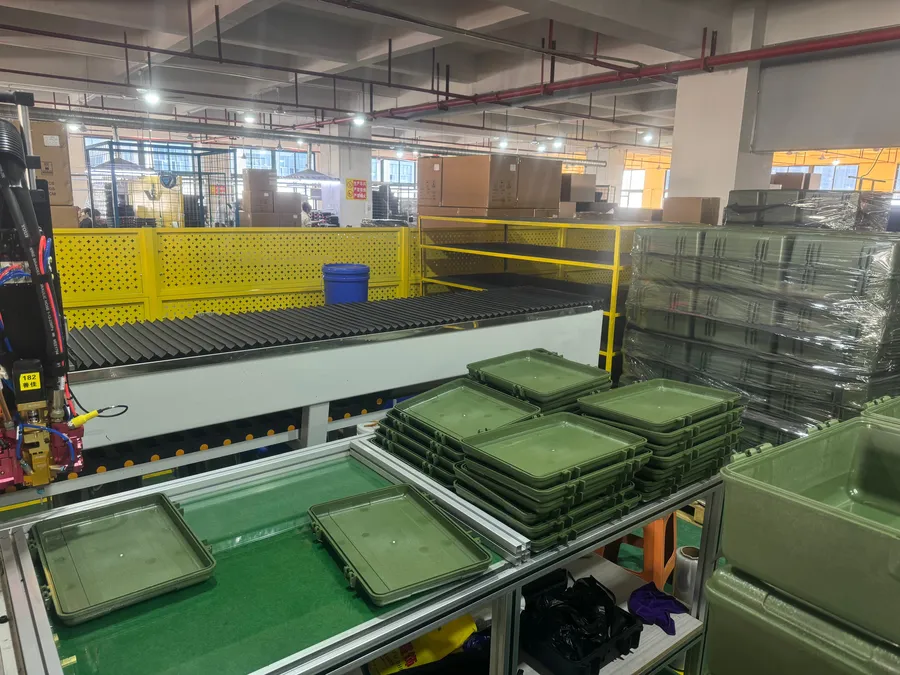
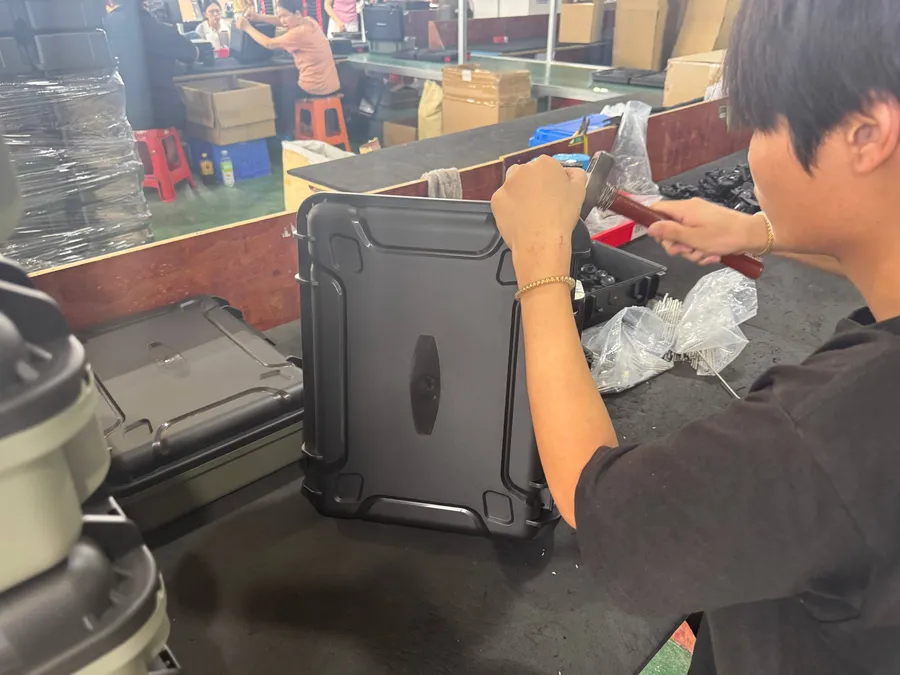
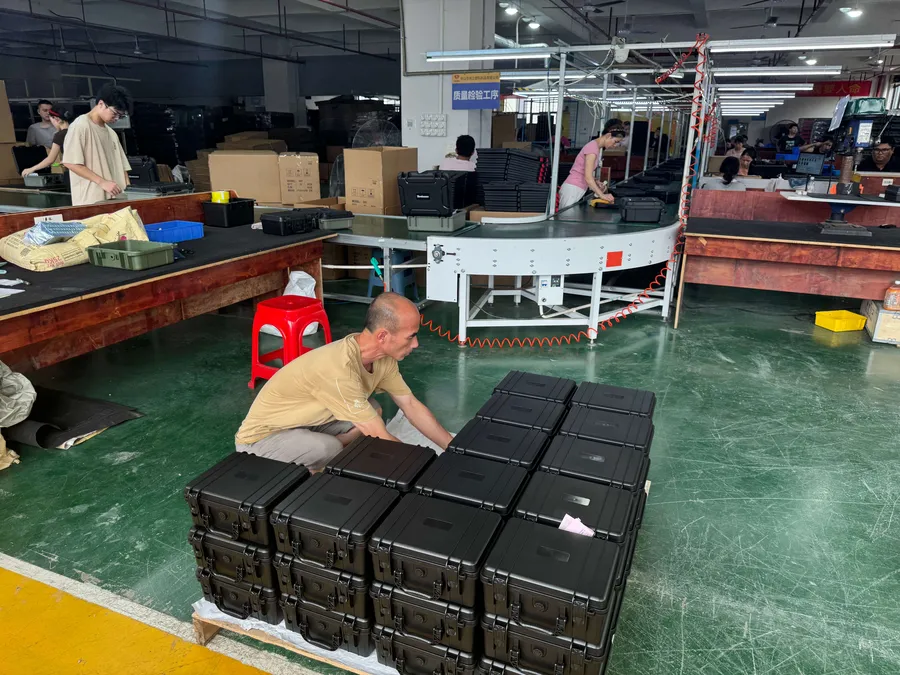
We cut the interior to your kit rather than to a catalogue label. For a product family the standard build is a fixed CNC tray for the durable devices plus a pluck-foam top layer for the consumables that change; we quote foam by contact pressure rather than a single blanket density, and the closed-cell versus pick-and-pluck choice follows how often the kit is restocked and how often it must be wiped. Colour matching and a moulded or printed logo are available on OEM programmes. The published parameters apply on a new tool: a first OEM sample in about 45 days, a new mould in about 125 days, and a 30 percent deposit on tooling, with production on EXW or FOB terms.
Notes before you buy
We supply transport packaging on wholesale and OEM terms for distributors, integrators and programmes, and we do not sell single units at retail; quotations are EXW or FOB, we do not offer DDP, and we hold no overseas warehouse stock, so build your own freight and clearance into the plan. We make no clinical, sterilisation or ingress claim for these shells: we publish measured physical figures per model — internal and external dimensions, wall thickness, empty mass and the lid-to-base split — and where a protection property has not been tested on a model we do not state it. Ask for the datasheet of the exact model you intend to order, because those figures vary across the range and they decide the fit.
Customisation
Everything described above is configurable on a standard shell: interior layout (pick-and-pluck, die-cut or CNC-cut), foam grade and thickness, colour, logo method, latch and lock count, pressure-equalisation valve, cable ports, document holder and identification plate. A bespoke exterior geometry requires a new mould — 125 days, from 3,000 units per moulded component.
Procurement considerations
| Question | What to send us |
|---|---|
| Which shell fits? | Equipment L × W × H as packed, plus required clearance per axis |
| What does it cost? | Order quantity and estimated annual quantity — the two drive different answers |
| Is tooling needed? | Whether an existing shell clears the envelope with usable foam depth |
| Lead time? | Your required delivery date, not just the order date |
| Certification? | The exact standard your tender names — we will say whether we can test to it |
| Freight? | Destination and preferred terms; carton and pallet data supplied with the quotation |
Comparison and selection guide
The tables on this page exist because a protective case is chosen by comparing three things: the envelope, the environment and the handling chain. Where no table applies, the rule below is.
| Situation | What To Do |
|---|---|
| Clinical environment | Closed-cell foam or a wipeable tray; no open-cell pluck foam. |
| Emergency use | Latches that open with one hand and a lid that stays up unaided. |
| High-value device | Deeper base foam, a separate transducer zone, and a documented drop test if required. |
- Size on internal dimensions plus clearance, never on a product name.
- Choose the carrying method before the shell: it changes the series, not just the price.
- Specify the interior last, and decide up front whether the end user will reconfigure it.
How should medical equipment be protected during transportation? relates to Military Case Guide. Related families: Medical Equipment Cases / Instrument & Equipment Cases / Military Equipment Cases / Military Protective Cases / Defense Equipment Cases / Custom Protective Cases. Related sectors: field and industrial equipment. Continue in the Military Case Guide cluster.
This page is written from our own production data. If your requirement differs, send the dimensions and we will tell you which of the 155 models fits, or whether a custom route is needed.