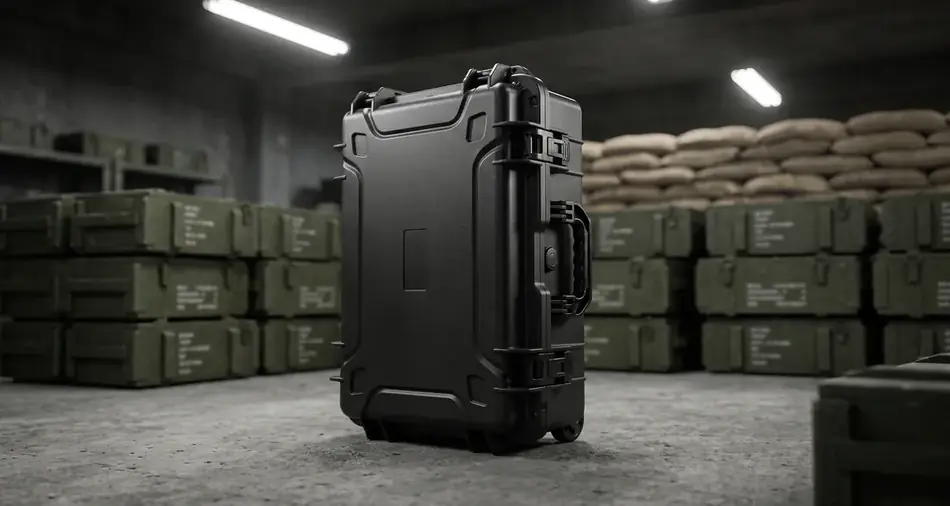
What makes a transport case suitable for field logistics?
A transport case is suitable for field logistics when it passes six practical tests, each answered by a figure published for that specific model: can the crew that exists move it loaded, does its external box fit the racks, bays and pallets it will meet, is its wall structure enough to carry the stack above it, does its closure keep handling residue out and show tampering, does the interior make the pack reproducible by whoever repacks it, and can the order be freighted from real carton data rather than an estimate. Nothing in that list is a material adjective. Suitability is arithmetic against the route, and in a 155-model catalogue the same internal volume can be supplied as a flat-stack shell or as a wheeled case, which is why the model page - not the product family - is the unit of decision.
Key points
- Judge a transport case against the route, not the brochure: mass, footprint, wall, closure, interior and packing are six separate tests that all have to pass.
- One footprint can answer three links: KX-87319, KX-87323 and KX-87336 share a 733 x 505 mm external box in 190, 230 and 357 mm heights.
- Empty mass is published and it decides crew size: the rolled models run from 4.91 kg to 15.32 kg before anything is packed inside, with handle travel from 240 mm to 485 mm.
- Wall thickness, published per model between 2.0 and 6.0 mm, is what allows a loaded case to sit under another one; a thin shell is not wrong, it is for a different job.
- A compressible gasket is offered on 124 of the 155 models - the rest are supplied without a sealing rim, so a closed rim must be matched model by model.
- Freight is bought by the carton: KX-64120 ships 6 to a 750 x 425 x 640 mm carton, KX-65522 ships 3 to a 565 x 450 x 665 mm carton, and trolley models ship one per carton.
Suitability is six tests, not one datasheet field
Most specification arguments start with the wrong question. They ask what a case is made of, and the answer tells you nothing about whether it will survive your route. The question that decides suitability is operational: what happens to this box between the stock point and the position, how many times, and to whom. A transport case earns the name by passing six tests at once - moving it, fitting it, stacking it, closing it, packing it and shipping it. Fail one and the case is worked around, and a worked-around case protects nothing however good its material is.
The six tests are also the honest way to read a catalogue. Where a property has not been measured for a given model it is marked as not measured rather than filled with a plausible number, so a specification built on published figures stays defensible through a tender review instead of collapsing when someone asks which test supports the claim.
Test 1: the mass test
Add the empty shell to the packed load and ask who moves it. That single calculation decides more about the case type than any material choice, because two-person work doubles labour and halves throughput on every handover in the chain. Empty masses are published per model: the smallest rolled shell, the 22.1-litre KX-85021, weighs 4.91 kg; KX-85827 at 44.0 litres weighs 7.80 kg; KX-86136 at 58.0 litres weighs 8.50 kg; KX-87336 at 86.6 litres weighs 10.66 kg; and the deepest shell in the range, the 139.5-litre KX-88442, weighs 15.32 kg before anything goes inside. Where handle travel is published it runs from 240 mm to 485 mm, which is what lets the pull angle be matched to the people doing the pulling rather than to a default.
The test is failed in both directions. A shell with wheels where none were needed carries dead mass on every lift from shelf to vehicle; a hand-carry shell chosen for a 200 metre crossing of loose ground turns a one-person move into a two-person move and gets dragged, which is how hinges and latches get replaced.
Test 2: the geometry test
A case must fit the infrastructure that already exists: shelf grids, rack bays, vehicle interiors and the pallet standard of the destination market. This is a test on external dimensions, not internal ones, and it is the reason the catalogue is organised as footprint ladders. The 8 Series family around a 733 x 505 mm external box makes the point clearly: KX-87319 is 190 mm tall with 650 x 430 x 170 mm internal and 47.5 litres, KX-87323 is 230 mm tall with the same plan and 58.7 litres, and KX-87336 is 357 mm tall with the same plan again and 86.6 litres. The rack, the bay and the pallet rule do not change between the three; only the depth does.
The geometry test also covers the awkward shapes that break naive stacking - the square footprint of KX-96127 at 610 x 610 mm external, or the long-format shell whose internal envelope runs 1,280 x 350 x 140 mm and cannot be folded into anything shorter. Measure the fixed openings first, then read the ladder.
Test 3: the structure test
Wall thickness is the figure that lets a loaded case sit under another loaded case, and it is published per model across a band from 2.0 mm to 6.0 mm. Thin-wall shells are not inferior; they are for hand-carried, shelf-stored loads where mass is the constraint. The heavy end of the catalogue exists for the other job: KX-6621 publishes a 6.0 mm wall on a 662 x 495 x 210 mm external box, KX-5321 publishes 5.8 mm, KX-85827 and KX-87336 publish 5.0 mm, and KX-85726 sits at 4.2 mm. The lid-to-base depth split belongs in the same test, because it decides where the structure is: KX-6621 and KX-5321 pair a 43 mm lid with a 149 mm base so almost the whole volume is in the load-bearing half, while KX-87336 splits 260 mm base to 50 mm lid.
Test 4: the closure test
Closure does two jobs a field route cares about: it keeps contamination out of the rim and it shows whether the box has been opened. A compressible gasket is offered as a configuration option on 124 of the 155 models, and the remaining shells are supplied without a sealing rim - which is a reason to read the model page rather than assume a family property. Latch bodies are published as accepting a standard padlock, latch count is set per configuration, and a pressure-equalisation valve can be fitted on suitable models so altitude and temperature changes do not fight the latch torque.
Even compression, not gasket thickness alone, is what keeps a rim closed. Latch count scales with lid area, hinges locate the lid, and a case that is closed unevenly will show it as a damp corner on the first wet cycle. State the closure exactly as built - gasketed rim, latch count, valve option - and leave ingress codes out of the paperwork unless the exact model and configuration has its own test record.
Test 5: the interior test
An interior is a load path and a checklist at the same time. A firm carrier layer under the device stops it settling; a softer contact layer protects finished faces; cut-outs locate each item so the correct layout is the easy layout, and a missing item shows as an empty silhouette during a handover check. Pick-and-pluck, die-cut and CNC-cut layouts in PE, EPE and EVA foam are available as configurations, assembled as base foam, top foam, layered or egg-crate structures and graded by zone where the load needs it. Custom foam on an existing shell starts from a single unit, so a layout can be proven before a fleet order is committed.
Reproducibility is the part buyers forget. In the field the same case is repacked by whoever is on duty, at night, in a hurry. If the correct layout is not obvious from the foam, the pack degrades after the first cycle and the case fails the test it was chosen for.
Test 6: the freight test
Carton data is published for 64 of the 155 models, and it is the difference between a landed cost you can quote and one you discover. Work the numbers in order: pieces per carton from published pack data, cartons per layer against the pallet footprint you actually use, then layers against the usable height of the container. Pallet quantities are calculated against your pallet standard rather than printed as a universal number, and 20 ft, 40 ft and high-cube builds are supplied with the quotation.
| Model | Internal Mm | External Mm | Empty Mass Kg | Stackable Published | Carton And Pieces |
|---|---|---|---|---|---|
| KX-2005 | 190 x 135 x 40 | 195 x 170 x 46 | 0.175 | Yes | 410 x 360 x 495 mm, 40 per carton |
| KX-705 | 420 x 270 x 112 | 425 x 320 x 115 | 0.83 | Yes | 645 x 435 x 595 mm, 10 per carton |
| KX-64120 | 378 x 307 x 187 | 405 x 362 x 195 | 2.64 | Yes | 750 x 425 x 640 mm, 6 per carton |
| KX-65522 | 507 x 385 x 190 | 545 x 440 x 215 | 4.86 | Yes | 565 x 450 x 665 mm, 3 per carton |
| KX-5321 | 481 x 373 x 192 | 525 x 434 x 214 | 4.81 | Yes | 530 x 440 x 635 mm, 3 per carton |
| KX-96127 | 545 x 545 x 210 | 610 x 610 x 270 | 8.54 | Not designated, wheeled shell | 640 x 625 x 280 mm, 1 per carton |
| KX-97227 | 590 x 435 x 210 | 720 x 500 x 270 | 10.00 | Not designated, wheeled shell | 715 x 515 x 280 mm, 1 per carton |
How the three common patterns answer the same route
The interesting part of that comparison is what it leaves out: none of the three is the right case in general. A fleet normally holds all three on one footprint so the racks, bays and pallet grids stay shared, and the pattern is chosen per link rather than per item. That is only possible when the external geometry repeats across the family, which is why the geometry test is worth settling before the mass and closure arguments begin.
| Pattern | Example Published | Strongest Link | Where It Fails |
|---|---|---|---|
| Flat-stack shell, no wheels | KX-87323: 733 x 505 x 230 mm external, 58.7 litres internal, 5.0 mm wall, stackable designation | Depot density and palletised line-haul | Long crossings of rough ground with one person available |
| Deep-body carry shell with a load-bearing base | KX-6621: 662 x 495 x 210 mm external, 48.9 litres, 6.0 mm wall, 43 mm lid to 149 mm base, 6.42 kg empty | System moves where the whole kit must travel in one lift | Shelf grids written for a smaller footprint |
| Wheeled case with a telescopic handle | KX-87336: same 733 x 505 mm footprint at 357 mm high, 86.6 litres, 10.66 kg empty, 240 mm handle travel | The last distance between vehicle and position | Stacking in store, where the wheeled shells are not designated stackable |
Selecting against a real route
Write the route down and number the handovers. For each one, name the person who moves the case and the surface under the wheels or feet. Then set the constraint that cannot move - the rack bay, the vehicle doorway, the pallet standard - and eliminate every model whose external box does not fit it. What remains is a shortlist of footprints, and inside each footprint read down the depth ladder for the internal envelope your packed system needs, allowing clearance on every axis so the insert rather than the shell wall takes the movement.
Only at that point does material enter the decision. The catalogue is injection-moulded thermoplastic: polypropylene on 94 models, engineering polypropylene on 38, ABS on 22 and one combination shell, and the choice between them follows the job - mass and chemical behaviour for the lighter shells, stiffness and finish for the heavy bodies. Finally check the flags against the plan: stackable on 136 of 155 models, gasket offered on 124, wheels plus telescopic handle on 19. A case that passes all six tests is a case nobody has to work around.
Where a suitable transport case earns its keep
Field and defence programmes use these shells as rotation equipment: the same case cycles depot to vehicle to position and back, so the properties that matter are the ones that survive repetition - a lid that still closes after a hundred cycles, feet that keep a stack column true, a liner that can be replaced without replacing the shell. Communications sets, optics and survey instruments, power distribution kits and crew maintenance sets are the typical payloads, and each is specified as a system rather than as a main unit, because accessories are what overruns the volume.
Customising a case so it passes the tests
We build to your system rather than to a catalogue name, and the interior carries most of that work: zone-graded foam, cut-out carriers for repeatable packing, document holders and marking surfaces for the handover link. Colour matching and a moulded or printed logo are available on OEM programmes with a 300-unit order floor, and an OEM first sample on an existing mould is scheduled at 45 days. A dedicated new size is a tooling project quoted at about 125 days from approved drawings with a minimum of 3,000 units per component - which is also the cleanest way to pass the geometry test, because the external box is then designed around your racks and pallets instead of the other way round. A 30 percent deposit starts production.
Purchasing notes
KeXin New Materials (Guangdong) Co., Ltd. works on wholesale and OEM terms only. We do not sell single units at retail, quotations are EXW or FOB from the factory, and we do not provide door-to-door delivery or hold stock in an overseas warehouse, so your own freight and clearance belongs in the plan.
Order against the datasheet of the exact model, not the family page: internal and external dimensions, narrow internal width where a shell tapers, wall thickness, lid-to-base split, empty mass, stackable designation, gasket availability and carton data are all per-model figures and they vary. Where a protection property has not been tested on that model and configuration we do not state it, and accredited testing can be commissioned as a separate work package when a programme needs documentation. A suitability argument built on measured figures is the one that survives review.
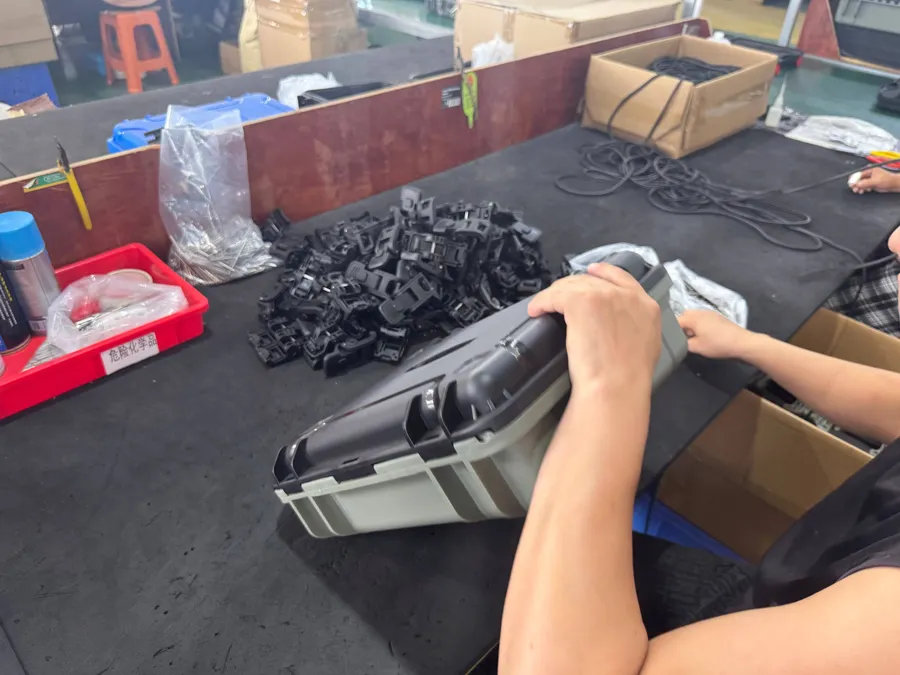
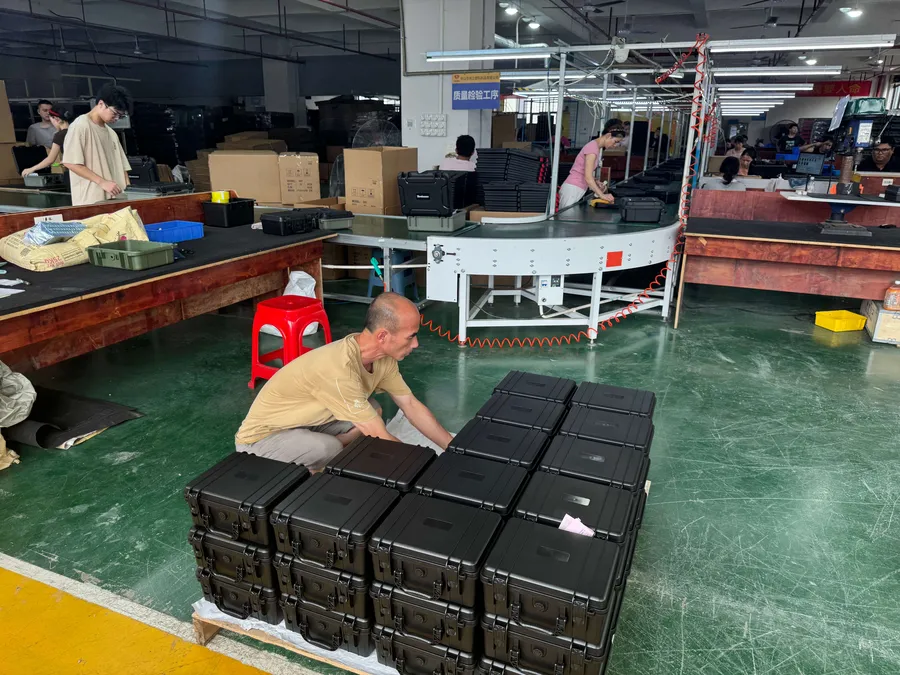
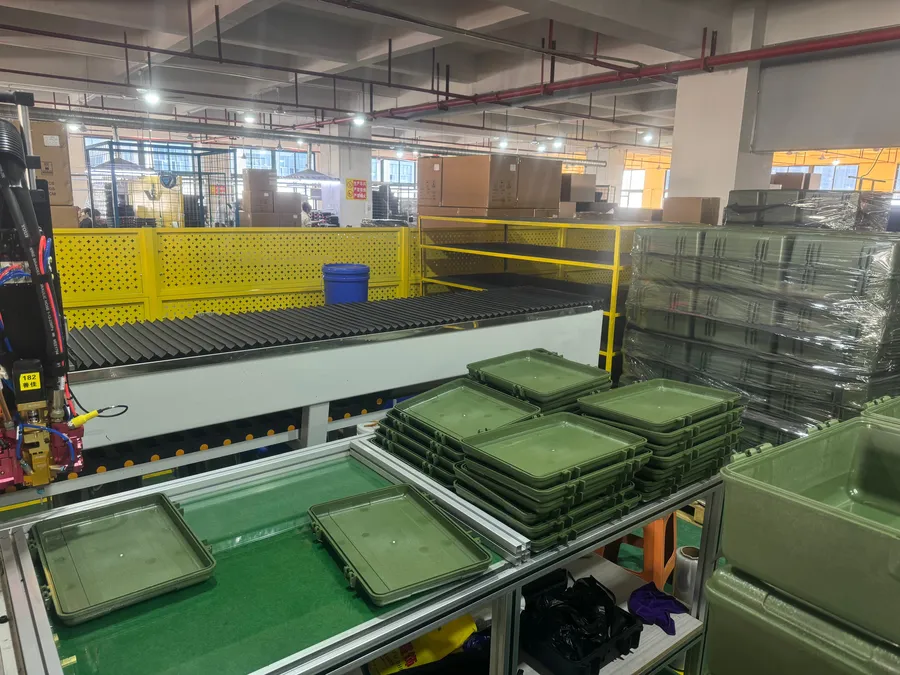
Customisation
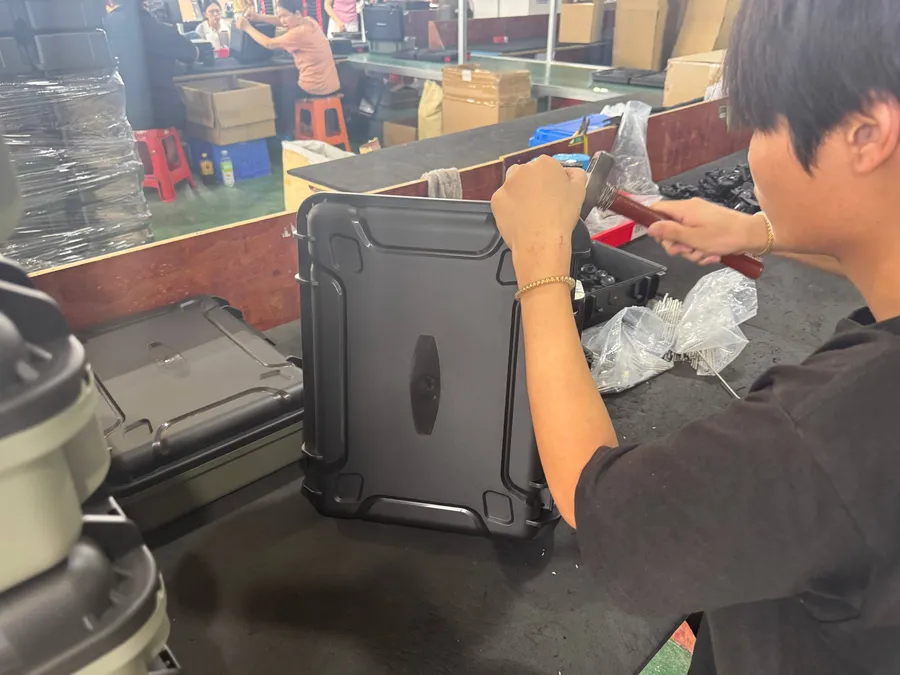
Everything described above is configurable on a standard shell: interior layout (pick-and-pluck, die-cut or CNC-cut), foam grade and thickness, colour, logo method, latch and lock count, pressure-equalisation valve, cable ports, document holder and identification plate. A bespoke exterior geometry requires a new mould — 125 days, from 3,000 units per moulded component.
Procurement considerations
| Question | What to send us |
|---|---|
| Which shell fits? | Equipment L × W × H as packed, plus required clearance per axis |
| What does it cost? | Order quantity and estimated annual quantity — the two drive different answers |
| Is tooling needed? | Whether an existing shell clears the envelope with usable foam depth |
| Lead time? | Your required delivery date, not just the order date |
| Certification? | The exact standard your tender names — we will say whether we can test to it |
| Freight? | Destination and preferred terms; carton and pallet data supplied with the quotation |
Comparison and selection guide
The tables on this page exist because a protective case is chosen by comparing three things: the envelope, the environment and the handling chain. Where no table applies, the rule below is.
| Situation | What To Do |
|---|---|
| Surface | Gravel and sand need a larger wheel diameter than a smooth apron. |
| User height | Handle travel changes the pull angle; check it against the people who will actually pull it. |
| Storage | Confirm the case stands upright on its base with the handle retracted. |
- Size on internal dimensions plus clearance, never on a product name.
- Choose the carrying method before the shell: it changes the series, not just the price.
- Specify the interior last, and decide up front whether the end user will reconfigure it.
What makes a transport case suitable for field logistics? relates to Military Case Guide. Related families: Military Transport Cases / Military Protective Cases / Equipment Transport Cases / Field Equipment Cases / Defense Equipment Cases. Related sectors: field and industrial equipment. Continue in the Military Case Guide cluster.
This page is written from our own production data. If your requirement differs, send the dimensions and we will tell you which of the 155 models fits, or whether a custom route is needed.