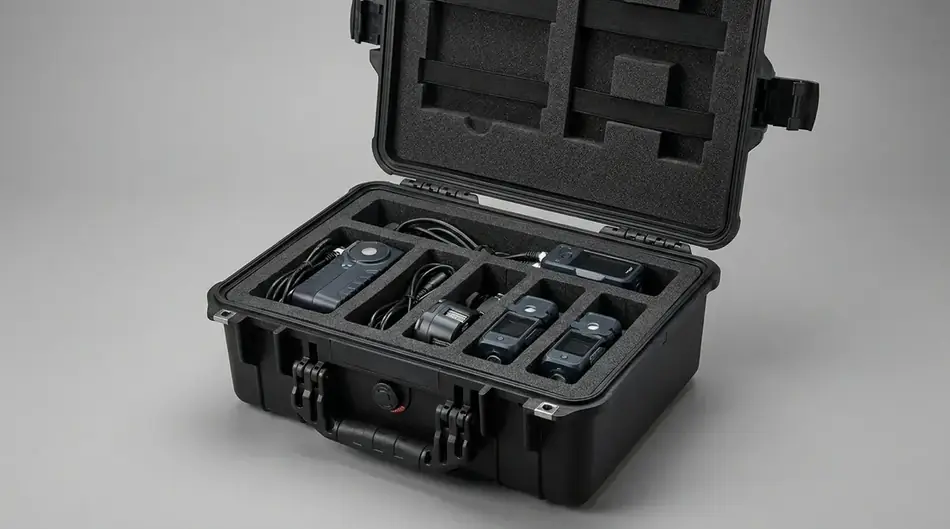
What protective case is suitable for field communication equipment?
A protective case suitable for field communication equipment is chosen by internal envelope first, then by how well the interior holds a transceiver, its batteries, handsets and coiled cable without shifting, and finally by the closure and carry hardware the route demands. Handheld radios and small terminals sit in a compact sealed-body shell around ten to fourteen litres; a manpack set with spares needs a deeper shell, and a crew kit that must be rolled benefits from wheels and a telescopic pull. The gasket is offered per model and KeXin publishes measured internal size, wall and net mass per model rather than stating a water or dust code, so the case is matched to the equipment and the handling, not to a label.
Key points
- Size the case on the radio plus its accessories, because cable and spares usually need more room than the set.
- Choose a sealed-body shell where moisture or blowing dust is expected, and confirm the gasket per model.
- A custom-cut interior that fixes each item stops transit knocks far better than a loose fit in a bigger box.
- Match carry hardware to distance: fixed handle for light hand-carried sets, wheels and pull for crew kits.
- Read the published net mass and internal dimensions of the exact model; they vary widely across the range.
Start from the equipment, not the case
Field communication gear is rarely a single object. A transceiver travels with batteries, a handset or paddle, a coiled lead, sometimes a small antenna kit and spares, and the accessories together often take up more volume than the radio itself. The right protective case therefore starts from the packed footprint: measure the longest, widest and tallest points of the set in its stowed configuration, with cables coiled as they will sit, then add the accessory volume as a separate pocket rather than assuming it slides into the gap. Sizing on the box the equipment arrived in, or on a photograph, is the most common way a field case ends up either too shallow for a connected handset or too large, letting the set move inside during transport.
Sealed body, gasket and why the code is not quoted
For field use the question people ask first is water and dust, and the honest answer is that a seal is a property of a specific build, not of the word military. KeXin offers a compressible gasket and a close-fitting closure on many shells, and lists whether a seal is available per model, but it publishes measured figures rather than stating an IP code, because a rating needs accredited testing on that exact configuration. What you can specify instead is real protection: a gasketed body with an even latch pattern so the seal is not lifted at the middle of a long lid, and an interior that keeps the connector face off the case wall. That is a stronger basis for a decision than a rating number borrowed from a different case.
Interior layout that survives handling
Communication sets are electronics with connectors, and connectors fail from movement and point load far more often than from a single big drop. A custom-cut or die-cut interior that gives each item its own pocket stops that movement, keeps a plugged-in handset from pressing on a socket, and makes a short-content check instant at the front of a mission. Where contents change between deployments, a pick-and-pluck top layer over a firm base carrier gives flexibility without losing the fixed primary seat. Foam structure and thickness are the levers that reduce what reaches the equipment; the shell alone is not a shock rating, which is why KeXin lists foam types and structures per configuration rather than promising a blanket figure.
Real models across the field range
It helps to see the stretch. For a hand-held set and accessories, KX-4010 lists an internal 390 by 315 by 88 mm, a 3.0 mm wall, a net mass near 1.0 kg and a gasket available on that body. For a wider control head, KX-4312 gives an internal 420 by 260 by 104 mm with a 3.5 mm wall and about 1.17 kg. For a manpack set with spares, KX-5321 offers an internal 481 by 373 by 192 mm, a 5.8 mm wall and roughly 4.8 kg. These are published per model; the interior, hardware and finish are then set to the specific kit, so the same logic that fits one radio family fits the next.
Case selection at a glance
| Equipment | Case Focus | Reference Model | Carry |
|---|---|---|---|
| Handheld radio plus spares | Compact sealed body, pluck top | KX-4010, internal 390x315x88 mm | Fixed handle |
| Control head or small terminal | Shallow wide base, cut pocket | KX-4312, internal 420x260x104 mm | Fixed handle |
| Manpack set with batteries | Deep base, connector off wall | KX-5321, internal 481x373x192 mm | Handle, optional wheels |
| Crew comms kit | Large interior, modular layers | Select by packed footprint | Wheels and telescopic pull |
How to specify one for a real route
Once the envelope and the interior are decided, the remaining choices follow the handling cycle. A case that is carried short distances can stay light with a fixed handle; one moved over rough ground or a long distance gains more from wheels and a telescopic pull than from a thicker shell. Latches, feet and a document holder are set to how the case is closed, stacked and identified in service. Send KeXin the packed-state measurements, the expected packed mass, the carry and stacking expectation and the ambient, and you get a configuration quoted on wholesale and OEM terms, EXW or FOB. KeXin does not sell at retail or hold overseas warehouse stock; OEM first samples run about 45 days and a new mould about 125 days, with a 30 percent deposit.
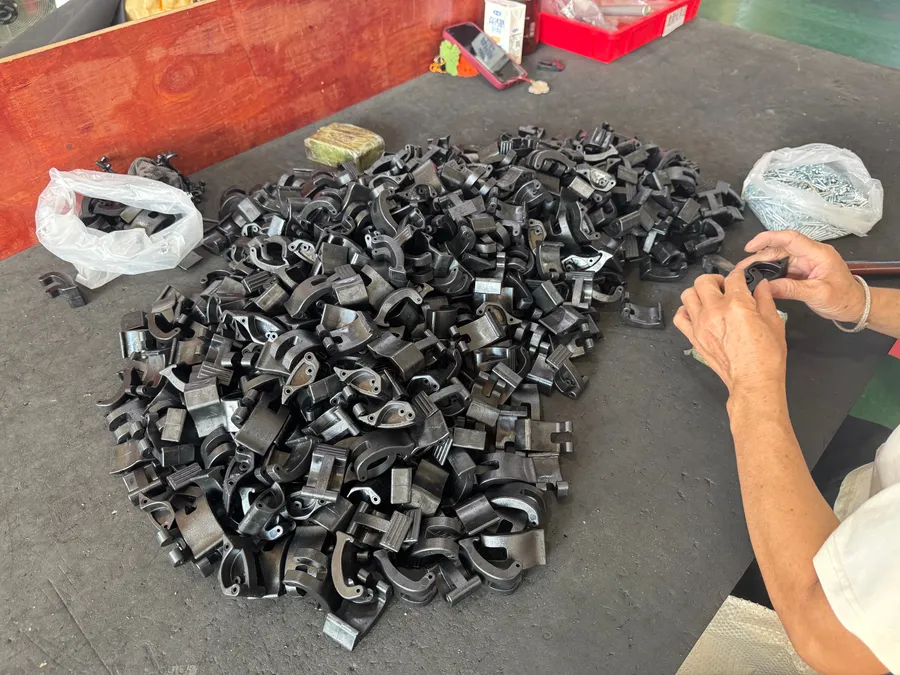
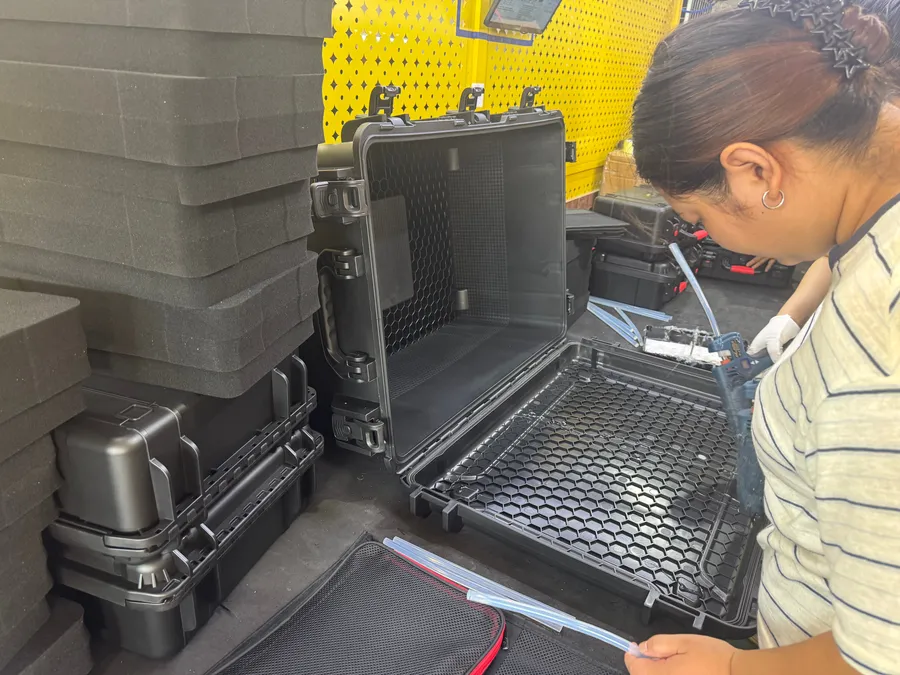
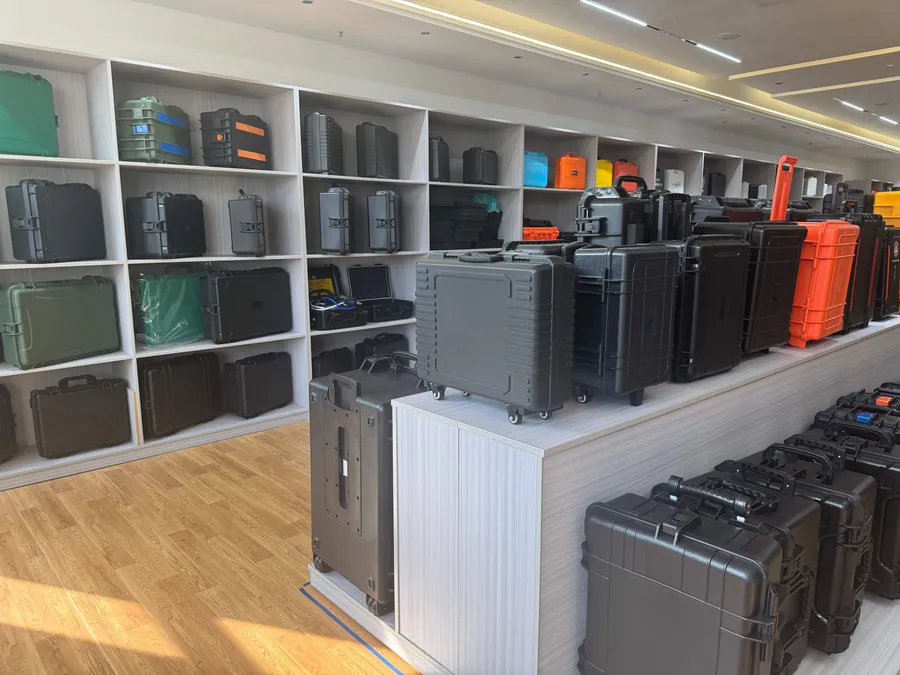
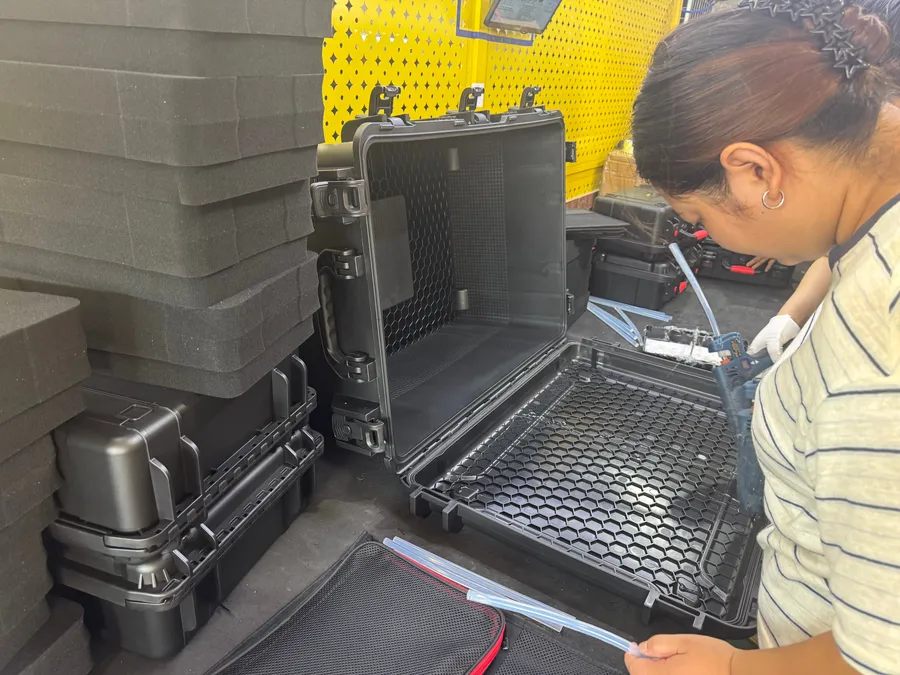
Customisation
Everything described above is configurable on a standard shell: interior layout (pick-and-pluck, die-cut or CNC-cut), foam grade and thickness, colour, logo method, latch and lock count, pressure-equalisation valve, cable ports, document holder and identification plate. A bespoke exterior geometry requires a new mould — 125 days, from 3,000 units per moulded component.
Procurement considerations
| Question | What to send us |
|---|---|
| Which shell fits? | Equipment L × W × H as packed, plus required clearance per axis |
| What does it cost? | Order quantity and estimated annual quantity — the two drive different answers |
| Is tooling needed? | Whether an existing shell clears the envelope with usable foam depth |
| Lead time? | Your required delivery date, not just the order date |
| Certification? | The exact standard your tender names — we will say whether we can test to it |
| Freight? | Destination and preferred terms; carton and pallet data supplied with the quotation |
Comparison and selection guide
The tables on this page exist because a protective case is chosen by comparing three things: the envelope, the environment and the handling chain. Where no table applies, the rule below is.
| Situation | What To Do |
|---|---|
| Battery isolation | Separate pockets, terminals up, with a physical barrier between cells and connectors. |
| Cable management | Dedicated coiled-cable channels rather than a shared compartment. |
| Field repair | Reserve a small loose compartment for spare fuses, connectors and seals. |
- Size on internal dimensions plus clearance, never on a product name.
- Choose the carrying method before the shell: it changes the series, not just the price.
- Specify the interior last, and decide up front whether the end user will reconfigure it.
What protective case is suitable for field communication equipment? relates to Military Case Guide. Related families: Communication Equipment Cases / Field Equipment Cases / Military Protective Cases / Electronics Cases. Related sectors: field and industrial equipment. Continue in the Military Case Guide cluster.
This page is written from our own production data. If your requirement differs, send the dimensions and we will tell you which of the 155 models fits, or whether a custom route is needed.