Army specialized foam-cut shockproof box?
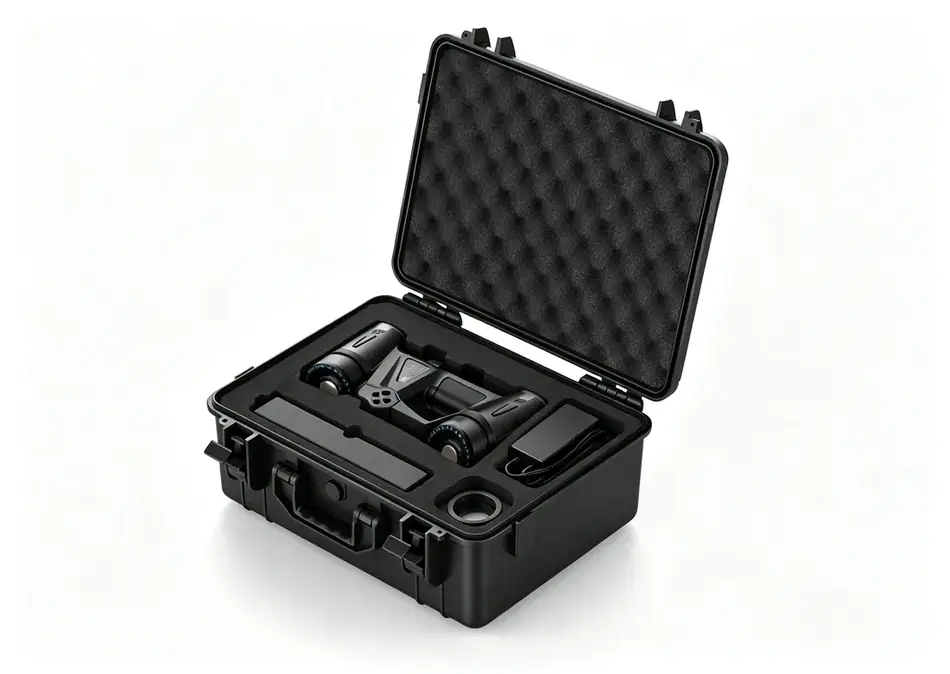
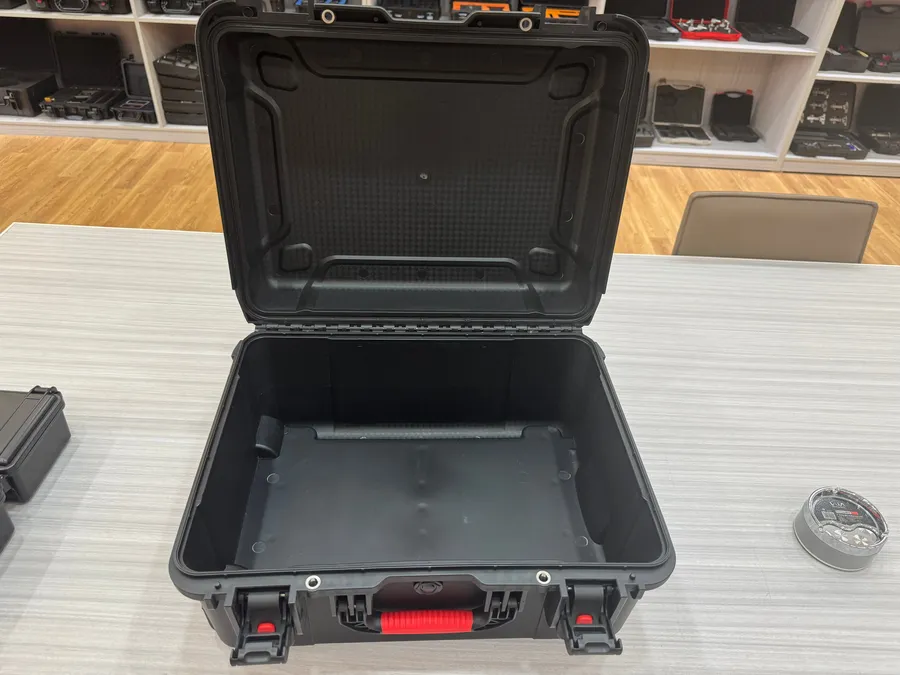
An army foam-cut case is a moulded shell with a liner cut to a specific equipment layout, not a generic padded box. Three decisions carry the order: the shell, chosen from the published dimension table; the foam, specified as top, base, egg-crate, layered or fully custom cut in PE, EVA or EPE; and the colour or marking, which moves the order to 300 units. No impact, ingress, temperature or stack-load figure is published for any of the 155 active models, so shockproof here describes what the liner is for, not a measured rating. Where a programme needs a number, accredited testing is quoted per configuration rather than implied by the page.
Key points
- Choose the shell by usable interior: KX-3218 publishes 10.5 L usable from 12.2 L internal, and KX-5321 27.5 L usable from 34.4 L internal.
- Foam is cut from a drawing, a scaled photograph or the physical kit; a custom liner on an existing mould starts at 1 unit.
- A specified colour, a logo or an OEM package each move the order to the 300-unit band; only new case geometry carries a 3,000-piece minimum.
- Lid depth decides whether an optic stands upright: KX-4321 publishes a 164 mm lid over a 38 mm base, KX-5321 a 43 mm lid over a 149 mm base.
- Ingress, impact, temperature and stack load are recorded as not measured on all 155 model records, so ask for a test quotation rather than assume a rating.
- Orders are wholesale and OEM only, on EXW or FOB terms, with no retail channel and no overseas warehouse.
What an army foam-cut case is, and what shockproof can mean
The phrase covers two components that are specified separately. The shell is an injection-moulded thermoplastic box with a seal, latches and a handle; the liner is a foam block cut so each item has its own pocket. In this catalogue the shell comes from 155 active models across seven series, and the liner is quoted as top foam, base foam, egg-crate, layered or custom cut, in PE, EVA or EPE, with die-cut and CNC cutting both listed on every model record. That separation matters at procurement: a shell and a case body can be reordered against a drawing that already exists, while a new liner is a new layout.
Buyers use shockproof to mean that the kit should survive being knocked about, and the honest answer is that protection rests on two published things and one unpublished one. Published: the wall, which runs from 2.2 mm on KX-2614 and 3.0 mm on KX-3218, KX-4010 and KX-4321 up to 5.8 mm on KX-5321, and the foam structure, which is listed per model. Unpublished: any impact or drop figure. No drop height, impact energy or g-force is published for any of the 155 models, so the word describes the intended use of the liner rather than a measured value, and we do not present it as one.
Published shell sizes for optics, tools and medical kits
The four records below are all published under military protective cases and are the ones most often shortlisted for army kit: two compact shells, one deep utility shell and one wheeled long-bed case. Dimensions are the published internal figures; usable volume is what remains once the liner is fitted, and on every one of these models the two differ by the liner allowance.
| Model | Internal (Mm) | Usable Volume | Wall | Net Weight | Carton |
|---|---|---|---|---|---|
| KX-3218 | 308 x 230 x 172 | 10.5 L of 12.2 L | 3.0 mm | 900 g | 645 x 530 x 550 mm, 12 pieces |
| KX-4321 | 411 x 208 x 202 | 14.9 L of 17.3 L | 3.0 mm | 2,330 g | 885 x 515 x 650 mm, 12 pieces |
| KX-5321 | 481 x 373 x 192 | 27.5 L of 34.4 L | 5.8 mm | 4,810 g | 530 x 440 x 635 mm, 3 pieces |
| KX-88442 | 740 x 518 x 364 | 111.6 L of 139.5 L | 5.0 mm | 15,320 g | not measured - quoted from the carton footprint |
How the foam cut is specified, sampled and reordered
A liner is not ordered from a photograph of the case; it is ordered from the equipment. We ask for a drawing of the packed kit, a photograph with a scale, or the physical items, and the pockets are cut to the largest outlines plus the clearance the layout needs. Lid depth and base depth are published on the records, and that split, not the total depth, decides whether an optic or a folded stock stands upright or lies flat: KX-4321 splits 164 mm and 38 mm, KX-5321 43 mm and 149 mm, KX-3218 86 mm and 86 mm.
A first sample on an existing mould follows 45 days with a 30 percent deposit, and a custom-foam liner carries a published minimum of 1 unit because no new tooling is involved. The signed drawing stays on file, so a replacement layer ordered later is cut to the same pockets and the same clearances, which is what keeps a unit's kit reproducible after a case is damaged or reassigned.
Army green, marking and identification
Colour is specified against a physical sample or a reference you supply, and it is one of the three items that move an order from 1 unit to the 300-unit band, together with a logo and an OEM package; the same 300 applies to each of them. Marking can be a moulded or applied logo, a unit or serial number, and an identification plate inside the lid so the case and its contents are identified without opening it.
What we do not do is claim a published government colour standard. The colour is matched to the sample you approve, and approval is against that sample rather than against a swatch book, which is why the approved sample and the liner drawing together become the reorder standard for the fleet. A second batch is then matched to the first by sample and drawing instead of by re-approving the whole specification.
Optics, medical kits and long equipment: where the layout changes
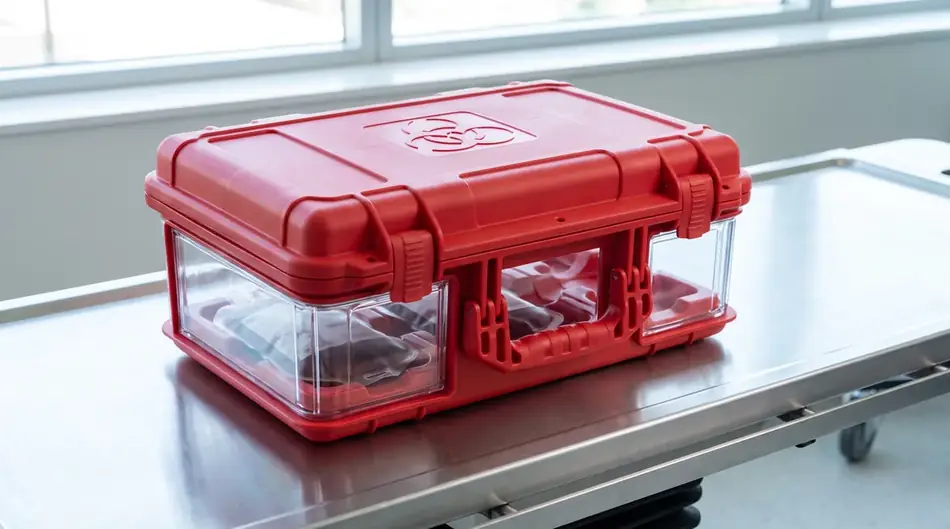
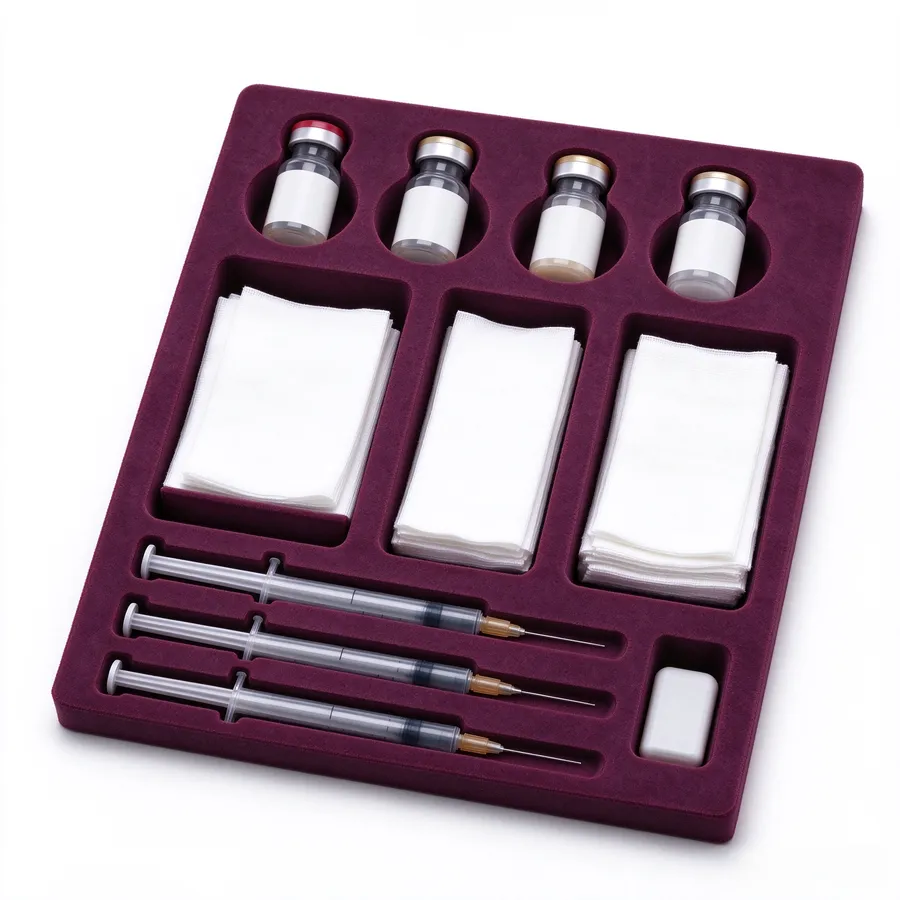
An optical sight is a tall, narrow object, so the first number to check is lid depth: KX-4321 at 164 mm and KX-88442 at 320 mm both leave room to stand a scope upright in the lid, while a flat shell such as KX-4010 at 44 mm and 44 mm is a lay-flat case for plates, spares or a folded cleaning kit. A tactical medical kit behaves differently again: the pockets are organised by intervention order rather than by size, and removable trays let a responder lift a whole layer onto a treatment surface.
For long items, KX-88442 publishes 740 mm of internal length, 111.6 L of usable volume, a 320 mm lid and wheels, all of which suit a folded stock or a long optic in one layer. Where a measured item is longer than that, the long equipment records are the place to start, because internal length is quoted from the model record rather than assumed from a family photo.
What we do not claim
Nothing on this page is a protection rating. The ingress, dust, ultraviolet, temperature, stack-load and load-capacity columns are recorded as not measured on all 155 model records; chemical and disinfectant compatibility is not measured; and the seal, where fitted, is described as a compressible gasket in a continuous moulded channel rather than as an ingress rating. No third-party conformity result is presented for a standard model.
When a programme needs a number to put in its own documentation, we quote an accredited laboratory test per configuration. That way the result is attached to the exact build that was tested and not to a family of cases that happens to share a shell size, and the buyer can state what was measured without overstating what the catalogue covers.
Ordering terms for one case or a fleet
KeXin New Materials (Guangdong) Co., Ltd. supplies wholesale and OEM orders on EXW or FOB terms only: no retail channel, no delivered-duty-paid arrangement and no overseas warehouse, so the buyer plans collection and import. Standard shells and custom foam on an existing mould start at 1 unit, a logo, colour or OEM package at 300, and a new case geometry at 3,000 pieces per component. A first sample on an existing mould follows 45 days with a 30 percent deposit; a new mould follows 125 days after drawing sign-off.
Carton data is published on 64 of the 155 records, for example KX-3218 packs 12 pieces to a 645 x 530 x 550 mm carton and KX-5321 packs 3 to a 530 x 440 x 635 mm carton. Pallet and container quantities follow the buyer's pallet size, so they are calculated from the carton footprint with the quotation rather than stated on the datasheet, and the same quotation carries the EXW or FOB price against the liner drawing you approved.
Customisation
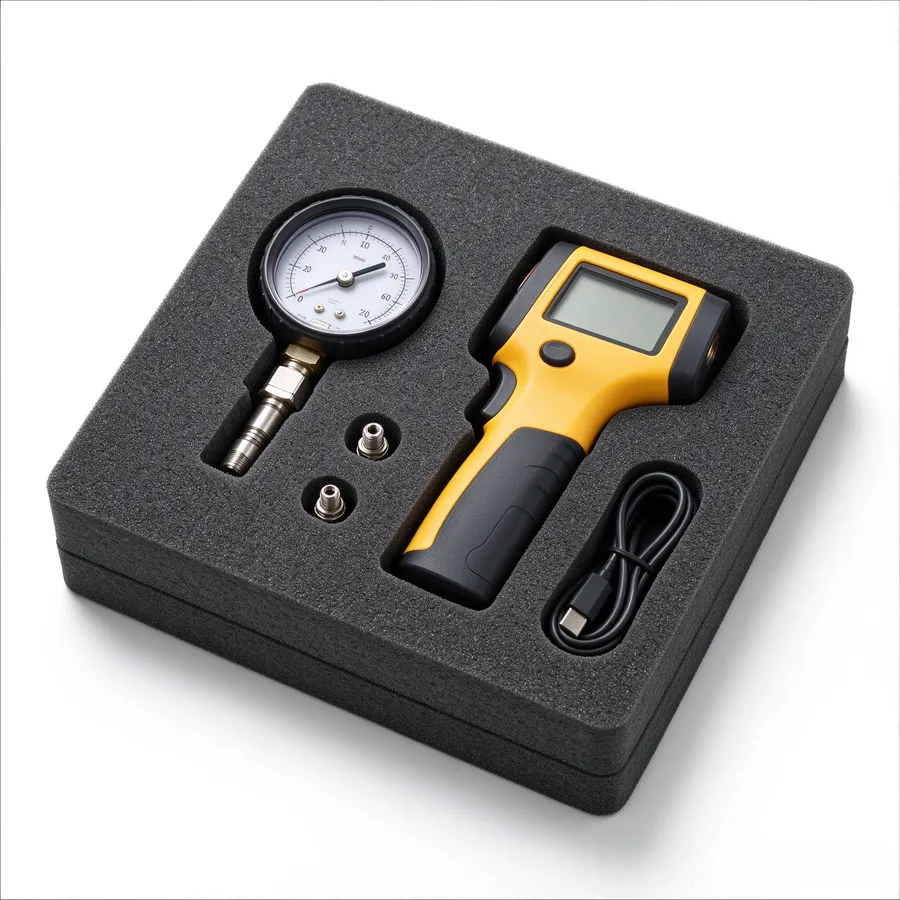
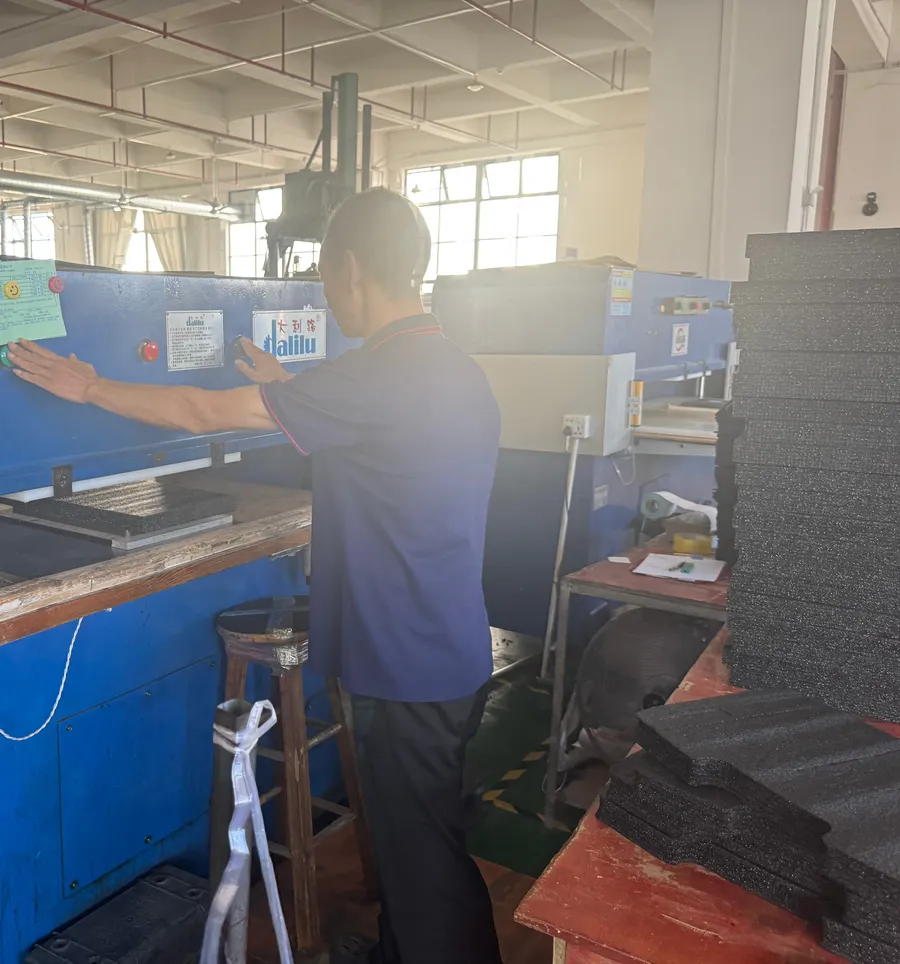
Everything described above is configurable on a standard shell: interior layout (pick-and-pluck, die-cut or CNC-cut), foam grade and thickness, colour, logo method, latch and lock count, pressure-equalisation valve, cable ports, document holder and identification plate. A bespoke exterior geometry requires a new mould — 125 days, from 3,000 units per moulded component.
Procurement considerations
| Question | What to send us |
|---|---|
| Which shell fits? | Equipment L × W × H as packed, plus required clearance per axis |
| What does it cost? | Order quantity and estimated annual quantity — the two drive different answers |
| Is tooling needed? | Whether an existing shell clears the envelope with usable foam depth |
| Lead time? | Your required delivery date, not just the order date |
| Certification? | The exact standard your tender names — we will say whether we can test to it |
| Freight? | Destination and preferred terms; carton and pallet data supplied with the quotation |
Comparison and selection guide
The tables on this page exist because a protective case is chosen by comparing three things: the envelope, the environment and the handling chain. Where no table applies, the rule below is.
| Situation | What To Do |
|---|---|
| Start from the equipment, not the case | Measure the tallest, widest and longest points of the packed equipment including antennas, handles and connectors. Add 20 mm minimum clearance per axis before selecting a shell. |
| Then choose the carrying method | Under 8 kg, a fixed handle is lighter and cheaper. Over 12 kg or any journey over 30 m, specify the T series with telescopic handle and wheels. |
| Then decide the interior | Pick-and-pluck for kits that change. Die-cut or CNC-cut for fixed layouts that must be auditable at a glance. |
- Size on internal dimensions plus clearance, never on a product name.
- Choose the carrying method before the shell: it changes the series, not just the price.
- Specify the interior last, and decide up front whether the end user will reconfigure it.
Army specialized foam-cut shockproof box? relates to Military Case Guide. Related families: Military Protective Cases / Optical Equipment Cases / Medical Equipment Cases. Related sectors: field and industrial equipment. Continue in the Military Case Guide cluster.
This page is written from our own production data. If your requirement differs, send the dimensions and we will tell you which of the 155 models fits, or whether a custom route is needed.