What should you consider when selecting a military equipment case?
Select a military equipment case from the equipment and the mission, in a fixed order. Start with the published internal dimensions that the load and its accessories actually need, then choose a shell wall thickness and material that match how roughly the case will be handled. Decide whether you need a continuous gasket channel and an even latch pattern, then pick the interior that organises and decouples the contents. Add the carry and stacking features the route requires, plan fleet consistency so spare interiors and lids interchange, and finally cost the freight using the carton packing data. KeXin lists 155 standard models with per-SKU figures, so every one of these decisions can be made from a datasheet instead of a guess.
Key points
- Size from the working set of the equipment, then subtract the foam to confirm the usable interior.
- Match wall thickness and material to the abuse level of the route, not to a heavy duty label.
- Decide the seal and latch requirements together; a gasket is only as good as the closure that holds it.
- Choose the interior by how often the contents change: die-cut for a fixed load, pluck for a reconfigured one.
- Standardise on a series so spare lids, foam and cartons interchange across a fleet.
- Lock colour, logo and packaging on the OEM bands so repeat orders are identical to the first.
Size the interior to the working load
The internal envelope decides everything downstream, so begin there. Measure the equipment at its widest configured state, including handles, optics, antennas, batteries, cables and anything that always travels with it, and pick the model whose published internal dimensions clear that envelope without leaving large free volume for items to travel in. Military shells span a wide range; the deep transport case KX-88442 offers an internal 740 x 518 x 364 mm, the flatter KX-88421 shares the 740 x 518 footprint at 189 mm depth, and the mid-size KX-86836 gives 595 x 460 x 315 mm on a wheeled shell. Subtract the foam you intend to line before committing, because a shallow case loses usable height to the liner faster than it loses length.
Match wall and material to the abuse level
A case that lives on a shelf and a case that is thrown into a convoy bed do not need the same shell. Wall thickness is published per model and is the more decisive factor than the material name alone; the shells above are listed at 5.0 mm and 4.8 mm polypropylene walls, which is the range that resists a corner knock and a stack load. If the load is heavy or the drops are likely, a thicker ABS or engineering-PP shell is worth the weight penalty; if the case is mostly hand-carried on flat ground, a lighter wall saves every kilometre the operator walks. Choose against the real handling path and read the figure off the datasheet for the specific SKU.
Decide closure, seal and lockability
Military loads carry dust, moisture and sensitive paperwork, so the closure is a selection decision, not an afterthought. Where a model publishes a continuous moulded gasket channel with a compressible gasket, that feature keeps dust and spray off the interior, but it only works if the latch pattern holds the lid evenly under a stack. Padlockable latches and moulded hinges are recorded per model, and the practical order is to filter candidates by seal availability, then confirm the latch and hinge arrangement on that same SKU. Where the contents must be secured, factor the lockable points in at selection time rather than retrofitting.
Add carry and stacking that fit the route
How a case is moved shapes which case is right. Moulded feet and a stackable flat lid turn a shelf of cases into a stable pallet, which is the flat-lid KX-88421 profile; a taller wheeled shell like KX-88442 or KX-96127 trades that stackability for mobility across a flight line or a compound. A fixed folding handle is standard, and options such as a shoulder strap, a pressure-relief valve for altitude swings and a document holder are manufacturer options that must be requested because not every shell carries the mounting. Decide the mobility pattern first, then choose stackable or wheeled accordingly.
Selection factors at a glance
| Factor | What To Consider | Data Source |
|---|---|---|
| Internal size | Working envelope after accessories, usable interior after foam | Published internal L x W x H per model |
| Shell wall and material | Abuse level of the route versus weight carried | Per-model wall in mm and material |
| Seal and closure | Dust, spray, stack hold, and lockable points | Gasket channel and latch pattern per model |
| Interior layout | How often the contents change between missions | Die-cut, CNC-cut, pluck, layered foam |
| Carry and stacking | Palletised shelf versus mobility on foot | Stackable flag, wheels, feet, handle |
| Fleet consistency | Interchangeable lids, foam and cartons | Series footprint across SKUs |
Reference models by mission profile
| Profile | Reference Model | Focus |
|---|---|---|
| Deep kit with a mounted optic | KX-88442, internal 740 x 518 x 364 mm, 5.0 mm wall | Wheeled tall shell, gasketed lid |
| Palletised flat load | KX-88421, internal 740 x 518 x 189 mm, 5.0 mm wall | Flat lid, stackable, gasketed |
| Mid-size mobile system | KX-86836, internal 595 x 460 x 315 mm, 4.8 mm wall | Wheels and pull, sealed lid |
| Square-footprint comms kit | KX-96127, internal 545 x 545 x 210 mm, 4.8 mm wall | Mobile gasketed shell |
Planning for a consistent fleet
Individual cases are bought once; fleets are reordered for years, so select for consistency. Staying within one shell series means spare lids, foam trays and outer cartons interchange across SKUs, and a replacement case bought later still fits the stack and the shelf. Lock the interior as a signed drawing so the same layout is reproduced on every unit and every reorder. Combine colour, logo and packaging changes on one order so the whole fleet presents the same scheme. These choices are what turn a pile of good cases into a manageable system rather than a set of near-identical one-offs.
Procurement notes and terms
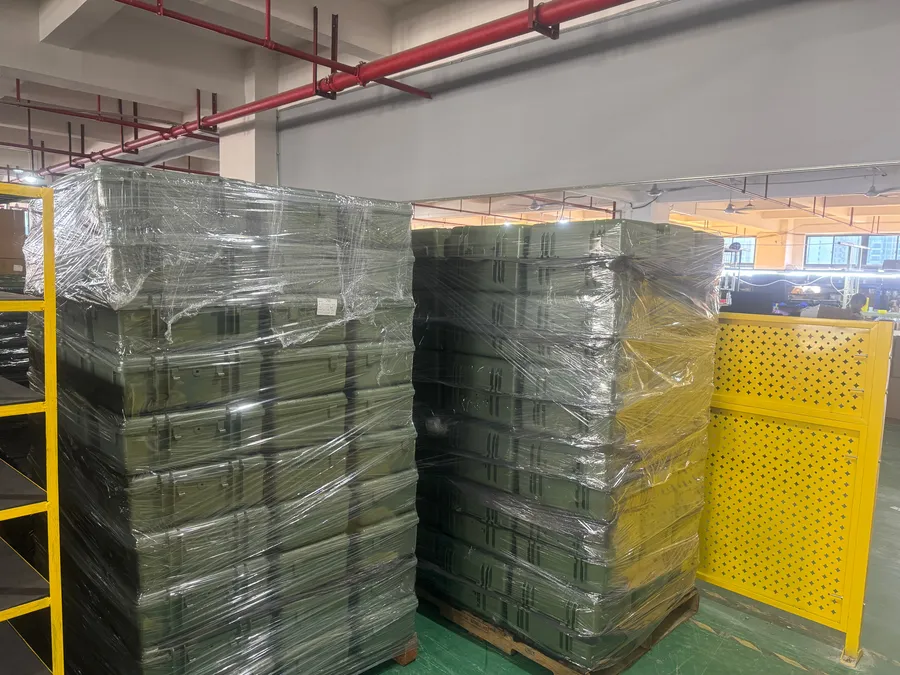
Specify from the datasheet, not a family claim: confirm each model's internal dimensions, wall thickness, seal type, stackable status and hardware in writing. Treat fields marked not measured as unknown instead of borrowing a neighbouring SKU's figure. Pallet configuration is calculated from the carton footprint against your pallet size, so send your standard and have the factory work the loading. Orders are wholesale and OEM on EXW or FOB terms with a 30 percent deposit against the proforma; a first OEM sample follows about 45 days and a new mould about 125 days at higher quantity. There is no retail, DDP or overseas-warehouse arrangement, so build landed cost and inbound freight into the selection.
Customisation
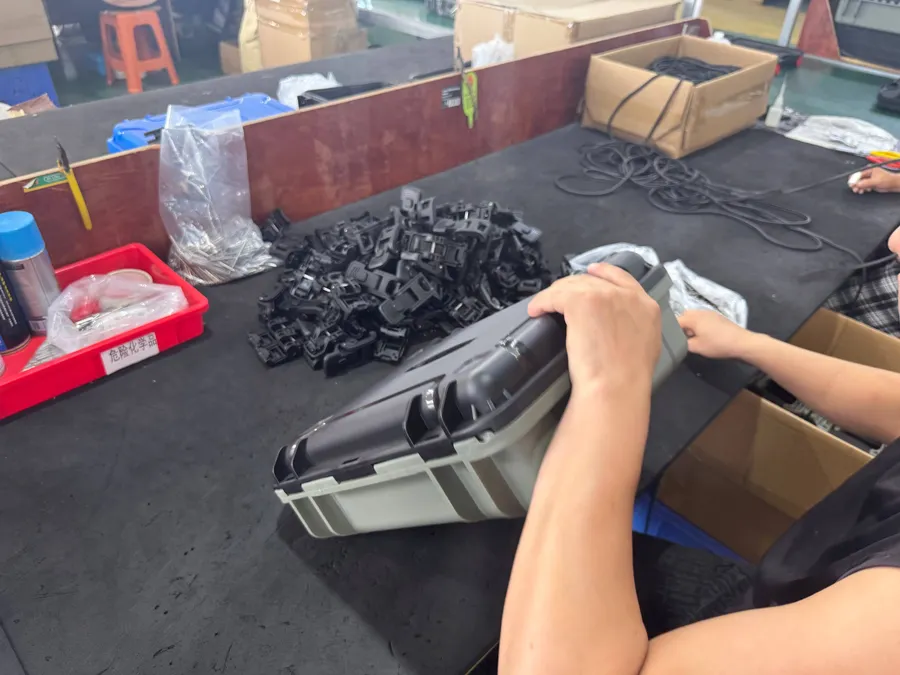
Everything described above is configurable on a standard shell: interior layout (pick-and-pluck, die-cut or CNC-cut), foam grade and thickness, colour, logo method, latch and lock count, pressure-equalisation valve, cable ports, document holder and identification plate. A bespoke exterior geometry requires a new mould — 125 days, from 3,000 units per moulded component.
Procurement considerations
| Question | What to send us |
|---|---|
| Which shell fits? | Equipment L × W × H as packed, plus required clearance per axis |
| What does it cost? | Order quantity and estimated annual quantity — the two drive different answers |
| Is tooling needed? | Whether an existing shell clears the envelope with usable foam depth |
| Lead time? | Your required delivery date, not just the order date |
| Certification? | The exact standard your tender names — we will say whether we can test to it |
| Freight? | Destination and preferred terms; carton and pallet data supplied with the quotation |
Comparison and selection guide
The tables on this page exist because a protective case is chosen by comparing three things: the envelope, the environment and the handling chain. Where no table applies, the rule below is.
| Situation | What To Do |
|---|---|
| Start from the equipment, not the case | Measure the tallest, widest and longest points of the packed equipment including antennas, handles and connectors. Add 20 mm minimum clearance per axis before selecting a shell. |
| Then choose the carrying method | Under 8 kg, a fixed handle is lighter and cheaper. Over 12 kg or any journey over 30 m, specify the T series with telescopic handle and wheels. |
| Then decide the interior | Pick-and-pluck for kits that change. Die-cut or CNC-cut for fixed layouts that must be auditable at a glance. |
- Size on internal dimensions plus clearance, never on a product name.
- Choose the carrying method before the shell: it changes the series, not just the price.
- Specify the interior last, and decide up front whether the end user will reconfigure it.
What should you consider when selecting a military equipment case? relates to Military Case Guide. Related families: Military Protective Cases / Defense Equipment Cases / Military Transport Cases / Equipment Transport Cases. Related sectors: field and industrial equipment. Continue in the Military Case Guide cluster.
This page is written from our own production data. If your requirement differs, send the dimensions and we will tell you which of the 155 models fits, or whether a custom route is needed.