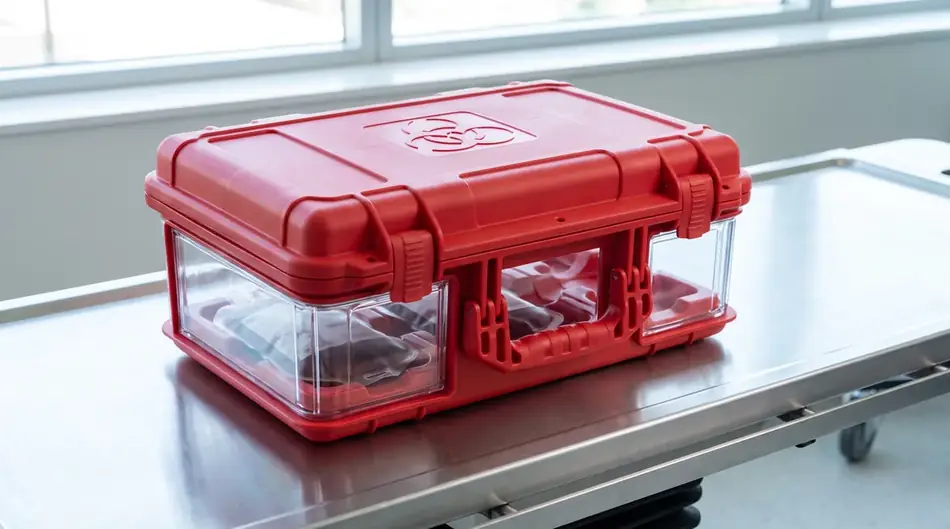
What type of case is suitable for portable medical equipment?
A case for portable medical equipment is chosen from the device, its accessories and the way it is carried, and the shortlist comes down to internal size, wall thickness, closure and whether the model publishes a gasket channel. Handheld monitors and diagnostic tools fit a compact ABS or engineering-PP shell around a 4 to 5 millimetre wall with a die-cut interior; a field kit with cables, battery and consumables fits a mid-size gasketed shell around a 460 by 340 by 230 millimetre interior; a larger console or a team medical bag steps up to a deep or wheeled thick-wall case. KeXin publishes internal dimensions, wall thickness, net weight and seal type per model, and states any value that has not been measured on that SKU as not measured rather than extrapolating it.
Key points
- Size the internal envelope to the device connected with its probe, cable and battery, not to the bare unit.
- Pick a wall thickness that matches how roughly the case travels; a clinic cart and a field route are different.
- A published gasket channel is the practical feature that keeps dust and spray off the equipment.
- A cut interior that fixes the device and its accessories is what protects electronics and glass surfaces.
- Wipeable shell and closed-cell foam suit hygiene-sensitive packs, but medical-grade claims must be confirmed, not assumed.
- Specify from the datasheet of the exact SKU and treat any unmeasured rating as unknown.
Size the case to the connected device
Portable medical equipment rarely travels as a bare unit. A monitor moves with its probe or transducer, a lead set, a battery, a charger and a consumables pouch, and a diagnostic device may carry a case of strips or a small calibration tool. Measure the assembled kit and pick the SKU whose published internal dimensions clear it with minimal dead volume. Compact tools fit a small instrument shell such as KX-63413 with an internal 310 x 255 x 106 mm and a 4.8 mm ABS wall; a fuller kit fits a mid-size gasketed shell such as KX-85025 around 463 x 338 x 231 mm. Confirm the usable interior after foam before committing, because a liner takes height faster than it takes length.
Wall thickness and shell material
The right wall depends on the route. A device that stays on a clinic trolley or in a vehicle sees gentler handling than one carried on foot over rough ground. Injection-moulded polypropylene shells in the 3 to 4 millimetre range suit light utility and accessories, while ABS and engineering-PP shells in the 4.5 to 6 millimetre range suit the main device where a dropped corner is likely. In the sample models, KX-63413 is listed at 4.8 millimetres ABS and KX-85025 at 4.5 millimetres engineering PP. Choose the figure from the specific SKU's datasheet rather than a general label.
Closure, seal and how the case stays clean
For hygiene-sensitive packs the two practical features are a smooth, wipeable shell and, where needed, a continuous moulded gasket channel with a compressible gasket that keeps dust and spray out of the interior. Closed-cell PE, EVA and EPE foams do not absorb liquid the way open-cell materials do, which is why they are the default lining for medical kits. KeXin does not attach a medical-grade, sterilisation or cleanroom claim to a model unless that attribute is published for it; if your use requires a specific cleanability or material standard, state it as a project requirement and the factory confirms what is available on that SKU.
Case type by equipment class
| Device Class | Case Type | Reference Size |
|---|---|---|
| Handheld monitor or pulse oximeter | Compact ABS shell, die-cut single cavity | KX-63413, internal 310 x 255 x 106 mm, 4.8 mm wall |
| Diagnostic tool with leads and battery | Gasketed engineering-PP shell, layered interior | KX-85025, internal 463 x 338 x 231 mm, 4.5 mm wall |
| Ultrasound or imaging handheld | Mid-size gasketed shell with probe relief | KX-65522, internal 507 x 385 x 190 mm, 5.3 mm wall |
| Team medical bag with consumables | Deep or wheeled thick-wall shell, two-layer foam | KX-6621, internal 587 x 434 x 192 mm, 6.0 mm wall |
| Accessories and consumables tray | Shallow PP utility shell, pluck interior | Selected from the utility size grid |
Interior that protects a medical device
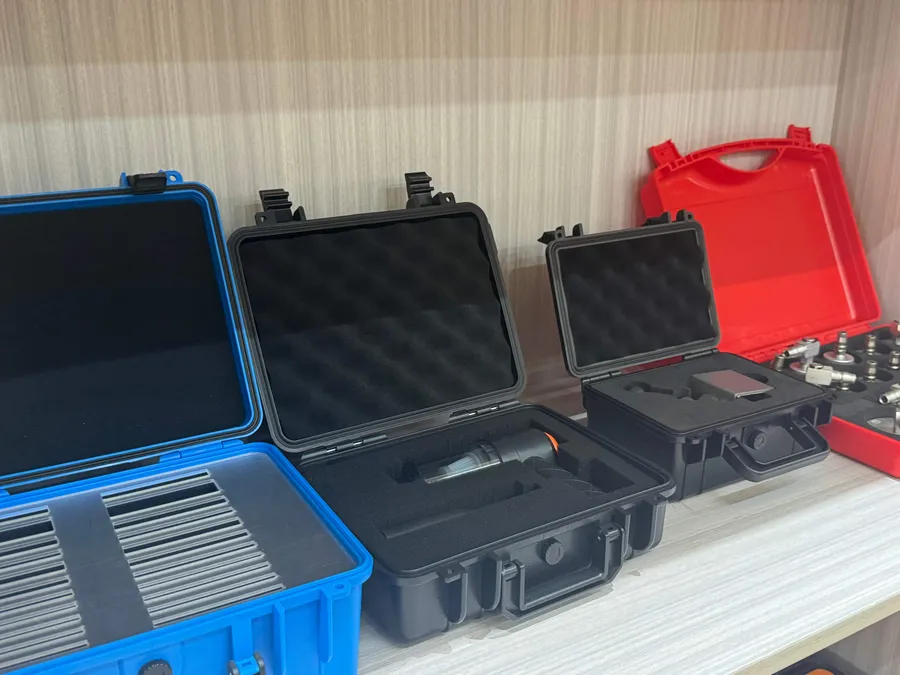
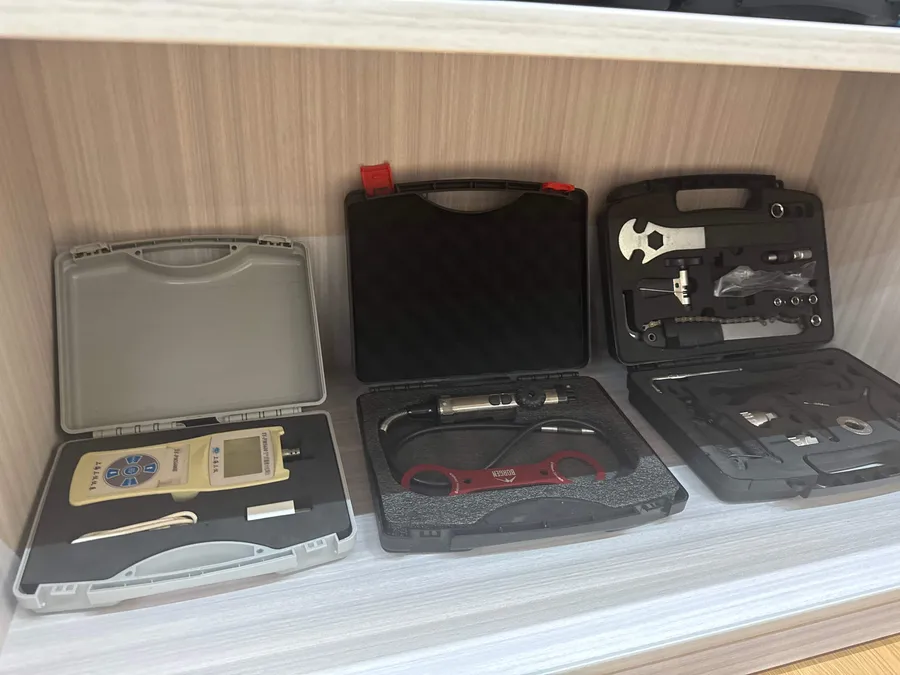
The interior is what protects the sensitive parts of a medical device: a screen, a lens, a transducer face, a connector or a calibration port. A die-cut or CNC-cut cavity fixes the main body and gives each accessory its own pocket, so nothing rests on the display or presses a probe against the wall. Relief under a transducer or an antenna keeps the fragile face unloaded, and a routed channel holds a lead so its plug cannot travel into a socket. For a kit whose contents change between callouts, a pluck top over a fixed base lets staff reconfigure without reprinting the entire cavity.
Carry, quick access and field use
Medical cases are often opened in a hurry and in awkward places, so the ergonomics matter. A fixed folding handle is standard, and options such as a shoulder strap and a document holder for instructions or checklists are available as manufacturer options on models that support them. A lid that stays open hands-free and an interior where the main device is visible the moment the case opens both speed field access. For a vehicle or facility route a stackable flat-lid shell keeps packs tidy on a shelf; for a walking route a wheeled shell reduces the load on the carrier.
Customising a medical case order
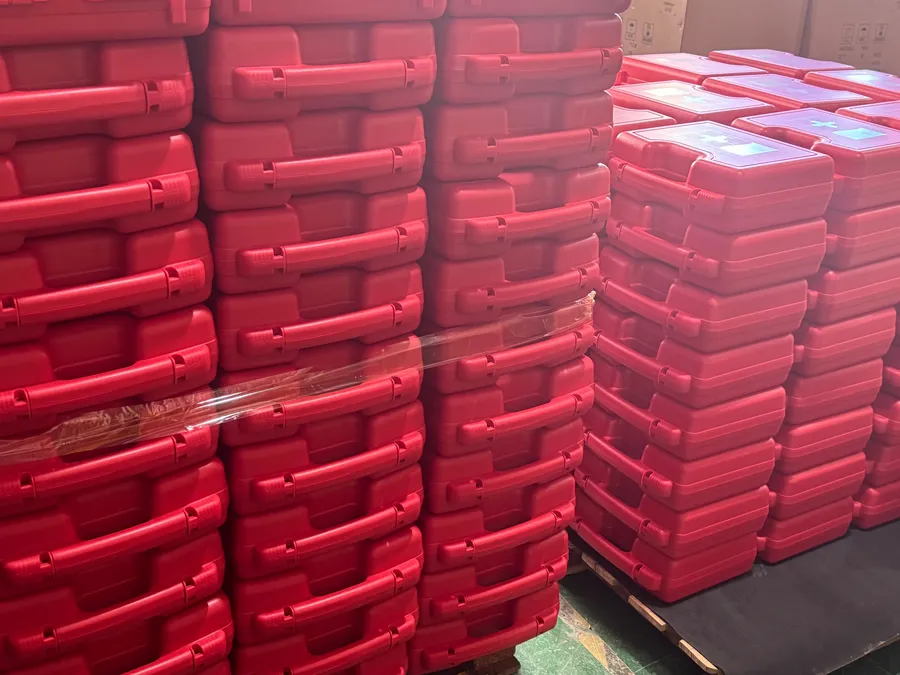
Medical cases take the same OEM options as the rest of the range: a custom die-cut or CNC-cut interior, colour matching, printed or in-mould logo and buyer-branded packaging, all on existing moulds. Standard OEM changes start around 300 pieces for logo and colour, custom foam starts from the low OEM band, and a first sample follows the standing lead time of about 45 days. A bespoke internal geometry needs a new mould at a higher quantity and follows about 125 days after drawing sign-off. Orders are wholesale and OEM on EXW or FOB terms with a 30 percent deposit; there is no retail, DDP or overseas-warehouse arrangement.
Procurement notes
Send the device, its connected accessories and the intended route so the case is chosen from the specific SKU's published internal dimensions, wall thickness and seal type. Confirm the usable interior after foam and ask for the datasheet in writing. Where a value such as an ingress, drop or material-standard claim is not measured on that model, treat it as unknown rather than assumed, and raise any cleanability or material requirement up front. Keep the approved interior drawing as the reorder standard so every unit in a fleet matches. Customise colour, logo and packaging on the OEM bands so a repeat order is identical to the first.
Buyer searches in this sector, answered with published model data
Each first-column phrase below is something buyers actually type when they are sourcing a case for a device that is carried rather than installed. The right-hand column is what our published product data (155 models in the site database, 71 of them tagged to the medical equipment category) supports, or a plain statement that the thing being asked about has not been measured. Model names and figures are quoted exactly as they appear in the published specifications; where a value is absent from that data it is written as not measured rather than inferred from a similar model.
| Search | What We Publish |
|---|---|
| portable generator equipment case | A generator is a poor first candidate for an enclosed case, and we say that before quoting anything: temperature range and any acoustic attenuation figure are recorded as not measured on every model, so we publish no heat derating curve and no noise-reduction number. What the data does give is the heavy end of the catalogue. KX 8-8442 lists an internal 740 x 518 x 364 mm cavity inside an external 843 x 592 x 415 mm shell, a 5.0 mm wall, a 320 mm lid over a 44 mm base, 111.6 L of usable interior and 15.32 kg empty weight, on wheels with 295 mm of published telescopic handle travel; KX 8-8434 is the same footprint 80 mm shallower at 87.1 L and 14.03 kg. Stack load in kilograms and payload capacity are not measured, so a unit that weighs several hundred kilograms when fuelled is quoted against cavity and published shell mass, never against a load rating. Corrosion is the one environmental item recorded as measured in our data: a thermoplastic shell has no ferrous corrosion path. |
| portable medical instrument case | The medical-tagged category is 71 published models: internal length 378-1280 mm, internal width 257-545 mm, internal depth 130-364 mm, wall thickness 2.5-6.0 mm, empty mass 1.36-15.32 kg and usable interior 16.5-111.6 L, with a median of 27.9 L. Thirty-five of the 71 offer 200 mm or more of internal depth, 64 publish an available compressible-gasket seal in a continuous moulded channel, and 19 are fitted with wheels and a telescopic handle. Handheld diagnostic tools sit below that category floor and are drawn from the instrument and electronics shells instead - this page already cites KX 6-3413 at internal 310 x 255 x 106 mm with a 4.8 mm ABS wall - while a monitor with probe, lead set and battery fits KX 8-5025 at internal 463 x 338 x 231 mm, 4.5 mm engineering-PP wall and 29.0 L usable interior. Ingress protection, drop height and any sterilisation-related attribute are recorded as not measured, and no medical-grade claim is attached to a model unless that attribute is published for it. |
| portable respiratory equipment case | Respiratory kit - a ventilator or CPAP unit, breathing circuits, masks, filters, an internal or external battery - is a cavity-and-cleanliness question rather than a rating question. The mid-depth shells are the usual fit: KX 8-5224 at internal 483 x 363 x 220 mm, 4.5 mm engineering-PP wall, 30.9 L usable interior, seal published and stackable; KX 8-5025 at internal 463 x 338 x 231 mm, 4.5 mm wall and 29.0 L; or KX 8-5021 at internal 437 x 308 x 164 mm, 17.7 L, 4.91 kg empty, on wheels with a telescopic handle for a ward-to-ward route. Linings are specified per zone in closed-cell PE, EVA or EPE, which do not absorb liquid the way open-cell foam does, and a CNC-cut cavity keeps a mask face, a flow sensor or a filter unloaded instead of resting the device housing on them. Cleanability, antimicrobial behaviour, sterilisation compatibility and particle shedding from foam are not measured in our published data; state the clinical requirement in the enquiry and we confirm what is published for that SKU, or quote accredited testing as a separate work package. |
| dental portable treatment equipment case | A portable dental kit is a divider-and-pocket problem: a high-speed handpiece or ultrasonic scaler, a curing light, a suction motor and its water tube, burs, mirrors and a mouth-prop, none of which should travel metal-against-metal. The two geometries from our published data that suit an assembled chair-side tray are KX 8-5224 (engineering PP, internal 483 x 363 x 220 mm, 4.5 mm wall, 30.9 L usable interior) and KX 6-5522 (ABS, internal 507 x 385 x 190 mm, 5.3 mm wall, 4.86 kg empty, 29.7 L), each with a layered or routed interior so the handpiece hangs clear of the shell floor. Divider sets, custom cut and custom thickness are quoted against the shell SKU, and custom foam starts from 1 unit on a stock shell, so a pilot kit does not need tooling. Nothing in our published model data records a dental-specific test: handpiece bearing protection, water-line hygiene and any clinical-standard requirement are handled as stated project requirements, and any attribute not published for the SKU is recorded as not measured. |
| medical case interior, carry and access options | Foam is published by type - Pick and Pluck, die-cut, CNC-cut, EVA, PE, EPE - and by structure: top foam, base foam, egg-crate or convoluted, custom cut and layered. Carry hardware is published per model: 19 of the 71 medical shells publish wheels, every one of them with a telescopic handle, and published handle travel on those models runs from 240 mm to 485 mm. Lid depth and base depth are published separately for 46 of the 71 medical shells, which is the figure that decides whether a console sits in the base with the probe set in the lid or everything shares one cavity. Shoulder strap, document holder and pressure-relief valve are published as configuration options rather than standard fittings. |
| medical device case wholesale and OEM terms | Wholesale and OEM/ODM only, EXW or FOB Guangdong: no retail, no DDP, no overseas warehouse. A stock shell with a custom-cut interior starts at 1 unit; colour or logo on a stock shell is 300 units per SKU; OEM on existing tooling quotes at 45 days; a new mould is 125 days at 3,000 units per component. Payment is a 30 percent deposit with the balance after inspection and before container loading, and third-party factory inspection is welcome. |
Heat, air paths and rotating instruments are three different engineering problems
A generator needs to get rid of heat and it needs air for combustion. A case is an enclosure, and an enclosure that is closed enough to keep dust off a shell is closed enough to change the temperature around the machine inside it. We publish cavity, wall thickness and shell mass, and we do not publish a thermal derating figure or a noise-reduction figure, because neither is measured on these models. If your specification depends on cooling, the honest engineering answer is usually an open frame, a vented installation or a site enclosure designed for the machine - not a transport case.
A respiratory device has the opposite problem: nothing inside it may shed particles or hold moisture, and the faces that matter are the mask seal, the flow sensor and the filter housing. That is a lining design decision. Closed-cell PE, EVA and EPE are the published foam choices, and a CNC-cut cavity that fixes the unit and gives each circuit its own pocket does more for a ventilator than any rating printed on a lid. What we have not measured is cleanability and sterilisation compatibility, so those are written as not measured rather than assumed from the foam type.
A dental kit is a fixed-point problem. A handpiece is a bearing and a shaft; the damage that matters happens when it knocks against another instrument or against the shell floor at a hard point. That is why the interior for a dental kit is routed with relief pockets and why metal burs and mirrors get their own partition. None of this is a claim about clinical performance: our published data records shell geometry, wall thickness and hardware, and nothing about what the instruments do afterwards.
Where our published medical model data stops
What to send with a generator, respiratory or dental case enquiry
The same shortlist of inputs produces a recommendation from any competent shell factory, which makes it a useful supplier screen as well as an enquiry checklist. Everything below is about the packed kit, not the bare device.
Customisation
Everything described above is configurable on a standard shell: interior layout (pick-and-pluck, die-cut or CNC-cut), foam grade and thickness, colour, logo method, latch and lock count, pressure-equalisation valve, cable ports, document holder and identification plate. A bespoke exterior geometry requires a new mould — 125 days, from 3,000 units per moulded component.
Procurement considerations
| Question | What to send us |
|---|---|
| Which shell fits? | Equipment L × W × H as packed, plus required clearance per axis |
| What does it cost? | Order quantity and estimated annual quantity — the two drive different answers |
| Is tooling needed? | Whether an existing shell clears the envelope with usable foam depth |
| Lead time? | Your required delivery date, not just the order date |
| Certification? | The exact standard your tender names — we will say whether we can test to it |
| Freight? | Destination and preferred terms; carton and pallet data supplied with the quotation |
Comparison and selection guide
The tables on this page exist because a protective case is chosen by comparing three things: the envelope, the environment and the handling chain. Where no table applies, the rule below is.
| Situation | What To Do |
|---|---|
| Clinical environment | Closed-cell foam or a wipeable tray; no open-cell pluck foam. |
| Emergency use | Latches that open with one hand and a lid that stays up unaided. |
| High-value device | Deeper base foam, a separate transducer zone, and a documented drop test if required. |
- Size on internal dimensions plus clearance, never on a product name.
- Choose the carrying method before the shell: it changes the series, not just the price.
- Specify the interior last, and decide up front whether the end user will reconfigure it.
What type of case is suitable for portable medical equipment? relates to Military Case Guide. Related families: Medical Equipment Cases / Instrument & Equipment Cases / Military Protective Cases / Custom Protective Cases. Related sectors: field and industrial equipment. Continue in the Military Case Guide cluster.
This page is written from our own production data. If your requirement differs, send the dimensions and we will tell you which of the 155 models fits, or whether a custom route is needed.