How should communication systems be transported?
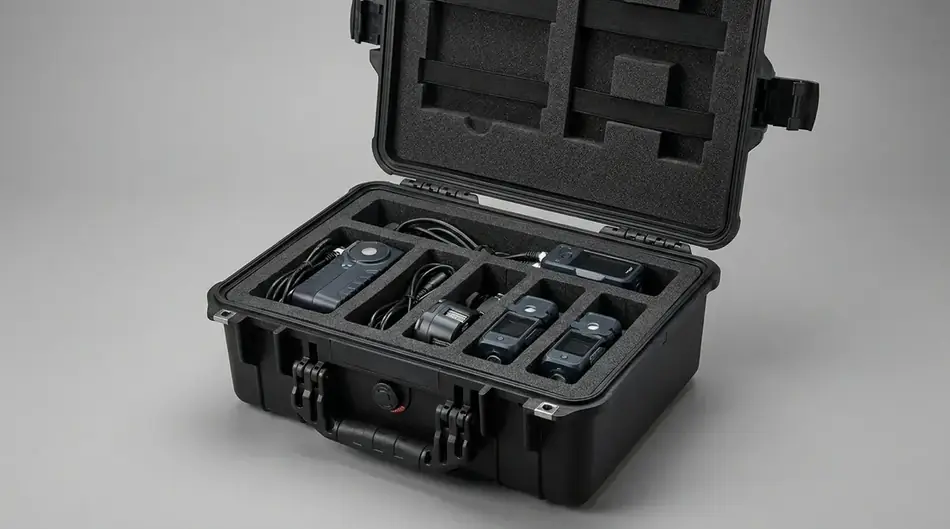
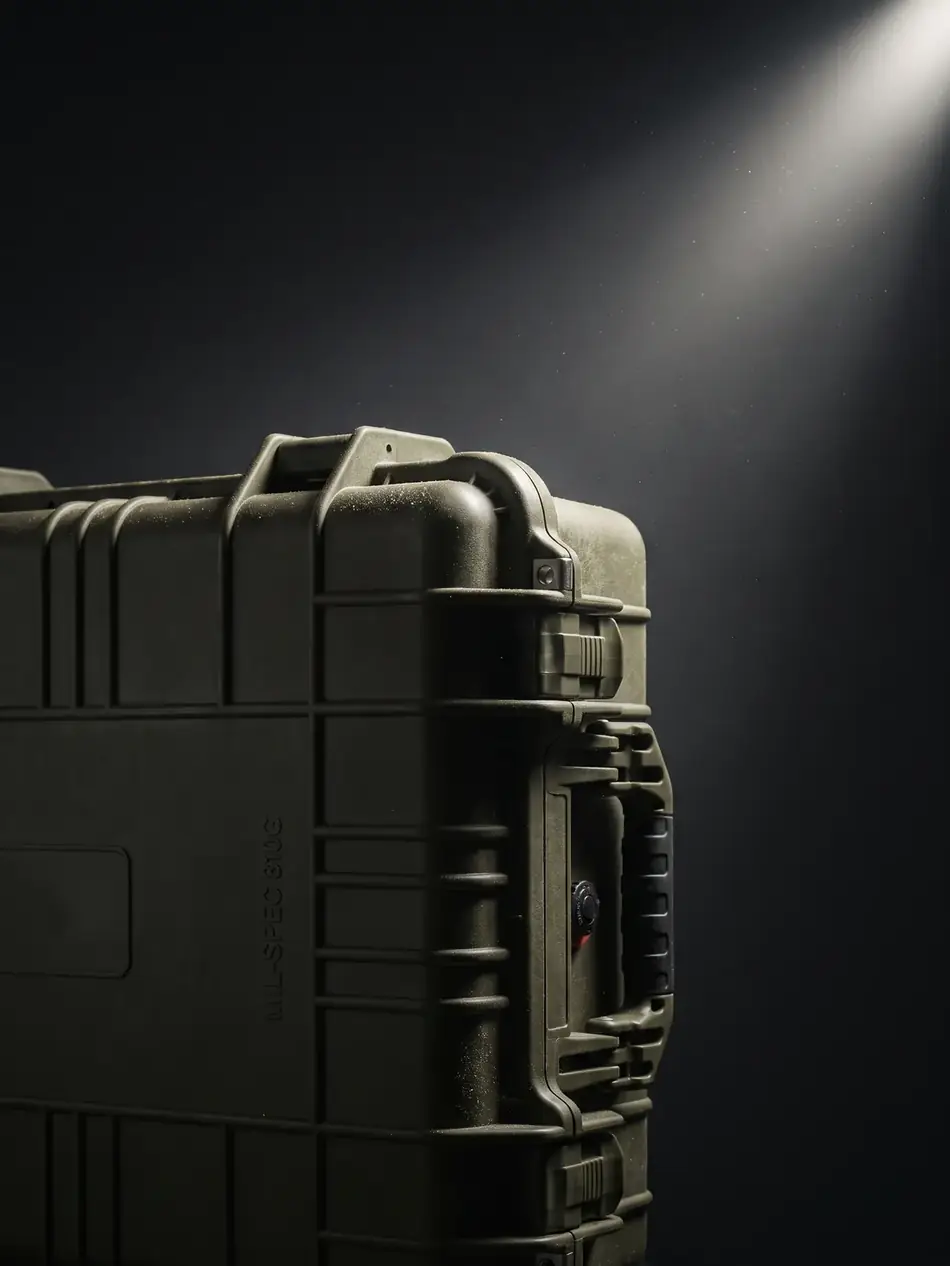
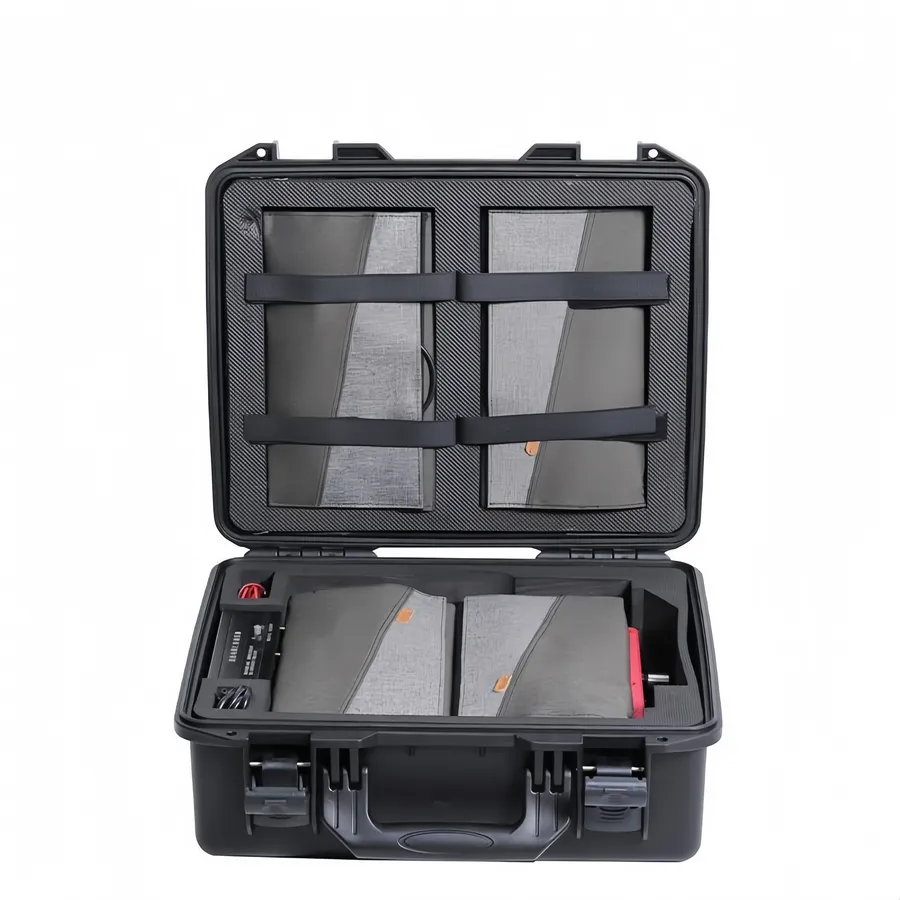
Transport communication systems as a single restrained subsystem, not as loose parts in a shared container. Put the radio, its power supply, handset, cabling and accessories into one rigid shell whose internal envelope clears every item with foam on all six faces, key the foam so nothing shifts, and choose the closure count and the external footprint around two numbers: how far a person carries it, and how many units must stack on one pallet. A sealed PP or ABS case with custom foam is the default; a wheeled case only earns its extra weight once the load passes roughly the point where a fixed handle stops being practical. Everything below is the order to size that in.
Key points
- Pack the radio and its accessories as one keyed subsystem, never loose in a shared box.
- Size on internal dimensions plus 20 mm clearance per axis, not on a model name.
- Key the foam on all six faces so vibration, not impact, is what you are designing against.
- Choose shell thickness from how many units stack on one pallet, not from catalogue looks.
- A fixed handle is lighter until the packed mass forces wheels; then wheels protect the kit.
- Confirm EXW or FOB terms early; the case must fit your pallet and container, not a demo.
Start from the whole subsystem, not the radio head
A communication system rarely travels as one box. It is a transceiver or control head, a power supply or battery pack, a handset or headset, a bundle of coiled cables, mounting brackets, and sometimes an antenna or a spare. The single most expensive mistake in field logistics is protecting the fragile radio head inside a padded sleeve and then throwing the rest loose into the same container, because it is the heavy power supply sliding around and the kinked cable that crack a connector, not the drop itself. Before you touch a case, lay every item out in the exact configuration it will ship in: antennas folded, cables coiled to their service loops, handles extended. Measure the longest, widest and tallest points of that full layout. In most field kits the accessories occupy more combined volume than the radio they belong to, and that is the number that drives the shell size.
Give the case an internal envelope with real clearance
Add at least 20 mm of clearance on every axis before you select a shell, because the internal figure is a hard wall and foam itself takes depth. A model such as our WL4616 publishes an internal envelope of 455 by 338 by 148 mm against a 460 by 367 by 155 mm external footprint and a 3.0 mm wall, which is a compact-radio layout; the larger ABS WL6-5522 steps up to an internal 507 by 385 by 190 mm for bulkier head-plus-power-supply sets. These are per-model published values, not a range you can assume across the line: request the datasheet for the exact SKU you are quoting. The clearance rule matters more for communication gear than for most products because connectors, knobs and BNC ports stick proud of the enclosure and must never carry the closing load of the lid.
Key the foam so the electronics never touch the shell wall
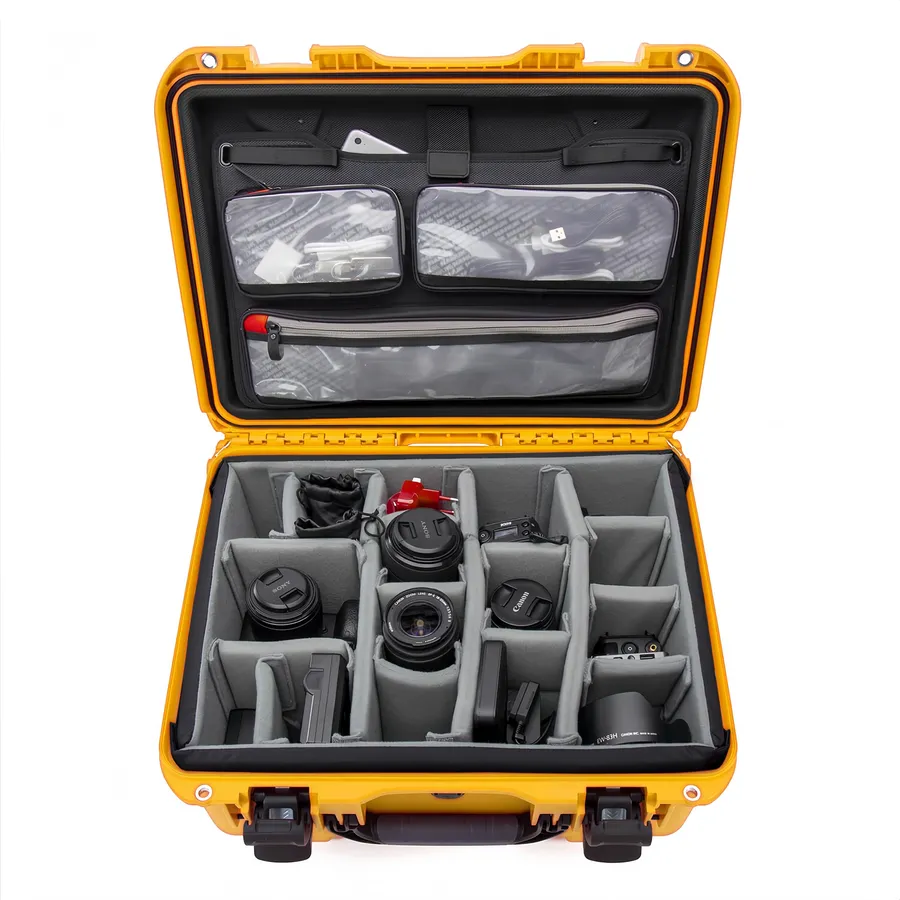
Foam does two jobs that a moulded shell cannot: it holds each item in its own pocket so nothing migrates, and it lengthens the deceleration time of an impact so the peak force reaching a circuit board stays low. For communication systems, cut pockets on all six faces and separate the power supply from the radio head with a wall of foam, because a dense battery is a missile inside a box during a drop. Our cases support pick-and-pluck, die-cut, CNC-cut, layered and egg-crate foam structures, and custom foam can be keyed to your exact layout from a single sample. Thickness usually protects more than density does, so a deeper cut around a fragile transceiver beats a harder foam. See our foam thickness guide and the communication foam article for how depth is chosen per component.
Match the closure and the seal to the route, not to the brochure
A seal only works if the lid is pulled evenly against the gasket, and that is a latch-count problem as much as a gasket problem. Long communication cases need latches at each end and often one in the middle, or the corners lift and the interior sees humidity and conductive dust on every truck transfer. Whether a shell offers a seal is published per model: WL4616 and WL6-5522 are listed with a seal option, while some thin-wall models are not. We do not attach an ingress-protection rating to a model unless it has actually been measured, and we will not claim a standard a unit has not passed; ask us for the measured value for the specific SKU. If you want to understand what a rating does and does not tell you, our dedicated page explains the limits of those numbers.
Compare representative models by the numbers that decide transport
| Model | Internal Mm | External Mm | Wall Mm | Net Weight G | Seal Option | Best For |
|---|---|---|---|---|---|---|
| WL3218 | 308 x 230 x 172 | 315 x 260 x 180 | 3.0 | 900 | Yes | handheld / small radio set |
| WL4616 | 455 x 338 x 148 | 460 x 367 x 155 | 3.0 | 1395 | Yes | radio head plus accessories |
| WL6-5522 | 507 x 385 x 190 | 545 x 440 x 215 | 5.3 | 4860 | Yes | bulkier head plus power supply |
| WL9-7227 | 590 x 435 x 210 | 720 x 500 x 270 | 6.0 | 10000 | Yes | wheeled / telescopic, heavy kits |
Decide between a fixed handle and a wheeled shell on mass and distance
Under roughly 8 kg of packed mass, a fixed handle is lighter, cheaper and has fewer parts to fail than a wheel set, and a compact case like WL3218 at about 0.9 kg empty stays well inside that. Between 8 kg and 12 kg the choice depends on how far the operator walks it and whether terrain is level. Over about 12 kg, or more than roughly 30 metres of carry, wheels and a telescopic handle stop being a comfort feature and become the reason the equipment arrives undamaged: a dropped case is what cracks a radio. A trolley model such as WL9-7227 adds wheels and a telescopic handle but is not stackable in the same way a rigid box is, so if these units will ride palletised in a convoy, weight the loss of stacking against the gain in individual handling.
Plan the pallet before you finalise the case footprint
For wholesale and unit deployments the case is a logistics object as much as a protective one. Choose the external footprint so the boxes grid cleanly onto your pallet size, close the gaps, and confirm how many cartons reach one pallet and one container. Our WL3218 ships 12 pieces to a carton with a 645 by 530 by 550 mm carton, while a trolley ships one to a carton, which changes the pallet picture completely. We publish internal and external dimensions and carton data per model, and we supply pallet and container figures with the quotation once we know your pallet standard, because a number calculated for the wrong pallet is worse than no number. If your load will stack or be double-stacked, read our stacking and palletising article before you lock the shell.
Applications: where this packing method is used
The same method covers field radio relays, base-station service kits, command and control heads, drone datalink ground units, and maintenance-instrument sets that ride with a communications truck. What changes is only the envelope, the foam key and the closure count; the order of decisions does not. For deployment kits we treat the case as part of the system specification: the buyer sends a packed-equipment list, we return a shell plus a keyed-foam proposal, and the whole thing is quoted on EXW or FOB terms as wholesale or OEM production. We do not sell retail single units as a distribution model, do not ship under DDP, and hold no overseas warehouse, so plan lead time around the manufacturing route rather than around stock availability.
Custom and OEM options for communication cases
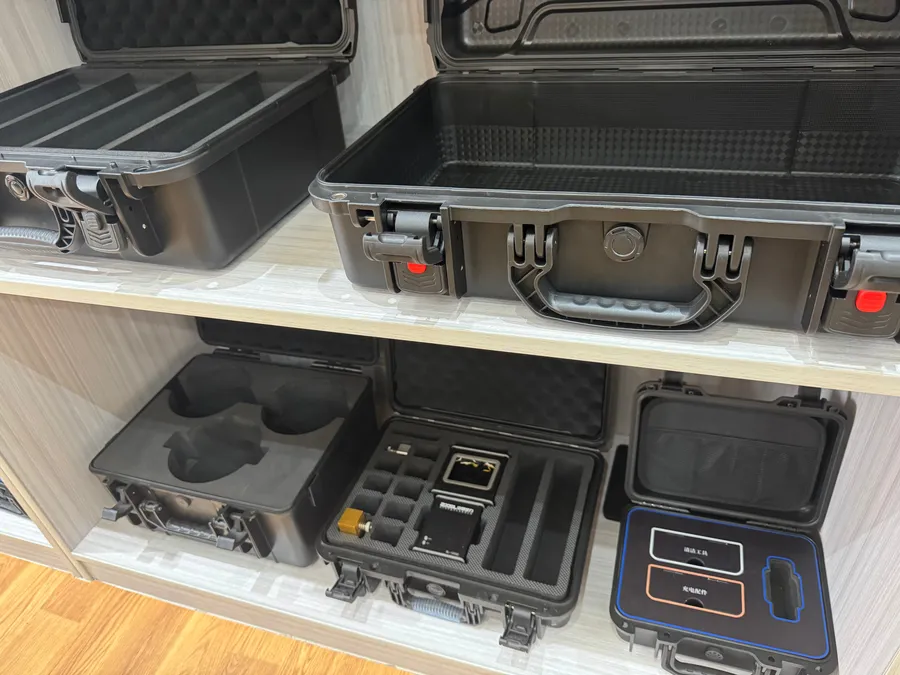
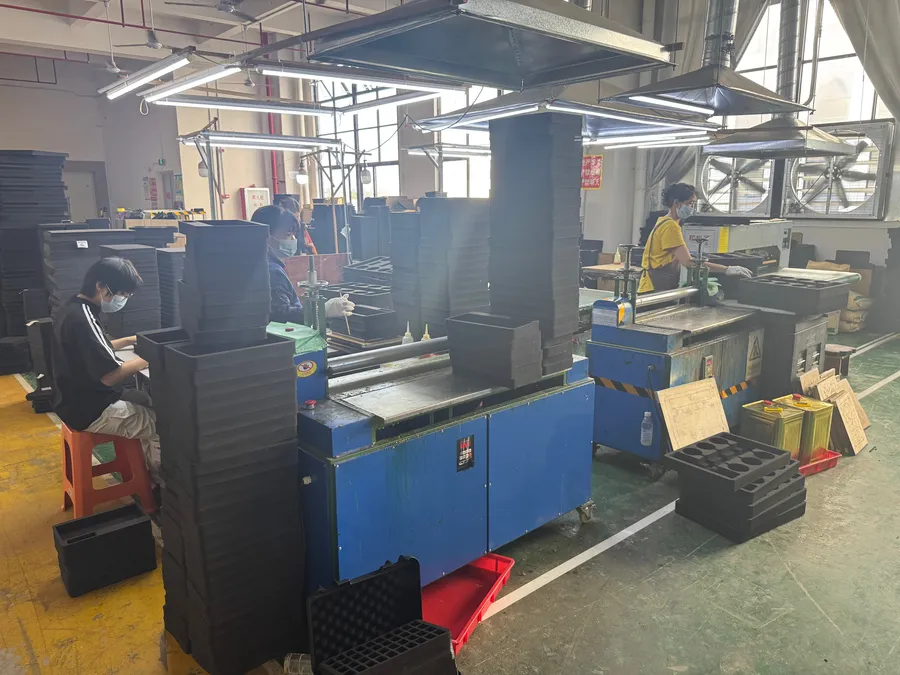
OEM work is where most communication cases end up: a custom foam insert keyed to your exact radio and accessories, a colour or a logo, and hardware changes such as extra latches, a pressure-management valve, cable ports or a document holder. These follow the business parameters we publish: an OEM first sample on an existing mould is about 45 days, a new tool is about 125 days, and orders carry a 30 percent deposit. MOQ differs by change: custom foam can start low, while a moulded-in logo, colour or a new shell needs a higher volume. Send us the packed-equipment layout and the route the case will take, and we will match the shell, the foam and the closure to those two facts rather than to a catalogue default.
Customisation
Everything described above is configurable on a standard shell: interior layout (pick-and-pluck, die-cut or CNC-cut), foam grade and thickness, colour, logo method, latch and lock count, pressure-equalisation valve, cable ports, document holder and identification plate. A bespoke exterior geometry requires a new mould — 125 days, from 3,000 units per moulded component.
Procurement considerations
| Question | What to send us |
|---|---|
| Which shell fits? | Equipment L × W × H as packed, plus required clearance per axis |
| What does it cost? | Order quantity and estimated annual quantity — the two drive different answers |
| Is tooling needed? | Whether an existing shell clears the envelope with usable foam depth |
| Lead time? | Your required delivery date, not just the order date |
| Certification? | The exact standard your tender names — we will say whether we can test to it |
| Freight? | Destination and preferred terms; carton and pallet data supplied with the quotation |
Comparison and selection guide
The tables on this page exist because a protective case is chosen by comparing three things: the envelope, the environment and the handling chain. Where no table applies, the rule below is.
| Situation | What To Do |
|---|---|
| Battery isolation | Separate pockets, terminals up, with a physical barrier between cells and connectors. |
| Cable management | Dedicated coiled-cable channels rather than a shared compartment. |
| Field repair | Reserve a small loose compartment for spare fuses, connectors and seals. |
- Size on internal dimensions plus clearance, never on a product name.
- Choose the carrying method before the shell: it changes the series, not just the price.
- Specify the interior last, and decide up front whether the end user will reconfigure it.
How should communication systems be transported? relates to Military Case Guide. Related families: Communication Equipment Cases / Defense Equipment Cases / Electronics Cases. Related sectors: field and industrial equipment. Continue in the Military Case Guide cluster.
This page is written from our own production data. If your requirement differs, send the dimensions and we will tell you which of the 155 models fits, or whether a custom route is needed.