How To Choose A Protective Case
Choose a protective case in this order: the internal envelope of the equipment plus clearance, the packed mass and how far it must be carried, the wall thickness needed for stacking, the foam grade and thickness for the impact you expect, the closure count needed to keep the seal even, the external footprint needed for the pallet or vehicle, and finally the interior layout that makes the contents verifiable. Everything else is decoration.
Key points
- Size on the internal envelope, not on a product name or a photograph.
- Add at least 20 mm of clearance on each axis before you select a shell.
- Wall thickness, not brand, is what decides stacking behaviour.
- Foam thickness reduces transmitted force far more than foam density does.
- A seal is a latch-count problem as much as a gasket problem.
Step 1 — measure the equipment as it will be packed
Measure the longest, widest and tallest points of the item in its transport configuration, with antennas folded, handles extended and cables coiled as they will sit. Then measure the accessories separately, because in most kits the accessories occupy more volume than the item they belong to.
The single most common sizing error is measuring the box the equipment arrived in. That box was sized for a different interior.
Step 2 — decide how it will be carried
Under 8 kg, a fixed handle is lighter and cheaper than a wheel set. Between 8 kg and 12 kg it depends on the distance. Over 12 kg, or over about 30 m of travel, wheels and a telescopic handle stop being a comfort feature and become the reason the equipment arrives.
Step 3 — choose the shell by structure, not by looks
| Factor | Watch |
|---|---|
| Wall thickness | Published per model, 2.0-5.0 mm. Drives stacking and racking. |
| Shell material | PP for cold impact and chemistry; ABS for stiffness and print finish. |
| Internal volume | Litres from internal dimensions, not external. |
| Narrow internal width | Some shells taper; the minimum internal width matters in a rack. |
| Lid and base depth split | Decides whether the item sits in the base or bridges the halves. |
Step 4 — specify the interior last
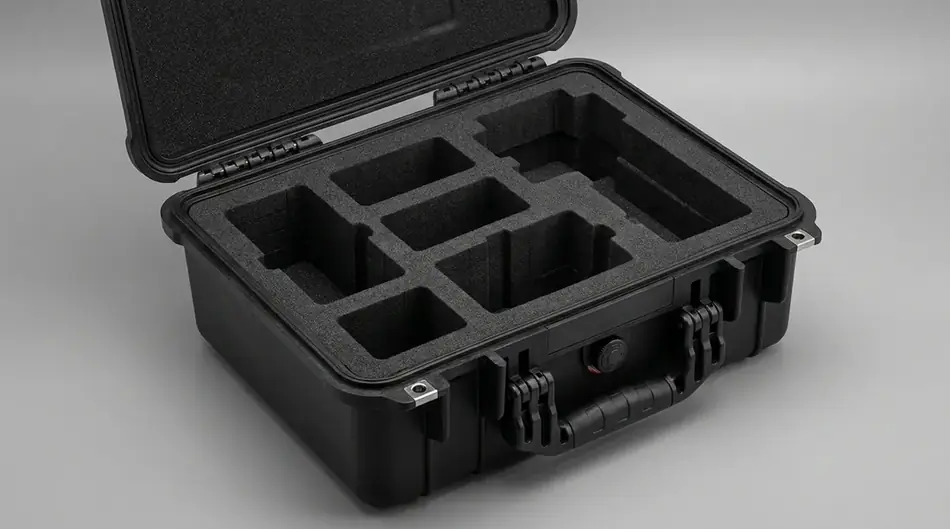
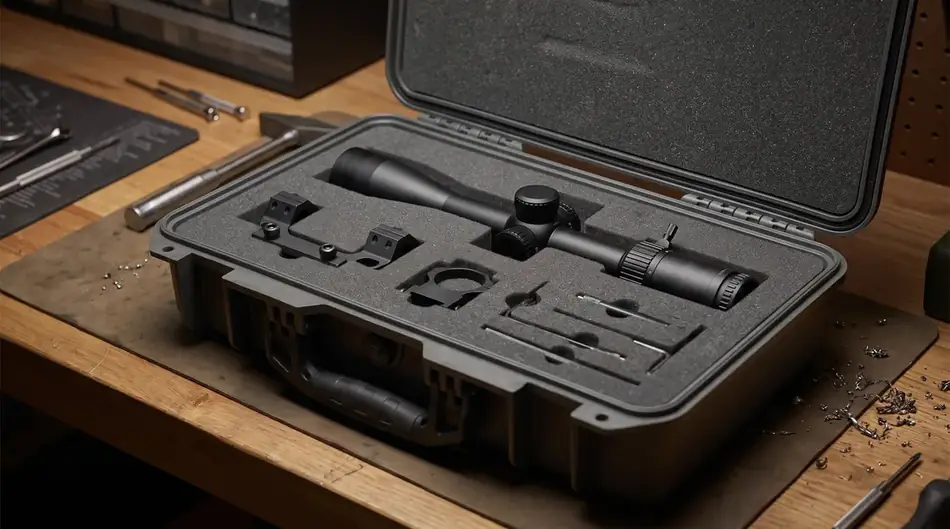
Once the shell is chosen, the interior is a set of trade-offs: precision versus flexibility (CNC cut versus pick-and-pluck), softness versus load-bearing (a soft contact layer over a firm carrier), and cleanability versus cost (closed-cell foam versus open-cell). Those three decisions answer almost every real requirement.
Applications
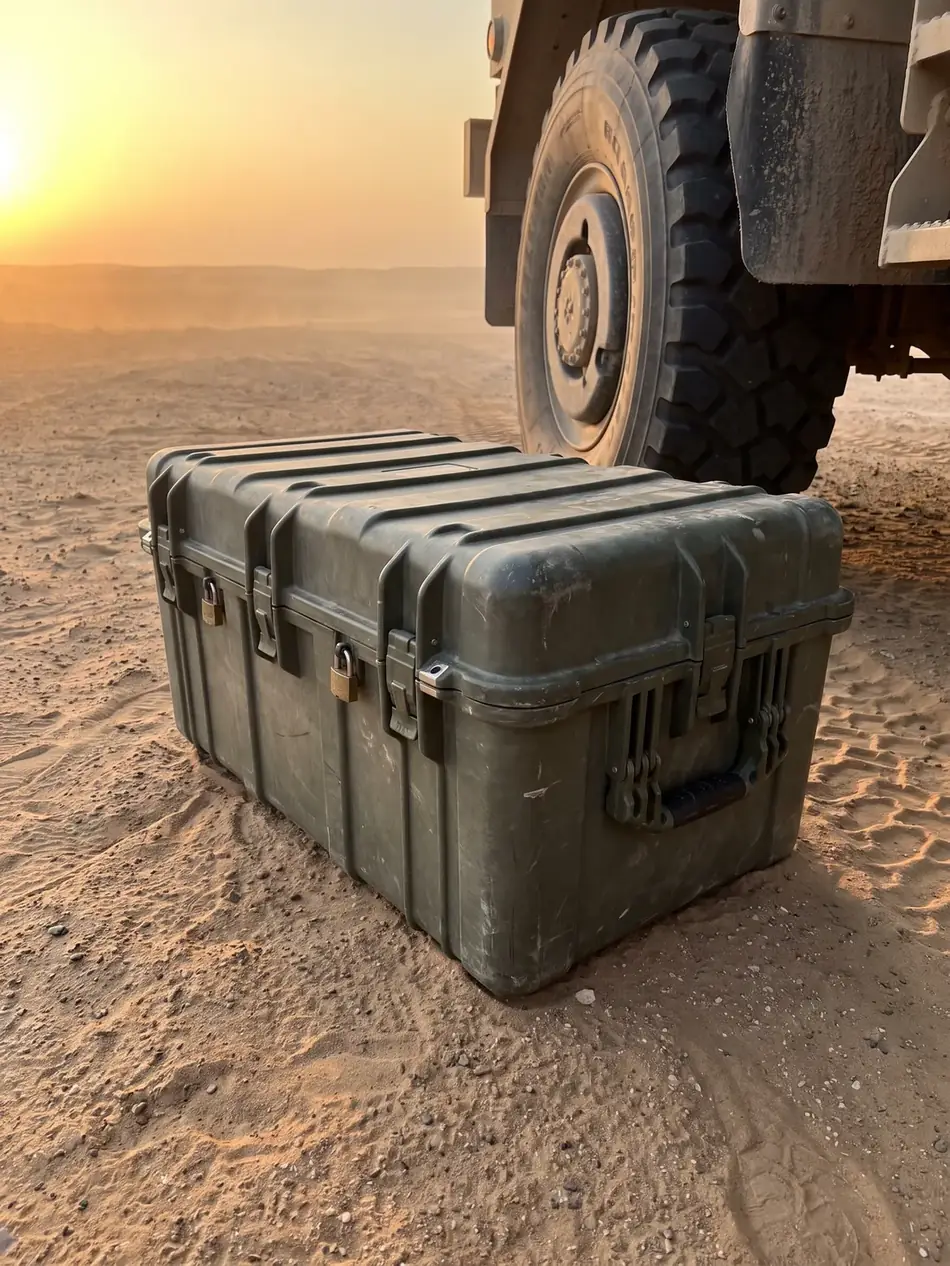
This matters most where the case is part of a movement chain rather than shelf packaging. In military and industrial equipment the same shell is specified differently because the handling, the environment and the verification requirement differ.
- Military — Military equipment moves through a chain of handlers, none of whom own the equipment and all of …
- Industrial Equipment — In an industrial setting the case is a working surface as much as a container, and its interior …
Customisation
Everything described above is configurable on a standard shell: interior layout (pick-and-pluck, die-cut or CNC-cut), foam grade and thickness, colour, logo method, latch and lock count, pressure-equalisation valve, cable ports, document holder and identification plate. A bespoke exterior geometry requires a new mould — 125 days, from 3,000 units per moulded component.
Procurement considerations
| Question | What to send us |
|---|---|
| Which shell fits? | Equipment L × W × H as packed, plus required clearance per axis |
| What does it cost? | Order quantity and estimated annual quantity — the two drive different answers |
| Is tooling needed? | Whether an existing shell clears the envelope with usable foam depth |
| Lead time? | Your required delivery date, not just the order date |
| Certification? | The exact standard your tender names — we will say whether we can test to it |
| Freight? | Destination and preferred terms; carton and pallet data supplied with the quotation |
Comparison and selection guide
The tables on this page exist because a protective case is chosen by comparing three things: the envelope, the environment and the handling chain. Where no table applies, the rule below is.
| Situation | What To Do |
|---|---|
| Fastest | Standard shell plus CNC foam — typically 45 days from approved drawing. |
| Branded | Standard shell plus custom colour and logo — MOQ applies to the resin colour. |
| Bespoke geometry | New mould — 125 days, MOQ from 3,000 units per component. |
- Size on internal dimensions plus clearance, never on a product name.
- Choose the carrying method before the shell: it changes the series, not just the price.
- Specify the interior last, and decide up front whether the end user will reconfigure it.
How To Choose A Protective Case relates to Protective Case Basics. Related families: Custom Protective Cases / Equipment Transport Cases. Related sectors: Military / Industrial Equipment. Continue in the Protective Case Basics cluster.
This page is written from our own production data. If your requirement differs, send the dimensions and we will tell you which of the 155 models fits, or whether a custom route is needed.