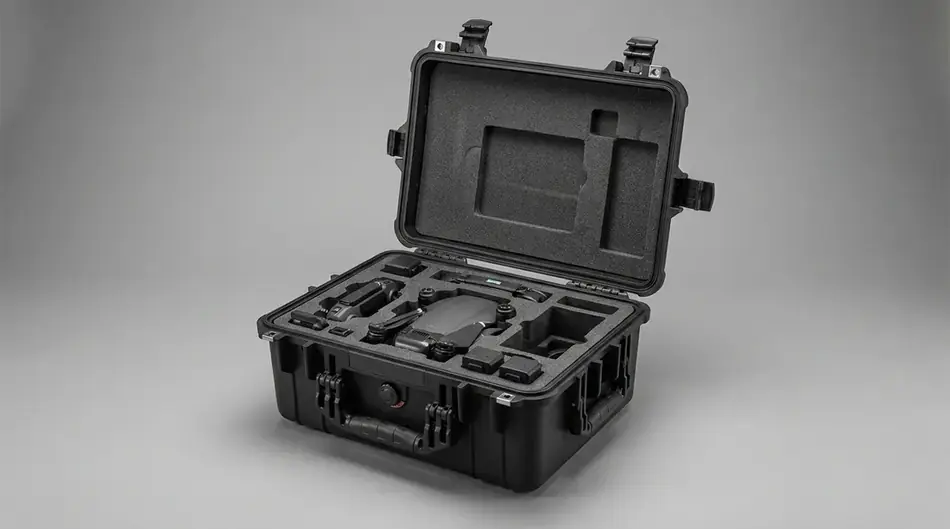
Professional Drone Combo Multi-Battery Hard Case: Sized To The Aircraft And The Packs
A drone combo with several batteries is sized by internal height and lid depth first, because the airframe with its landing gear, gimbal and antennas is the tallest thing in the kit and the batteries are the heaviest per litre: a T-series moulding such as the KX-86830 with 595 by 460 by 255 mm internal, a 210 mm lid over a 45 mm base on a 4.8 mm wall, about 55.8 litres usable and wheels with a telescopic handle is the working default for a folding professional airframe plus four to six packs and a controller, while the KX-85835 gives 500 by 400 by 305 mm internal and a 260 mm lid where the aircraft stands on its legs, and the KX-97227 puts a 6.0 mm wall and a 168 mm base under a long flat kit. Batteries travel in their own cut pockets, low and separated, never against the lid line; tripods and ballheads need internal length such as the 582 by 300 by 130 mm bed of the KX-86216 or the 737 mm cavity of the KX-87926; microphones, soundcards and small radio gear sit in sealed shallow boxes such as the ABS KX-62109 and KX-62209. KeXin publishes internal and external dimensions, wall thickness, lid and base depth, usable volume, net weight and carton packing model by model across 155 mouldings, and leaves an unmeasured field blank instead of filling it with a catalogue average. What we do not do: print an ingress protection class, a free-fall height or a stacking load for a model that has no record of it, describe a thermoplastic shell as a fire-containment or thermal-runaway barrier, or treat the pack maker's battery documentation as something a case can supply. Where your tender or your insurer names a figure, we say which measurements exist for the build you order and quote the rest as accredited laboratory testing on that configuration.
Key points
- Size the combo box by internal height and lid depth first: airframes with legs, gimbals and antennas fail at the lid, not on the footprint.
- Batteries belong low and in separate pockets: mass per litre decides the base plank, and a lid that must close over standing packs is a different moulding.
- Fifty-nine of our 155 models are listed for drone and UAV payload and 19 publish wheels with a telescopic handle, which is the shortlist for loaded carry.
- A tripod and ballhead want internal length rather than volume; 35 models publish 500 mm or more and the KX-87926 gives 737 by 257 mm.
- Microphones, soundcards and small radio gear travel in shallow sealed boxes: 124 of 155 models list a gasket in a continuous moulded channel, 31 a plain rim.
- A moulded plastics shell is not a fire-containment barrier and a gasket is not an ingress class, so battery paperwork and any named rating stay with the pack maker and the laboratory.
- KeXin is wholesale and OEM or ODM only on EXW or FOB terms: first article near 45 days, a new mould near 125 days, 30 per cent deposit.
Size It From The Aircraft As It Is Actually Packed
A professional drone is not a rectangle. The airframe has landing legs, a gimbal that must be released or carried in its own well, antennas that stand up, a battery bay that is already a compartment, and a controller with sticks that protrude. Buyers who shortlist by litres end up with a box that needs a knee on the lid, and a lid that needs a knee lifts its gasket. So the order of work is: measure the packed kit as it leaves the vehicle, with the packs in the bag and the gimbal in its case; add about ten millimetres per side for the cut walls and five to ten at the closing line; then read published internal length, width, height, lid depth and base depth for a named model. KeXin publishes all of those figures model by model across 155 mouldings, including internal volume from 0.3 to 139.5 litres and usable volume from 0.3 to 111.6 litres, which is the difference between a cavity and the space your foam layout actually leaves you. Wall thickness is listed on 148 models from 2.0 mm to 6.0 mm, net weight on 93 from 100 g to 15,320 g, and thirty-seven models publish internal height at 200 mm or more, which is the shortlist for an airframe that stays upright in transit.
Professional Drone Combo Multi-Battery Hard Case
The phrase professional drone combo multi-battery hard case describes one box carrying the whole outfit: airframe, several packs, controller, charger, filters, prop guards or spare props, spare arms, tools and the licence paperwork. That is a volume-and-mass combination problem, and the published ladder runs from large flat mouldings to deep wheeled ones. The KX-87323 lists 650 by 430 by 210 mm internal with a 160 mm lid over a 50 mm base on a 5.0 mm wall, about 47.0 litres usable and a stackable body, which suits a folding airframe laid flat with a tray of packs beside it; the KX-86127 gives 530 by 360 by 248 mm with a 200 mm lid on a 5.0 mm wall and about 37.8 litres for the same kit standing on its legs; the KX-86830 extends to 595 by 460 by 255 mm with about 55.8 litres, wheels and a telescopic handle at about 10,160 g empty; and where height decides it, the KX-85835 gives 500 by 400 by 305 mm internal with a 260 mm lid on a 5.0 mm wall and the KX-86136 gives 530 by 360 by 304 mm with a 260 mm lid at 46.4 litres, both wheeled. Note one published consequence of wheels: the 19 models that carry wheels and a telescopic handle are listed as not stackable, because the moulded base is a wheel housing rather than a stacking foot. A two-person crew lift on site is therefore a wheel-and-telescopic decision, while a rack of boxes in a store is a stackable-footprint decision, and the same trip cannot be done by one box.
Batteries: Pockets, Mass And The Paperwork That Travels Separately
Batteries are the part of a combo kit that buyers most often ask a case to solve, and a case cannot solve it. What a case does do is three concrete things: it separates each pack into its own pocket so terminals cannot bridge against a spare arm or a coin, it keeps the mass low in the moulding so a lid never carries the load, and it makes a missing pack visible at a glance with a printed outline per bay. Published construction figures that matter here are wall thickness and base depth: the KX-97227 lists a 6.0 mm wall with a 168 mm base under a 42 mm lid at 590 by 435 by 210 mm internal and about 10,000 g empty, which puts steel-hard loads and a bank of packs in the deepest part of the box, while the KX-86830 has the opposite architecture at a 210 mm lid over a 45 mm base and is chosen when the payload must stand up. What we do not claim, and say plainly: a moulded thermoplastic shell is not offered as a fire-containment or thermal-runaway barrier, and we publish no unmeasured figure for one. Damaged or swollen packs should not be packed with the airframe at all. The cell or pack test summary, the state-of-charge limit and the shipping documentation your forwarder or airline asks for belong to the battery maker and to your operating paperwork; a case number on a label does not create them, and no configuration we build should be described on a manifest as a substitute for them.
Photography Tripod & Ballhead Hard Protective Case
A tripod and its head are a length problem, and legs that telescope to 700 mm or more are why buyers end up with two boxes instead of one. Thirty-five of our 155 models publish internal length at 500 mm or more and twelve at 600 mm or more. The KX-86216 lists 582 by 300 by 130 mm internal with a 100 mm lid over a 30 mm base on a 3.3 mm wall and about 19.5 litres usable, which takes a carbon tripod with the head mounted alongside; the KX-87926 gives 737 by 257 by 240 mm with a 175 mm lid over a 65 mm base on a 4.0 mm wall and about 36.4 litres for a long leg set plus a video head; the KX-85718 covers 520 by 296 by 155 mm on a 4.2 mm wall with about 19.1 litres, and the wheeled KX-85726 keeps that same 520 by 296 mm bed at 210 mm internal height with a 155 mm lid, about 25.8 litres and about 5,600 g empty. Two details decide whether a ballhead survives: it is either mounted on the legs, in which case the combined outline is what you measure, or it travels in its own machined well with the plate removed, because a quick-release plate and an Allen key loose in a lid cavity will score the anodising and jam the knob. Check the external figure against the vehicle and the overhead bin as well; a 788 mm external length is a hatch, a trolley or a checked bag, not a hand-baggage item.
Wireless Microphone & Soundcard Moisture-Proof Case
The small expensive half of a location kit is where a moisture-proof claim matters most and is easiest to buy wrong. Wireless microphone bodies, receivers, a USB soundcard, lavaliers, wind jammers, slim antennas and a tangle of cables are a shallow-box problem, and the published footprints are compact: the ABS KX-62109 lists 195 by 128 by 81 mm internal on a 3.0 mm wall with about 1.7 litres usable and about 470 g with a gasket; the KX-62209 gives 200 by 98 by 78 mm on a 3.5 mm wall at about 410 g with a gasket; the KX-82812 covers 219 by 160 by 100 mm on a 3.4 mm wall with about 3.0 litres; the KX-83015 gives 245 by 190 by 140 mm on a 3.7 mm wall with about 5.6 litres; and the KX-63317 offers 300 by 178 by 152 mm in ABS on a 4.0 mm wall with about 6.5 litres at about 1,370 g. On the sealing question our own line is short: 124 of 155 models publish a compressible gasket running in a continuous moulded channel and 31 publish a plain rim, and we list which for the model you order. A gasket keeps splash, grit and condensation tracks out of the lid line, which is what rain on a sports sideline or a dewy dawn shoot actually is. It is not, by itself, an ingress protection class, and we do not print one for any model, because no such measurement is on record. The other moisture failure is not water but temperature: a closed box moving from a cold vehicle into a warm hall condenses inside, so a breather position, a desiccant pocket or a soft-cell liner that soaks up a few millilitres is quoted per configuration, and a connector that is wet should be dried before it is powered rather than trusted to a box.
Published Sizes: Combo Load To The Figure You Should Check
| Combo Load | Figure To Check | Published Example | Long Tail This Answers |
|---|---|---|---|
| Folding airframe flat, four to six packs, controller, charger | Internal length and width at the folded arms, lid clearance over the sticks | KX-86830: 595 x 460 x 255 mm internal, 210/45 mm lid/base, 4.8 mm wall, about 55.8 L, 10,160 g, wheels and telescopic handle, gasket | Professional drone combo multi-battery hard case |
| Airframe standing on its legs with gimbal in place | Internal height and lid depth | KX-85835: 500 x 400 x 305 mm internal, 260/45 mm lid/base, 5.0 mm wall, about 48.8 L, 8,520 g, wheeled | Professional drone combo multi-battery hard case |
| Bank of packs plus arms, props and tools | Base depth under the mass, wall thickness | KX-97227: 590 x 435 x 210 mm internal, 42/168 mm lid/base, 6.0 mm wall, Engineering PP, about 43.1 L, 10,000 g | Professional drone combo multi-battery hard case |
| Flat long kit racked in a store or a van shelf | Stackable footprint plus external height | KX-87323: 650 x 430 x 210 mm internal, 160/50 mm lid/base, 5.0 mm wall, about 47.0 L, listed stackable, no wheels | Professional drone combo multi-battery hard case |
| Mid-size outfit, one aircraft and a tray of packs | Usable volume after the cut, not cavity volume | KX-86127: 530 x 360 x 248 mm internal, 200/48 mm lid/base, 5.0 mm wall, about 37.8 L, stackable | Professional drone combo multi-battery hard case |
| Carbon tripod with the head mounted | Internal length of the collapsed set plus the head outline | KX-86216: 582 x 300 x 130 mm internal, 100/30 mm lid/base, 3.3 mm wall, about 19.5 L, gasket | Photography tripod & ballhead hard protective case |
| Long leg set with a video head and spreader | Internal length, then the external figure against the vehicle | KX-87926: 737 x 257 x 240 mm internal, 175/65 mm lid/base, 4.0 mm wall, about 36.4 L, external 788 x 330 x 258 mm | Photography tripod & ballhead hard protective case |
| Tripod and head carried on a location walk-in | Lid depth over a machined head well | KX-85726: 520 x 296 x 210 mm internal, 155/55 mm lid/base, 4.2 mm wall, about 25.8 L, 5,600 g, wheels and telescopic handle | Photography tripod & ballhead hard protective case |
| Wireless mic bodies, receivers and cables | Shallow internal height with a gasketed lid line | KX-62109: 195 x 128 x 81 mm internal, ABS, 3.0 mm wall, about 1.7 L, 470 g, gasket, 20 pcs in 470 x 365 x 560 mm carton | Wireless microphone & soundcard moisture-proof case |
| Soundcard, lavaliers, wind jammers, small radio gear | Pocket count per item and a pocket for the spare washers of the kit | KX-62209: 200 x 98 x 78 mm internal, ABS, 3.5 mm wall, about 1.3 L, 410 g, gasket, 20 pcs in 475 x 285 x 495 mm carton | Wireless microphone & soundcard moisture-proof case |
| Mic set plus a handheld transmitter and charger | Internal height under the aerial | KX-63317: 300 x 178 x 152 mm internal, ABS, 4.0 mm wall, about 6.5 L, 1,370 g, gasket, 8 pcs in 510 x 350 x 750 mm carton | Wireless microphone & soundcard moisture-proof case |
| Camera body with two lenses and a gimbal | Usable volume at a shallow lid, then the filter thread clearance | KX-84122: 385 x 313 x 205 mm internal, 3.7 mm wall, about 21.2 L, gasket, stackable; KX-4616: 455 x 338 x 148 mm, 74/74 mm lid/base, 1,395 g | Professional drone combo multi-battery hard case |
What We Publish And What We Leave Blank
Drone and broadcast buyers frequently forward us a tender line that asks for an ingress class, a free-fall figure, a stacking load, a salt-spray duration or a temperature range. Our answer is the same every time and it is on this page. Published and measured per model: internal and external dimensions, wall thickness on 148 mouldings, lid and base depth, internal volume, usable volume, net weight on 93 models, shell material across PP, engineering PP and ABS, gasket availability, stackability, wheels and telescopic handle, and carton dimensions with pieces per carton on 64 models. Recorded as not measured and left blank: any ingress protection class, any free-fall height, any stacking load figure, a temperature range, ultraviolet exposure and pallet quantity, which we calculate from the carton footprint against your pallet size rather than quote from a catalogue. Shock and impact behaviour in our own data is recorded as a construction option that depends on the foam layout you specify, because the moulding alone is not a shock figure. Where your contract names a class or a load, we quote accredited laboratory testing on the exact configuration you order as a separate work package, and we say in the same sentence which measurements already exist. A lithium battery's own test summary and its transport documentation remain the pack maker's and the operator's records; nothing printed on a case lid creates them.
Selection Guidance: Six Checks Before You Order A Combo Box
First, orientation: does the airframe lie flat or stand, because that chooses between a long flat cavity such as the KX-87323 and a deep lid such as the KX-85835. Second, lid depth read separately from total height, since gimbal, antenna and controller sticks are lid problems. Third, mass placement: how many packs, at what mass, and which layer carries them, because fifty batteries in a fleet programme is a base plank conversation rather than a volume one. Fourth, carry: the loaded weight against the route, which is where the 19 wheeled mouldings earn their place and lose stackability. Fifth, the envelope: external dimensions against the vehicle, the bin, the rack or the carton stack, not just the cavity. Sixth, the document: which figures your customer, insurer or tender actually has to see, so that the enquiry tells us what evidence you need rather than what colour you would like. KeXin will not build a proposal around a number it has not measured on the model you order; where a published field is blank we say so and quote the missing measurement on the ordered configuration.
Where These Cases Are Used
Survey and mapping crews, inspection and utilities teams flying asset routes, film and broadcast production, documentary and event videography, wedding and real-estate operators, aerial photography studios, drone service companies flying a client fleet, police and fire search-and-rescue units, civil engineering and photogrammetry contractors, agriculture and crop-scouting operators, wind and solar farm inspection, heritage and mapping institutions, rental houses turning a fleet over every weekend, and drone manufacturers who ship a matched case with the aircraft. The same mouldings cross over deliberately: a professional drone combo multi-battery hard case for a survey crew, a photography tripod and ballhead hard protective case for a video unit and a wireless microphone and soundcard moisture-proof case for an outside-broadcast team may share one shell family and differ only in the cut, the gasket, the divider count and the marking. Buyers who specify the item that has to arrive working, then build the interior around it, stop paying for volume they cannot fill and stop losing packs, plates and receivers.
Customising The Interior And The Shell
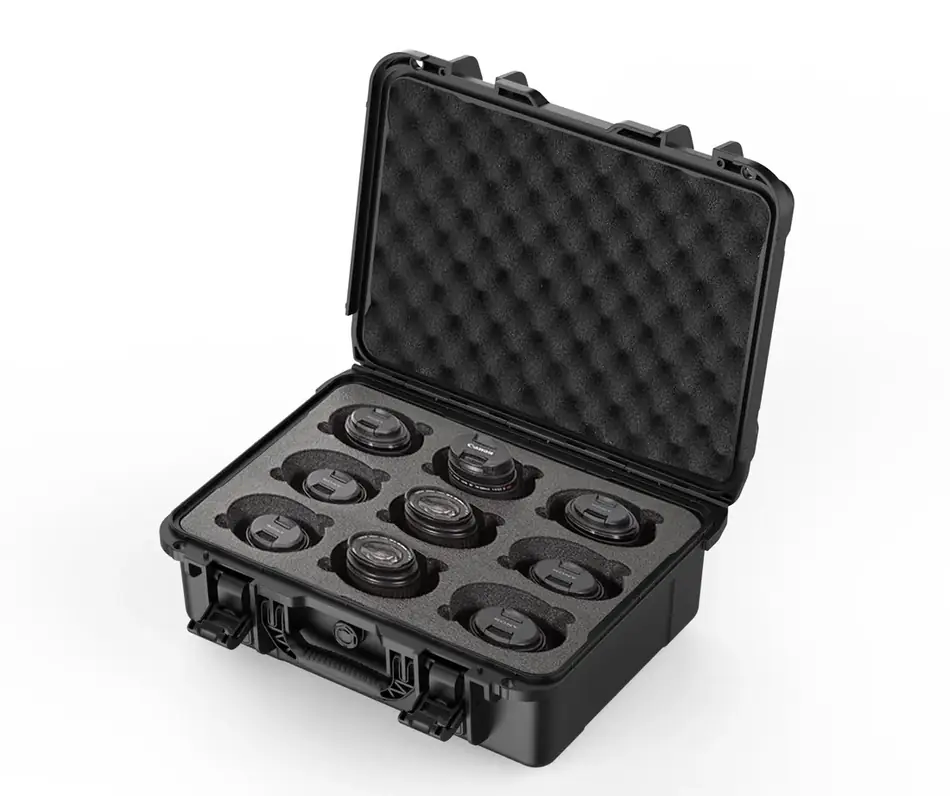
Combo kits are cut, not stuffed. The layouts we build most often put a machined well for the airframe in the base with the arms supported rather than suspended, a separate pocket per battery with the terminals isolated and a printed outline that shows a missing pack at a glance, a channel for the charger lead, a mesh or elastic tray for props, filters and spare arms, a machined cradle for the controller with the sticks recessed, and a document pocket in the lid for the aircraft registration and the operating paperwork. Cross-linked PE, EVA and EPE plank are all available, die-cut or CNC-cut, with a firmer base under mass and a softer face against gimbal and lens surfaces; dividers-only interiors suit rental fleets that repack every weekend. Shell changes are OEM or ODM projects quoted per build: colour, a moulded or pad-printed logo, a marking band, extra latches, a padlockable hasp, a tether eye, a breather position, a desiccant pocket, an added handle, wheels or their omission, and a serial or asset-tag field. Since we ask what is really going inside before proposing a shell, send a drawing, a photograph of the packed kit or a physical sample, and we confirm the material datasheet for the nominated model rather than assuming one grade across 155 mouldings.
Procurement Notes: Wholesale Terms, MOQ And Lead Time
KeXin New Materials (Guangdong) Co., Ltd. sells to wholesale and OEM or ODM buyers on EXW or FOB terms only. There is no retail channel, no delivered-duty-paid quotation and no overseas warehouse, so freight is arranged by the buyer or quoted separately as logistics rather than folded into a unit price. On existing mouldings the standard MOQ starts at a single piece and custom foam is likewise quoted from one, so a fleet operator can trial one combo box against its own aircraft before committing to twenty; logo, colour and OEM production begin near 300 pieces and a custom mould near 3,000 pieces per component. A first OEM article on existing tooling runs about 45 days and a new mould about 125 days, with a 30 per cent deposit and the balance paid after inspection and before shipment. Third-party inspection at our facility is welcome before goods leave. Packed drone dimensions are quoted as the aircraft and kit you actually fly, not as a nominal class. Send the packed dimensions, the pack count, the quantity and the figure your purchaser must see to Fred Zhao or the KeXin Sales Team, WhatsApp +86 135 3588 0002, and the reply names the model with its published numbers or states what has not been measured and what it costs to measure it.
Customisation
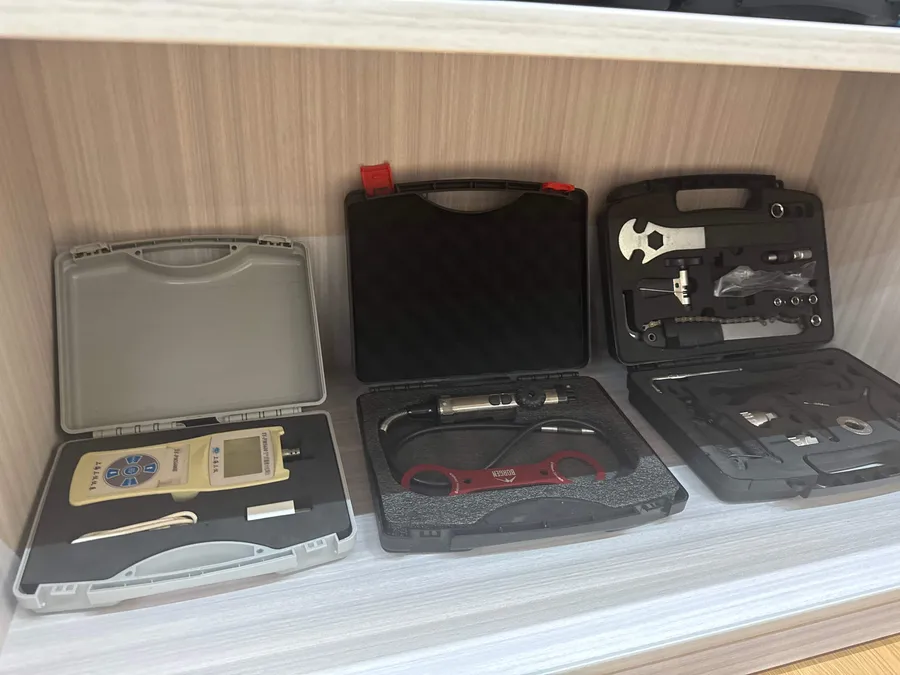
Everything described above is configurable on a standard shell: interior layout (pick-and-pluck, die-cut or CNC-cut), foam grade and thickness, colour, logo method, latch and lock count, pressure-equalisation valve, cable ports, document holder and identification plate. A bespoke exterior geometry requires a new mould — 125 days, from 3,000 units per moulded component.
Procurement considerations
| Question | What to send us |
|---|---|
| Which shell fits? | Equipment L × W × H as packed, plus required clearance per axis |
| What does it cost? | Order quantity and estimated annual quantity — the two drive different answers |
| Is tooling needed? | Whether an existing shell clears the envelope with usable foam depth |
| Lead time? | Your required delivery date, not just the order date |
| Certification? | The exact standard your tender names — we will say whether we can test to it |
| Freight? | Destination and preferred terms; carton and pallet data supplied with the quotation |
Comparison and selection guide
The tables on this page exist because a protective case is chosen by comparing three things: the envelope, the environment and the handling chain. Where no table applies, the rule below is.
| Situation | What To Do |
|---|---|
| Folded or fixed | Measure the airframe in its folded transport configuration, then add 20 mm. |
| Battery count | Each battery needs its own pocket, not a shared compartment. |
| Ground station | Controllers, tablets and monitors are best in a separate lid layer. |
- Size on internal dimensions plus clearance, never on a product name.
- Choose the carrying method before the shell: it changes the series, not just the price.
- Specify the interior last, and decide up front whether the end user will reconfigure it.
Professional Drone Combo Multi-Battery Hard Case: Sized To The Aircraft And The Packs relates to Protective Case Basics. Related families: Drone & UAV Cases / Camera & Photography Cases / Electronics Cases / Rolling Cases / Custom Protective Cases / Equipment Transport Cases / Field Equipment Cases. Related sectors: field and industrial equipment. Continue in the Protective Case Basics cluster.
This page is written from our own production data. If your requirement differs, send the dimensions and we will tell you which of the 155 models fits, or whether a custom route is needed.