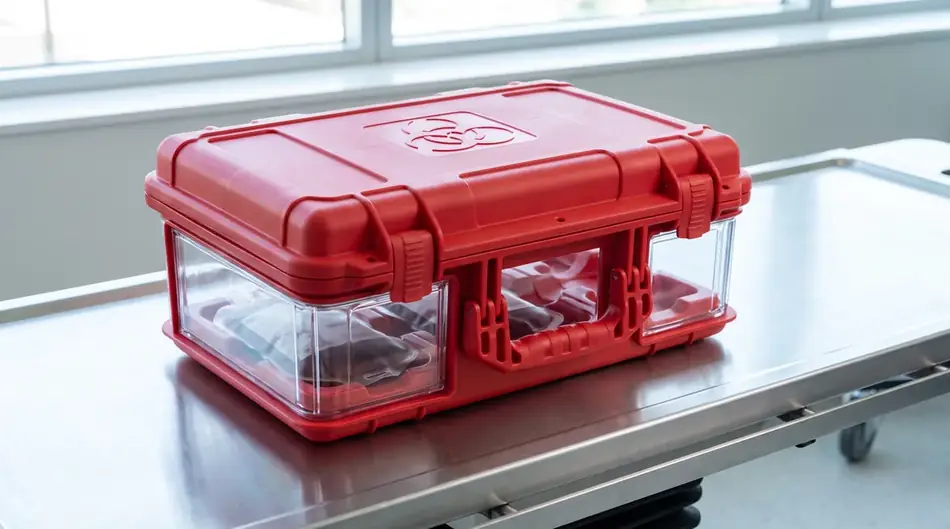
Medical Ultrasound Probe Protective Case: Sized To The Head, The Cable And The Gel
A probe travels as three loads in one shell: the probe itself, its cable coiled as it actually packs, and the bedside accessories that go with it, so the internal height and the lid plane decide the case long before the length does. Measure the probe across the acoustic window and up to the top of the connector, measure the cable as a coil rather than as a length, then add about 20 mm per axis for the cut foam wall, the gasket land and the draft of the moulding. In our published library a single probe lying flat fits the 200 x 98 x 78 mm internal cavity of KX-62209 (ABS, 3.5 mm wall, 1.5 litres, 410 g), a probe with a coiled cable and a gel bottle fits 300 x 178 x 152 mm on KX-63317 (4.0 mm wall, 8.1 litres, 1,370 g), and a probe that stands connector-up fits 300 x 200 x 200 mm on KX-93221, where 165 mm of that depth sits in the lid over a 35 mm base. Two probes plus a tablet move to the 380 x 267 mm footprint, offered in seven internal heights from 115 mm on KX-84113 to 215 mm on KX-84123. KeXin publishes internal and external dimensions, wall thickness on 148 of 155 mouldings, lid and base depth, volume, usable volume, net weight on 93 models, gasket presence on 124, stackability and carton data model by model. What we publish for no model: a water or dust class, an impact or free-fall figure, a stack load, a temperature range, and no figure for disinfectant compatibility, because a transport case is a container and not part of the probe reprocessing procedure.
Key points
- Decide internal height and lid depth first: a standing probe with its connector up needs lid plane, not a longer shell.
- Size the cable as a coil. A 2 to 3 m cable packed in a loop is a cylinder, and it sets the pocket, not the probe body.
- Our medical-listed group starts at 378 mm internal length, so a probe-only kit is chosen from the smaller electronics and instrument shells.
- One footprint, many depths: the 437 x 308 mm internal is offered in eight heights from 129 to 230 mm, so a shelf plan serves several probe kits.
- A gasket is a moulded seal, not an ingress class: 124 of 155 models record one, and no water or dust figure is published for any model.
- The case sits inside your cleaning procedure as a wipeable container; it is not a sterile barrier and we publish no antimicrobial claim.
- Custom foam starts at one unit with no tooling; colour, logo and OEM hardware start at 300 units, on EXW or FOB wholesale terms.
Medical Ultrasound Probe Protective Case: What Actually Travels In One Box
An ultrasound probe is never one object in transit. It is a probe body with an acoustic window at one end and a connector at the other, a cable that has a coil diameter of its own, and a small kit of bedside items: a gel bottle or a pack of single-use gel, the transducer protector or steering wheel if the exam uses one, a spare, a cloth and the paperwork. The case envelope is decided by whichever of those is tallest as packed and by where the connector hood sits, because the connector is the part that must not be pressed. Lay the probe flat and the shell can be shallow; stand it with the connector up and the lid plane has to clear the hood without the foam carrying that load.
For a single probe lying flat, our published cavity starts at 200 x 98 x 78 mm on KX-62209, an ABS moulding with a 3.5 mm wall, 1.5 litres internal and 1.3 litres usable, 410 g empty, a compressible gasket recorded in a continuous moulded channel and a stacking foot, shipped 20 pieces in a 475 x 285 x 495 mm carton. Add the coiled cable and the gel and the pocket becomes the decision: KX-63317 publishes 300 x 178 x 152 mm internal on a 4.0 mm wall at 8.1 litres and 1,370 g, with eight pieces in a 510 x 350 x 750 mm carton. Where the probe must stand, KX-93221 gives 300 x 200 x 200 mm internal with 165 mm of that depth in the lid over a 35 mm base, a 5.0 mm wall, 12.0 litres (9.6 usable) and 1,230 g.
A two-probe kit is where the footprint ladder pays for itself. The 405 x 325 mm external shell family is published with 380 x 267 mm internal in seven heights, from 115 mm on KX-84113 through 165 mm on KX-84117 to 215 mm on KX-84123, each on a 3.4 mm wall with a gasket recorded and each stackable. Same shelf, same carton footprint, different interior depth: the probe set that gains a wireless dongle or a spare steering wheel does not need a new store layout, only the next height in the family. That is the practical meaning of modular storage in a hospital or field context, and it is a moulding fact rather than a design phrase.
Hospital Infection Control Test Device Hard Case: What It Does And What It Does Not Do
Buyers in this category ask the case to carry a cleaning obligation, and it is worth separating the two. What we supply is the outer container: a moulded thermoplastic shell, a cut foam interior and a closing line. Across the 155 active mouldings the shell is PP on 94, engineering PP on 38, ABS on 22 and PP/ABS on one, and we record shell corrosion resistance as measured because a thermoplastic shell has no ferrous corrosion path. What we publish nothing for, on any model, is a disinfectant or cleaning-agent compatibility figure, a bioburden or antimicrobial claim, or a sterile-barrier function. Those belong to your facility procedure and to the probe maker reprocessing instructions, and a case label does not create either one.
What you can specify instead is geometry that makes your own procedure executable: full-depth pockets so nothing overhangs a wall, a single-piece base foam rather than glued strips that trap residue, no small closed channels that cannot be reached with a wipe, finger lifts cut into the pocket so the probe can be lifted out without prising it from the foam, and the lid plane left clear over the connector. A surface that can be wiped and dried is a property of the shape you approve, which is why we ask for the packed equipment or a drawing of it rather than a weight and a price.
The gasket field is where the same discipline applies. A compressible gasket running in a continuous moulded channel keeps grit and splash off the closing line, and 124 of our 155 models record one, including 64 of the 71 shells our library lists under medical equipment. The remaining 31 mouldings record no seal offered on that shell, so the field is read model by model, not series by series. No water or dust class and no ingress protection figure is published for any model, because none is on record; where a tender names one, we quote accredited laboratory testing of the exact shell, gasket and foam build as a separate work package and say in the same sentence which measurements already exist.
Sizing By Probe Family: Linear, Convex, Phased Array, Endocavity And Wireless
A linear array probe is wide across the acoustic window and short in the body, so internal length and width decide it. KX-2811 publishes 253 x 180 x 98 mm internal on a 5.0 mm wall, 4.5 litres (3.6 usable) and 890 g, with a 71 mm lid over a 27 mm base; KX-3315 gives 303 x 224 x 135 mm at a 4.1 mm wall, 100 mm of lid over 35 mm of base, 9.2 litres (7.4 usable) and 1,670 g. Where the same box also has to take a biopsy guide or an offset bracket, the lid figure matters more than the total depth, because the bracket is the item that will not lie flat.
A convex or phased-array probe is fatter through the housing, so read internal height next: KX-92817 publishes 253 x 180 x 152 mm internal with a 125 mm lid over a 27 mm base on a 5.0 mm wall at 6.9 litres and 940 g, and KX-83015 gives 245 x 190 x 140 mm on a 3.7 mm wall, 6.5 litres (5.6 usable) with a gasket recorded. Endocavity probes with a curved shaft are the case where a long shallow box fails and a shorter deep box works, which is why 333 x 217 x 175 mm on KX-63619 (3.5 mm wall, 12.6 litres, 1,660 g) or 340 x 220 x 175 mm on KX-83719 (3.3 mm wall, 140 mm lid over 35 mm base, 13.1 litres) is usually the right answer rather than a longer shell.
A wireless probe travels with a tablet or a charger, and that is a flat-load problem: 380 x 305 x 110 mm internal on KX-4012, with 85 mm in the lid over a 25 mm base on a 3.5 mm wall, 12.7 litres (10.9 usable) and 1,480 g, ten pieces in a 725 x 420 x 580 mm carton. Where the tablet travels with two probes and a keyboard, 420 x 260 x 104 mm on KX-4312 (3.5 mm wall, 11.4 litres, 1,170 g, ten per carton) or 455 x 338 x 84 mm on KX-4610 (3.0 mm wall, 12.9 litres, 1,115 g, carton 755 x 470 x 650 mm) keeps the stack flat and the connector unloaded.
Published Envelopes: Probe Kit Mapped To The Model That Clears It
The table maps each kit described above to the published figure that decides the choice and to one model in our library that sits in that band. Every dimension is the internal figure recorded for that SKU, and the seal, stacking and carton notes are the fields recorded for the same model rather than a general statement about the series.
| Kit As It Travels | Figure That Decides | Published Example | Seal And Carry |
|---|---|---|---|
| One probe lying flat, no cable loop | Internal length across the acoustic window, then pocket depth | KX-62209: 200 x 98 x 78 mm internal, 3.5 mm wall, 1.5 litres (1.3 usable), 410 g, ABS | Gasket recorded; stackable; fixed handle; 20 pieces per 475 x 285 x 495 mm carton |
| Probe plus coiled cable and gel bottle | Coil diameter as a cylinder, plus the gel height | KX-63317: 300 x 178 x 152 mm internal, 4.0 mm wall, 8.1 litres (6.5 usable), 1,370 g, ABS | Gasket recorded; stackable; 8 pieces per 510 x 350 x 750 mm carton |
| Probe standing with the connector up | Lid depth over the connector hood, not total depth | KX-93221: 300 x 200 x 200 mm internal, 165/35 mm lid and base, 5.0 mm wall, 12.0 litres (9.6 usable), 1,230 g | Gasket recorded; stackable; engineering PP shell; no carton figure published for this SKU |
| Two probes on one shelf | One footprint, stepped internal height | KX-84113 380 x 267 x 115 mm through KX-84117 380 x 267 x 165 mm to KX-84123 380 x 267 x 215 mm, all 3.4 mm wall | All seven heights in this family record a gasket and are listed stackable; external 405 x 325 mm constant |
| Endocavity probe with a curved shaft | Internal height for the arc of the shaft | KX-63619: 333 x 217 x 175 mm internal, 3.5 mm wall, 12.6 litres (10.8 usable), 1,660 g; KX-83719: 340 x 220 x 175 mm, 140/35 mm split | Both record a gasket and are stackable; KX-63619 ships 6 pieces per 585 x 385 x 620 mm carton |
| Wireless probe, tablet and charger | Flat internal area and a lid plane for the tablet | KX-4012: 380 x 305 x 110 mm internal, 85/25 mm split, 3.5 mm wall, 12.7 litres (10.9 usable), 1,480 g | Gasket recorded; stackable; 10 pieces per 725 x 420 x 580 mm carton |
| Machine head and two probes in one carry | Internal depth ladder on a 437 x 308 mm footprint | KX-84818: 437 x 308 x 164 mm internal, 4.5 mm wall, 22.1 litres (17.7 usable); KX-84824: 437 x 308 x 230 mm, 31.0 litres (26.7 usable) | KX-84818 records a gasket and stacks; KX-84824 records no gasket; the family shares one external footprint |
| Heavy kit moved by one person over distance | Wheels, telescopic handle and loaded mass | KX-85021: 437 x 308 x 164 mm internal, 4.5 mm wall, 22.1 litres, 4,912 g empty; KX-88442: 740 x 518 x 364 mm, 5.0 mm wall, 139.5 litres (111.6 usable), 15,320 g | Both have wheels and a telescopic handle and both are listed as not stackable; 19 of 155 models are in that group |
How To Choose: The Order In Which The Figures Decide
Work the decision in a fixed order and the shortlist writes itself. First, measure the kit as it travels rather than as it is displayed, with the cable coiled the way the sonographer coils it. Second, choose internal height and lid depth before length, because the connector hood and the shaft arc are what fail in a shallow shell. Third, pick a footprint and stay inside it, so the next kit revision is a different height rather than a different store: 437 x 308 mm internal is published in eight heights from 129 to 230 mm across KX-84814, KX-84815, KX-84818, KX-85021, KX-84820, KX-85022, KX-84823 and KX-84824, and 380 x 267 mm in seven heights from 115 to 215 mm. Fourth, read the seal field per model, because the same family is not uniform: inside that 437 x 308 family KX-84818 and KX-85021 record a gasket while KX-84814, KX-84815, KX-84823 and KX-84824 record none.
Fifth, decide the carry before the interior. Stackability is published on 136 of 155 mouldings; the 19 shells that are not stackable are exactly the ones fitted with wheels and a telescopic handle, so a wheeled shell is a floor-moving tool and not a shelf unit. Telescopic height is published on 11 models at 240, 295, 310, 385 and 485 mm, and it is published per model, never as a range for the series. Sixth, ask which requested figures do not exist and get the answer in writing. A quotation that answers a water class or a free-fall question with a series name instead of a measurement reference has not answered it.
Applications: The Trips That Decide The Shell
A bedside probe in one ward rarely leaves the building, and a shallow stackable shell with a cut pocket is the whole requirement. A probe that moves between rooms on a trolley gains a second job: it is picked up, set down and leaned against a wall, so the wall thickness and the stacking foot matter more than the weight. A screening or outreach programme packs several probes, gel stock and consumables into one carry and travels by road, and the 437 x 308 mm family covers most of that range without a wheeled shell. Where the department runs a service exchange or a rental fleet, the case has to survive check-in and check-out, and a document holder under the lid, published as a configuration option on every model, is the practical way to keep the kit list with the kit.
For a machine head and a probe set travelling together, the medical-listed group in our library is where the large shells sit: 71 mouldings with internal length from 378 mm to 1,280 mm, usable volume from 16.5 to 111.6 litres, wall thickness published on 66 of them from 2.5 mm to 6.0 mm, a gasket recorded on 64, 52 listed as stackable, and 19 carrying wheels and a telescopic handle. Net weight is published for 36 of the 71, from 1,360 g on KX-707 to 15,320 g on KX-88442. A probe-only kit is deliberately chosen outside this group, because the smallest medical-listed cavity is already larger than a single probe needs.
Customisation: Foam, Colour, Logo, Hardware And Mould
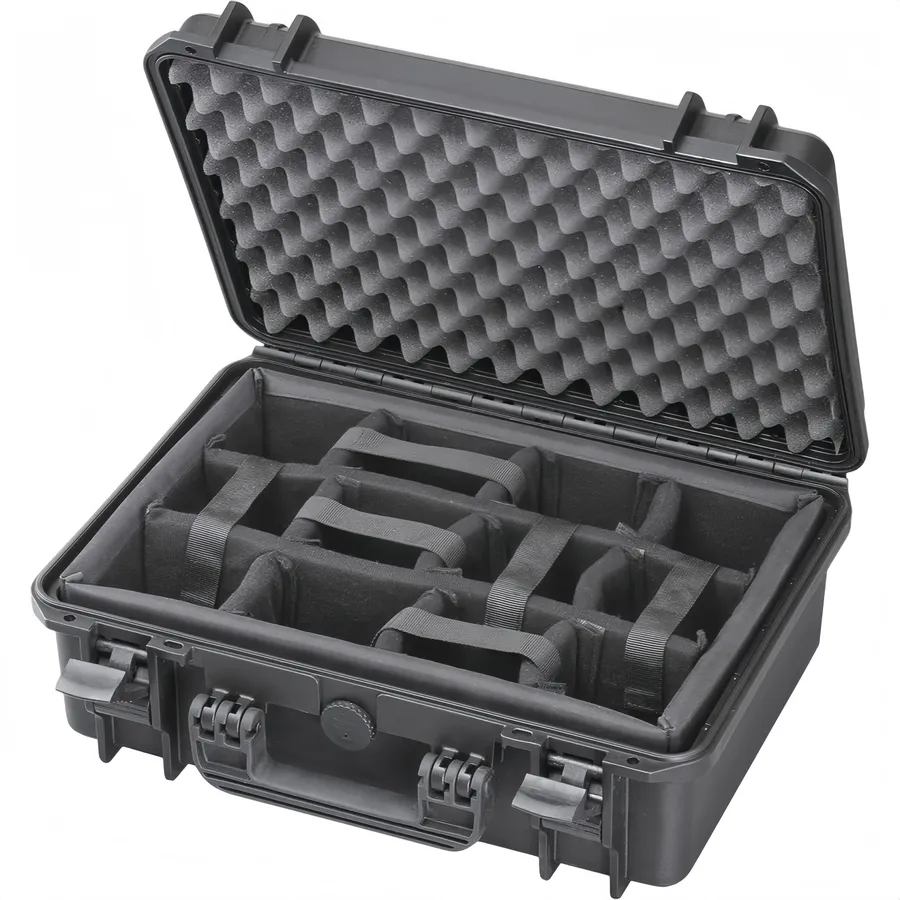
The interior is the part that becomes probe-specific, and it is quoted from one unit with no tooling. Our published foam options are pick and pluck, die-cut, CNC-cut, EVA, PE and EPE, arranged as top foam, base foam, egg-crate or convoluted, layered or custom cut, in cross-linked PE, EVA or EPS by zone. A typical probe layout is a full-depth pocket for the body with a relief under the connector hood, a separate channel or a shallow loop bay for the cable so the jacket is never bent past its radius, a lid bay for the gel and consumables, and a finger lift at the head so the probe comes out without prising. To cut it we need the packed equipment, a drawing, or a photograph of the kit as it travels; that is the field our library records as the drawing requirement for every moulding.
Beyond the foam, colour, logo and OEM hardware start at 300 units, OEM work on an existing mould is quoted at 45 days from first sample, and a new moulded exterior starts at 3,000 units per moulded component and 125 days. The hardware fields we record are handle style, latch count specified per configuration, hinge, feet and a lock body that accepts a standard padlock, all published as measured for the relevant model, while pressure valve, shoulder strap and document holder are published as configuration options rather than as fitted features. A sealed shell with a pressure equalisation option is the usual request when the same case travels by air as checked baggage or moves between cold storage and a warm room.
What We Publish And What We Leave Blank
Published per model, for the 155 active mouldings: internal and external dimensions, wall thickness on 148 of them from 2.0 mm to 6.0 mm, lid depth from 16 mm to 320 mm and base depth from 15 mm to 168 mm on the 100 mouldings that publish them, internal volume up to 139.5 litres and usable volume from 0.3 to 111.6 litres, net weight on 93 models from 100 g to 15,320 g, shell material, gasket presence on 124, stackability on 136, wheels and telescopic handle on 19, and carton dimensions with pieces per carton on 64. On the same page you can read the minimums that apply to each kind of order and the lead times for an existing mould and a new one.
Recorded as not measured and left blank for every model: any water or dust class, any impact or free-fall figure, any stack load, any load capacity, any temperature range, ultraviolet exposure, a fixed pallet count and any cleaning-agent compatibility result. A pallet figure is calculated from the carton footprint against your pallet standard when we quote, and where a tender names one of the blank fields we quote accredited laboratory testing of the exact shell, gasket and foam build as a separate work package. Nothing in the interior changes that: foam is a construction option, and the assembled configuration is what would be tested, not the moulding by itself.
Wholesale, OEM And The Order Path
KeXin New Materials (Guangdong) Co., Ltd. supplies wholesale, OEM and ODM only, on EXW or FOB terms. We do not sell retail, do not quote delivered-duty-paid prices and keep no overseas warehouse stock. Payment is a 30 per cent deposit with the balance after inspection before shipment. Custom foam starts at one unit with no tooling; colour, logo and OEM hardware start at 300 units; OEM work on an existing mould is quoted at 45 days from first sample; a new moulded exterior starts at 3,000 units per component and 125 days.
For a probe project, send the equipment as it travels or a drawing of it, the number of probes and accessories per case, the quantity in the first order and the annual estimate, and the destination. We return the shells that clear the envelope with usable foam depth, the published carton data for those models, and a written statement of which requested figures we can measure and which we cannot. If the first article has to be approved against a physical probe, send the probe and the cable and the foam will be cut to them, so the sample and the production run are the same construction.
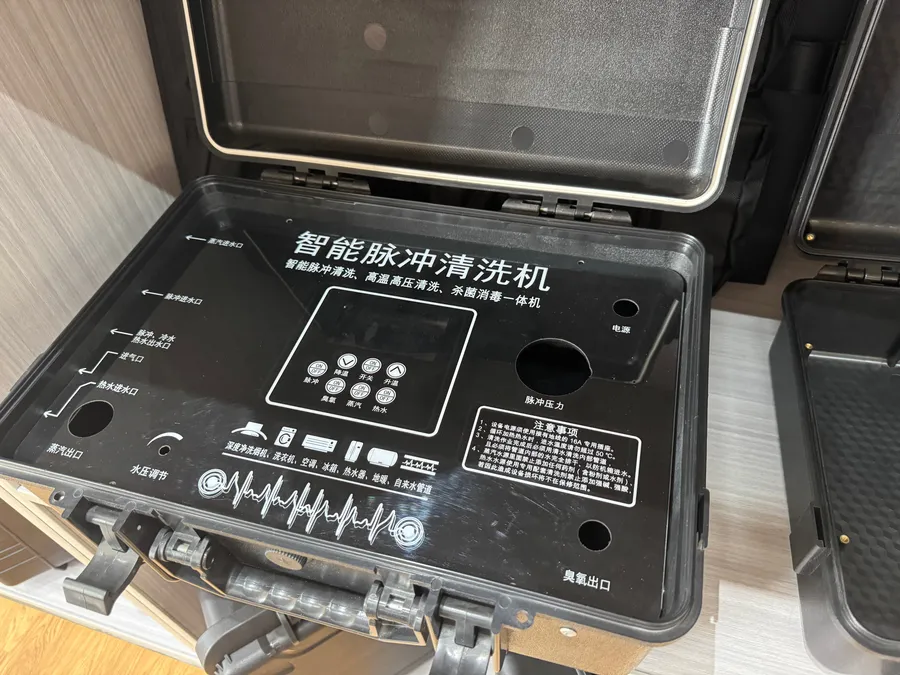
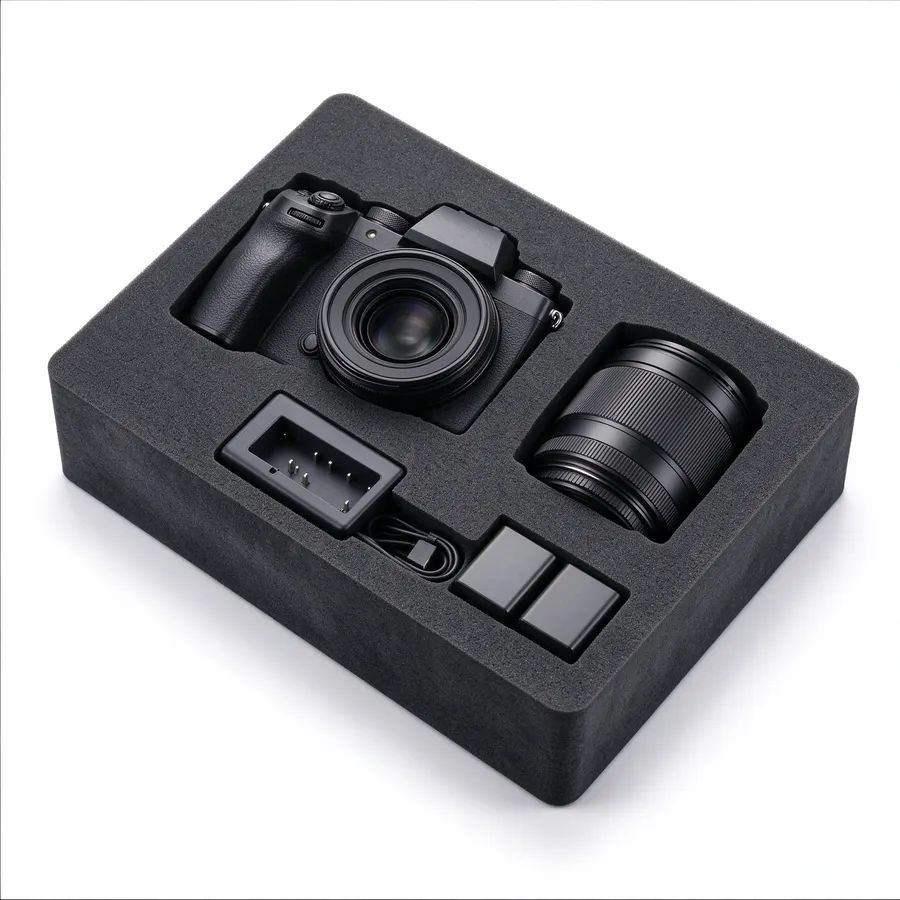
Customisation
Everything described above is configurable on a standard shell: interior layout (pick-and-pluck, die-cut or CNC-cut), foam grade and thickness, colour, logo method, latch and lock count, pressure-equalisation valve, cable ports, document holder and identification plate. A bespoke exterior geometry requires a new mould — 125 days, from 3,000 units per moulded component.
Procurement considerations
| Question | What to send us |
|---|---|
| Which shell fits? | Equipment L × W × H as packed, plus required clearance per axis |
| What does it cost? | Order quantity and estimated annual quantity — the two drive different answers |
| Is tooling needed? | Whether an existing shell clears the envelope with usable foam depth |
| Lead time? | Your required delivery date, not just the order date |
| Certification? | The exact standard your tender names — we will say whether we can test to it |
| Freight? | Destination and preferred terms; carton and pallet data supplied with the quotation |
Comparison and selection guide
The tables on this page exist because a protective case is chosen by comparing three things: the envelope, the environment and the handling chain. Where no table applies, the rule below is.
| Situation | What To Do |
|---|---|
| Clinical environment | Closed-cell foam or a wipeable tray; no open-cell pluck foam. |
| Emergency use | Latches that open with one hand and a lid that stays up unaided. |
| High-value device | Deeper base foam, a separate transducer zone, and a documented drop test if required. |
- Size on internal dimensions plus clearance, never on a product name.
- Choose the carrying method before the shell: it changes the series, not just the price.
- Specify the interior last, and decide up front whether the end user will reconfigure it.
Medical Ultrasound Probe Protective Case: Sized To The Head, The Cable And The Gel relates to Protective Case Basics. Related families: Medical Equipment Cases / Instrument & Equipment Cases / Electronics Cases / Custom Protective Cases. Related sectors: field and industrial equipment. Continue in the Protective Case Basics cluster.
This page is written from our own production data. If your requirement differs, send the dimensions and we will tell you which of the 155 models fits, or whether a custom route is needed.