Can electronics cases be manufactured according to equipment dimensions?
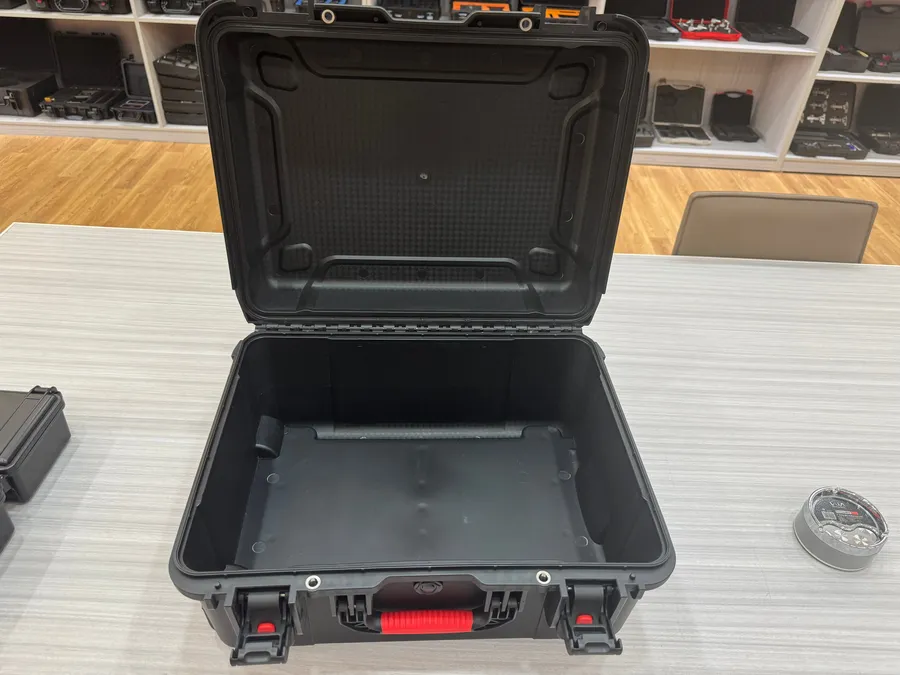
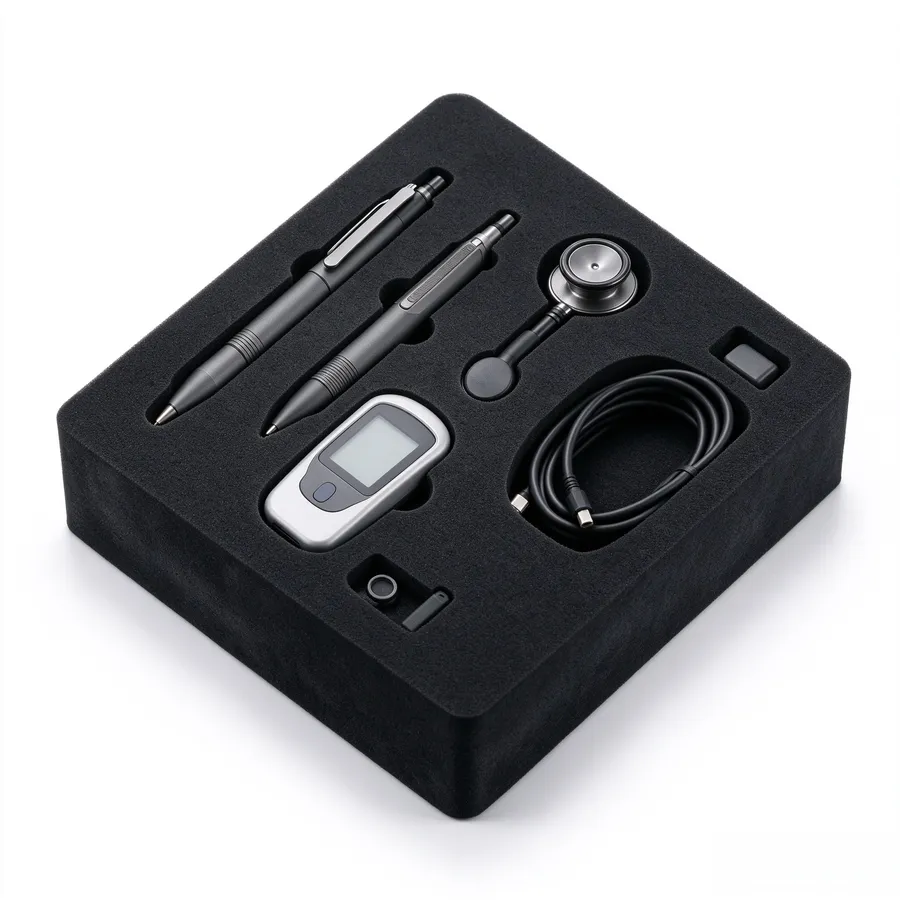
Yes. Electronics cases here are manufactured to the dimensions of the equipment inside, not selected by a nominal catalogue name. We size from the internal envelope of the unit measured in its packed state, add clearance on each axis, then choose or tool a shell whose published internal length, width and height all exceed that figure and cut the foam to hold it. Internal lengths across the electronics range run from about 115 to 880 millimetres, so most boards, instruments and handheld devices land on an existing shell with a bespoke interior rather than a new mould.
Key points
- Manufacture to the internal envelope of the equipment, never to the box it shipped in.
- Add clearance on all three axes before a shell is chosen; about 20 mm per axis is a working default.
- Match internal length, width and height separately, because the tallest or narrowest point decides it.
- Most electronics sizes fit a published shell; only an unusual envelope justifies opening a new mould.
- We produce on wholesale and OEM terms, EXW or FOB, with a first bespoke sample in about 45 days.
Sizing from the equipment, not the catalogue name
The first dimension that matters is the unit measured in its transport configuration, with connectors, antenna stubs, mounting brackets and coiled leads included, because those features set the true internal envelope. A board that is 180 millimetres long in the design file can need an internal bay of over 200 millimetres once its housing, terminals and cable exits are counted.
Only after the packed envelope is fixed do we look at shells. Reading the catalogue by model name inverts the process and is the usual cause of a case that arrives either too tight to close or absurdly large for its contents.
The parameters that decide the fit
| Parameter | What We Control | Note |
|---|---|---|
| Internal length, width, height | Published per model | Pick the shell that exceeds each axis |
| Narrow internal width | Tapered shells | Check the minimum, not the mouth |
| Lid and base depth split | How the item sits | A deeper lid clears tall connectors |
| Wall thickness | Published per model | A stiffer wall costs internal room |
| Clearance allowance | Insert design | About 20 mm per axis as a default |
| Internal volume | From internal dims | Measured in litres, not external |
From measurement to a manufactured case
You send the packed dimensions and the mass; we return the closest published shells and propose the interior. For a common instrument this is a stock shell plus a custom foam cut, finished in days to a couple of weeks. For an out-of-range envelope we quote tooling, where a new mould runs up to about 125 days before the production window opens.
A first sample is produced against the agreed drawing so you can confirm the fit on real hardware before the run. About 45 days for a bespoke sample is the working figure, and the sample is what turns a measurement into a manufacturable part.
The size ladder you can build on
Electronics shells carry concrete published internals, which is what makes dimension-driven manufacturing reliable. A compact unit fits an internal bay near 115 by 78 by 32 millimetres; a mid-size instrument or controller fits around 443 by 285 by 126 millimetres with a narrow internal width of about 263 millimetres; large sealed transport envelopes reach 500 by 400 by 220 millimetres and about 44 litres.
Those are per-model figures published as measured, not a single generic wall specification stretched across the range. Reading them model by model is how you avoid both an over-built shell and a case that will not shut.
Applications and the interior that finishes the fit
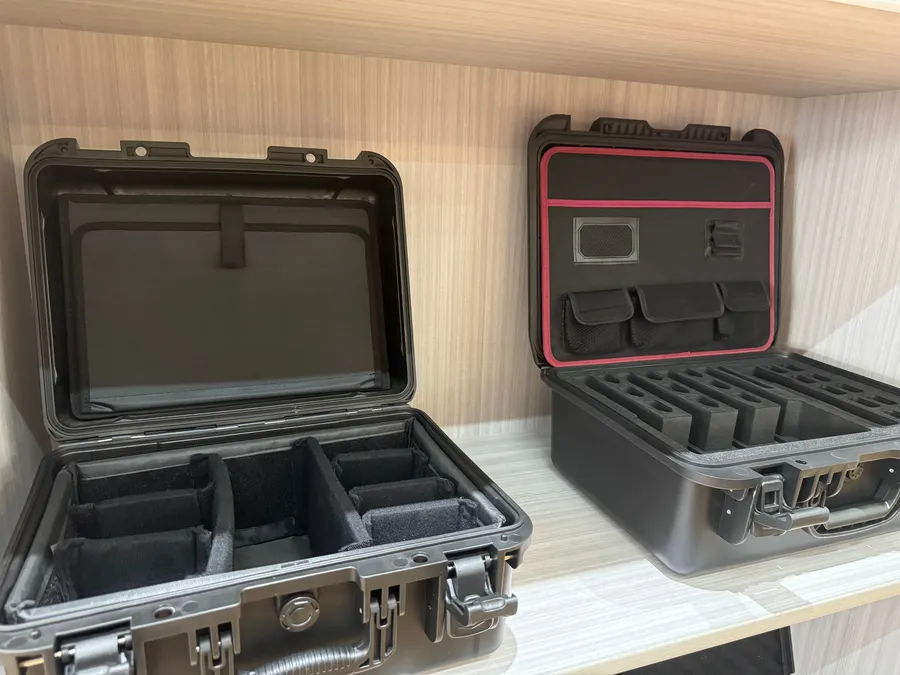
Dimension-led builds cover benchtop instruments, handheld field devices, communications modules, battery packs and camera or optical units. The interior is where the fit is completed: a closed-cell foam as a firm carrier, a soft contact face over it for a delicate finish, and pick-and-pluck where a product family shares one manufactured shell.
Where the equipment varies between units, a fixed base carrier holding the main body and a pluck layer for the accessories lets one manufactured shell serve a whole line, which is cheaper and faster than cutting a separate tool for every variant. That shared-shell approach is also the reason a modest order of custom interiors can cover a broad product family.
Manufacturing terms and the limits we hold to
We manufacture on wholesale and OEM terms, quoted EXW or FOB with a 30 percent deposit. We do not sell at retail, quote DDP, or keep overseas warehouse stock, and the minimum order quantity depends on whether a job reuses an existing shell or opens a new tool.
Internal and external dimensions and wall thickness are published per model. We do not state protection ratings or environmental limits we have not measured for that specific case, and we will not extend one model's numbers across the rest of the range.

Customisation
Everything described above is configurable on a standard shell: interior layout (pick-and-pluck, die-cut or CNC-cut), foam grade and thickness, colour, logo method, latch and lock count, pressure-equalisation valve, cable ports, document holder and identification plate. A bespoke exterior geometry requires a new mould — 125 days, from 3,000 units per moulded component.
Procurement considerations
| Question | What to send us |
|---|---|
| Which shell fits? | Equipment L × W × H as packed, plus required clearance per axis |
| What does it cost? | Order quantity and estimated annual quantity — the two drive different answers |
| Is tooling needed? | Whether an existing shell clears the envelope with usable foam depth |
| Lead time? | Your required delivery date, not just the order date |
| Certification? | The exact standard your tender names — we will say whether we can test to it |
| Freight? | Destination and preferred terms; carton and pallet data supplied with the quotation |
Comparison and selection guide
The tables on this page exist because a protective case is chosen by comparing three things: the envelope, the environment and the handling chain. Where no table applies, the rule below is.
| Situation | What To Do |
|---|---|
| Shock | Base layer thickness and grade sized to the packed mass. |
| ESD | Anti-static PE, specified by surface resistivity range. |
| Dust | Sealed configuration with a continuous rim. |
- Size on internal dimensions plus clearance, never on a product name.
- Choose the carrying method before the shell: it changes the series, not just the price.
- Specify the interior last, and decide up front whether the end user will reconfigure it.
Can electronics cases be manufactured according to equipment dimensions? relates to Protective Case Basics. Related families: Electronics Cases / Custom Protective Cases / Instrument & Equipment Cases / Communication Equipment Cases. Related sectors: field and industrial equipment. Continue in the Protective Case Basics cluster.
This page is written from our own production data. If your requirement differs, send the dimensions and we will tell you which of the 155 models fits, or whether a custom route is needed.


