How a Protective Case Matching Engine Works
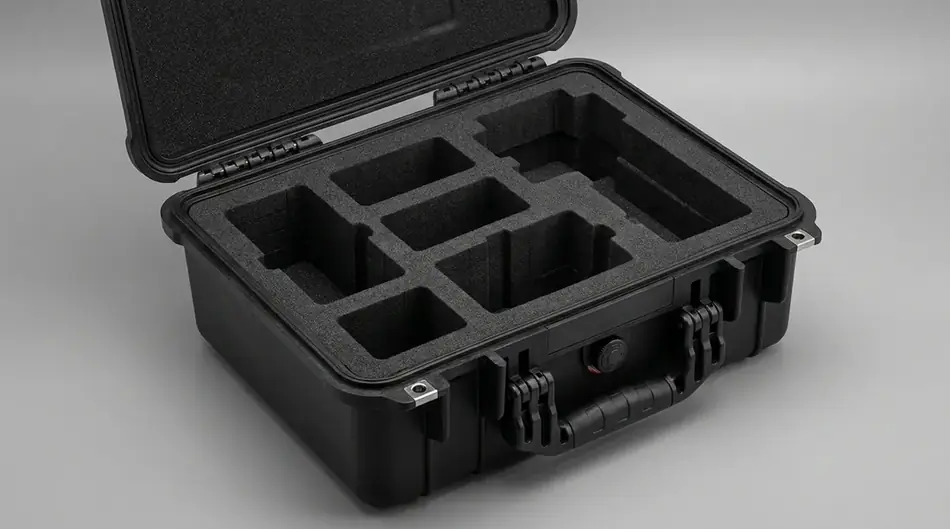
A case matching engine filters a product database on internal length, width and height against the equipment envelope plus a clearance allowance, then removes candidates that fail weight, feature and application constraints, then ranks what remains by unused volume, evenness of clearance, empty mass and feature bonuses, and finally returns three tiers rather than one answer.
Key points
- The first filter must be internal dimensions. Matching on external dimensions produces a case the equipment will not fit inside.
- Clearance is not optional: without 20 mm per axis there is no room for foam, and the equipment bottoms out on impact.
- Unused volume is the right dominant ranking term, because it is what you pay freight on for the life of the product.
- A no-match result is a business outcome, not an error. It routes the buyer to a custom route instead of a bad fit.
The six steps in order
Order matters. Dimension and feature filters are hard constraints — a model either clears them or is gone. Scoring terms come after, and they only ever rank candidates that already fit. An engine that scores first and filters later will happily recommend a case with 4 mm of slack because it is the "closest" volume, and the buyer finds out at packing.
| Step | What | Type |
|---|---|---|
| 1 Dimension filter | internal L, W and H each exceed envelope + clearance | hard exclusion |
| 2 Weight filter | packed mass plus empty mass over 25 kg without wheels | hard exclusion |
| 3 Feature filter | wheels, sealing option, lock, handle, custom foam | hard exclusion |
| 4 Application filter | sector must exist in the model application set | exclusion plus weighting |
| 5 Fit score | unused volume, slack evenness, empty mass, feature bonuses | ranking, clamped 35-99 |
| 6 Three tiers | best fit, more interior space, alternative structure | presentation |
What a fit score is not
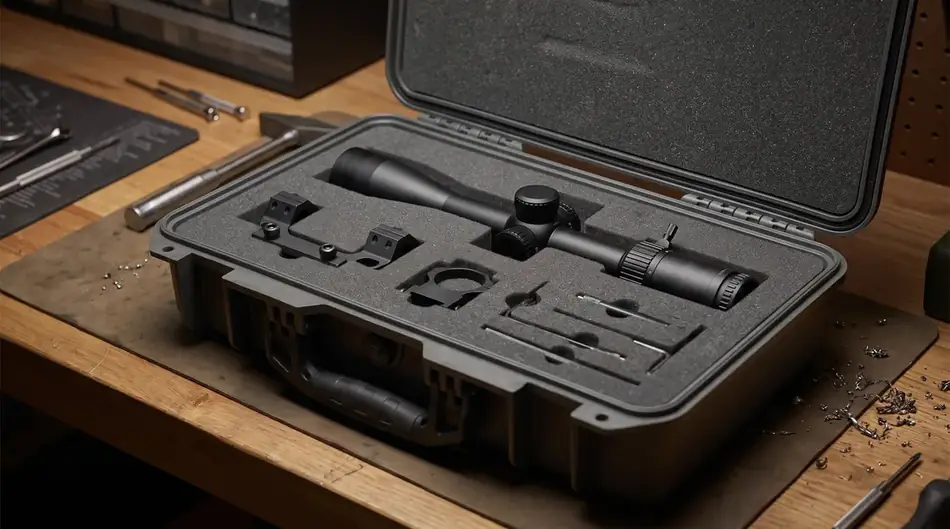
A fit score is a comparison of models against one buyer requirement. It is not a quality rating, and it is not portable: a shell scoring 91 for a 620 × 420 × 280 mm radio set may score 40 for a flat optical assembly with the same volume. Any number that looks like a grade should be treated with suspicion until you see which envelope it was computed against.
Applications
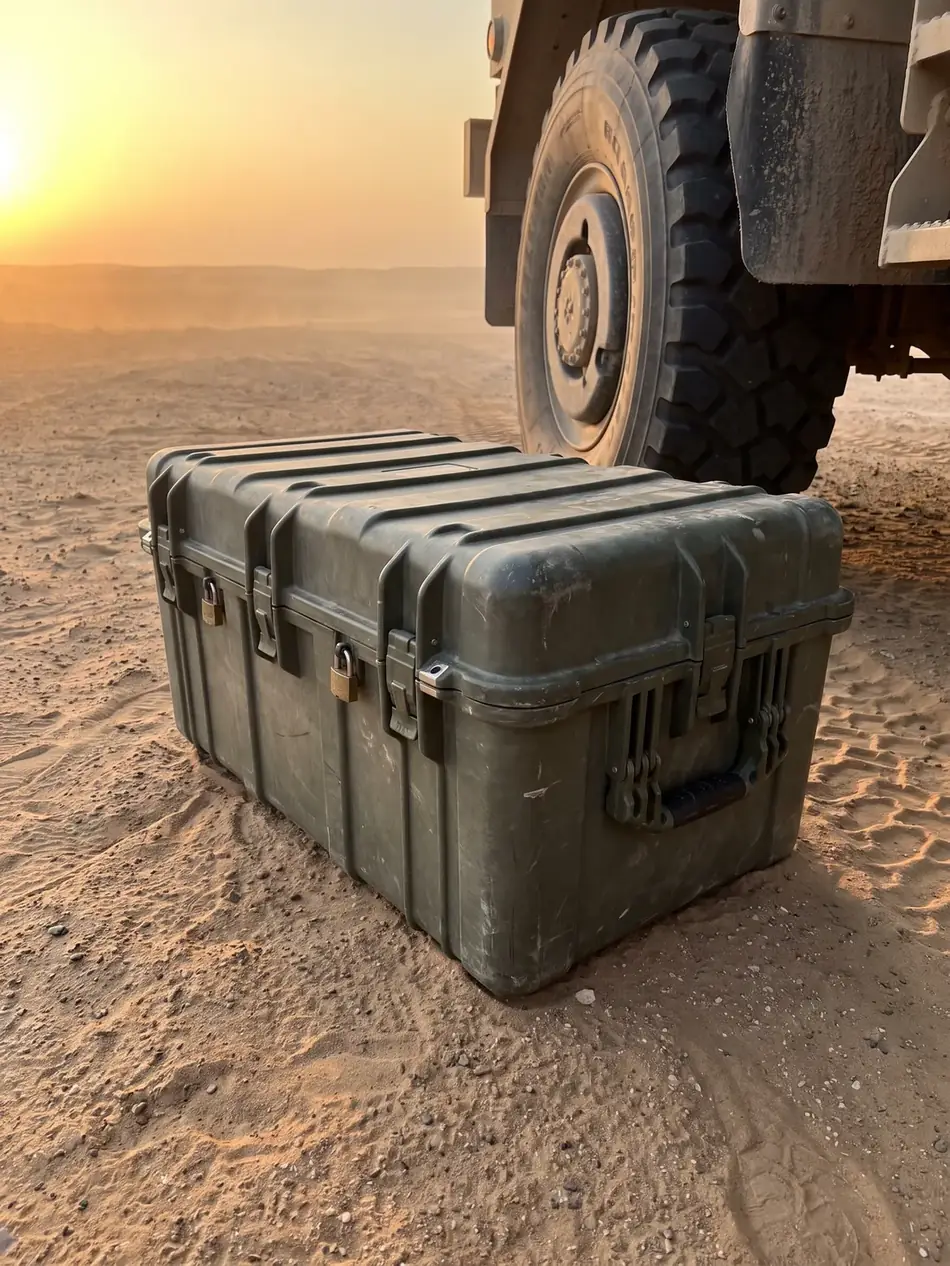
This matters most where the case is part of a movement chain rather than shelf packaging. In military and industrial equipment the same shell is specified differently because the handling, the environment and the verification requirement differ.
- Military — Military equipment moves through a chain of handlers, none of whom own the equipment and all of …
- Industrial Equipment — In an industrial setting the case is a working surface as much as a container, and its interior …
Customisation
Everything described above is configurable on a standard shell: interior layout (pick-and-pluck, die-cut or CNC-cut), foam grade and thickness, colour, logo method, latch and lock count, pressure-equalisation valve, cable ports, document holder and identification plate. A bespoke exterior geometry requires a new mould — 125 days, from 3,000 units per moulded component.
Procurement considerations
| Question | What to send us |
|---|---|
| Which shell fits? | Equipment L × W × H as packed, plus required clearance per axis |
| What does it cost? | Order quantity and estimated annual quantity — the two drive different answers |
| Is tooling needed? | Whether an existing shell clears the envelope with usable foam depth |
| Lead time? | Your required delivery date, not just the order date |
| Certification? | The exact standard your tender names — we will say whether we can test to it |
| Freight? | Destination and preferred terms; carton and pallet data supplied with the quotation |
Comparison and selection guide
The tables on this page exist because a protective case is chosen by comparing three things: the envelope, the environment and the handling chain. Where no table applies, the rule below is.
| Situation | What To Do |
|---|---|
| Fastest | Standard shell plus CNC foam — typically 45 days from approved drawing. |
| Branded | Standard shell plus custom colour and logo — MOQ applies to the resin colour. |
| Bespoke geometry | New mould — 125 days, MOQ from 3,000 units per component. |
- Size on internal dimensions plus clearance, never on a product name.
- Choose the carrying method before the shell: it changes the series, not just the price.
- Specify the interior last, and decide up front whether the end user will reconfigure it.
How a Protective Case Matching Engine Works relates to Protective Case Basics. Related families: Custom Protective Cases / Equipment Transport Cases. Related sectors: Military / Industrial Equipment. Continue in the Protective Case Basics cluster.
This page is written from our own production data. If your requirement differs, send the dimensions and we will tell you which of the 155 models fits, or whether a custom route is needed.