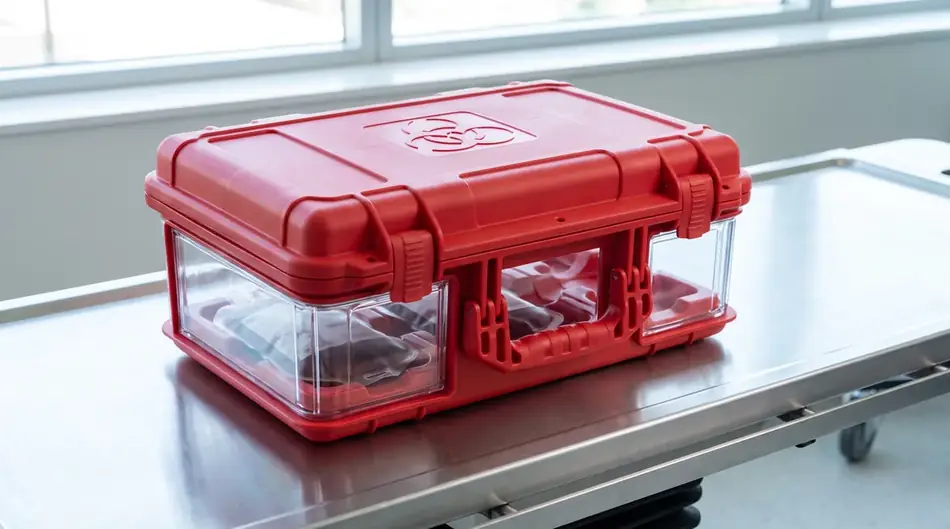
Protective Cases for Medical & Diagnostic Equipment and Medical
Short answer: a medical or diagnostic device case is chosen from three published numbers on one named model - internal length, width and height; the lid-to-base split; and whether that shell records a gasket in a moulded channel - and then from how the item is carried and where its connectors, screen or sample wells stand proud. KeXin publishes internal and external dimensions and usable interior volume for all 155 thermoplastic shells, wall thickness for 148 of them between 2.0 and 6.0 mm, lid and base depth separately for 100, empty mass for 93, and a compressible gasket in a moulded channel recorded on 124 while 31 record none. What we publish for no model is an ingress code, a humidity figure, a cold-chain hold time, a free-fall height, a temperature range or a sterilisation compatibility, so refrigerated, moisture-proof, sterile, airtight or shockproof requests are answered on this page as construction facts plus an optional accredited test on the exact build - not as a property of a moulding.
Key points
- Size from the packed device, not the catalogue footprint: keep connectors, screen, sample blocks and probes clear of the closure line.
- Read lid depth and base depth separately: an 86/32 mm split on KX-3213 and a 43/149 mm split on KX-5321 are different cases at similar totals.
- No humidity, cold-chain or ingress figure is published for any model; 124 of 155 shells record a gasket and 31 do not.
- A case is outer packaging, not a sterilisation, refrigeration or biohazard system - those remain the device owner's validated process.
- Wheeled transport buys carry distance but costs the stacking face: 19 models publish wheels, all recorded non-stackable.
- Screen and well-plate work wants a stiff ABS wall: KX-62810 at 4.0 mm and KX-63413 at 4.8 mm hold a machined pocket better than a thin wall.
How A Case For Medical And Diagnostic Devices Is Actually Specified
Medical and diagnostic equipment is not one product; it is a monitor with a glass face, a ventilator with a hose stack and a control knob, a haematology analyser with reagent bays, an ultrasound probe with a cable, a field first-aid kit of many flat consumables, or a reagent tray of matched wells - and each fails in transport in a predictable place. Two failure modes dominate. The first is face and edge damage: a screen, a sample window or a well plate loaded by something that moved inside the case, which is why the device is carried on its strongest datum - the chassis, the feet or the mount plate - and the glass or the wells hang over an open relief. The second is connector and hose damage: a probe plug, a power inlet, a gas fitting or a suction line pushed into a socket or kinked against a lid that closes over it, which is why the interior routes leads in a channel and leaves the connector face unloaded. Everything else follows from those: wall thickness for stacking on a shelf or in a rack, lid depth for the tallest standing part, gasket construction for grit and splash, and empty mass and carry format for the distance crossed. KeXin publishes these figures per model and leaves an unmeasured field marked not measured rather than filling it with a series average, which is why this page can name millimetres but not ratings.
Medical Equipment Storage Packaging
Storage packaging for consumables, instruments and spare parts is a volume and visibility problem before it is a protection problem. For flat consumables, gloves, syringes, dressings and tubing, a shallow stiff shell that stacks on a shelf beats a deep box that hides the bottom layer. The polypropylene KX-2507 lists 245 x 175 x 64 mm internal on a 2.0 mm wall at about 340 g and 2.7 litres with a 32/32 mm lid-to-base split; KX-2005 gives 190 x 135 x 40 mm at about 175 g and 1.0 litre for a small parts bin. Where the stored items must be kept out of grit and incidental splash, choose a model that records a gasket: KX-3207 lists 308 x 230 x 64 mm internal on a 3.0 mm wall at about 570 g with a 32/32 mm split, and the ABS KX-63413 covers 310 x 255 x 106 mm on a 4.8 mm wall at about 1,680 g for a heavier instrument library. For storage that later becomes a shipped kit, ask for a printed or routed outline per position so a missing item shows the moment the lid opens; that single feature is what turns a box into an issuable package.
Medical Polymer Plastic Sealed Tool Box
A sealed tool box for clinical, veterinary or field-service use is really two requests: a polymer shell and a lid that resists grit. The honest split is that we can publish a gasket and a latch count, but not an ingress code, because none is measured for any of the 155 models. The polymer here is injection polypropylene or engineering polypropylene with ABS where stiffness per millimetre is needed. Gasketed starting points by size: KX-1905 at 180 x 160 x 40 mm internal, 3.0 mm wall and about 250 g for a small instrument set; KX-3607 at 355 x 280 x 60 mm on a 3.0 mm wall at about 800 g for a flat tool tray; and KX-83514 at 315 x 235 x 122 mm on a 4.9 mm wall for a heavier service kit. Sealing depends on even compression, so latch count and rim geometry are specified per configuration rather than assumed; a box that is closed unevenly leaks grit at one corner no matter how good the gasket is. Where the request is genuinely airtight in a metrology sense, that belongs to a commissioned test on the ordered build, not to a product name.
Medical Refrigerated Reagent Latch Briefcase
We have to be blunt about the word refrigerated, because it is where a case supplier can do the most damage with a comfortable sentence. A moulded shell is not a refrigerator and holds no cold on its own: cold-chain behaviour comes from insulation thickness, a phase-change material or gel pack, and a measured hold time - none of which we publish as a rating for any model. What a briefcase-format shell does provide is a latched, carry-ready outer casing that protects reagent tubes and a small block from light, grit and knocks on the way to a cold unit. For that format the ABS KX-62109 lists 195 x 128 x 81 mm internal on a 3.0 mm wall at about 470 g with a gasket recorded and a fixed handle; KX-62810 gives 253 x 182 x 86 mm on a 4.0 mm wall at about 900 g for a rack of tubes and a small analyser; KX-62205 is the narrow option at 200 x 98 x 41 mm for a single strip. If the requirement is a genuine controlled low-temperature store, a validated cooler with a data logger is the right equipment and a transport shell is the wrong one. Raise the payload, the ambient range and the required hold time at quotation and we will confirm the gasket material for that exact SKU rather than promise a number.
Medical Field Rescue Emergency Kit Box
A field or rescue kit is many small high-value items rather than one object, and the case only earns its keep if each item has its own shape, because loose metal instruments are exactly what tears a sterile field pack or crushes a dressing. Choose a mid-size stiff shell cut in two layers: a base plank locating tourniquets, scissors, forceps, airway and a small monitor with their faces unloaded, and a shallow lid tray for gloves, dressings, tape and a cable set. Gasketed options sized to that kit: KX-3213 at 308 x 230 x 118 mm internal with a 86/32 mm split on a 3.0 mm wall at about 860 g and 8.4 litres; KX-4010 at 390 x 315 x 88 mm with a 44/44 mm split at about 1,015 g; KX-4312 at 420 x 260 x 104 mm on a 3.5 mm wall at about 1,170 g; and the ABS KX-63612 at 333 x 217 x 114 mm on a 3.5 mm wall at about 1,300 g where a rigid, non-tipping body is wanted. Colour-code zones so several responders can restock the same kit, and keep a resuscitation bag or a pocket_mask in its own relief so a buckle never rides on a valve.
Rescue Team Disaster Emergency Medical Box
A disaster or mass-casualty cache is a different purchase: it must carry a larger mixed load, survive being stacked in a container or a vehicle bay, and stay identifiable after weeks in a store. The deciding figures are internal volume, wall thickness for stacking, and a gasket recorded against the lid. The wide gasketed formats are the practical answer: KX-4616 lists 455 x 338 x 148 mm internal on a 3.0 mm wall at about 1,395 g with a 74/74 mm split and 22.8 litres; KX-5321 gives 481 x 373 x 192 mm on a stiff 5.8 mm wall at about 4,810 g with a 43 mm lid over a 149 mm base so heavy items sit low and a lid tray stays shallow; KX-6621 covers 587 x 434 x 192 mm on a 6.0 mm wall at about 6,420 g and 48.9 litres for a full team bag plus consumables; and the ABS KX-64819 at 454 x 325 x 173 mm on a 3.5 mm wall at about 2,800 g suits a cache with a screen device. For a cache that is carried over rough ground rather than palletised, weigh a non-wheeled shell you can stack against a wheeled one you cannot: pallet and carton arithmetic comes from the 64 models that publish it.
Medical Device Plastic Shell Protective Box Custom
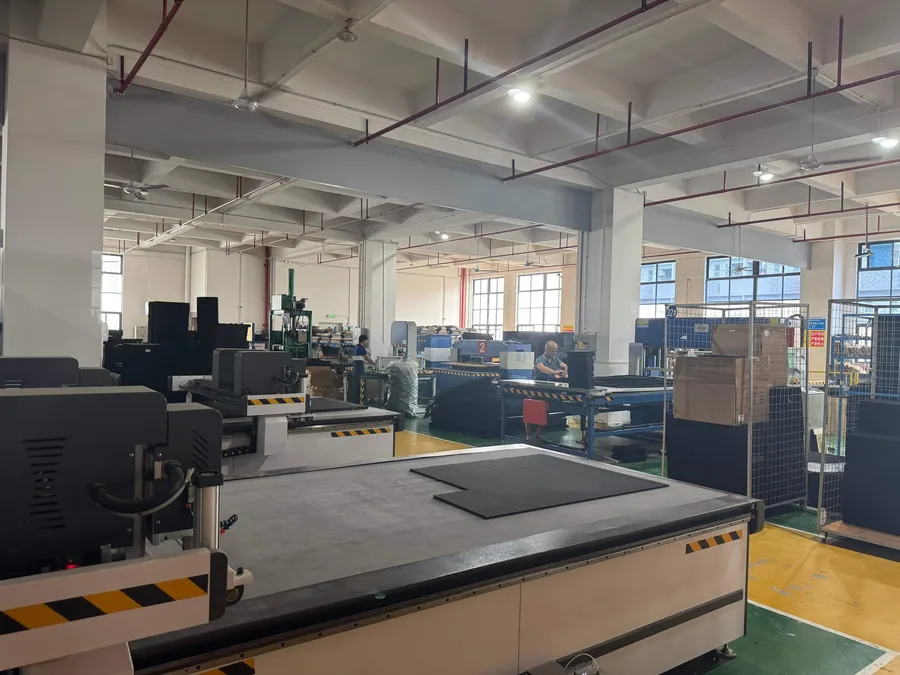
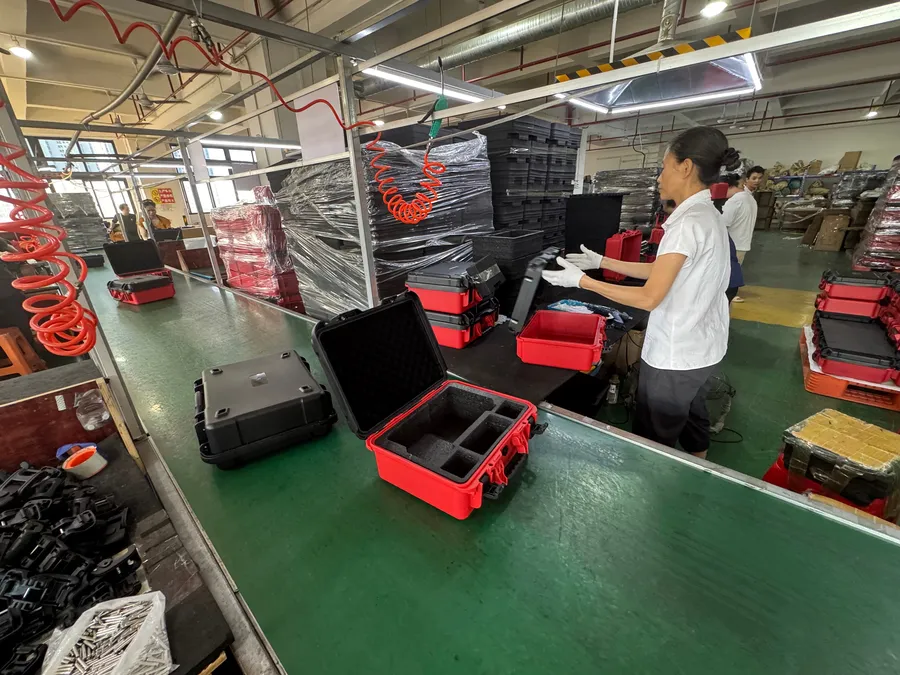
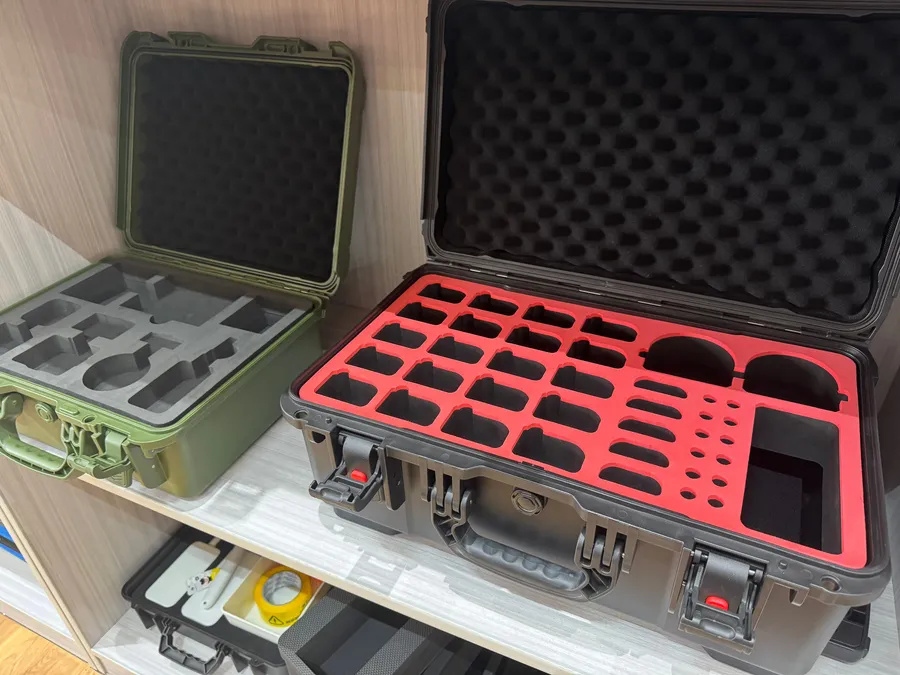
Most medical buyers do not want a standard box; they want a shell that fits one device and its accessory set, and that is a custom-foam brief before it is a custom-mould brief. Interior work is where the device is won and it starts at one unit: we cut cross-linked PE, EVA or EPE plank by zone, die-cut where a production layout repeats, CNC-cut where a pocket wall must hold tolerance around a probe handle or a control knob, layered builds with a firmer carrier under a heavy base and a softer face against a finished housing, routed channels so a probe plug or a gas line cannot travel into its socket, and relieved windows under a screen or a sample window. Stiff small-and-mid cavities that hold a machined medical pocket include the ABS KX-63416 at 310 x 255 x 138 mm on a 4.8 mm wall at about 1,800 g, KX-63619 at 333 x 217 x 175 mm on a 3.5 mm wall, and KX-64114 at 378 x 307 x 120 mm on a 4.0 mm wall at about 2,100 g. Shell-side configuration - colour, printed or in-mould logo, extra latches, a document holder, a tamper-evident seal point - is quoted per build; colour, logo and OEM hardware begin near 300 units, and only a change to the shell itself needs a mould at near 3,000 units per component and about 125 days from approved drawings. Send the packed-state dimensions, a scale photo or the device and we confirm the nominated model's material datasheet rather than assuming one grade across 155 shells.
Medical Device Transport Protection Solutions
Transport protection is a system, and the case is one layer of it. The layers are: immobilise the device in a cut interior so nothing rests on a screen, a probe or a connector; carry it on its strongest datum, usually the chassis or feet; choose a wall that survives the stack it will sit in; choose a gasket and latch count against the grit and splash it will meet; and choose a carry format against the distance. For short carries a carried mid-size shell is cheapest and stacks: KX-84416 gives 395 x 295 x 135 mm internal on a 4.2 mm wall with a 90/45 mm split. For a longer walk across a campus, a hospital forecourt or an event site, the wheeled formats publish wheels and a telescopic handle: KX-85424 at 483 x 363 x 190 mm and about 6,000 g, KX-85827 at 500 x 400 x 220 mm and about 7,800 g, and KX-85835 at 500 x 400 x 305 mm and about 8,520 g. The trade is explicit in the data: all 19 wheeled models are recorded non-stackable, while the 136 non-wheeled shells are recorded stackable, so a distributor palletising a fleet buys a stock programme of non-wheeled shells and reserves a wheeled SKU for the end user who genuinely walks. Vibration, shock and free-fall figures are not published for any model, so where a device's own manual names a transport limit, commission an accredited test on that configuration rather than trusting a moulding.
Medical Sterile Dressing Moisture-Proof Box
Two words in this phrase need an honest answer. Sterile is a property of the dressing and its own validated sterilisation and barrier packaging, not of an outer box we mould; a transport shell is secondary packaging and does not make a pack sterile, so we say that plainly. Moisture-proof is the same family of problem as waterproof: our published data records a compressible gasket in a continuous moulded channel on 124 of the 155 shells and no gasket on 31, and it records no humidity figure, no dry-air hold time and no interior relative-humidity value for any model, because we have not measured one. So a gasketed hard shell is a useful outer casing that slows air exchange and keeps grit off a rim; the moisture control itself comes from a desiccant with enough capacity, a hygrometer you can read, and a routine. Where a sealed box is still wanted for dressings moving between a humid store and a field vehicle, pick a model that actually records the gasket and a wall that resists a stack: KX-3207 at 308 x 230 x 64 mm on a 3.0 mm wall, KX-3609 at 355 x 280 x 80 mm at about 900 g, or the deeper KX-92817 at 253 x 180 x 152 mm on a 5.0 mm wall with a 125 mm lid over a 27 mm base at about 940 g. If a tender names an ingress code or a humidity number, we quote accredited testing of the ordered shell, gasket and latch - we do not print one from a product name.
Portable Ventilator And Suction Pump Hard Case
A transport ventilator or a suction pump is a dense box with a screen, a control knob that stands proud, a gas inlet or an oxygen fitting, a hose port, and often an internal battery - so the deciding figures are internal height plus the lid split, because a knob, a manifold or a coiled hose line is what a lid will otherwise crush. Choose a deep gasketed cavity that keeps the body flat with its connectors relieved: the ABS KX-64117 lists 393 x 280 x 156 mm internal on a 3.8 mm wall at about 2,100 g with 17.2 litres; KX-64120 gives 378 x 307 x 187 mm on a 4.0 mm wall at about 2,640 g and 21.7 litres where the unit travels with a circuit, a humidifier chamber and spare filters; the polypropylene KX-84416 at 395 x 295 x 135 mm with a 90/45 mm split suits a compact ventilator with its trolley removed; and the engineering-PP KX-5723 at 500 x 340 x 211 mm on a 5.0 mm wall with a 169/42 mm split at about 4,680 g handles a suction pump with a canister and footswitch. Batteries are their own regulated shipment matter and we state no battery approval for a shell; the interior simply stops the unit rocking onto its inlet.
Veterinary Portable Diagnostic Equipment Box
Veterinary field diagnostics is a portable ultrasound with a probe and gel, a haematology or chemistry analyser with reagent bays, a digital radiography plate and reader, or an endoscope stack - and the pattern is the same: a wide flat body with a protruding probe or plate, plus accessories that must not ride on top. For a portable ultrasound the deep-base ABS shells hold the body flat and stand the probe in its own relieved pocket: KX-64618 lists 430 x 290 x 165 mm internal on a 4.7 mm wall with a 140 mm lid over a 25 mm base at about 2,775 g, so everything heavy sits low and a probe and gel lie in the thin lid; KX-64621 gives 430 x 288 x 186 mm at about 3,000 g for a unit with two probes and a charger; the wide KX-65522 covers 507 x 385 x 190 mm on a 5.3 mm wall at about 4,860 g and 37.1 litres for an analyser plus a DR plate. Radiography plates and DR detectors want the same rule as any flat glass face: carried face-up in their own relieved pocket with nothing resting on the active area.
Medical Waste Emergency Disposal Sealed Box
A sharps or clinical-waste container is a regulated item, and regulated is the buyer's word, not ours: colour, the biohazard symbol, the closure rule, the volume limit and the disposal route are set by the jurisdiction and the site's own medical-waste policy, and a transport shell makes no claim about any of them. What we can supply is a robust lidded polymer box that a site fills, closes and hands to its licensed waste contractor - chosen for internal volume, a wall that will not flex when full, a gasket recorded against leakage of the contents onto the outside of the case, and a smooth interior that can be cleaned. For a small emergency cache the gasketed KX-3508 lists 344 x 268 x 72 mm internal on a 3.0 mm engineering-PP wall at about 995 g; KX-83514 gives 315 x 235 x 122 mm on a 4.9 mm wall; and for a larger volume KX-5321 at 481 x 373 x 192 mm on a 5.8 mm wall or KX-6621 at 587 x 434 x 192 mm on a 6.0 mm wall carry the load with the mass low and a shallow lid. Confirm the waste class and the local requirement with your own compliance officer; we supply the box to that brief, not the certification.
Buyer Search Phrase To The Published Figure That Decides It
Every figure above is a published specification for the model named, not a performance rating, and the comparison is only valid against the packed envelope you measure on your own device. Where a hospital procurement team, a veterinary distributor or an analyser OEM needs documented proof of ingress, humidity or shock behaviour, we quote accredited testing of that exact shell, gasket, latch and foam configuration as a separate work package rather than printing a number we cannot document, and we say plainly when a stock cavity is closer and cheaper than a new moulding.
| Buyer Search | Deciding Published Figure | Published Example |
|---|---|---|
| medical equipment storage packaging | Shallow stiff cavity that stacks and shows its bottom layer | KX-2507: 245 x 175 x 64 mm, 2.0 mm, about 340 g, 2.7 L; KX-3207: 308 x 230 x 64 mm, gasket recorded |
| medical polymer plastic sealed tool box | Gasket recorded per model plus latch count; no ingress code published | KX-3607: 355 x 280 x 60 mm, 3.0 mm, about 800 g, gasket; KX-83514: 315 x 235 x 122 mm, 4.9 mm, gasket |
| medical refrigerated reagent latch briefcase | No cold-chain figure published; latch and handle are, insulation is separate | KX-62109: 195 x 128 x 81 mm ABS, 3.0 mm, about 470 g, gasket, fixed handle |
| medical field rescue emergency kit box | Mid gasketed cavity cut in two layers so metal cannot tear a pack | KX-3213: 308 x 230 x 118 mm, 86/32 mm lid/base, about 860 g; KX-4312: 420 x 260 x 104 mm, 3.5 mm |
| rescue team disaster emergency medical box | Internal volume plus wall for stacking, gasket against grit | KX-5321: 481 x 373 x 192 mm, 5.8 mm, 43/149 mm, about 4,810 g; KX-6621: 587 x 434 x 192 mm, 6.0 mm |
| medical device plastic shell protective box custom | Custom foam from one unit; a new mould only near 3,000 per component | KX-63416: 310 x 255 x 138 mm ABS, 4.8 mm; KX-64114: 378 x 307 x 120 mm ABS, 4.0 mm |
| medical device transport protection solutions | Carry distance plus the stack trade: 19 wheeled models are non-stackable | KX-84416: 395 x 295 x 135 mm carried; KX-85835: 500 x 400 x 305 mm, wheels, about 8,520 g |
| medical sterile dressing moisture-proof box | Sterile is the device's own process; moisture is a gasket plus desiccant, no figure | KX-3207: 308 x 230 x 64 mm, gasket; KX-92817: 253 x 180 x 152 mm, 5.0 mm, 125/27 mm lid/base |
| portable ventilator/suction pump hard case | Internal height plus lid split for a knob, manifold or hose | KX-64120: 378 x 307 x 187 mm ABS, 4.0 mm, about 2,640 g; KX-5723: 500 x 340 x 211 mm, 169/42 mm |
| veterinary portable diagnostic equipment box | Deep base for the body, relieved pocket for the probe or plate | KX-64618: 430 x 290 x 165 mm ABS, 4.7 mm, 140/25 mm lid/base, about 2,775 g; KX-65522: 507 x 385 x 190 mm |
| medical waste emergency disposal sealed box | Internal volume, a stiff non-flexing wall, cleanable interior; waste class is the buyer's | KX-3508: 344 x 268 x 72 mm, gasket; KX-6621: 587 x 434 x 192 mm, 6.0 mm wall |
Selection Guidance: Five Checks Before A Medical Or Diagnostic Order
One: decide what carries the load - the chassis, the feet or a mount plate - and if the answer is that a screen, a probe face or a sample window carries it, the interior is wrong before the shell is chosen. Two: measure the device as it actually travels, cables coiled, probe attached, humidifier fitted, and record the tallest standing item separately, because that is what the lid will meet. Three: read lid depth and base depth apart; 100 of the 155 models publish both, and a 140/25 mm split is not the same case as a 74/74 mm split at a similar total. Four: check the external dimensions against the shelf, trolley bay, ambulance compartment or rack the case must live in, and the narrow internal width where a cavity tapers. Five: confirm hardware on that model's datasheet - gasket recorded or not, latch count, handle, wheels and telescopic height - rather than assuming a series capability, then write down which documents your purchaser actually needs, because a kit for a rescue team and a shell written into a device procurement specification are two different briefs and only the second needs a commissioned test.
Where These Cases Are Used
The buyers are wider than the hospital. Ambulance, rescue and disaster-response teams need field kits and caches that survive a vehicle bay and are restocked by hand. Point-of-care, laboratory and diagnostics companies ship an analyser and its reagents as one issuable package and make the interior drawing the reorder standard. Veterinary practices and mobile imaging teams move ultrasound, DR plates and analysers between sites and need deep-base cavities that stand a probe safely. Device OEMs and contract manufacturers need a shell and a cut that repeat across a production run, which is why this page sits next to the instrument and electronics categories in the catalogue. Distributors and procurement offices need carton and pallet arithmetic that lets them forecast. All draw on the same shells and differ in the cut, the gasket, the carry format, the marking and the documents they must file - and each of those is answered with a published figure or an optional test, not a marketing claim.
Procurement Notes: Wholesale Terms, Verification And What We Will Not Claim
KeXin New Materials (Guangdong) Co., Ltd. manufactures these shells and supplies wholesale and OEM or ODM buyers on EXW or FOB terms only. There is no retail channel, no delivered-duty-paid quotation and no overseas warehouse, so landed cost is an FOB figure plus your own freight and clearance; carton size and pieces per carton are published on 64 of the 155 models, and pallet and container arithmetic is built from those or supplied with the quotation. Minimum order is one unit on a stock shell and one on a custom foam layout, near 300 units for colour, logo or OEM hardware and near 3,000 per component for a dedicated mould, with a first OEM article about 45 days on existing tooling and a new mould about 125 days. Payment is a 30 per cent deposit with the balance after inspection, and third-party factory inspection before shipment is welcome. Then apply the same three questions to us as to any supplier: which accredited report produced this figure, what method and conditions were used, and does it cover the exact build being bought. Any field our datasheet records as not measured - ingress, humidity, cold-chain hold, free-fall height, shock, temperature, stack load - is the answer we will give you. Medical device, sterilisation, cold-chain and clinical-waste compliance remain the buyer's validated process; a transport shell does not assert them. Enquiries go to Fred Zhao or the KeXin Sales Team, WhatsApp +86 135 3588 0002.
Buyer searches for a portable diagnostic case, answered with our published data
This table lines up the phrasing device buyers search with the measured figures we publish, and states plainly what we leave out because we have not run the test on our own line. Every number below is model data, not a general capability statement.
| Search | What We Publish |
|---|---|
| portable diagnostic equipment case | A hand-carry diagnostic case is usually a size-and-foam question rather than a rating question, so we answer it with published figures. Our small handled shells start around the KX-1905, with a 180 by 160 by 40 mm interior, a 3.0 mm wall and an empty weight of 250 g, and we cut a foam layout to the instrument you specify. The shell alone is not a shock figure; how the device rides depends on the foam you approve, and we publish only what we have measured. |
| lightweight cases for portable medical and diagnostic devices | Across the catalogue the lightest usable shells weigh from about 250 g empty and step up through handled models near 570 to 900 g before the larger wheeled carriers. That spread matters for a device that is lifted into an ambulance or a clinic by hand, because empty weight is carried on every trip. We list net weight and internal length, width and depth per model so a buyer can match a device to a shell without guessing. |
| what a portable diagnostic case should and should not claim | On this line we record water and dust resistance as not measured, and we do not publish an ingress number or present a shell as holding a protection rating. What we publish and can verify is the internal volume, wall thickness, net weight and the gasket-channel option where fitted. If a tender names a defined level, we say whether we already hold that record and can quote accredited third-party laboratory testing against it for the configuration you order. |
Matching a device to a shell without a rating shortcut
For diagnostic gear the practical first filter is internal volume and empty weight, not a headline number, because the case has to fit the instrument and its accessories and then be carried comfortably. Where a claim would depend on a test we have not run on our own product, we name the missing test instead of implying a result, so a procurement officer can decide whether to ask us to arrange it.
Customisation
Everything described above is configurable on a standard shell: interior layout (pick-and-pluck, die-cut or CNC-cut), foam grade and thickness, colour, logo method, latch and lock count, pressure-equalisation valve, cable ports, document holder and identification plate. A bespoke exterior geometry requires a new mould — 125 days, from 3,000 units per moulded component.
Procurement considerations
| Question | What to send us |
|---|---|
| Which shell fits? | Equipment L × W × H as packed, plus required clearance per axis |
| What does it cost? | Order quantity and estimated annual quantity — the two drive different answers |
| Is tooling needed? | Whether an existing shell clears the envelope with usable foam depth |
| Lead time? | Your required delivery date, not just the order date |
| Certification? | The exact standard your tender names — we will say whether we can test to it |
| Freight? | Destination and preferred terms; carton and pallet data supplied with the quotation |
Comparison and selection guide
The tables on this page exist because a protective case is chosen by comparing three things: the envelope, the environment and the handling chain. Where no table applies, the rule below is.
| Situation | What To Do |
|---|---|
| Clinical environment | Closed-cell foam or a wipeable tray; no open-cell pluck foam. |
| Emergency use | Latches that open with one hand and a lid that stays up unaided. |
| High-value device | Deeper base foam, a separate transducer zone, and a documented drop test if required. |
- Size on internal dimensions plus clearance, never on a product name.
- Choose the carrying method before the shell: it changes the series, not just the price.
- Specify the interior last, and decide up front whether the end user will reconfigure it.
Protective Cases for Medical & Diagnostic Equipment and Medical relates to Protective Case Basics. Related families: Medical Equipment Cases / Instrument & Equipment Cases / Electronics Cases / Equipment Transport Cases / Waterproof Cases / Custom Protective Cases / Field Equipment Cases. Related sectors: field and industrial equipment. Continue in the Protective Case Basics cluster.
This page is written from our own production data. If your requirement differs, send the dimensions and we will tell you which of the 155 models fits, or whether a custom route is needed.