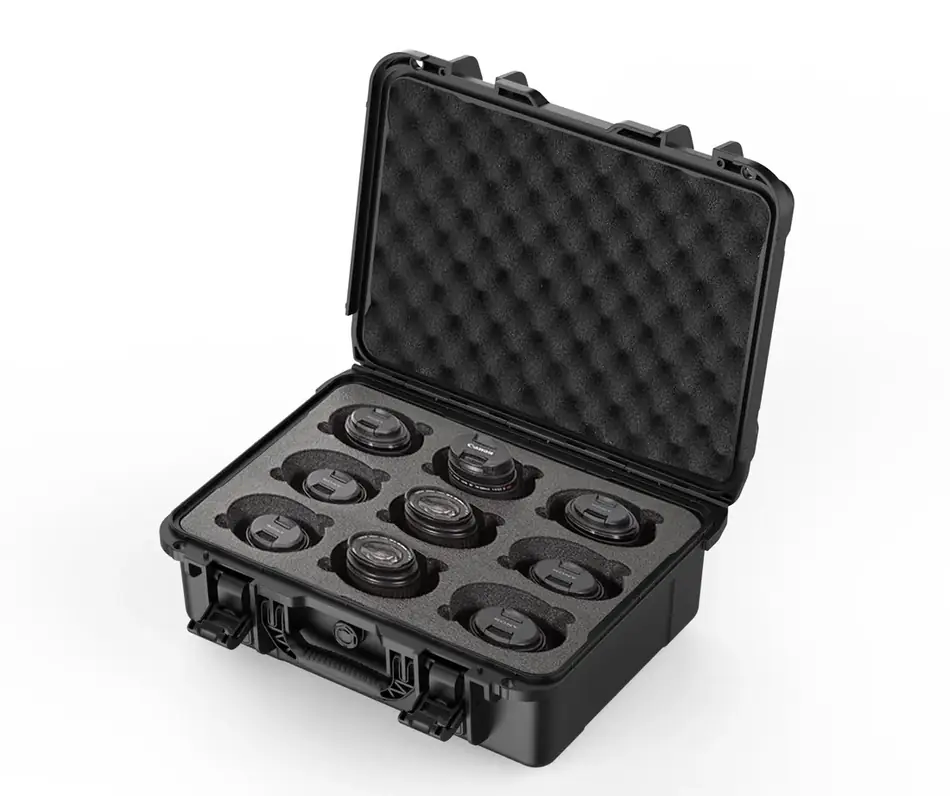
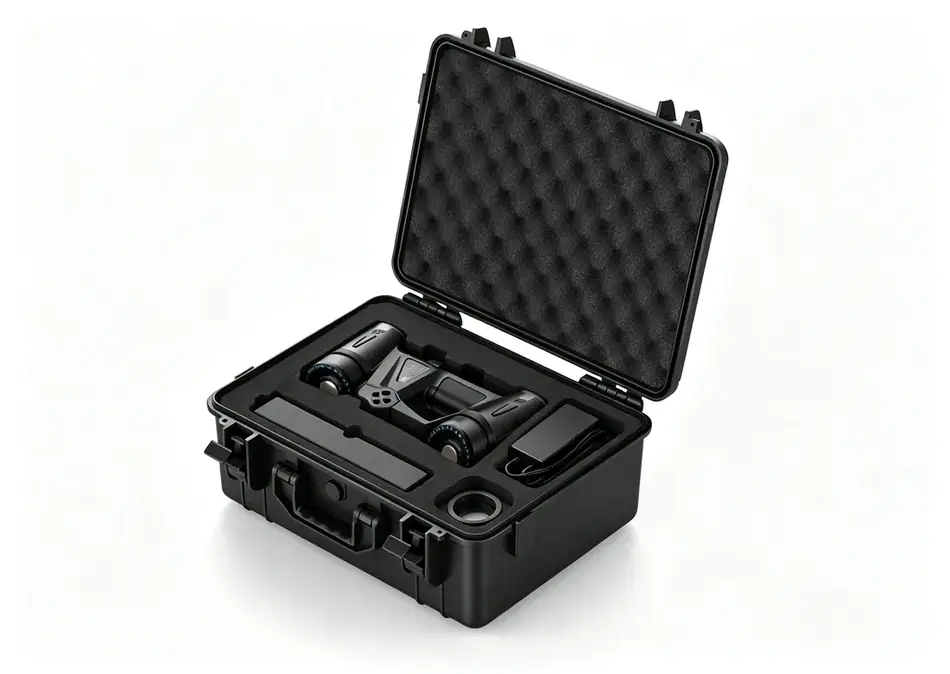
Protective Cases for Optics, Cameras & Precision Instruments
Short answer: optical, camera and precision-instrument kit is bought as a set of cavities sized against published numbers, not as one box with a borrowed rating. KeXin New Materials (Guangdong) Co., Ltd. injection-moulds 155 thermoplastic shells and publishes internal and external dimensions and usable interior volume for every one of them, wall thickness for 148 (2.0 mm to 6.0 mm), the lid-over-base depth split for 100, empty mass for 93, and a compressible gasket in a moulded channel on 124. What we publish for none of the 155 is an ingress code, a free-fall height, a shock figure, a temperature range or a load rating, because those fields are recorded as not measured. For an endoscope, a meter, a camera body, a thermal imager or a bench oscilloscope the decision therefore comes down to four numbers on one named datasheet: internal length and width against the packed footprint, internal height against whatever stands proud, lid depth against the tallest accessory, and wall thickness against how the case is actually moved. This page takes each of the nine buyer searches in turn and gives the published figures that settle it.
Key points
- Size three separate cavities for most instrument kits: the instrument body, the optics or sensor head, and the accessories that stand proud of both.
- Add roughly 20 mm of working clearance per axis for the foam cut, then read that against published internal length, width and height on one named model.
- Wall thickness is published per model from 2.0 mm to 6.0 mm on 148 of 155 shells, so stiffness is a quoted number rather than a heavy-duty label.
- 124 of the 155 shells record a compressible gasket in a moulded channel and 31 record none, including several of the lightest shallow formats.
- No ingress code, free-fall height, shock figure or temperature range is published for any model, because every one of those fields is recorded as not measured.
- A lid-over-base split of 43/149 mm behaves nothing like 140/25 mm at a similar total depth, so read the two figures separately before committing a tray.
Industrial Endoscope Protective Hard Latch Case: Control The Bending Section And The Tip
A videoscope or industrial borescope is carried in four parts and breaks in two of them. The distal tip and its bending section are the fragile pair: a kinked insertion tube or a crushed tip window is a written-off probe, and the damage usually happens where the tube is coiled, not where the body sits. The second failure point is the connector, which stands proud of the housing and gets loaded by a descending lid. So the insertion tube travels in a relieved circular channel with a minimum bend radius respected, the tip lies over an empty pocket, and the connector sits in its own cut with a clear shoulder around it. For a probe plus handle plus light source, the ABS shell KX-63317 lists 300 x 178 x 152 mm internal on a 4.0 mm wall at about 1,370 g with 6.5 litres usable, and KX-83620 gives the same class of work in polypropylene at 290 x 220 x 185 mm internal with a 135 mm lid over a 50 mm base, 3.3 mm wall and 10.1 litres. Where the kit is a longer rigid borescope, KX-87926 publishes 737 x 257 x 240 mm internal on a 4.0 mm wall with a 175/65 mm lid-and-base split and 36.4 litres, and KX-86216 gives 582 x 300 x 130 mm with a 100/30 mm split. On the closure: all 155 models publish a latch body that accepts a standard padlock, and latch count is a per-configuration option rather than a fixed series feature.
Medical Endoscope Cleaning And Transit Box: Where The Case Stops And The Protocol Begins
Be precise about what a transit box is for, because this is where purchasers most often over-ask. Our shells are carriers: they protect a scope during movement between points of use and they keep a kit contained and identifiable. They are not a validated reprocessing barrier, and nothing in this catalogue is offered as a decontamination claim - the cleaning, high-level disinfection and leak-test sequence belongs to the device maker's instructions for use and the facility's own protocol, and only those can be validated. Mechanically, the useful figures are a cavity that holds the scope on a preformed bed rather than coiled tight, wipeable pocket walls, and a shell that can be wiped down without a label or a foam face lifting. KX-62810 gives 253 x 182 x 86 mm internal in ABS on a 4.0 mm wall at about 900 g with 3.2 litres and a recorded gasket; KX-63413 is 310 x 255 x 106 mm in ABS on a 4.8 mm wall, about 1,680 g and 6.7 litres; KX-84113 in polypropylene is 380 x 267 x 115 mm on a 3.4 mm wall with 10.1 litres and a gasket in a moulded channel. If the box has to survive a wet room floor, note that no model is published as retaining liquid inside or resisting immersion: dust and water resistance are recorded as not measured across all 155 shells, and a gasket channel describes construction, not a validated barrier.
Environmental Monitoring Instrument Case: One Sampler Per Cavity, Intakes Kept Clear
Environmental monitoring kit is awkward because it is several instruments plus consumables that must not be crushed: a gas analyser with its pump, a particulate or dust sampler with its head and filter cassette, a flow calibrator, spare cells, tripod fittings, intake tubing coiled to a radius, and filter media that is soft and easily deformed. The layout that works is one instrument per pocket with a firm carrier under the sampler body, a relieved window under the intake stack so nothing bears on the inlet, and a separate shallow layer for cassettes laid flat rather than stacked. For a single analyser with pump and leads, KX-3608 lists 355 x 280 x 70 mm internal on a 3.0 mm polypropylene wall at about 870 g with 6.0 litres and a gasket recorded; KX-3609 is the same footprint at 355 x 280 x 80 mm, 900 g and 6.9 litres when the kit travels with a charger. Two instruments side by side fit KX-4010 at 390 x 315 x 88 mm, 3.0 mm, about 1,015 g and 9.3 litres, or KX-4010-2 at 388 x 307 x 90 mm on a thicker 3.4 mm wall. Sampler-plus-consumables fleets generally land on KX-84116 (385 x 313 x 145 mm, 3.7 mm, 15.0 litres), KX-84419 (395 x 295 x 165 mm, 4.2 mm, a 120 mm lid over a 45 mm base, 15.4 litres) or KX-85819 (500 x 400 x 165 mm, 4.75 mm, 26.4 litres).
Environmental Monitoring Meter Shockproof Plastic Case: The Insert Does The Work
Shockproof is a word buyers use and a specification we cannot sign, so here is the honest position. Across all 155 models the shock entry in the datasheet is recorded as a manufacturer option with the note that a specified foam layout is required, because the shell on its own is not a shock rating; impact is recorded the same way, stating the wall thickness of that model and claiming no free-fall height without a test. What you can specify today is the assembly. A meter is potted: a firm carrier under the body, a softer closed-cell face against the display window, the probe and lead in their own channel so a connector never takes a load, and enough foam above and below that the instrument never contacts the shell at the rim. Then the wall figure carries the handling. KX-2507 is 245 x 175 x 64 mm internal on a 2.0 mm wall at about 340 g; KX-2808 steps to 265 x 190 x 76 mm on 2.2 mm at about 430 g. Where a gasket is wanted on a meter of that size, the ABS KX-62109 gives 195 x 128 x 81 mm internal on a 3.0 mm wall, about 470 g and 1.7 litres, and KX-62209 is 200 x 98 x 78 mm on 3.5 mm, about 410 g. The polypropylene KX-1905 is 180 x 160 x 40 mm on 3.0 mm at about 250 g with a recorded gasket, though its published narrow internal width of 130 mm has to be checked against a meter with a standing probe.
Meter And Instrument Display Portable Briefcase: Read The Shallow Cavity Properly
Briefcase formats fail for one reason: a buyer matches total height and ignores the taper. Our shells are moulded with a draft, so the cavity is narrower at the closure line than at the base, and 36 of the 155 models publish that narrow internal width for exactly this reason. Read it before committing a rigid tray or a meter with a bezel that overhangs. The published shallow options run from KX-1204 at 115 x 78 x 32 mm internal with a 70 mm narrow width, 2.6 mm wall and about 100 g empty - one of the 31 shells with no gasket - up through KX-2005 at 190 x 135 x 40 mm, 127 mm narrow width, 2.0 mm wall and about 175 g, KX-2305 at 225 x 150 x 40 mm with a 135 mm narrow width, KX-2405 at 220 x 162 x 49 mm and KX-2406 at 230 x 155 x 50 mm. A display instrument with a folded probe suits KX-2805 at 270 x 190 x 46 mm, 175 mm narrow width and about 340 g, or KX-3607 at 355 x 280 x 60 mm on a 3.0 mm wall with a 255 mm narrow width and a recorded gasket. For the widest flat instruments KX-4610 publishes 455 x 338 x 84 mm internal, a 302 mm narrow width, 3.0 mm wall and about 1,115 g, while KX-4710 is 458 x 345 x 90 mm on a lighter 2.5 mm wall with no gasket.
Optical Instrument Transport Case: Support The Mount, Relieve The Glass
Two rules carry an optical instrument. Nothing rests on a glass face, so a lens, objective, eyepiece or telescope tube travels supported on its mount plate, its cell or its barrel cradle with an empty relieved pocket under the front element; and the mechanism that gets adjusted in the field - a focuser, a dioptre ring, a leveling screw, a prism clamp - is locked by the cut rather than relying on the instrument's own friction. Size against the packed envelope including sunshade, dew cap, finderscope and any prism diagonal left in place, because those are what stop a lid closing. The mid formats that usually take a single instrument with mount are KX-712 at 308 x 250 x 96 mm internal with a 54/42 mm lid-and-base split on a 2.8 mm wall, about 710 g; KX-3207 at 308 x 230 x 64 mm on 3.0 mm, about 570 g with a gasket and a 205 mm narrow width; and the same footprint with deeper halves in KX-3213 at 118 mm internal height and KX-3218 at 172 mm. An instrument with a tripod head suits the ABS KX-64114 at 378 x 307 x 120 mm on a 4.0 mm wall, about 2,100 g and 11.1 litres, or KX-64117 at 393 x 280 x 156 mm with 14.8 litres. Long tubes are a length problem, not a volume problem: KX-86216 publishes 582 x 300 x 130 mm, KX-89616 publishes 880 x 350 x 140 mm and KX-814641 publishes the catalogue-longest 1,280 x 350 x 140 mm cavity with 50.2 litres usable.
Oscilloscope Special Pressure-Resistant Waterproof Case: What We Publish And What We Do Not
Pressure resistance and waterproofing get asked together in this category, so the two answers belong in separate sentences. Pressure resistance is a construction question and we can answer it with published figures: a scope with its probe set, a bench power supply or a portable analyser wants a stiff shell and a deep base rather than a shallow lid, because the mass and the connector panel sit low and the display sits under a thin lid. KX-64112 gives 393 x 280 x 112 mm internal in ABS on a 3.8 mm wall at about 1,820 g with 10.6 litres; KX-5321 publishes 481 x 373 x 192 mm on a 5.8 mm wall with a 43 mm lid over a 149 mm base, about 4,810 g and 27.5 litres; KX-6621 goes to 587 x 434 x 192 mm on a 6.0 mm wall - the thickest published in this library - with a 43/149 mm split, about 6,420 g and 39.1 litres; and the ABS KX-65522 gives 507 x 385 x 190 mm on a 5.3 mm wall at about 4,860 g with 29.7 litres. Waterproofing is a different answer. 124 of the 155 shells record a compressible gasket in a continuous moulded channel and 31 record none; a pressure-equalisation option is quoted per configuration. But protection rating, dust resistance and water resistance are recorded as not measured on every model, so we state no ingress code anywhere in this catalogue. Where a tender needs one, we quote accredited testing on the exact shell, gasket, latch and foam build as a separate work package instead of printing a figure we cannot document.
Outdoor Thermal Imager And Handheld Camera Box: Drop Protection Is An Assembly, Not A Label
Thermal imagers, night-vision units and rugged handheld cameras are the kit that is genuinely dropped - off a ladder rung, off a vehicle hood, onto compacted gravel - and the specification has to be written accordingly. The shell contribution is stiffness and mass management: KX-62205 publishes 200 x 98 x 41 mm internal in ABS on a 3.5 mm wall at about 310 g with 0.7 litres and a gasket recorded, with carton figures of 475 x 285 x 320 mm for 20 pieces; KX-62209 is the same footprint at 200 x 98 x 78 mm, 410 g and 1.3 litres when the imager travels with a charger and spare cell. A unit with a lens cluster and a remote suits KX-63413 at 310 x 255 x 106 mm on a 4.8 mm ABS wall, about 1,680 g and 6.7 litres, or the polypropylene KX-84113 at 380 x 267 x 115 mm, 3.4 mm and 10.1 litres. Heavier mixed survey loads go to KX-84818 (437 x 308 x 164 mm, 4.5 mm engineering polypropylene, 17.7 litres), KX-85017 (463 x 338 x 156 mm, 4.5 mm, 19.5 litres) or KX-85215 (483 x 363 x 140 mm, 4.5 mm, 19.6 litres). The insert is where the protection is bought: a firm carrier beneath the body, a softer closed-cell face against the detector window, the lens relieved over an empty pocket, and retention loops so the unit cannot lift out of its cut when the case is closed over it. The lens cap is a habit, not a specification.
Buyer Search Phrase Mapped To The Published Figure That Decides It
Every figure in that table is a published specification for the model named, not a performance rating, and it is only meaningful against your own measured packed envelope. Where a purchasing document asks for an ingress code, a free-fall height or a temperature range, our datasheet records those fields as not measured for all 155 shells, and we will say so in the quotation rather than let a borrowed label travel into your tender file.
| Buyer Search | Deciding Published Figure | Published Example |
|---|---|---|
| industrial endoscope protective hard latch case | Relieved channel for the insertion tube at its minimum bend radius; latch body and latch count per configuration | KX-63317: 300 x 178 x 152 mm internal ABS, 4.0 mm wall, about 1,370 g, 6.5 L usable; KX-83620: 290 x 220 x 185 mm, 135/50 mm lid/base |
| medical endoscope cleaning & transit box | Wipeable interior faces and a cavity that beds the scope; no reprocessing or leak-test claim is made by the case | KX-62810: 253 x 182 x 86 mm ABS, 4.0 mm, about 900 g, gasket recorded; KX-63413: 310 x 255 x 106 mm ABS, 4.8 mm, 6.7 L |
| environmental monitoring instrument case | One instrument per pocket with relief under the intake stack, then lid depth for standing fittings | KX-3609: 355 x 280 x 80 mm PP, 3.0 mm, about 900 g, 6.9 L; KX-4010: 390 x 315 x 88 mm, 3.0 mm, about 1,015 g, 9.3 L |
| environmental monitoring meter shockproof plastic case | Wall thickness per model plus a specified foam layout; shock is recorded as a manufacturer option on all 155 shells | KX-62109: 195 x 128 x 81 mm ABS, 3.0 mm, about 470 g, 1.7 L; KX-2808: 265 x 190 x 76 mm PP, 2.2 mm, about 430 g |
| meter & instrument display portable briefcase | Narrow internal width at the closure line, published on 36 of the 155 models, read before total height | KX-2805: 270 x 190 x 46 mm, 175 mm narrow width, about 340 g, 2.1 mm wall; KX-4610: 455 x 338 x 84 mm, 302 mm narrow width |
| optical instrument transport case | Internal length for tube plus mounted accessories, and the lid-over-base split for anything standing | KX-712: 308 x 250 x 96 mm, 54/42 mm lid/base, about 710 g; KX-87926: 737 x 257 x 240 mm, 175/65 mm, 36.4 L usable |
| oscilloscope special pressure-resistant waterproof case | Wall thickness and deep-base split for stiffness; gasket channel recorded on 124 shells and no ingress code published | KX-5321: 481 x 373 x 192 mm, 5.8 mm, 43/149 mm lid/base; KX-6621: 587 x 434 x 192 mm, 6.0 mm wall, about 6,420 g |
| outdoor thermal drop-proof plastic hard box | Foam carrier and relieved window under the detector; impact states a wall thickness with no free-fall height claimed | KX-62205: 200 x 98 x 41 mm ABS, 3.5 mm, about 310 g, carton 475 x 285 x 320 mm for 20 pieces |
| thermal imager special plastic hard safety box | Cavity depth for lens plus remote, padlockable latch, and retention loops cut into the carrier layer | KX-63413: 310 x 255 x 106 mm ABS, 4.8 mm, about 1,680 g, 6.7 L; KX-85017: 463 x 338 x 156 mm, 4.5 mm, 19.5 L |
| how are optical instrument dimensions measured before ordering | Packed-state extremes rather than body dimensions, then about 20 mm working clearance per axis | Cavities published from 115 x 78 x 32 mm on KX-1204 to 740 x 518 x 364 mm on KX-88442, all 155 models with internal volume |
Selection Guidance: Four Checks That Reach A Model Number
First, split the kit into cavities before you look at any shell: instrument body, optic or sensor head, power and cable set, and any fitting that stands proud. Most instrument programmes end up with two shells rather than one overloaded one, because a single box asked to carry analyser, sampler and consumables forces the lid onto a connector. Second, measure in the carried state and add working clearance: sunshade fitted, probe coiled at its bend radius, filter cassettes flat, and roughly 20 mm per axis for the cut, then read that against published internal length, width and height. Third, read the two depth numbers separately. A model publishing a 43 mm lid over a 149 mm base and a model publishing 140 mm over 25 mm at the same total height are different boxes: one keeps a display under a thin lid with the mass low, the other buries the instrument under a deep lid. Fourth, decide the carry and the environment on the datasheet of the nominated model: 136 of the 155 shells are published as non-wheeled and stackable, the 19 wheeled models publish a telescopic handle and give up the flat stacking face, and gasket presence is model-specific rather than series-wide. If your document names a dimension, a wall or a volume, we can answer it today. If it names a rating, budget the test as its own line item.
Where These Cases Are Used
The buyer is rarely the person who breaks the instrument. Metrology and calibration laboratories issue a reference standard or a comparator in a case whose interior drawing becomes the reorder standard, so the cut has to be repeatable rather than improvised. Environmental and public-health monitoring teams build a per-crew kit that leaves a vehicle, sits on grass or gravel, and comes back with dust on the lid line. Industrial inspection and non-destructive-testing contractors move borescopes, thickness gauges and flaw detectors between plant shutdowns, where the case is handled like cargo. Optical and imaging manufacturers ship a unit with its accessories as one issuable package and need the packed dimensions to match a published cavity exactly so that packaging engineering is not redone each release. Field survey and geospatial groups carry instruments, tripods and tablets as three loads that must not share a pocket. Medical device service organisations assemble a transit box that is wiped down between sites. Distributors and integrators build a demonstration case that has to survive a car boot, a hotel room and an air-freight leg. All of them draw on the same shells and differ mainly in the cut, the gasket, the carry format and the marking - which is why the related category pages for camera, optical and instrument cases, and the foam-insert and material guides, matter as much as the datasheet.
Customisation: Interior, Hardware, Marking And Tooling
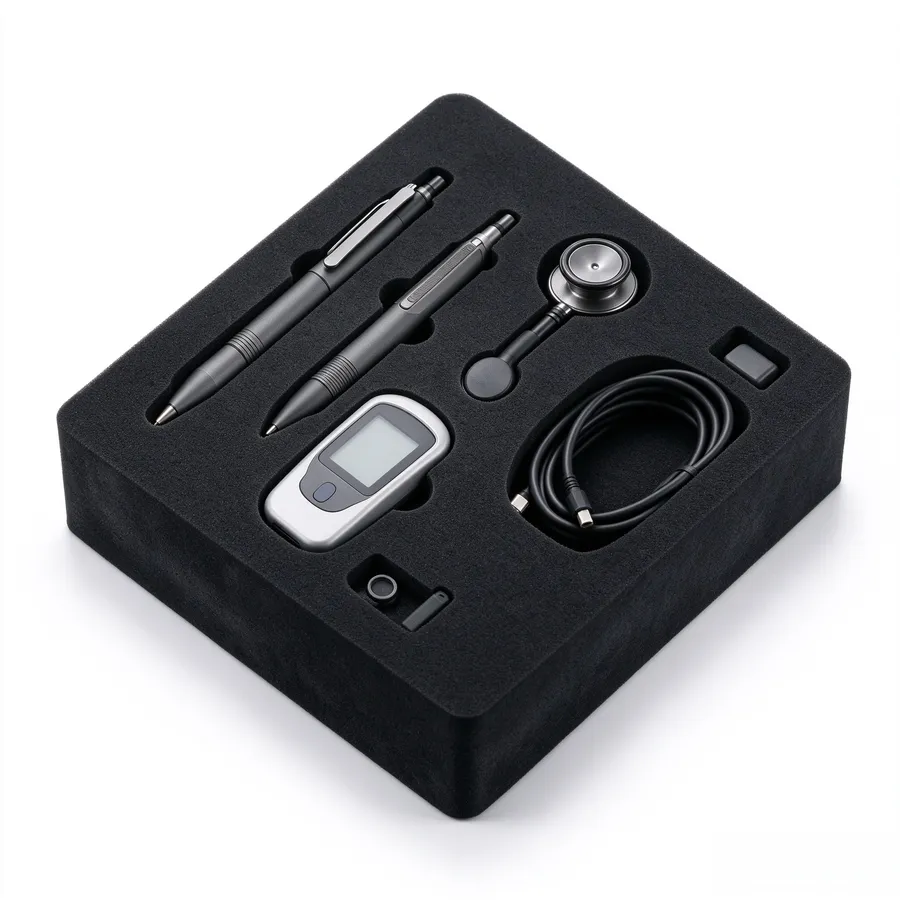
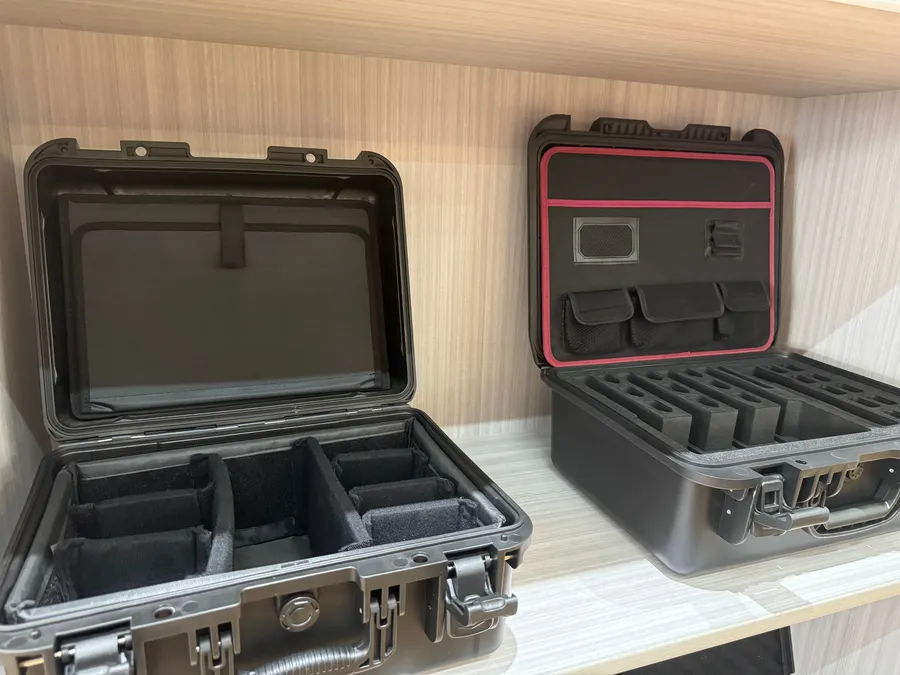
Interior work is the fast path and it starts at one unit. We cut cross-linked PE, EVA or EPE die-cut or CNC-cut, in layered builds, lift-out trays, pluck tops over a fixed base, egg-crate faces, and routed outlines so that a missing probe or filter shows as an empty shape at issue and at recovery. For optics the specific features that earn their cost are a relieved window under a front element, a channel routed so a lead cannot push its plug into a socket, a soft face against a detector or display, and a standing pocket for a battery brick so mass stays below the closure line. Custom foam needs a drawing, a photograph of the packed kit or a physical sample, and it needs no new tooling on an existing shell. Hardware is ordered the same way: latch count, hinge and stay arrangement, handle, document holder, shoulder strap and a pressure-equalisation option are manufacturer options quoted per configuration, and every one of the 155 models publishes a latch body that accepts a standard padlock. Colour, logo, printed identification and buyer-branded packaging begin at about 300 units. Only a change to the shell itself requires a mould, at roughly 3,000 units per component and about 125 days from approved drawings, while an OEM first sample on an approved existing shell takes about 45 days. Most instrument programmes never need new tooling, because the published cavity range already brackets the kit.
Procurement Notes: Wholesale Terms, Verification And What We Will Not Claim
KeXin New Materials (Guangdong) Co., Ltd. is the manufacturer of these shells and works wholesale, OEM and ODM only, on EXW or FOB terms. There is no retail channel, no delivered-duty-paid quotation and no overseas warehouse stock, so build landed cost from an FOB figure plus your own freight and clearance. We publish no pallet loading figure for any model, but carton size is published on 64 models and pieces per carton on 58, so the pallet arithmetic can be done from the datasheet rather than from a guess. Payment is a 30 per cent deposit with the balance after inspection, and third-party factory inspection before goods leave is welcome. Corrosion resistance is the one protection field we record as measured across all 155 shells, on the plain grounds that a thermoplastic shell has no ferrous corrosion path. Everything else in the protection block is either a manufacturer option or not measured, and not measured means exactly that: no ingress code, no free-fall height, no shock figure, no UV or temperature range, no stack load and no load capacity. Then apply the same three questions to us that you would apply to any supplier, because they are the ones that catch an inflated catalogue out: which accredited report produced this figure, what method and what conditions were used, and does that report cover the exact build being bought. Enquiries go to the KeXin sales team through the RFQ page with your packed dimensions attached.
Customisation
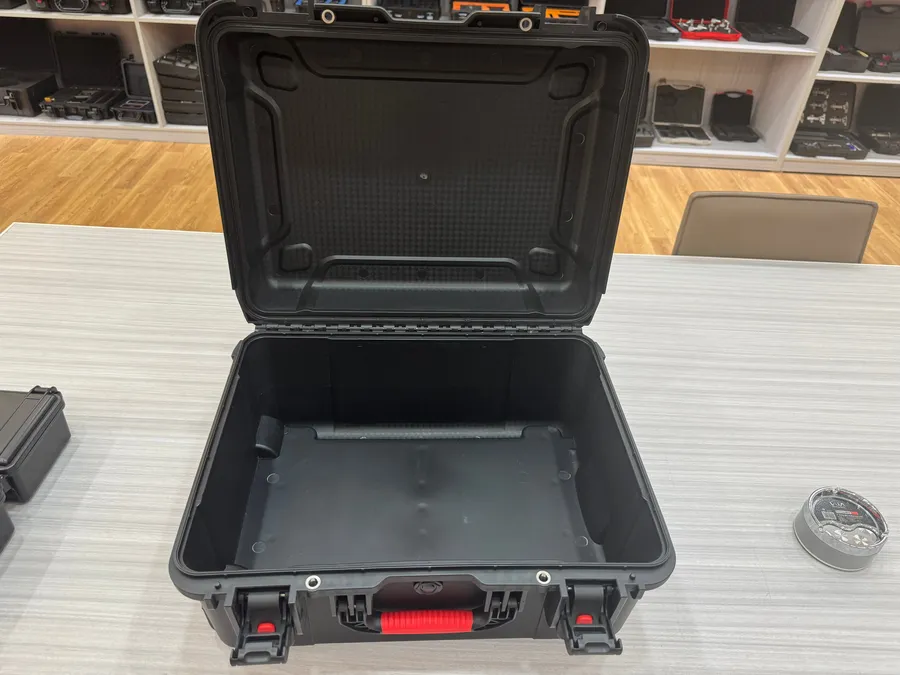
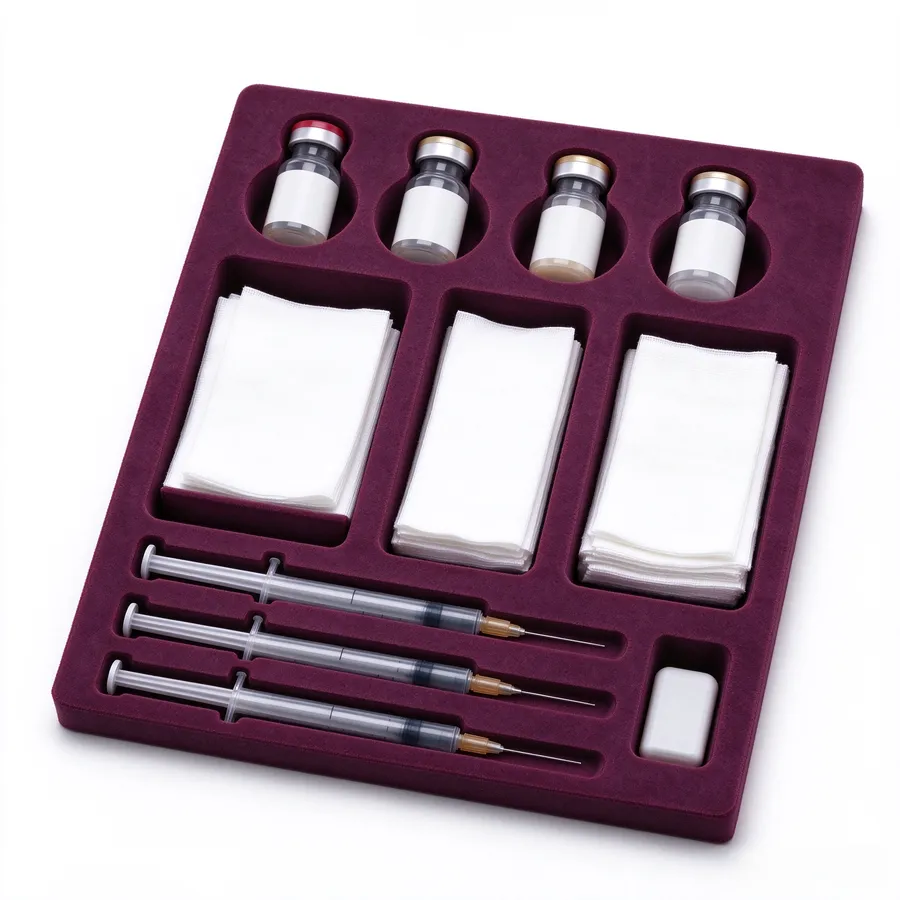
Everything described above is configurable on a standard shell: interior layout (pick-and-pluck, die-cut or CNC-cut), foam grade and thickness, colour, logo method, latch and lock count, pressure-equalisation valve, cable ports, document holder and identification plate. A bespoke exterior geometry requires a new mould — 125 days, from 3,000 units per moulded component.
Procurement considerations
| Question | What to send us |
|---|---|
| Which shell fits? | Equipment L × W × H as packed, plus required clearance per axis |
| What does it cost? | Order quantity and estimated annual quantity — the two drive different answers |
| Is tooling needed? | Whether an existing shell clears the envelope with usable foam depth |
| Lead time? | Your required delivery date, not just the order date |
| Certification? | The exact standard your tender names — we will say whether we can test to it |
| Freight? | Destination and preferred terms; carton and pallet data supplied with the quotation |
Comparison and selection guide
The tables on this page exist because a protective case is chosen by comparing three things: the envelope, the environment and the handling chain. Where no table applies, the rule below is.
| Situation | What To Do |
|---|---|
| Changing kits | Layered pluck foam, rebuilt by hand. |
| Fixed rental fleet | CNC silhouette with serial pockets and an inventory list. |
| Harsh locations | Sealed shell plus desiccant provision in the lid. |
- Size on internal dimensions plus clearance, never on a product name.
- Choose the carrying method before the shell: it changes the series, not just the price.
- Specify the interior last, and decide up front whether the end user will reconfigure it.
Protective Cases for Optics, Cameras & Precision Instruments relates to Protective Case Basics. Related families: Camera & Photography Cases / Optical Equipment Cases / Instrument & Equipment Cases / Electronics Cases / Medical Equipment Cases / Equipment Transport Cases / Custom Protective Cases / Outdoor Protective Cases / Long Equipment Cases / Waterproof Cases. Related sectors: field and industrial equipment. Continue in the Protective Case Basics cluster.
This page is written from our own production data. If your requirement differs, send the dimensions and we will tell you which of the 155 models fits, or whether a custom route is needed.