How should scientific equipment dimensions be measured?
Measure the instrument as it will actually travel, in three maximum extents, with everything that stays attached, then add working clearance and check the result against a published internal record rather than against a catalogue picture. Concretely: take the maximum length, maximum width and maximum height over the whole packed envelope, not the nameplate size of the chassis; weigh the packed kit including cables, batteries and the mount that always goes with it; add clearance for the cushion you intend to use rather than a single number copied off a template; and compare the result against the internal dimensions a supplier publishes for a named model. Our 155 models publish an internal and an external dimension set, wall thickness on 148, a narrower internal width on 36, lid and base depth on 100, and an internal volume that matches the product of the three internal figures on every record, so a quotation can be checked line by line instead of accepted on trust. Scientific equipment dimensions measured this way produce one deliverable: an envelope in millimetres, a mass in grams, and a list of the features that decide whether the case can actually be used - handle, feet, latch line, taper. Where the answer is no is just as useful as where it is yes, which is why the internal figures below are quoted exactly as published.
Key points
- Measure the packed envelope, not the chassis: maximum extent in each of the three axes with cables, batteries, mounts and probes that travel attached.
- Weight the complete packed kit, because cushion thickness is chosen from mass; net shell mass is published on 93 of 155 models and is the load the carrier layer must survive for years.
- Add clearance per axis for the interior you actually specify, then check it against the published base depth: lid and base depth appear together on 100 models and sum exactly to internal height.
- On 36 models a second, narrower internal width is published, between 8 and 37 millimetres below the nominal width; a rigid instrument has to clear the narrow figure, not the wide one.
- Internal volume published on all 155 models equals the product of the three internal dimensions, while usable interior volume is lower on 154 of them, so read both columns before you trust litres.
- Send millimetres, grams and a photograph with a ruler in shot; that is what we need to nominate a model rather than guess one.
What Scientific Equipment Dimensions Measured Properly Produces
A dimension set is only useful if it converts into a decision, so start from the deliverable. What a case supplier needs is three maximum extents in millimetres, one packed mass, a short list of the parts that must not carry load, and a statement of how the kit travels. What comes back is a named model, its published internal dimensions, the base depth your item must sit inside, the wall and material you are buying, and a foam proposal. Everything else - the bench drawing, the datasheet cut-out, the nominal size printed on the instrument - is background. The reason this matters more with scientific equipment than with general hardware is that the sensitive items are usually not the chassis: they are a reference cell, an optical bench, a detector head, a gimbal, a pump, or a stand, and those are the parts that stick out beyond the box. Measure the extreme points, not the silhouette. And measure with the accessories that always travel with the instrument, because a kit measured on the bench and packed in the field does not match any case anybody has ever built.
The Three Axes, And The Mistakes That Make Them Wrong
Length, width and height as maximum extents. Four mistakes account for almost every mis-sized order we see. First, measuring the body instead of the envelope: a connector, a knob, a carrying handle folded flat, a probe socket or a folded tripod leg adds millimetres off the true corner. Second, measuring only at the bench footprint: an item is often widest at a flange halfway up and tallest at a sensor on top, so each axis has to be read from the extremes, not from the base plate. Third, forgetting the accessory that travels loose inside the same case - a charger, a spare battery pack, a filter set, a manual folder - which needs its own pocket rather than lying beside the instrument. Fourth, measuring a single unit and ordering for a kit: if three units plus a shared accessory box go in one case, the arithmetic is a layout problem, not a multiply-by-three problem. Take the reading twice, with the kit laid out as it will actually be packed, and record it in millimetres. Our own record structure is the same three numbers per model, so there is no translation step and no rounding argument.
Mass Is A Dimension Too: Weigh The Packed Kit
Cushion thickness is chosen from mass, so mass belongs in the same request for quotation as the millimetres. A 15 kilogram assembly and a 1.5 kilogram assembly of identical footprint do not take the same interior: the heavier one needs a firmer carrier layer and more working thickness, or it compresses the foam out of existence and arrives having hit the shell. Weigh the packed kit - instrument, cables, batteries, mount - on a normal scale and record grams or kilograms as you read them. For scale, the empty shell mass we publish ranges from about 100 grams on the KX-1204 to about 15,320 grams on the KX-88442, with a median near 1,480 grams across the 93 models that publish a figure; your instrument mass should be read against that, not against a generic assumption about what a case weighs. Two honest gaps to note: gross weight is published on none of the 155 records, so a landed shipment weight has to be calculated from the carton data we do publish - carton dimensions appear on 64 models and pieces-per-carton on 58 - and load capacity in kilograms is recorded as not measured for every model, so nobody should tell you a shell carries a stated working load.
Clearance: What To Add, And Why Not A Fixed Number
Clearance is the cushion, not a template value. The working rule we use on the measurement pages of this site is to add clearance per axis before looking at a catalogue, but the amount that gets added has to be the amount of interior you intend to buy: 20 millimetres of plucked foam and 50 millimetres of layered foam are different envelopes, and adding the first while specifying the second guarantees a return. Read it in three places. Under the item, because that is where the mass works. Around the item, because that is where a sideways impact is absorbed. Above the item, because that is where a stacked or lid-first impact appears. Then check the vertical result against the published base depth rather than the total internal height: lid depth and base depth are published together on 100 of the 155 models and on all 100 they sum exactly to the internal height, so the split tells you how much cushion you genuinely have under the item. A KX-5321 publishes 43 millimetres of lid over 149 millimetres of base inside 192 millimetres of height; a KX-64618 publishes 140 millimetres of lid over only 25 of base inside 165. Same task, opposite layouts, and only the base-depth column reveals it.
Read The Published Record Line By Line
| Field | Published On | How To Use It |
|---|---|---|
| Internal dimensions | 155 of 155 models | The envelope your measured kit must fit inside. Compare maximum extents against these three numbers, not against the external box. |
| External dimensions | 155 of 155 models | For racks, vehicle bays, pallets and airline limits. The gap between the two sets varies widely - median 26 mm in length and 57 mm in width - and on one long-case record the two sets are listed in a different axis order, so check the ordering before committing a rack design. |
| Wall thickness | 148 of 155 models, 2.0 to 6.0 mm | Rim stiffness and stacking behaviour. It is not an impact rating and it does not tell you how the item must be captured. |
| Narrow internal width | 36 of 155 models, 8 to 37 mm below the nominal width | The taper. A rigid chassis has to clear this figure at the joint line, so scientific equipment dimensions measured at the bench must be checked against the narrow number as well as the wide one. |
| Lid depth and base depth | 100 of 155 models | Where the cushion actually sits. On all 100 records the two figures sum exactly to the internal height. |
| Internal volume | 155 of 155 models, 0.3 to 139.5 L | Arithmetic, not a claim: every record equals the product of its three internal dimensions, so it can be re-derived and cross-checked. |
| Usable interior volume | 155 of 155 models, 0.3 to 111.6 L | The volume left after the moulding's taper and hardware. Lower than internal volume on 154 of 155 records, typically around 85 per cent of it. |
| Net shell weight | 93 of 155 models, 100 to 15,320 g | What your team carries. Add it to the packed instrument mass to get the true handled load. |
| Gross weight | none of the 155 records | Not published. Freight weight is calculated from carton dimensions and pieces per carton, which appear on 64 and 58 models respectively. |
| Ingress code, drop height, stack load, load capacity | none of the 155 records | All recorded as unmeasured. If your purchaser needs one, it is commissioned as accredited testing on the nominated model and configuration. |
| Material | 155 of 155 models | 94 polypropylene, 38 engineering polypropylene, 22 ABS, 1 recorded as PP / ABS. Read it with wall thickness, never instead of it. |
Worked Examples Against Real Published Figures
Example one, a hand meter with a folded probe: measured envelope 210 by 145 by 60 millimetres, packed mass about 1.6 kilograms. The KX-1905 interior of 180 by 160 by 40 millimetres is under size on length and height before anything else is considered. The KX-2507 at 245 by 175 by 64 millimetres on a 2.0 millimetre wall and about 340 grams empty leaves about 35 millimetres in length and 30 in width, but only 4 millimetres in height, and its published split is 32 millimetres of lid over 32 of base - so a 60 millimetre tall item has no cushion under it at all. The correct answer is either a deeper shell such as the KX-2614 at 240 by 200 by 120 millimetres with 60 millimetres of base over 60 of lid, or a lid-carried layout accepted knowingly. Example two, a datalogger with a battery pack: measured 300 by 200 by 90 millimetres, about 3.4 kilograms packed. The KX-62810 interior of 253 by 182 by 86 millimetres is under size; the KX-63413 at 310 by 255 by 106 millimetres on a 4.8 millimetre ABS wall fits with 10 to 55 millimetres of working margin per axis. Example three, a total station head: 330 by 210 by 160 millimetres, 8 kilograms. The KX-93221 interior of 300 by 200 by 200 millimetres fails on length and width before the lid and base split is even discussed, and its published 165 millimetres of lid over 35 of base is the wrong arrangement for a mass that must sit low anyway; the KX-4821 at 447 by 312 by 194 millimetres with 50 millimetres of base, a 144 millimetre lid and a 4.5 millimetre wall is closer, and the decision was made from the published columns rather than from a picture.
Outdoor Scientific Equipment Dimensions Measured In The Field
Outdoor scientific equipment dimensions measured on a site bench are routinely wrong in one specific way: everything that only gets attached in the field is left out. The tripod, the mast section, the external antenna, the solar panel, the spare battery case and the sample kit travel with the instrument and change the envelope completely. Take the measurement at the point where the kit is actually packed, and if that is a vehicle tailgate, do it there. Two more field-specific checks. First, the narrow width: on the 36 models that publish it, the internal width at the tighter section is between 8 and 37 millimetres below the nominal figure, which is exactly the tolerance a wrapped instrument loses when it is pushed in at an angle. Second, the lid line: an item measured to sit flush with the rim will contact the closure when the interior is added, and then the load goes into latches and gasket rather than into foam. If the kit has to be usable with gloves, in wind, or in the dark, note that in the enquiry as well, because it changes whether the answer is one large case or two smaller ones - and the two-smaller answer usually fits a vehicle bay, an aircraft hold and a person's back better than the one large case does.
What We Do Not Measure, And What To Do About It
The dimension record is complete; the performance record deliberately is not. Ingress protection codes, drop heights, stack load in kilograms, working load capacity, ultraviolet resistance and temperature range are recorded as not measured for every one of the 155 models, and no protection code is stated on any of them. Shock protection and impact resistance appear as construction options with an explicit note that the shell alone is not a shock rating and that a specified foam layout is required. That means an outdoor scientific specification that names a level has to be answered in one of two honest ways: either we confirm the published construction that addresses the mechanism - wall thickness, gasket channel on 124 of 155 models, feet and padlockable latch bodies recorded as measured - or we quote accredited third-party testing on the nominated model and interior as a separate work package and tell you which it is before you bid. If a supplier answers a rating question with a grade rather than a report, ask for the method, the specimen configuration and the laboratory, and treat the answer as a claim until those three exist.
Send Us The Numbers: What A Good Request Looks Like
The request that gets a same-day, checkable answer contains six lines. One: maximum length, width and height of each item as packed, in millimetres. Two: packed mass of each item, in grams or kilograms. Three: the accessory list that travels inside the same case. Four: how it travels - carried on foot, vehicle, aircraft hold, rack stack. Five: the quantity per size per year, and your pallet or rack constraint if there is one. Six: a scale photograph of the packed kit, or the physical sample if the layout is awkward. On that we return the nominated model with its published internal dimensions, wall thickness, lid and base depth, material and net mass, an interior proposal with thickness per face, and a written statement of what is measured, what is an option and what is untested. KeXin New Materials (Guangdong) Co., Ltd. works on wholesale and OEM or ODM terms only, quoted EXW or FOB, with no retail, no delivered-duty-paid price and no overseas warehouse; one piece on a standard model, one on a custom foam layout, about 300 for logo, colour or OEM and about 3,000 per component for a dedicated new mould, roughly 45 days for a first OEM article on existing tooling and about 125 days for a new mould, 30 per cent deposit with the balance after inspection, and third-party inspection welcome. Contact Fred Zhao or the KeXin Sales Team, WhatsApp +86 135 3588 0002.
Customisation
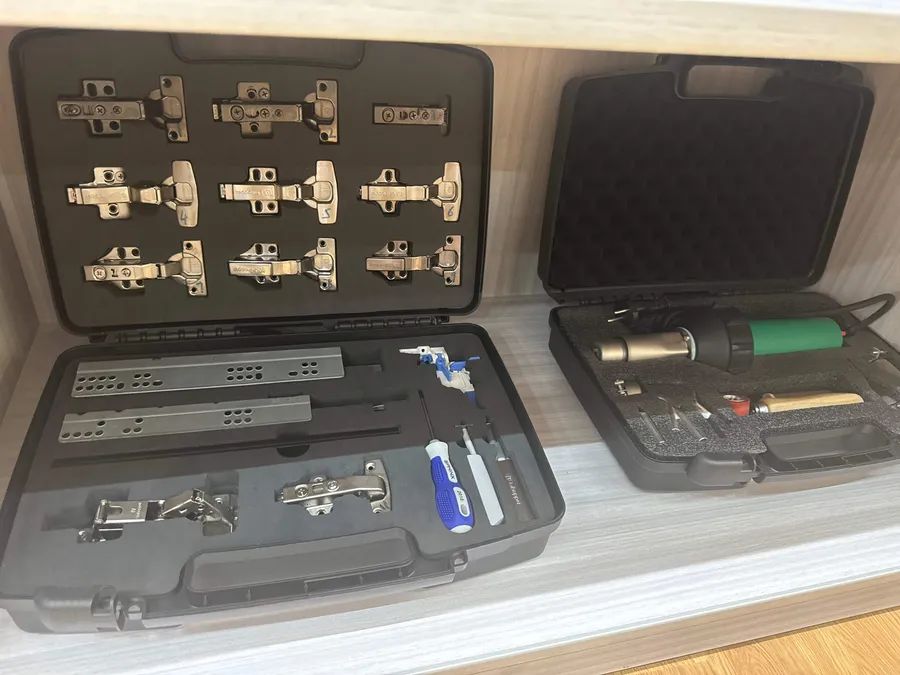
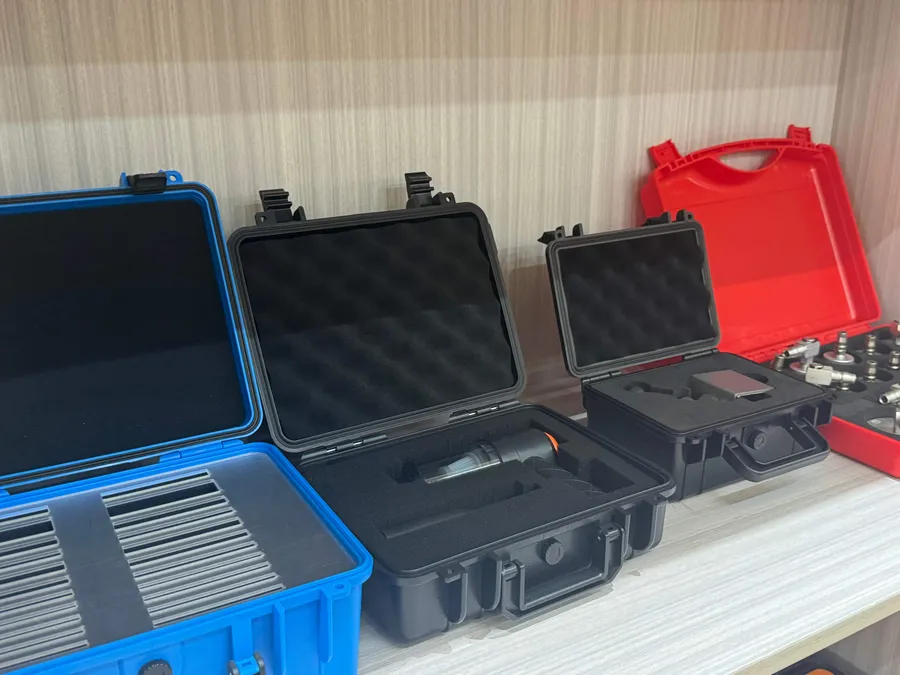
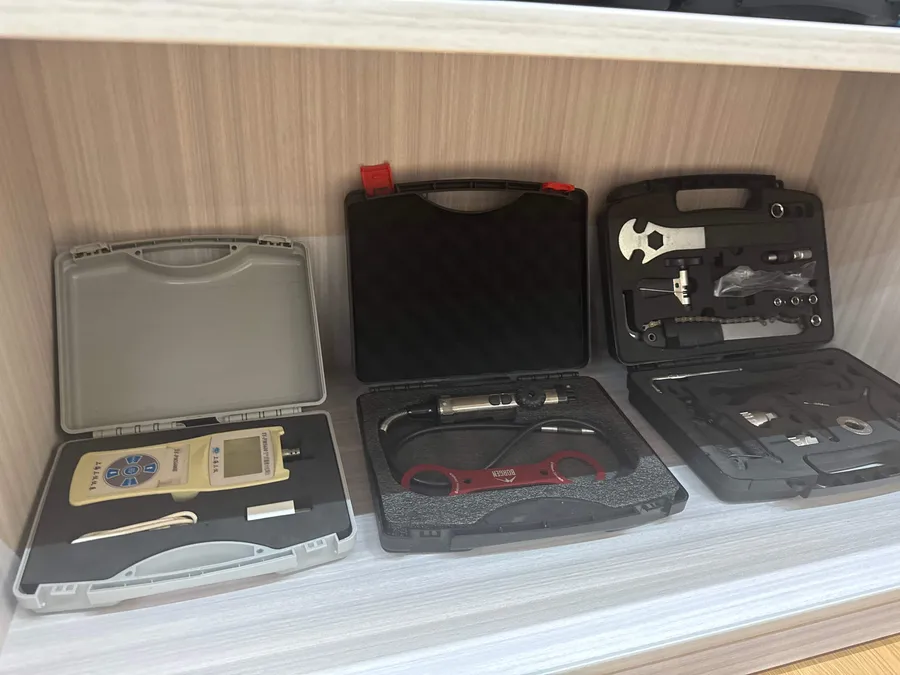
Everything described above is configurable on a standard shell: interior layout (pick-and-pluck, die-cut or CNC-cut), foam grade and thickness, colour, logo method, latch and lock count, pressure-equalisation valve, cable ports, document holder and identification plate. A bespoke exterior geometry requires a new mould — 125 days, from 3,000 units per moulded component.
Procurement considerations
| Question | What to send us |
|---|---|
| Which shell fits? | Equipment L × W × H as packed, plus required clearance per axis |
| What does it cost? | Order quantity and estimated annual quantity — the two drive different answers |
| Is tooling needed? | Whether an existing shell clears the envelope with usable foam depth |
| Lead time? | Your required delivery date, not just the order date |
| Certification? | The exact standard your tender names — we will say whether we can test to it |
| Freight? | Destination and preferred terms; carton and pallet data supplied with the quotation |
Comparison and selection guide
The tables on this page exist because a protective case is chosen by comparing three things: the envelope, the environment and the handling chain. Where no table applies, the rule below is.
| Situation | What To Do |
|---|---|
| Marine or wet | Sealed configuration with a drain-friendly interior and stainless hardware. |
| Dry and dusty | A close-fitting rim and a lid that can be opened one-handed without spilling contents. |
| Carried far | Under 10 kg packed, with a padded handle or shoulder webbing. |
- Size on internal dimensions plus clearance, never on a product name.
- Choose the carrying method before the shell: it changes the series, not just the price.
- Specify the interior last, and decide up front whether the end user will reconfigure it.
How should scientific equipment dimensions be measured? relates to Protective Case Basics. Related families: Outdoor Protective Cases / Instrument & Equipment Cases / Field Equipment Cases / Electronics Cases / Equipment Transport Cases / Custom Protective Cases / Optical Equipment Cases / Medical Equipment Cases / Military Protective Cases / Tactical Equipment Cases. Related sectors: field and industrial equipment. Continue in the Protective Case Basics cluster.
This page is written from our own production data. If your requirement differs, send the dimensions and we will tell you which of the 155 models fits, or whether a custom route is needed.


