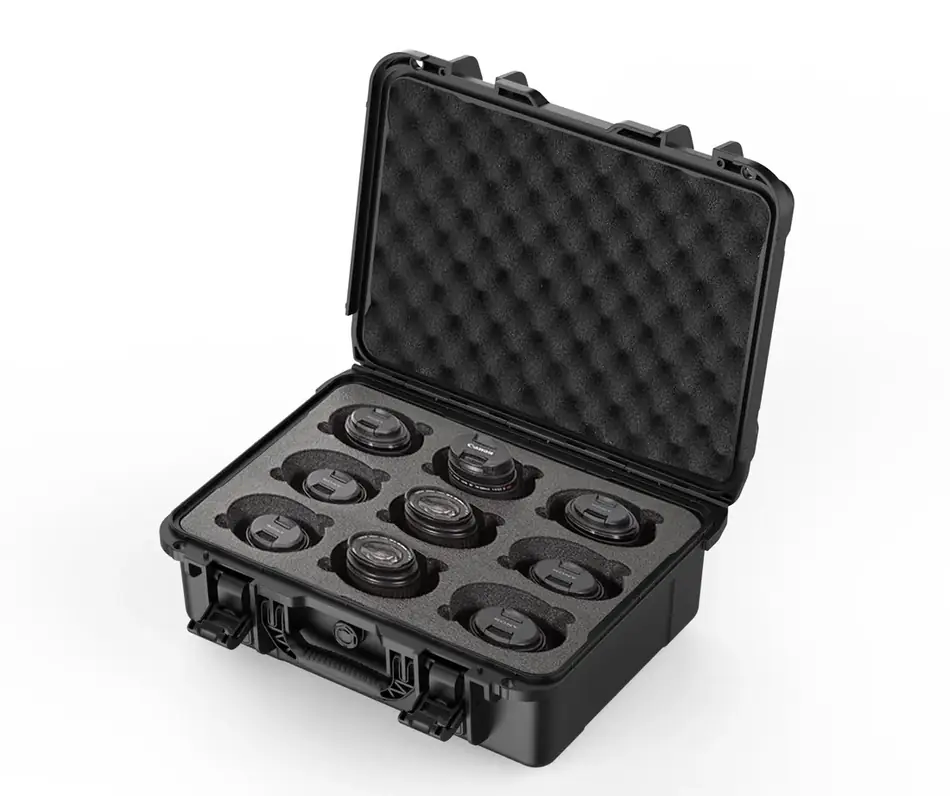
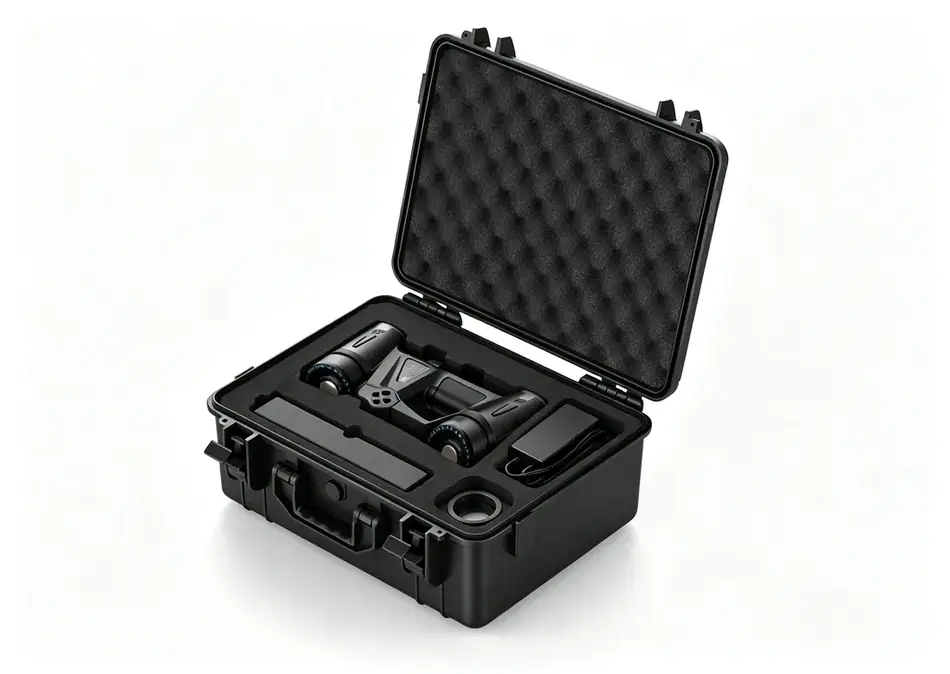
How should cameras and lenses be protected during transport?
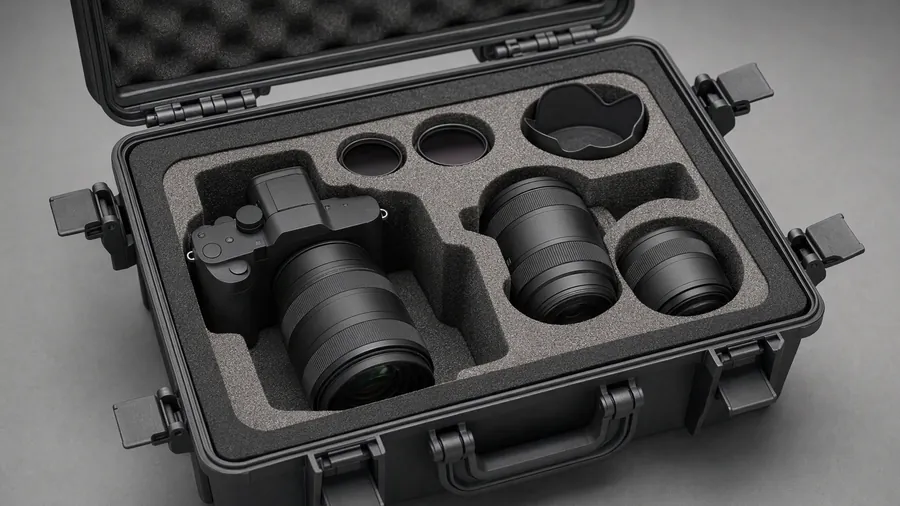
Cameras and lenses are protected in transport by a load path, not by a box: each item held in its own pocket, that pocket supported by foam of a thickness matched to the item mass, the foam contained by a rigid thermoplastic shell, and the shell closed so the lid cannot lift and the contents cannot shift. In our published file the 85 listings tagged to the camera category carry 5.0 L to 21.2 L of usable interior volume with a median of 11.6 L, and their longest internal edge runs from 240 mm to 582 mm, which is the envelope range a photo kit has to be checked against. Three habits decide most failures: lenses carried in their own pockets rather than mounted on bodies, glass and bodies separated so nothing transmits a point load through the mount, and a lid depth chosen so tall items stand instead of lying across each other. We state geometry and construction per model, and we state no ingress code, no drop height and no shock figure, because those are recorded as not measured on all 155 listings in our file.
Key points
- Our 85 camera-category listings span 5.0 L to 21.2 L usable interior volume, median 11.6 L, all published per model.
- Longest internal edge across those listings runs 240 mm to 582 mm; measure your lens from mount to front ring and compare.
- Lid depth is published on 48 of the 85 camera listings, 30 mm to 165 mm, median 79 mm; base depth median 41 mm.
- Wall thickness is published on 83 of 85 camera listings, 2.1 mm to 5.0 mm, median 3.5 mm, and it is not a shock rating.
- A compressible gasket is recorded as measured on 70 of the 85 camera listings; waterproof and dust are recorded as not measured.
- Custom foam has a 1-unit minimum on every listing; OEM is 300 units in 45 days, a new mould 3,000 units in 125 days.
Short answer: the four-part load path that protects photo kit
A camera or a lens is damaged in transit in one of three ways: a point load on a barrel or filter ring, a shock that travels through whatever is between the item and the ground, or abrasion plus vibration that works an item out of a loose pocket and into another item. All three are layout problems before they are shell problems. The load path that answers them has four parts, and every part is a specification line rather than an adjective. First, one pocket per item, sized to the item so it cannot rotate. Second, foam of a thickness matched to that item, with glass and heavy bodies in the base zone rather than stacked in the lid. Third, a rigid shell whose wall and lid geometry are published so you can check them. Fourth, a closure that keeps the lid down under a load thrown into a vehicle bed - latches plus, where the configuration calls for it, a padlockable latch body, which our file records as measured on every listing that states a lock.
What a shell does not do is absorb a hit by itself. In our specification file shock protection and impact resistance are recorded as manufacturer options on all 155 listings, with the note that a specified foam layout is what carries the load and the shell alone is not a shock figure. That single sentence is the most useful thing in this whole category, because it converts the question from how strong is the case to how is your kit held, which is the question a buyer can actually control and specify.
What buyers searching cameras lenses protected during transport are really asking
The search phrase cameras lenses protected during transport is a compressed question, and unpacked it has five parts: where each item sits, how deep the cavity has to be, what the interior measures at its narrowest, what the whole thing weighs when you carry it, and what happens at the transitions - vehicle, hotel, trailhead, gate. The longer form outdoor cameras lenses protected during transport adds a sixth part, which is mixed loads: a body and glass travelling with filters, batteries, a gimbal, a cleaning kit and sometimes a drone, in wet or sandy conditions where the case gets opened with dirty hands.
Our answer to each part is a published number rather than a promise. Internal length, width and height are on all 155 listings, so the fit check is arithmetic. Lid depth and base depth are published on 48 of the 85 camera listings, which is what tells you whether a zoom stands upright. The narrow internal width, published on 23 of the 85 camera listings and running 180 mm to 308 mm there, tells you whether an assembled rig passes the throat of the shell. Net weight is published on 48 of the 85 camera listings, from 460 g to 5,012 g with a median of 1,370 g, which is the carrying cost before a gram of glass goes in.
Published envelopes by kit type, counted from our own file
The 85 camera-tagged listings fall into four volume bands, and the bands are close to even: 23 listings between 5 L and 8 L, 22 between 8 L and 12 L, 17 between 12 L and 16 L, and 23 between 16 L and 22 L. The table maps those bands to the kit shapes buyers actually order them for, using figures from the listings themselves. Where a field is blank in our file - several 8-series shells have no published net weight, for instance - we leave it blank rather than estimating it, and that is also the standard we ask you to hold other suppliers to.
Use the band as a starting filter and the internal dimensions as the decision. A kit that needs 12 L of volume but measures 411 mm along one item will not fit a 12 L shell whose longest internal edge is 380 mm, which is why the edge length column exists on our product pages at /products/camera-equipment-cases/.
| Kit Shape | Volume Band And Listings | Internal Envelope Examples | Notes From The Published Fields |
|---|---|---|---|
| One body with two primes or a compact zoom | 5 L to 8 L, 23 listings | KX-3308 internal 325 x 236 x 76 mm, 575 g; KX-2813 internal 260 x 200 x 117 mm, 800 g; KX-3213 internal 308 x 230 x 118 mm, 860 g | KX-3308 and KX-2813 are offered without a seal; KX-3213 records a gasket, wall 3.0 mm, lid depth 86 mm |
| Two bodies plus standard zoom, batteries and small accessories | 8 L to 12 L, 22 listings | KX-4010-2 internal 388 x 307 x 90 mm, 1,240 g, narrow width 278 mm; KX-4012 internal 380 x 305 x 110 mm, 1,480 g; KX-4318 internal 407 x 187 x 178 mm, 1,970 g | KX-4318 inverts the usual split: lid depth 38 mm over base depth 140 mm, so depth lives under the tray |
| Pro body set with a long zoom carried in its own pocket | 12 L to 16 L, 17 listings | KX-4613 internal 455 x 338 x 116 mm, 1,370 g; KX-4321 internal 411 x 208 x 202 mm, 2,330 g, lid depth 164 mm; KX-64117 internal 393 x 280 x 156 mm, 2,100 g | KX-64117 and KX-4613 differ by over 700 g of shell for a similar volume, which is a carrying decision |
| Rental, production and video packages with gimbal and lighting | 16 L to 22 L, 23 listings | KX-64120 internal 378 x 307 x 187 mm, 2,640 g; KX-85021 Trolley internal 437 x 308 x 164 mm, 4,912 g, two wheels; KX-86216 internal 582 x 300 x 130 mm | KX-86216 has the longest internal edge in the camera category at 582 mm; the trolley listings add 4,900 g to 5,012 g of shell |
| Search phrase as buyers type it, mapped to a layout | all four bands | cameras lenses protected during transport maps to one-pocket-per-item layouts with glass separated from bodies | outdoor cameras lenses protected during transport adds mixed loads and dirty-hand access, so lid zones carry the frequently opened items |
The five published fields to check before you specify an insert
Internal versus external dimensions. All 155 listings publish both, and the difference is the wall plus the hardware. On KX-4010-2 the external figure is 400 x 350 x 100 mm against an internal 388 x 307 x 90 mm; on KX-86216 it is 620 x 360 x 155 mm outside against 582 x 300 x 130 mm inside. Compare your measured kit to the internal set only, then subtract the foam you intend to use, because a kit measured at 130 mm tall needs an interior taller than 130 mm once it sits in a cavity instead of on a floor.
Depth split between lid and base. Lid depth is published on 48 of the 85 camera listings, running 30 mm to 165 mm with a median of 79 mm, and base depth on the same 48 listings runs 25 mm to 140 mm with a median of 41 mm. A lens that must stand needs the deep half of that split where the lens will stand: KX-92817 offers 125 mm of lid over 27 mm of base, KX-83719 offers 140 mm of lid over 35 mm of base, while KX-4318 offers 38 mm of lid over 140 mm of base and is therefore a flat-load shell. Ordering on total depth alone is how rental houses end up with a shallow lid and a tray of bodies lying on their mounts.
Narrow internal width. Tapered shells are narrower somewhere inside than the nominal width, and 23 of the 85 camera listings publish that figure between 180 mm and 308 mm. KX-2614 lists an internal width of 200 mm but a narrow internal width of 180 mm, so a 190 mm accessory is a no even though the headline numbers say yes. Anything that has to pass the throat of the shell assembled - a body with a lens already on it - is checked against this field, not the nominal one.
Wall thickness and shell material. Wall thickness is published on 83 of the 85 camera listings, 2.1 mm to 5.0 mm with a median of 3.5 mm. Materials in this category are polypropylene on 46 listings, engineering polypropylene on 25 and ABS on 14. Treat both fields as construction facts: they tell you what the shell is made of and how thick, and they do not tell you a performance result.
Net weight and packing. Net weight appears on 48 of the 85 camera listings, 460 g to 5,012 g, median 1,370 g, and carton data appears on 36 of them; KX-3508 ships 20 pieces in a 730 x 615 x 428 mm carton, KX-3218 12 pieces in 645 x 530 x 550 mm, KX-64117 8 pieces in 705 x 430 x 735 mm and KX-85022 one piece in 495 x 375 x 245 mm. Those numbers set your inbound freight and your shelf plan, so ask for them in the same message as the unit price.
Foam layout for bodies, glass and the things that break mounts
The layout rules that hold across photo kit are simple to state and constantly skipped. Lenses travel in their own pockets, not mounted on bodies, because an assembled rig transmits every load in the case through the mount. Glass is separated from glass: two barrels touching in a shared cavity is a scratch and sometimes a helicoid problem. Heavy bodies go in the base zone on a solid floor, and light accessories - filters in their cases, hoods, battery sets, caps, a cleaning kit - go in the lid or in a divider tray above the base foam, so opening the case for a battery does not disturb the load path beneath it. Cable and strap items get their own channel rather than being draped over glass.
Our file offers pick and pluck, die-cut, CNC-cut, EVA, PE and EPE foam, built as top foam, base foam, egg-crate or convoluted, custom cut and layered, and it records the input we need for any of them as measured: a drawing, a photograph of the kit as actually packed, or a physical sample. Custom foam carries a 1-unit minimum on all 155 listings, which is why the normal first order in this segment is a stock shell with a cut interior rather than a new tool. Where a kit has items of very different mass - a metal gimbal next to a plastic-body zoom - a layered build is the answer: denser base foam under the heavy item, softer top foam shaping the light one, so the heavy item does not ride on the light one when the case is lifted by the handle.
Transitions: vehicle, gate, trailhead and the mixed outdoor load
Most damage in photo transport happens at transitions, not on long smooth drives: the case thrown into a vehicle bed, the bag pushed through a gate check, the case opened on a rock at a trailhead, the case stacked in a van with a tripod leg against a lid corner. Two design responses matter here. The first is closure discipline: latch count is recorded in our file as specified per configuration rather than as a fixed number, so a load that will be walked over rough ground is quoted with more latches and, if you want it, a padlockable latch body, which is recorded as measured on listings that state a lock. The second is carry geometry, because a case that must be dragged or rolled is a different object from one that is carried: 19 of our 155 listings publish wheels, 11 publish a telescopic height from 240 mm to 485 mm, and KX-85022 pairs an internal 437 x 308 x 180 mm with two wheels and 5,012 g of shell.
For outdoor loads specifically, the honest engineering point is that a sealed shell keeps water out only as well as the gasket and the closure, and it keeps whatever humidity was already inside it just as effectively. Our file records waterproof and dust resistance as not measured on all 155 listings, so we do not state an ingress code and we do not describe a shell as rated. What we describe is what changes in the specification: acclimatise a cold case before opening it in a warm environment so condensation does not form on glass, keep silica out of direct contact with elements and mount it in the lid tray, and pack the frequently opened items in the lid zone so the base seal is broken as rarely as possible in wet conditions.
What we do not claim about camera cases
Search titles in this segment regularly carry standard names, rating codes and test phrases. We treat them as a topic to explain rather than as a claim to copy onto a product page. In our own specification file, waterproof, dust resistance, any ingress code, drop height, stack load, UV exposure and temperature range are recorded as not measured across all 155 listings; corrosion resistance is recorded as measured because a thermoplastic shell has no ferrous corrosion path; shock and impact protection are recorded as manufacturer options that depend on the foam layout you specify. Electrostatic protection is not a property we record at all, so we do not offer it as a stated feature and we do not imply that a colour or a foam type delivers it.
Where a buyer needs a performance figure for a market, a tender or an insurance position, the route is accredited testing of the exact shell and interior configuration, quoted as a separate work package and scoped in writing before it starts. We will tell you plainly which fields on our datasheets come from our own production records, which are configuration options and which are simply untested, because a datasheet that mixes those three categories is the actual hazard in this trade. A gasket in a continuous moulded channel is recorded as measured on 124 of our 155 listings and on 70 of the 85 camera-category listings; on the remaining shells no seal is offered, and we say that instead of implying otherwise.
Ordering photo kit cases: wholesale, OEM and terms
We work wholesale and OEM or ODM only, on EXW or FOB terms from Guangdong, China, with no retail channel, no DDP quotation and no overseas warehouse, so your forwarder and your customs broker sit on the other side of those terms. Minimums on all 155 listings follow the same pattern: 1 unit for a stock shell, 1 unit for custom foam, 300 units for a custom logo, a custom colour or an OEM build, and 3,000 units per component for a private mould. Lead time is 45 days for OEM work on an existing mould and 125 days for a new one. Payment is a 30 percent deposit with the balance settled after inspection, and third-party inspection and factory audits are welcome rather than something to negotiate.
Send four things and we can quote against geometry instead of guesses: the measured length, width and height of each item as you actually pack it, the packed photograph or drawing, the annual quantity per SKU, and whether the case is carried, rolled or stacked. Fred Zhao of the KeXin Sales Team handles this on WhatsApp at +86 135 3588 0002, and /request-a-quote/ is the direct form. For layouts, the interior pages under /oem-odm/custom-foam-inserts/ and the manufacturing notes at /manufacturing/foam-insert-production/ explain how a cut interior is produced and what it costs to change.
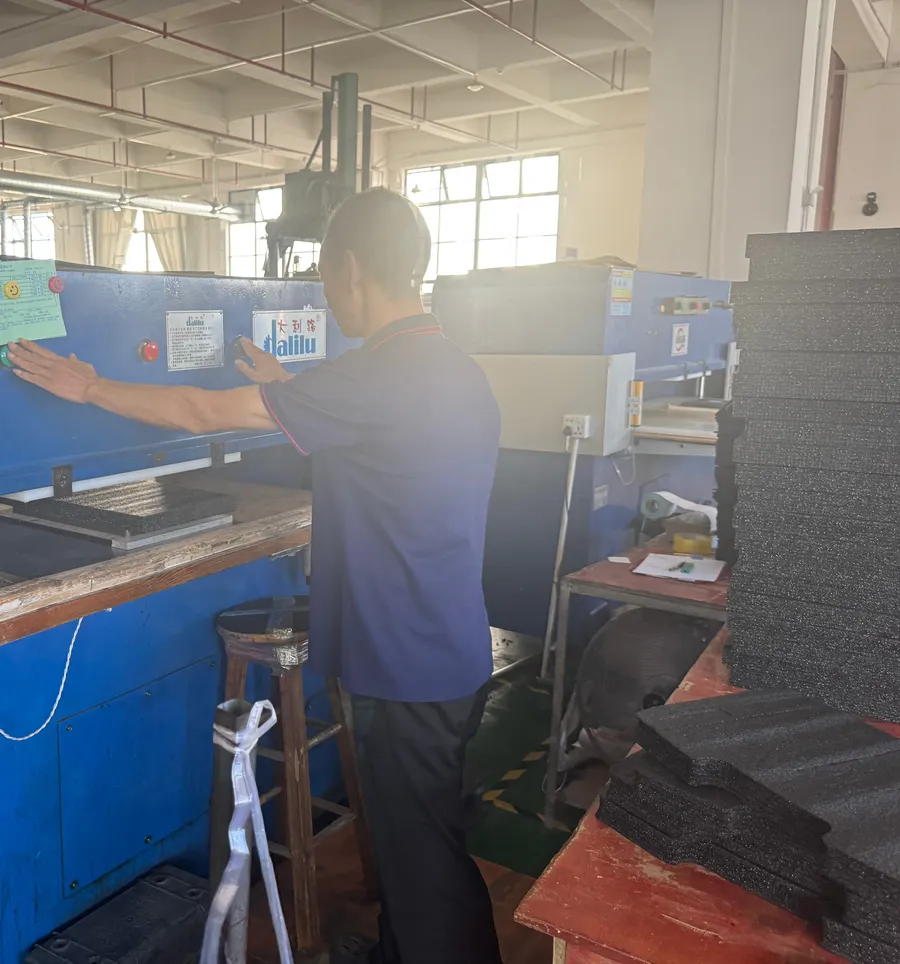
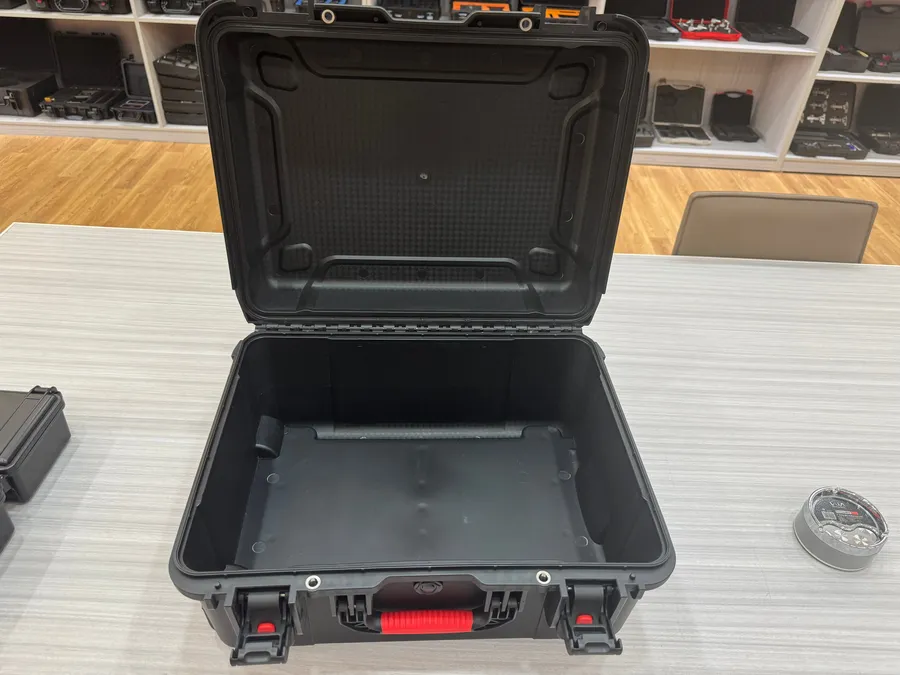
Customisation
Everything described above is configurable on a standard shell: interior layout (pick-and-pluck, die-cut or CNC-cut), foam grade and thickness, colour, logo method, latch and lock count, pressure-equalisation valve, cable ports, document holder and identification plate. A bespoke exterior geometry requires a new mould — 125 days, from 3,000 units per moulded component.
Procurement considerations
| Question | What to send us |
|---|---|
| Which shell fits? | Equipment L × W × H as packed, plus required clearance per axis |
| What does it cost? | Order quantity and estimated annual quantity — the two drive different answers |
| Is tooling needed? | Whether an existing shell clears the envelope with usable foam depth |
| Lead time? | Your required delivery date, not just the order date |
| Certification? | The exact standard your tender names — we will say whether we can test to it |
| Freight? | Destination and preferred terms; carton and pallet data supplied with the quotation |
Comparison and selection guide
The tables on this page exist because a protective case is chosen by comparing three things: the envelope, the environment and the handling chain. Where no table applies, the rule below is.
| Situation | What To Do |
|---|---|
| Changing kits | Layered pluck foam, rebuilt by hand. |
| Fixed rental fleet | CNC silhouette with serial pockets and an inventory list. |
| Harsh locations | Sealed shell plus desiccant provision in the lid. |
- Size on internal dimensions plus clearance, never on a product name.
- Choose the carrying method before the shell: it changes the series, not just the price.
- Specify the interior last, and decide up front whether the end user will reconfigure it.
How should cameras and lenses be protected during transport? relates to Protective Case Basics. Related families: Camera & Photography Cases / Optical Equipment Cases / Outdoor Protective Cases / Electronics Cases / Custom Protective Cases / Rolling Cases / Instrument & Equipment Cases. Related sectors: field and industrial equipment. Continue in the Protective Case Basics cluster.
This page is written from our own production data. If your requirement differs, send the dimensions and we will tell you which of the 155 models fits, or whether a custom route is needed.