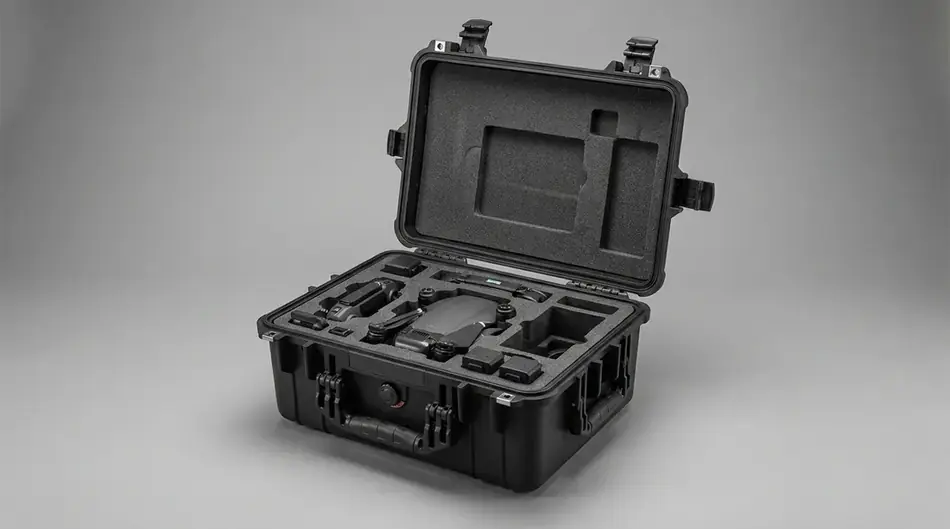
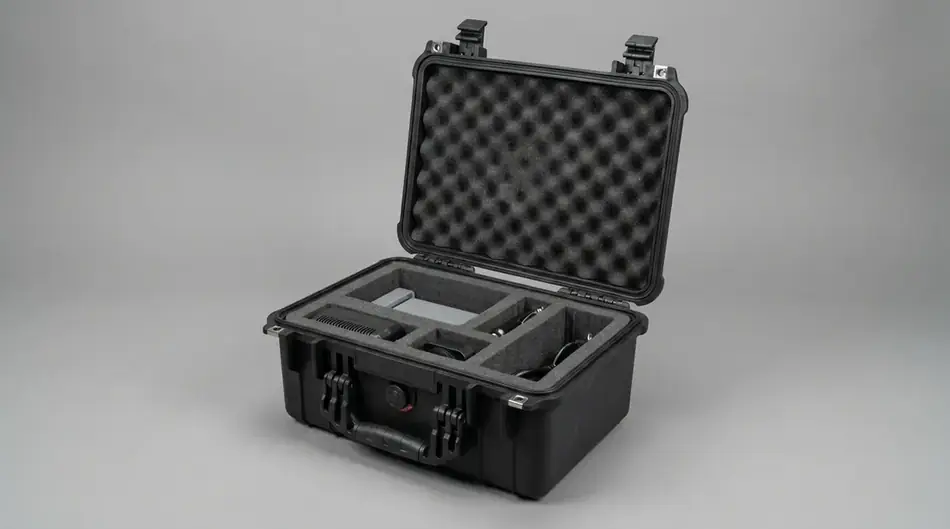
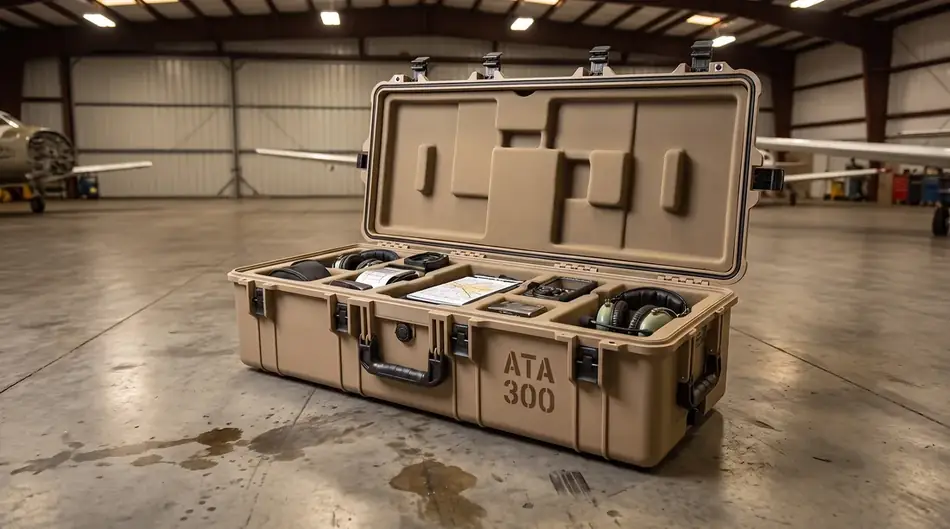
Drone Arm Protective Case: Sizing Arms, Props and Flight Sim Gear
An arm is a lever, so a drone arm protective case is not solved by length alone. The shell has to support the tube along its span, lock the motor mount so the arm cannot rotate, and keep propellers out of the same cavity, because a carbon tube under a point load at one end fails differently from the same tube resting on a foam saddle. We mould 155 hard-shell models and publish, per model, the internal and external dimensions, usable litres, wall thickness on 148 of them and whether a gasket is offered. Twelve models publish an internal length of 600 mm or more, and exactly one reaches 1,280 mm inside, so the first number to measure is the arm with its hinge or quick-release fitted, not the arm as advertised. We publish no ingress code, no shock or vibration result and no load rating for any model; those fields are recorded as not measured.
Key points
- An arm is a lever: support it along the tube with foam saddles and lock the motor end, or the case becomes a bending rig in transit.
- Only one published shell reaches 1,280 mm internally, KX-814641, and 12 models publish 600 mm or more, so measure before shortlisting.
- KX-814641 and KX-89616 publish a 350 x 140 mm internal section at a 5.0 mm wall, which suits a folded arm pair better than a wide box.
- Props are the fragile part: store them flat in their own shallow cut, never in the same cavity as a carbon tube with a metal end fitting.
- No model on this site publishes an ingress, shock or vibration result; the gasket is a construction option offered on 124 models, not a rating.
- Agricultural sprayer kits are a volume problem rather than a length one: tank, pump and nozzles want separate shallow cuts in a 22 to 45 litre shell.
- Flight sim grips are a height problem: KX-87926 publishes 240 mm of internal height for a throttle or collective that stands upright.
What a drone arm protective case has to do that a long box does not
A long box holds an arm. A case protects one, and the difference is how the load is carried. An arm is a lever with a hinge or quick-release at one end and a motor mount at the other, and when a loaded case is set down or tilted the arm tries to rotate about its mount. If the interior only contacts the arm at two distant points, those points become the fulcrum of a bending load and the tube takes the whole moment. If the interior carries the tube on a continuous saddle over most of its span and the motor mount sits in a shaped pocket, the shell takes the load instead. That is a foam drawing question, not a shell question, which is why the case and the insert have to be designed together.
The second job is separation. Propellers are thin, they are the part most often damaged, and they should never share a cut with a tube that has a metal end fitting. The third job is handling: an arm case is long, and a long case carried by one handle at the midpoint swings at both ends. That is the reason the rolling models matter here, and the reason a long shell that is stackable is worth having even when the individual case is not heavy, because a stack of long cases behaves very differently in a container from a stack of cubes.
The published long-shell ladder: twelve models at 600 mm and above
Our catalogue is not organised by drone type, so the way to find an arm case is to sort by internal length and then read the section. Twelve models publish an internal length of 600 mm or more. Of those, one reaches 1,280 mm, one reaches 880 mm, and the rest sit between 600 mm and 740 mm. The section matters as much as the length: an arm with a folding hinge is thicker at the joint than along the tube, and a shell with 140 mm of internal section will not close over a hinge block that stands 170 mm proud. Read the internal width and height in the same table as the length, because a long shell with a shallow section is a tube case and a long shell with a deep section is a folded-arm case.
The figures below are published per model, exactly as they appear on the datasheet for that model. They are not a general capability statement about the range, and a buyer should read the row for the model being quoted rather than the extremes of the column.
| Model | Internal (Mm) | External Length | Usable Volume | Wall | Gasket | Stackable |
|---|---|---|---|---|---|---|
| KX-814641 | 1,280 x 350 x 140 | 1,356 mm | 50.2 L | 5.0 mm PP | offered | yes |
| KX-89616 | 880 x 350 x 140 | 956 mm | 34.5 L | 5.0 mm PP | offered | yes |
| KX-88015 | 725 x 350 x 140 | 800 mm | 28.4 L | 5.0 mm PP | offered | yes |
| KX-87926 | 737 x 257 x 240 | 788 mm | 36.4 L | 4.0 mm PP | offered | yes |
| KX-87323 | 650 x 430 x 210 | 733 mm | 47.0 L | 5.0 mm PP | offered | yes |
| KX-87336 | 650 x 430 x 310 | 733 mm | 69.3 L | 5.0 mm PP | offered | no, wheeled |
Agricultural Drone Accessories Case: separating the tank, the pump and the nozzles
An Agricultural Drone Accessories Case is usually a set of cases rather than one, because a spray drone travels with parts that have incompatible shapes. The tank is bulky and empty, the pump is a dense block with hose tails, the nozzles are small and easily lost, and the arms and props are long. Packing them together means the dense pump shares a cavity with something fragile. The practical arrangement is one long shell for arms and props, one medium shell for the pump and hose set, and one shallow shell or compartment for nozzles, filters and spares, each cut to its own contents.
For the medium shell, a 22 to 45 litre model with a reasonable floor area is the usual landing zone: KX-4616 publishes 455 x 338 x 148 mm inside at 19.6 litres usable, KX-5321 publishes 481 x 373 x 192 mm at 27.5 litres, and KX-87323 publishes 650 x 430 x 210 mm at 47.0 litres for a pump and hose set that needs length. The gasket is offered on all four, and the closure line is the part that matters when a wet hose is coiled back into the case at the end of a spraying day, because the interior will be damp whatever the seal does. A removable tray or a foam block that lifts out for drying is worth specifying at the same time.
Drone Arm Protective Case: the arm itself, measured two ways
A Drone Arm Protective Case is sized from the arm in its travelling state, and there are two travelling states that matter. A detached arm is measured from the hinge pin to the motor mount face, plus the connector and cable that stay attached. A folded arm on a folding-frame aircraft is measured as a pair, with the fold joint open enough that the two tubes do not press on each other. Those two numbers can differ by 300 mm on the same aircraft, and they lead to different shells: a detached arm on a large spray drone can need the 1,280 mm internal length of KX-814641, while a folded pair on a smaller airframe often lands on KX-89616 at 880 mm.
Three details decide whether the shell works in service. The foam must carry the tube on saddles rather than at the ends, so the cut is a channel with ribs rather than a rectangular slot. The motor mount needs its own pocket, deep enough that the bell and the propeller adapter do not bear on the foam. And the cable that runs along the arm should have a channel of its own, because a cable pressed between foam and tube will chafe at the first fold. All three are drawing decisions we make from photographs and a dimensioned sketch, and all three change the foam specification rather than the shell model, which is why a quotation for an arm case should always state the interior drawing and not only the case number.
Flight Simulation Equipment Case: grips, pedals and a base that does not slide
A Flight Simulation Equipment Case is a different geometry problem again. A throttle or collective stands upright on a base, and its grip is the tallest and most fragile part; a set of rudder pedals is wide, flat and heavy, and it wants to sit on the floor of the case rather than hang in foam. That combination is a height and floor-area problem, not a length problem. KX-87926 publishes 737 x 257 x 240 mm inside, and that 240 mm of internal height is what allows an upright grip to travel without the lid pressing on it; KX-87323 publishes 650 x 430 x 210 mm for a wider base and a separate pedal cut.
Two practical notes apply to simulation hardware. First, the base of a HOTAS or pedal set is usually heavier than it looks, so the foam under it should be a firm grade and the base should sit on the shell floor rather than on a foam column. Second, a simulation rig travels by car and by air, and a long case with wheels is easier to move through an airport than a cube of the same weight, which is why the wheeled models are worth considering for a full rig even when the individual components are not heavy.
What we publish, and what we do not claim
Our data is a shell record. Internal and external dimensions are published on all 155 models, internal volume runs from 0.3 to 139.5 litres, internal height reaches 200 mm or more on 37 models, wall thickness is published on 148 models from 2.0 to 6.0 mm, net weight on 93 models from 100 to 15,320 g, and lid and base depth are both published on 100 models. A compressible gasket is recorded as a construction option on all 155, offered on 124 and not offered on 31. Stackability is recorded per model and 136 are stackable. Wheels and a telescopic handle are published together on 19 models.
What is absent is equally specific. There is no ingress code, no immersion depth or time, no drop height, no vibration spectrum, no compression load and no temperature range published for any model. Those are recorded as not measured. A drone case is often described in the market with a protective adjective, and the reason we do not do that is simple: an adjective cannot be checked at goods-in, whereas a dimension can. If your programme needs a shock or vibration result for the packed configuration, that is a test to be scoped with the laboratory you appoint, and it is quoted separately from the shell.
| Published Field | Coverage | What It Decides |
|---|---|---|
| Internal length | 155 of 155, 115 to 1,280 mm | Whether a detached arm or a folded pair fits at all |
| Internal section | 155 of 155 | Whether a hinge block or a motor mount clears the closure line |
| Wall thickness | 148 of 155, 2.0 to 6.0 mm | Stiffness of a long span under a lid load |
| Gasket offered | 124 yes, 31 no | Whether the closure can be compressed against a seal, not how well it seals |
| Stackable and wheeled | 136 stackable, 19 wheeled with telescopic handle | How a set of long cases behaves in a container or at an airport |
| Ingress, shock, vibration, load | 0 of 155, recorded as not measured | Whether a test has to be commissioned for your programme |
Four ways to pack a drone, compared
Most buyers arrive with one aircraft and one idea about packing, and the idea is usually a big case for everything. The table below compares four arrangements against the published shells, and the pattern is that the arrangement which separates the loads costs less in foam and protects more. The right answer for a fleet is often two sizes rather than one, because the arm case and the accessory case have different shapes and are used at different times.
| Arrangement | What It Protects | Shell To Start From |
|---|---|---|
| Arm only, detached | The tube and the motor mount; nothing else travels in the case | KX-814641 at 1,280 mm inside for a large spray drone arm |
| Arm pair, folded | Two tubes with the fold joint open, plus the cable run | KX-89616 at 880 mm inside, or KX-87323 for a deeper section |
| Airframe, arms and props together | Everything, but with props at risk from the tube ends | KX-87336 at 650 x 430 x 310 mm inside, wheeled for the weight |
| Field kit: aircraft, battery, controller | The full sortie, with each class in its own cavity | Two shells: a long case plus a 22 to 45 litre accessory case |
| Simulation rig: grips and pedals | Upright grips and a heavy flat base | KX-87926 at 240 mm internal height, or KX-87323 for width |
Selection guidance: five checks that reach a model number
The checks below are in the order that avoids rework. Measure first, then check the section, then the closure line, then the carry method, and only then look at volume. A buyer who starts with volume usually ends up with a case that is long enough and too shallow, which is the most common and most expensive mistake in this category, because the shell cannot be made deeper after it is moulded.
If the arm does not fit any published shell, that is a tooling conversation rather than a case conversation, and it should be priced as one. A new mould is 125 days from tool approval and starts at 3,000 units per moulded component, so for a small fleet the usual answer is a slightly larger published shell with a custom foam cut, accepting some unused space, rather than a new tool.
| Check | How To Apply It | Example Outcome |
|---|---|---|
| Measure the arm in its travelling state | Hinge pin to motor mount face, with connector and cable attached | A 1.2 m arm lands on KX-814641, a 0.8 m arm on KX-89616 |
| Read the section, not just the length | Compare the hinge block height and the motor bell diameter to internal width and height | A 170 mm hinge needs a deep section such as KX-87323 at 210 mm |
| Plan the closure line | Decide whether the lid closes over cables or the cables unplug and store separately | A cable channel in the foam rather than a cavity that pinches it |
| Decide the carry method | One person, two people, or trolley from vehicle to field | A loaded long case with a 10.6 kg shell suggests the wheeled KX-87336 |
| Separate the accessory loads | List pump, nozzles, batteries and controller as their own envelopes | A 22 to 45 litre accessory shell instead of one oversized cavity |
Where these cases are used
Arm cases turn up in four working contexts. In agriculture, a spray drone is dismantled between fields and the arms travel in a vehicle that is also carrying chemical and water, so the case has to tolerate being set down on wet ground and the interior has to be removable for drying. In survey and mapping, the aircraft travels by air and the case is checked as baggage, which puts the emphasis on the shell wall and on a closure that does not open under handling rather than on field robustness. In training, simulators and airframes are moved between classrooms and the loads are benign but frequent, so the foam layout has to survive being opened and closed several times a day. In service and repair, a technician carries one arm and a set of spares, and a smaller case with a rigid insert does the work of a large one.
Each context changes which published field matters. The agriculture buyer reads the gasket and the interior volume; the survey buyer reads the external length against an airline limit and the wall thickness; the training buyer reads the closure hardware and the foam life; the service buyer reads the internal length of the smallest shell that will still take the arm. That is why the same aircraft can justify two different case models for two different departments.
Customisation: interior, hardware, marking and tooling
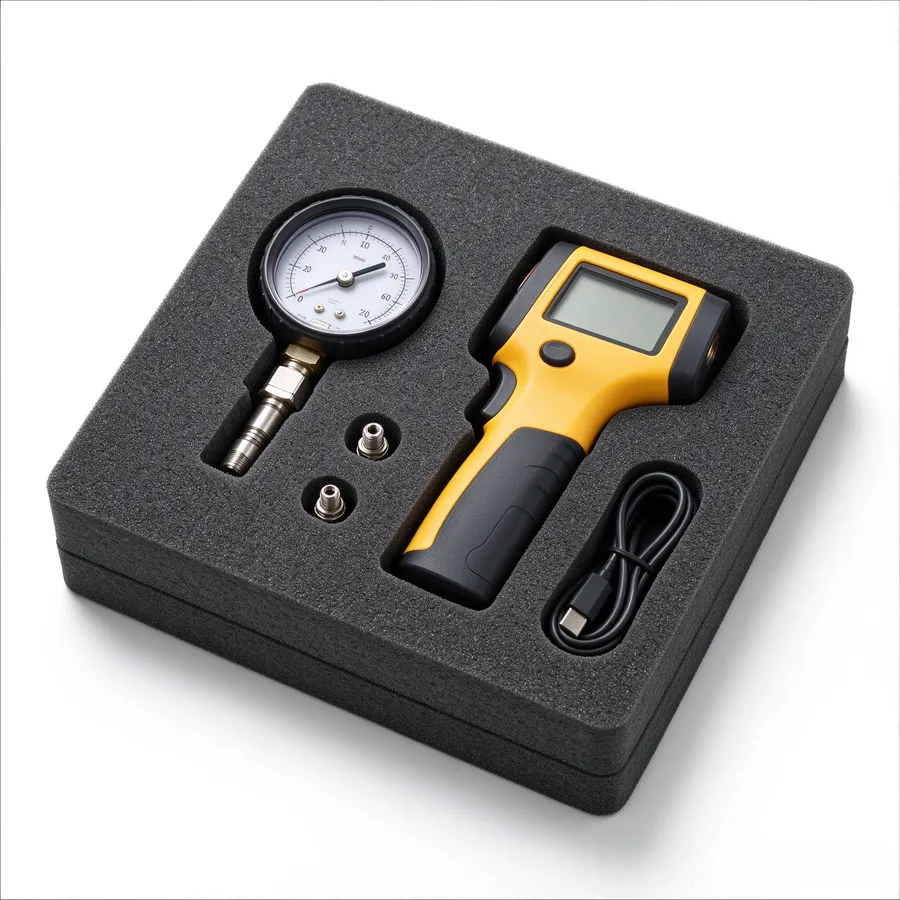
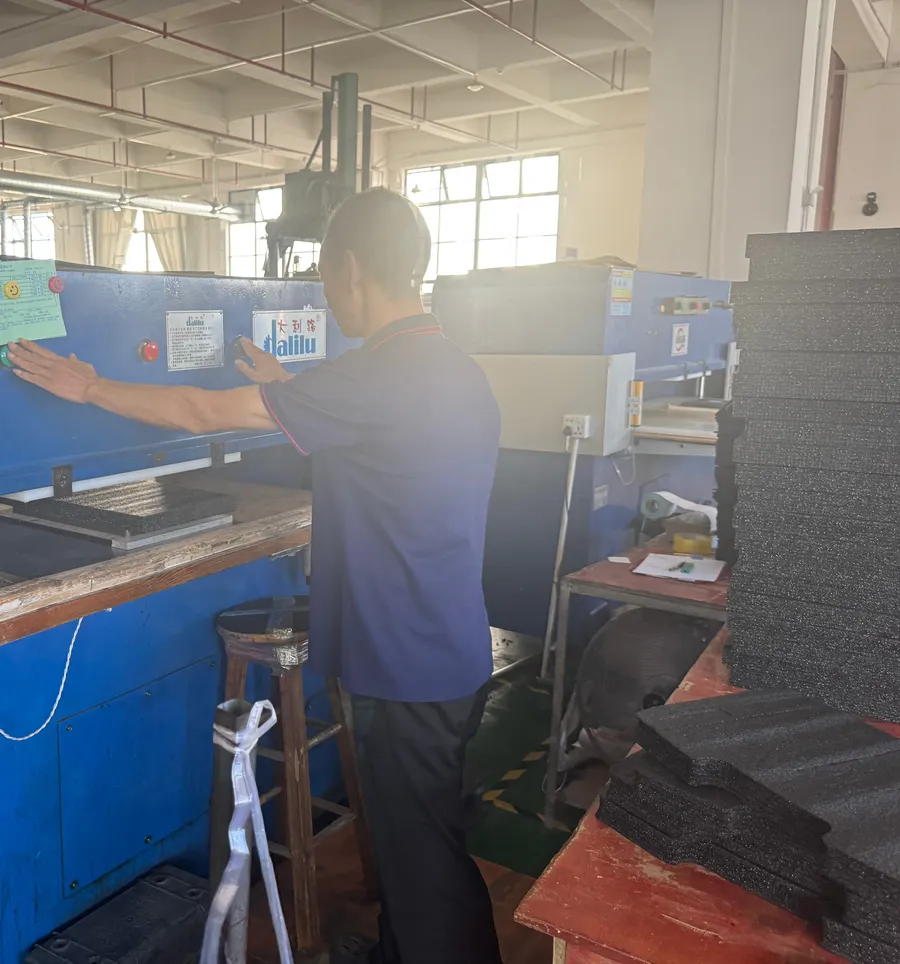
The interior is where an arm case is actually made: pick-and-pluck foam for a quick layout, die-cut foam for a repeatable one, or CNC-cut foam when the cavity has ribs and channels. We ask for photographs of the arm in its travelling state, a dimensioned sketch, and the position of the cable exit, and we return a foam drawing for approval before production. Foam grade and thickness are specified per zone, so the tube can sit on a firm grade while the props sit on something softer. Colour, logo method, latch and lock count, a pressure-equalisation valve where the shell allows it, cable ports, a document holder and an identification plate are all configuration items on a standard shell.
A larger exterior geometry is a moulding project. It is quoted at 125 days from tool approval and from 3,000 units per moulded component, and it only makes sense when a fleet is large enough to amortise the tool. For most buyers the practical route is to choose the published shell that is closest above the envelope, accept the unused space, and spend the difference on a better foam drawing, because the interior is what protects the arm and the shell is what carries the interior.
Procurement notes: wholesale terms, verification and what we will not claim
We supply wholesale and OEM only, on EXW or FOB terms. We do not sell retail, we do not quote DDP, and we hold no overseas warehouse. A standard shell is available from one piece; logo, colour and OEM marking start at 300 units; a new mould starts at 3,000 units per moulded component. OEM first samples take 45 days, a new mould takes 125 days, and the payment term is a 30 percent deposit on order. Carton and pallet quantities are published per model, and for long shells they matter more than for cubes, because a 1,356 mm case packs and palletises differently from a 500 mm one and the freight difference can exceed the unit price difference.
On verification, we will check every dimension on your drawing against the published record for the model you choose, agree a first-article inspection, and state which fields are not measured rather than let a comparison table imply them. We do not describe a shell as explosion-proof, we do not print an ingress code, and we do not present a shock or vibration result we do not hold. If your programme needs one, we will help scope it with the laboratory you appoint and quote the shell work separately, which is the arrangement that keeps both the delivery date and the evidence honest.
Applications
This matters most where the case is part of a movement chain rather than shelf packaging. In drone & uav operations and aerospace & avionics and field & deployment the same shell is specified differently because the handling, the environment and the verification requirement differ.
- Drone & UAV Operations — A drone kit is three different protection problems in one box: a light awkward airframe, heavy b…
- Aerospace & Avionics — In aviation ground support, the case is part of the tooling chain and its mass is a direct cost.…
- Field & Deployment — Field deployment removes every assumption a depot specification makes: no forklift, no dry stora…
- Outdoor & Recreation — Consumer and professional outdoor brands buy cases as a component of their product. That means c…
Customisation
Everything described above is configurable on a standard shell: interior layout (pick-and-pluck, die-cut or CNC-cut), foam grade and thickness, colour, logo method, latch and lock count, pressure-equalisation valve, cable ports, document holder and identification plate. A bespoke exterior geometry requires a new mould — 125 days, from 3,000 units per moulded component.
Procurement considerations
| Question | What to send us |
|---|---|
| Which shell fits? | Equipment L × W × H as packed, plus required clearance per axis |
| What does it cost? | Order quantity and estimated annual quantity — the two drive different answers |
| Is tooling needed? | Whether an existing shell clears the envelope with usable foam depth |
| Lead time? | Your required delivery date, not just the order date |
| Certification? | The exact standard your tender names — we will say whether we can test to it |
| Freight? | Destination and preferred terms; carton and pallet data supplied with the quotation |
Comparison and selection guide
The tables on this page exist because a protective case is chosen by comparing three things: the envelope, the environment and the handling chain. Where no table applies, the rule below is.
| Situation | What To Do |
|---|---|
| Folded or fixed | Measure the airframe in its folded transport configuration, then add 20 mm. |
| Battery count | Each battery needs its own pocket, not a shared compartment. |
| Ground station | Controllers, tablets and monitors are best in a separate lid layer. |
- Size on internal dimensions plus clearance, never on a product name.
- Choose the carrying method before the shell: it changes the series, not just the price.
- Specify the interior last, and decide up front whether the end user will reconfigure it.
Drone Arm Protective Case: Sizing Arms, Props and Flight Sim Gear relates to Protective Case Basics. Related families: Drone & UAV Cases / Long Equipment Cases / Equipment Transport Cases / Outdoor Protective Cases / Custom Protective Cases / Rolling Cases. Related sectors: Drone & UAV Operations / Aerospace & Avionics / Field & Deployment / Outdoor & Recreation. Continue in the Protective Case Basics cluster.
This page is written from our own production data. If your requirement differs, send the dimensions and we will tell you which of the 155 models fits, or whether a custom route is needed.