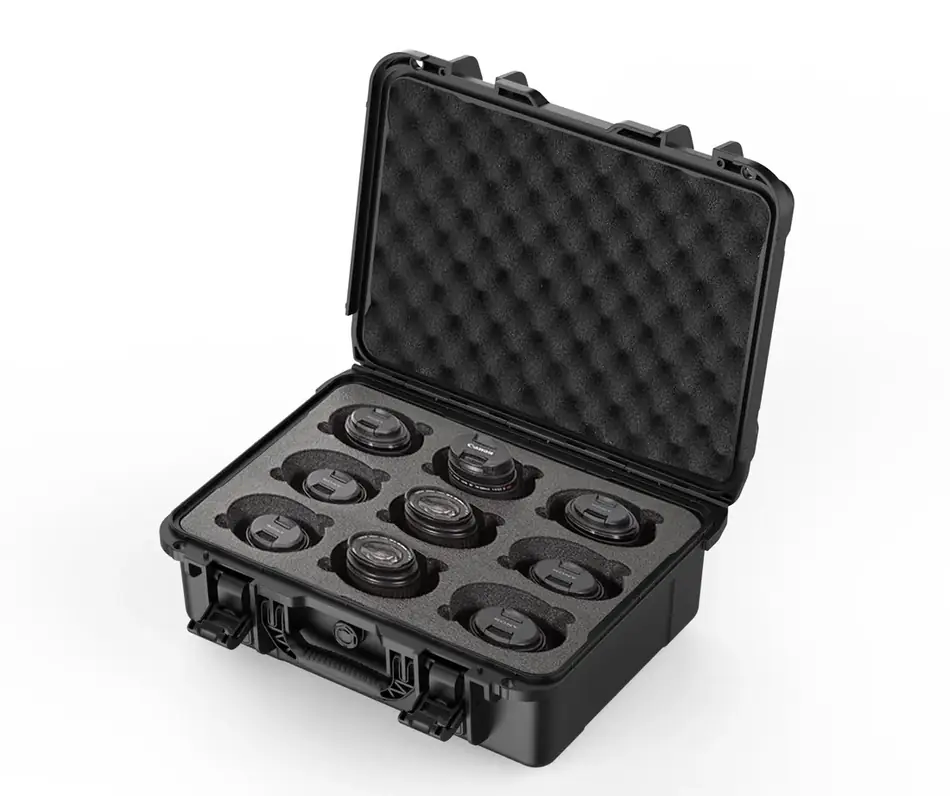
Display Accessories Transport Case?
A Display Accessories Transport Case is chosen in three steps, not one: size the internal envelope on the largest rigid item packed whole, check that item against the published narrow internal width rather than the nominal width, then place the screen in the half of the shell that keeps it below the lid-to-base split line. Our library holds 155 moulded shells with internal lengths from 115 mm to 1280 mm, internal widths from 78 mm to 545 mm and internal depths from 32 mm to 364 mm. A 15.6 inch portable monitor packed at about 360 x 230 mm does not clear KX 3607 at 355 x 280 x 60 mm, clears KX 4010 at 390 x 315 x 88 mm comfortably, and clears KX 4312 at 420 x 260 x 104 mm by only 6 mm at that model's published narrow internal width of 236 mm. A 24 inch panel with the stand detached usually measures about 540 mm across, which KX 8-6224 misses by 2 mm at 538 mm internal and KX 8-7323 clears at 650 mm. On performance we publish geometry, not results: no model in the library lists an ingress code, a free-fall height, a temperature range, a stack load or an electrostatic shielding figure, so a tender that names one of those needs testing on the exact shell, gasket and latch build being ordered, quoted as a separate work package.
Key points
- Size on the largest rigid item packed whole, then re-check it against the narrow internal width: 36 of the 155 shells publish one, and it sits 8 mm to 37 mm below the nominal width.
- On the 100 models that publish both halves, lid depth plus base depth equals the internal depth exactly, so you can read where a screen sits relative to the closure line straight off the datasheet.
- A compressible gasket is recorded on 124 of the 155 shells and 31 record none; that is a construction field, and no model publishes a water or dust result.
- Export carton dimensions are published on 64 models and pieces per carton on 58, with counts from 1 to 40, so freight is quoted from the carton rather than from case volume.
- 136 shells record stackable and the 19 that do not are exactly the 19 that publish wheels and a telescopic handle, which is what changes a pallet plan.
- Custom foam starts at 1 unit and needs a drawing, a photograph of the packed kit or a sample; logo, colour and OEM hardware start at 300 units and a new mould at 3,000 per component.
Display Accessories Transport Case: What The Search Phrase Actually Covers
A Display Accessories Transport Case is a buyer phrase rather than a product family, and it bundles four different packing problems. The first is the screen itself: a portable or field monitor, a camera top unit, a small confidence display or a calibration reference panel. All of them are thin, rigid, glass-faced, and damaged at an edge or a connector rather than in the middle of the face. The second is the accessory set that travels with it: power adapters, HDMI, DisplayPort, SDI and USB leads, converters, splitters, a wireless video receiver, a touch pen and a pouch of screws. The third is the metal that holds a screen up: desk arms, gas-spring mounts, VESA plates, quick-release brackets, clamps and stands, which are heavy, hard and full of machined edges. The fourth is larger format: a signage panel, a conference display or a broadcast reference monitor that two people lift. Each of those four wants a different internal envelope, a different lid-to-base split and a different foam layout, which is exactly why a single case size cannot answer the search.
Our library holds 155 moulded shells with published internal dimensions, and internal length runs from 115 mm to 1280 mm, internal width from 78 mm to 545 mm and internal depth from 32 mm to 364 mm. That spread is the reason the phrase is worth answering properly. A 15.6 inch portable monitor is a shallow-load problem that KX 3607 almost solves and KX 4010 solves outright, while a 24 inch panel with its stand detached is a length problem that several mid-size shells miss by a few millimetres. The sections below work through the published numbers, the two datasheet fields that trip display buyers up most often, and the interior layout that keeps a glass face away from the weight of a metal mount.
What this page deliberately does not do is convert a category name into a performance statement. A shell is a moulded polypropylene or ABS enclosure with a gasket land, latches, a hinge and a fixed handle, and we publish the geometry of each one. Screen fragility is answered by the foam layout and by where the item sits relative to the closure line, which is why most of the space here goes to those two things rather than to adjectives.
Published Internal Envelopes For Display Accessory Kits
The table lists thirteen shells that a display or AV accessory kit is commonly built around, using the figures exactly as published in our product database. Where a field is blank in the source data this table says not published rather than estimating it from a neighbouring size, because the two fields that matter most for flat loads - the narrow internal width and the lid and base split - are recorded per moulding and cannot be inferred from a series name. Use the rows as an envelope shortlist, then confirm against your own packed dimensions before the foam is cut.
| Model | Internal Mm | Narrow Internal Width Mm | Lid Plus Base Mm | Wall Mm | Empty Mass G | Gasket Recorded |
|---|---|---|---|---|---|---|
| KX 1204 | 115 x 78 x 32 | 70 | 16 + 16 | 2.6 | 100 | none recorded |
| KX 3508 | 344 x 268 x 72 | 240 | 36 + 36 | 3.0 | 995 | compressible gasket |
| KX 4010 | 390 x 315 x 88 | 282 | 44 + 44 | 3.0 | 1015 | compressible gasket |
| KX 4312 | 420 x 260 x 104 | 236 | 52 + 52 | 3.5 | 1170 | compressible gasket |
| KX 4610 | 455 x 338 x 84 | 302 | 42 + 42 | 3.0 | 1115 | compressible gasket |
| KX 4616 | 455 x 338 x 148 | 302 | 74 + 74 | 3.0 | 1395 | compressible gasket |
| KX 4710 | 458 x 345 x 90 | 308 | 45 + 45 | 2.5 | 1370 | none recorded |
| KX 6-4112 | 393 x 280 x 112 | not published | not published | 3.8 | 1820 | compressible gasket |
| KX 6-5522 | 507 x 385 x 190 | not published | not published | 5.3 | 4860 | compressible gasket |
| KX 8-6224 | 538 x 408 x 220 | not published | 175 + 45 | 5.0 | not published | compressible gasket |
| KX 8-7323 | 650 x 430 x 210 | not published | 160 + 50 | 5.0 | not published | compressible gasket |
| KX 8-5022 | 437 x 308 x 180 | not published | not published | 4.5 | 5012 | compressible gasket |
| KX 9-6127 | 545 x 545 x 210 | not published | 165 + 45 | 4.8 | 8540 | compressible gasket |
| KX 8-8434 | 740 x 518 x 284 | not published | 240 + 44 | 5.0 | 14030 | compressible gasket |
The Two Datasheet Fields That Decide A Flat Load
The first is the narrow internal width. Internal width is measured at the widest point of the base moulding, but most shells are not the same width all the way down: latch bosses, hinge knuckles, rib runs and the draft angle on a wall reduce the passage somewhere along the path an item travels when you slide it in. We publish a narrow internal width on 36 of the 155 shells, and the gap between the nominal and the narrow figure runs from 8 mm to 37 mm. On the shallow display-class shells it is at the top of that range: KX 4710, KX 4713 and KX 4716 all list 345 mm nominal against 308 mm narrow, and KX 4610 and KX 4616 list 338 mm against 302 mm. A buyer who sizes a 330 mm tray against the nominal 338 mm number on KX 4610 has bought a lid that will not close.
The worked example that matters most for portable monitors is KX 4312. Its internal envelope is 420 x 260 x 104 mm and its narrow internal width is 236 mm. A 15.6 inch panel packed at roughly 360 x 230 mm clears the length by 60 mm and the nominal width by 30 mm, which looks generous until you read the narrow figure: 6 mm of total clearance across the width, which is 3 mm per side. That is enough for a foam wall on one axis and not enough on the other, so the panel must be offered to the cavity along its length rather than pressed in sideways. KX 4010, at 390 x 315 x 88 mm with a narrow width of 282 mm, is the safer shell for the same panel because the width margin survives the narrow point.
The second field is the depth split. On the 100 models where we publish both halves, lid depth plus base depth equals the internal depth exactly, so you can read the closure line straight off the datasheet. Most shells are lid-heavy: KX 8-4821 lists 150 mm of lid over 40 mm of base, KX 8-5823 lists 165 over 45, KX 8-6224 lists 175 over 45 and KX 8-8434 lists 240 over 44. A few are the opposite, and those are the ones a flat panel prefers: KX 5321 and KX 6621 both list 43 mm of lid over 149 mm of base, and KX 9-7227 lists 42 over 168. With a deep base the panel lies below the split line, the closure joint passes above it, and nothing in the lid can bear on the glass when the latches are pulled down.
Shell Material And Wall Thickness, Read Correctly
Of the 155 shells, 94 publish a polypropylene shell, 38 an engineering-grade polypropylene, 22 ABS and one a polypropylene and ABS combination. Wall thickness is recorded on 148 models and runs from 2.0 mm to 6.0 mm. Those two fields are useful for comparing mouldings: a thicker wall and an ABS shell generally mean a stiffer rim, which matters when a case is going to be lifted by its handle with a metal mount inside it. What they do not do is predict an outcome. A wall thickness is a moulding dimension, not an impact result, and our own product records say so in the field notes - a wall figure is published with no free-fall height attached to it.
Empty mass is published on 93 of the 155 models and ranges from 100 g on KX 1204 to 15,320 g on the largest rolling shell. For a display kit the mass figure earns its place in a specification because it adds to the packed weight on every carry: KX 4010 at 1,015 g empty is a bag-of-panels case you will happily walk to a car, while KX 9-6127 at 8,540 g empty is a wheeled case before you put anything in it. All 155 shells publish a fixed handle; 19 also publish a telescopic handle and two wheels, and those same 19 are the only shells recorded as non-stackable.
Foam Layout For A Screen: Face, Edge, Connector And Stand
A display panel breaks at an edge or at a connector, almost never in the middle of a face. That single fact drives the whole interior layout. The face needs a smooth, flat bearing over its full area - a sheet of foam with a skin, not an egg-crate surface that prints into a touch layer over time. The edges need support along their length rather than at the four corners, because corner-only support lets the middle of an edge span a void and take the load when something is stacked on the lid. The connector edge needs a relieved pocket so a plugged-in cable cannot transmit a bend into an HDMI or SDI socket, and the stand or yoke should come off and travel in its own pocket rather than under the panel.
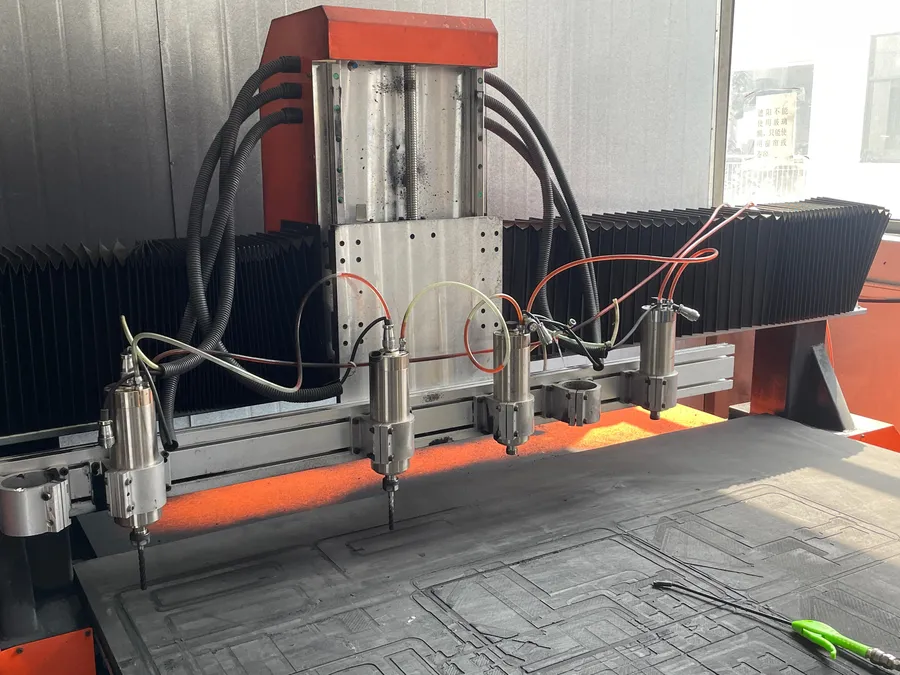
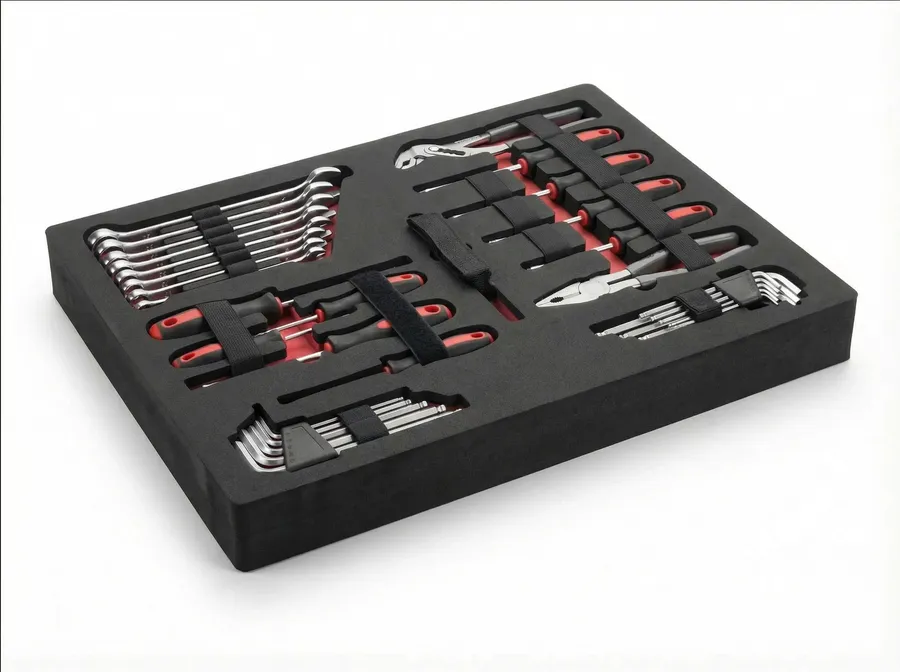
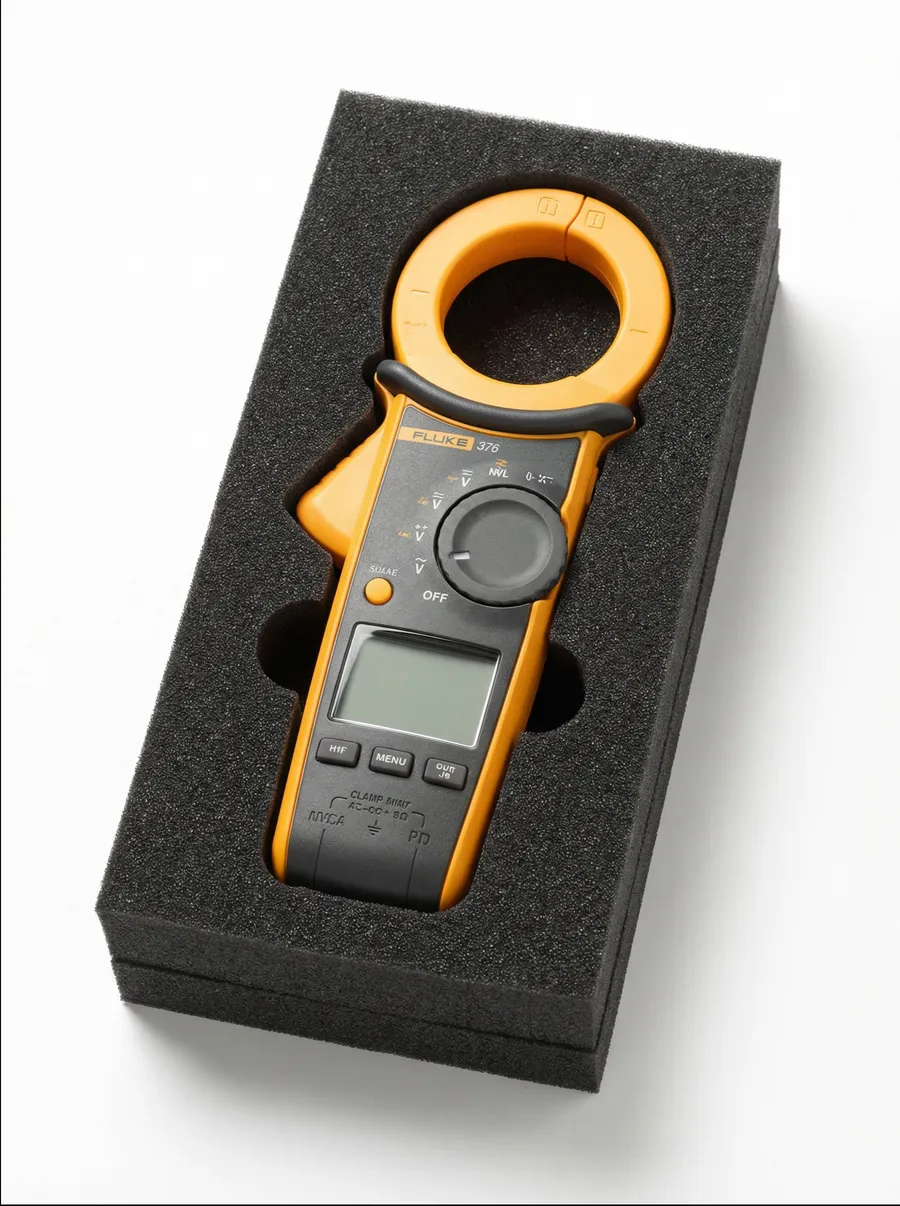
In practice we build display kit interiors as layers rather than as one deep hole. The base carries a routed well for the panel with a firm floor and a foam wall on all four edges; a lift-out tray sits above it for adapters, leads and the mount hardware, so the mass of the metal is carried by the tray and never by the panel; and the lid face takes a protective sheet plus the light, soft items such as microfibre, pens and a calibration cap. Our published foam options are pick and pluck, die-cut and CNC-cut in PE, EVA or EPE, with top foam, base foam, egg-crate or convoluted faces, layered builds or a custom cut by zone. For a screen we specify a plain faced skin against the glass and keep the convoluted face for the tray side.
Add allowance before you compare a panel size to an internal size. The working rule we use on this class of kit is about 20 mm per axis for the foam wall, the gasket land and the moulding draft, and it should be applied twice across the width so that both edges get a wall. On a 360 x 230 x 12 mm packed panel that means a target envelope of roughly 400 x 275 x 55 mm before you look at any narrow-width or closure-line constraint. Applying that target to the table above lands you on KX 4010, KX 4312 with the width caveat, KX 4610, or two panels stacked in KX 4616 at 455 x 338 x 148 mm.
Cables, Adapters, Power Supplies And Small Parts
The accessory load is where a display case either works for years or gets abandoned. Power bricks are dense and have pins; converters are small hard boxes; leads coil into a spring that pushes everything away from it; a touch pen is long, thin and snaps. The layout that survives is one pocket per item with the item's own shape, cables coiled to a fixed radius in a routed channel rather than a loose loop, adapters in individual cells so their metal bodies cannot rattle against each other or against the panel edge, and a small parts pocket with a lip so screws and VESA hardware cannot migrate to the panel face when the case is turned over.
For the smallest items it is often better to pack a second shell than to build one large one. KX 1204 at 115 x 78 x 32 mm internal, 100 g empty and with a narrow internal width of 70 mm takes a probe kit, a set of adapters and a pen, and it travels inside the lid tray of a KX 4010 or a KX 6-4112 without disturbing the panel layout. This costs one more shell and saves the panel: the failure mode it removes is a loose adapter standing on end under a foam lid and pressing a point load into a glass face every time the case is lifted.
Mounting Hardware And The Mixed-Load Problem
Gas-spring desk arms, VESA brackets, clamp bases and quick-release plates are the reason a display kit is heavy rather than bulky. Metal has a small volume and a high density, which means two things for a case: it needs a floor that will not deflect locally, and it must not sit above the screen. In a mixed kit we therefore split by mass rather than by size - mount hardware in the base in a routed well or in a rigid tray, panel in its own well, and the light items in the lid face. Where a single shell has to carry both, a deep-base moulding such as KX 8-4821 at 410 x 360 x 190 mm with a 40 mm base and 150 mm lid is the wrong direction; KX 5321 at 481 x 373 x 192 mm with 43 mm lid and 149 mm base puts the mass where the mass belongs.
The other mixed-load risk is a case that is closed over something proud. A clamp handle, a ball head or a folded arm leg that stands above the rim line is what bends a latch or holds a lid off its gasket land. Before the foam is cut we ask for the packed dimensions of the heaviest metal item in the kit as well as the panel, and we set that item's height against the base depth plus a margin, not against the total internal depth. It is a slower brief and it is the difference between a case that latches cleanly for five years and one that never quite seals after the first quarter.
Display Case Configurations Compared
The rows below are configurations rather than products: each is a way of combining a published shell with an interior and a carrying method. The published-data column states what can be quoted from the library today, and anything the library does not hold is described as quoted for the order instead of estimated from a similar model.
| Configuration | Example Envelope | What It Carries | Carrying | Published Data Note |
|---|---|---|---|---|
| Single field monitor shell | KX 4010 at 390 x 315 x 88 mm | One 15 to 17 inch portable monitor, one adapter, two leads, a pen | Fixed handle, hand carry | Narrow width 282 mm, gasket recorded, 10 per carton |
| Monitor plus full accessory tray | KX 4616 at 455 x 338 x 148 mm | Panel in the base well, lift-out tray of adapters and leads above | Fixed handle, hand carry | Depth split 74 + 74 mm, narrow width 302 mm |
| Dual monitor or two-up kit | KX 6-5522 at 507 x 385 x 190 mm | Two panels face to face with a skin between, plus mounts | Fixed handle, two-person for a loaded case | Wall 5.3 mm, empty mass 4,860 g, 3 per carton |
| Twenty-four inch class conference display | KX 8-7323 at 650 x 430 x 210 mm | Panel with the stand detached, plus a bar of small parts | Fixed handle, shallow 50 mm base and 160 mm lid | KX 8-6224 at 538 mm internal is 2 mm short of a 540 mm panel |
| Large format or signage panel | KX 8-8434 at 740 x 518 x 284 mm | Big-format panel, arms and a full cable set | Two wheels and a telescopic handle, 14,030 g empty | Recorded as non-stackable because it publishes wheels |
| Square rolling AV case | KX 9-6127 at 545 x 545 x 210 mm | Two panels packed side by side, or one panel with a mount | Wheels and telescopic handle, 1 per carton | Depth split 165 + 45 mm, wall 4.8 mm |
| Small parts and calibration shell | KX 1204 at 115 x 78 x 32 mm | Probe, adapters, pens, screws, filters | Travels inside a larger lid tray | 100 g empty, narrow width 70 mm, no gasket recorded |
Choosing By Duty Cycle And Route
For a kit that stays on a desk and travels occasionally, a shallow stock shell with a die-cut or CNC-cut interior is the whole answer. KX 3508 at 344 x 268 x 72 mm, KX 4010 at 390 x 315 x 88 mm and KX 4312 at 420 x 260 x 104 mm cover the single-monitor range, all three record a compressible gasket, all three are recorded stackable, and all three publish an export carton of 615 to 730 mm on the long side, which means they palletise predictably.
For a kit that travels daily - a rental panel, an outside-broadcast monitor, a survey display that goes out on a van - the choice moves on carrying method first and shell size second. KX 8-5022 at 437 x 308 x 180 mm internal publishes wheels, a telescopic handle and 5,012 g of empty mass, and it ships one per 495 x 375 x 245 mm carton. KX 8-8434 at 740 x 518 x 284 mm and 14,030 g empty is the version of the same decision for a large panel. Both are recorded as non-stackable, which is not a fault but a handling instruction: they are the bottom of a stack or standing on their wheels, not in the middle.
For a bulk order going to dealers or to a hire fleet, the number that decides the landed cost is not the unit price but the pieces per carton. Our library publishes export carton dimensions on 64 models and pieces per carton on 58, and the counts run from 1 to 40. KX 3508 ships 20 per 730 x 615 x 428 mm carton, KX 4010 ships 10 per 710 x 410 x 500 mm, KX 4312 ships 10 per 615 x 440 x 560 mm, KX 6-4112 ships 10 per 705 x 430 x 650 mm, KX 6-5522 ships 3 per 565 x 450 x 665 mm, and KX 9-6127 ships one per 640 x 625 x 280 mm. Comparing a 10-per-carton shell with a 3-per-carton shell on unit price alone compares two different freight costs.
We do not publish a pallet-loading quantity for any model, and we do not publish a container figure. A pallet plan is built for the order from the recorded carton footprint against your pallet size, and 20 GP, 40 GP and 40 HQ loadings are supplied with the quotation rather than copied off a page. If a shell has no carton recorded in the library, that carton is quoted for the order instead of being estimated from a neighbouring size.
What We Publish And What We Do Not
This section is the reason a display buyer should read the specification twice. Across all 155 models we publish geometry, materials, hardware options, the gasket field and the packing fields. We publish no ingress code, no water or dust test result, no free-fall height, no impact figure, no temperature range, no ultraviolet figure, no stack load, no load capacity and no electrostatic shielding or discharge figure for any shell. The protection records in our own database carry the note that no ingress code is stated and that accredited testing can be quoted per configuration; a gasket field, a wall thickness and a stackable flag are construction facts and none of them turns into a test result.
The gasket number needs the same careful reading, because it is the field most often misquoted by resellers. A compressible gasket seated in a continuous moulded channel is recorded on 124 of the 155 shells, and 31 shells record none - KX 3308, KX 4710, KX 4713, KX 4716, KX 9-5419 and KX 1204 are among the shells that do not carry one. That tells you whether a gasket is part of the build. It does not tell you what the shell would do in water or in dust, and it is not a rating. A pressure-equalisation valve is likewise a configuration option rather than a standard fitting.
We also publish no customer names, no order volumes and no delivery references, and we make no claim about where our shells rank against anyone else's. Where a figure is missing from the library, this page says so rather than filling the gap with an industry typical value. If a tender or an insurance schedule names a standard or a test level, send us the exact standard, the exact shell and the exact gasket and latch build, and we will tell you whether accredited third-party testing can be arranged and quote it as a separate work package with its own lead time.
Customisation, MOQ And Lead Times
Interior work is the fast path and needs no new tooling. We cut foam to a layout, add lift-out trays, pluck tops, plain-face skins and routed cable channels, and configure latches, a padlock provision in the latch body, a pressure-equalisation valve, a document holder and a shoulder strap on a standard shell. Minimum order on a stock shell and on a custom foam cut is 1 unit. Custom colour, custom logo and OEM hardware start at 300 units, and OEM work on an existing mould is quoted at 45 days from first sample.
A new moulded exterior - a shell sized exactly to one panel and one mount, with the closure line placed where that panel needs it - starts at 3,000 units per moulded component and 125 days. That is the right route only when no published envelope clears the equipment, and for display kit that is rare: with internal lengths from 115 mm to 1280 mm and internal depths from 32 mm to 364 mm already in the library, most display accessory problems are a foam problem rather than a tooling problem. For private-label programmes, logo, colour, packaging and an OEM hardware set are available from the same 300-unit level.
To brief a display kit we need the packed dimensions and mass of the panel, the packed dimensions of the heaviest metal item, a list of connectors that stay plugged in, the number of units in the first order and in a year, the carrying method, and whether the units ship in individual cartons or in a master carton. With those inputs we can name an envelope, tell you whether its narrow width clears the panel, say where the closure line falls, and quote on EXW or FOB terms.
Procurement Notes Before Ordering
KeXin New Materials (Guangdong) Co., Ltd. supplies wholesale, OEM and ODM buyers only. Quotations are issued on EXW or FOB terms. There is no retail channel, no delivered-duty-paid quotation and no overseas warehouse stock, so a landed cost is built from the FOB figure plus your own freight and clearance. Payment is a 30 per cent deposit with the balance settled after inspection and before shipment, and third-party factory audits are welcome on appointment. Carton dimensions and pieces per carton accompany the quotation for the models where they are recorded; pallet plans and container loadings are calculated for the order.
Contact Fred Zhao or the KeXin Sales Team, WhatsApp +86 135 3588 0002. Send the panel drawing or a photograph of the packed kit and we will come back with a named envelope, a narrow-width check against your dimension, a proposed depth split, a foam layout and a price. For a fleet order the three answers that move the quotation most are the annual quantity, whether the kit includes metal mount hardware, and whether the units are hand-carried or wheeled - those three decide shell size, interior layering and whether you should be looking at one of the 19 shells that publish wheels.
Customisation
Everything described above is configurable on a standard shell: interior layout (pick-and-pluck, die-cut or CNC-cut), foam grade and thickness, colour, logo method, latch and lock count, pressure-equalisation valve, cable ports, document holder and identification plate. A bespoke exterior geometry requires a new mould — 125 days, from 3,000 units per moulded component.
Procurement considerations
| Question | What to send us |
|---|---|
| Which shell fits? | Equipment L × W × H as packed, plus required clearance per axis |
| What does it cost? | Order quantity and estimated annual quantity — the two drive different answers |
| Is tooling needed? | Whether an existing shell clears the envelope with usable foam depth |
| Lead time? | Your required delivery date, not just the order date |
| Certification? | The exact standard your tender names — we will say whether we can test to it |
| Freight? | Destination and preferred terms; carton and pallet data supplied with the quotation |
Comparison and selection guide
The tables on this page exist because a protective case is chosen by comparing three things: the envelope, the environment and the handling chain. Where no table applies, the rule below is.
| Situation | What To Do |
|---|---|
| Changing kits | Layered pluck foam, rebuilt by hand. |
| Fixed rental fleet | CNC silhouette with serial pockets and an inventory list. |
| Harsh locations | Sealed shell plus desiccant provision in the lid. |
- Size on internal dimensions plus clearance, never on a product name.
- Choose the carrying method before the shell: it changes the series, not just the price.
- Specify the interior last, and decide up front whether the end user will reconfigure it.
Display Accessories Transport Case? relates to Protective Case Basics. Related families: Camera & Photography Cases / Electronics Cases / Equipment Transport Cases / Custom Protective Cases / Rolling Cases. Related sectors: field and industrial equipment. Continue in the Protective Case Basics cluster.
This page is written from our own production data. If your requirement differs, send the dimensions and we will tell you which of the 155 models fits, or whether a custom route is needed.