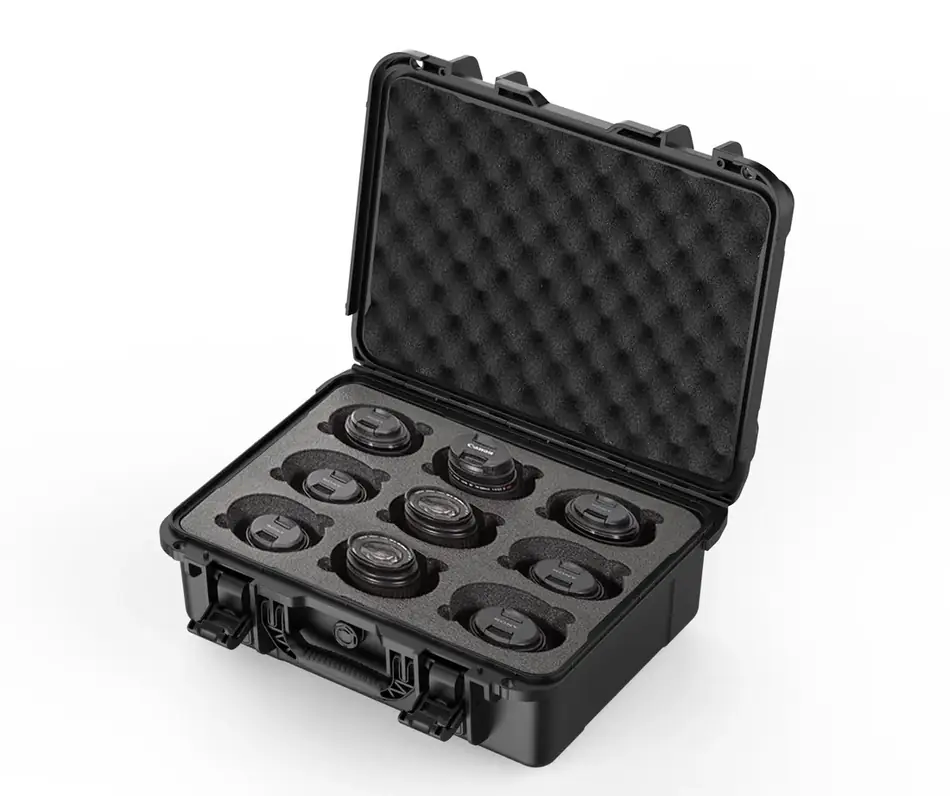
Cinema 8K Camera Protective Flight Case Alternative?
Short answer: yes, a moulded thermoplastic case can replace a flight case for a cinema 8K package when the built camera fits a published internal envelope and the route is a van, a carry or a checked-bag trip rather than an air-cargo movement that names a construction standard in its paperwork. The decision is made on published figures, not on the word flight: internal length, width and height, the lid-over-base split, wall thickness and empty mass. KX 8-6216 publishes 582 x 300 x 130 mm internal, 22.7 litres with 19.5 usable, a 3.3 mm wall and a 100 mm lid over a 30 mm base, which suits a long, low build such as a body on a bridge plate with a matte box. KX 8-5827 publishes 500 x 400 x 220 mm, 44.0 litres with 35.2 usable, a 5.0 mm wall and 7,800 g empty, for a taller rig. KX 8-6127 goes to 530 x 360 x 248 mm and 47.3 litres, KX 9-6027 is the wheeled option at 502 x 337 x 214 mm and 6,110 g, KX 8-4430 gives 275 mm of internal height, and KX 6621 carries 587 x 434 x 192 mm in engineering PP at a 6.0 mm wall and 6,420 g. What none of them publishes is an ingress code, a free-fall height, a temperature range or a stack load, so a tender that names one of those needs a test on the exact build.
Key points
- A flight case and a moulded case are different constructions, not two grades of one product: compare published envelope, wall, empty mass and carton before either word decides the order.
- Size the shell on the built rig, not the bare body: KX 8-6216 gives 130 mm of internal height, KX 8-5827 gives 220 mm, KX 8-6127 gives 248 mm and KX 8-4430 gives 275 mm.
- Empty mass is published per model, so the comparison can be made: 6,110 g for wheeled KX 9-6027, 6,420 g for KX 6621 and 7,800 g for KX 8-5827, set against the flight-case figure you were quoted.
- Wheels and stacking compete for the same face: KX 9-6027 records wheels, a telescopic handle and a non-stackable shell, while the fixed cases in the same table record stackable.
- No ingress code, free-fall height, temperature range, ultraviolet exposure or stack load is published for any model, so a tender that names one of those needs accredited testing on that exact build.
- Custom colour, logo and OEM hardware start at 300 units, an OEM sample on an existing mould at 45 days, and a new moulded exterior at 3,000 units per moulded component and 125 days.
What A Cinema 8K Package Actually Asks Of A Case
A cinema 8K package is not a camera in a box. It is a body on a baseplate or bridge plate, a lens and matte box that the crew may refuse to strip on location, a monitor on an arm, a battery plate with two bricks, a follow-focus, a top handle and often a cage carrying a wireless transmitter. Before any case is quoted, lay that assembly out as it travels and measure three things: the footprint, the tallest standing item, and the height of anything that stays fitted because removing it would cost a recalibration. The case then has one job at the top of the list, which is to hold that volume without putting load through the lens mount, the monitor arm or a connector, and to let one person move it between a van and a set.
A flight case and a moulded case answer that brief with different construction. A flight case is fabricated from panels around a stated internal volume: skins, aluminium extrusions, steel corners, a lid that may be shallow or deep, and foam cut to the contents. It can be built to any size because it is assembled rather than moulded. A moulded shell is a fixed tool. Its internal envelope, wall, lid split, latch positions and hardware come from one mould, and every one of those figures is published per model in our library. That is the whole trade: the fabricated case buys size freedom, and the moulded case buys a repeatable unit with numbers attached.
The practical consequence is easy to state. A flight case is the right answer when the object falls outside every published mould, when a purchase document names a construction standard that the supplier can demonstrate, or when the case is a one-off for a single production. A moulded case is the right answer when the built kit fits one of the 155 published envelopes, when the buyer wants the same unit repeated across a fleet, and when carton dimensions and pieces per carton matter as much as the case itself. The question in the title is therefore not whether moulded plastic is better than a flight case in general. It is whether your packed camera fits a published envelope, and whether the evidence you need can be produced for that envelope.
Flight Case Versus Moulded Case: Four Differences That Decide The Order
Weight is the first number a crew feels, and it is the easiest to compare honestly. We publish empty mass for 93 of the 155 shells. KX 8-5827 records 7,800 g, KX 9-6027 records 6,110 g with wheels and a telescopic handle, KX 6621 records 6,420 g, KX 8-6216 records nothing in that field, and the ABS KX 6-5522 records 4,860 g. A fabricated case of similar internal volume has its own mass, which depends on skin, frame and hardware. Put both quoted weights on one sheet and add the foam, because a deep foam build can add more than the difference between two shells.
Repairability is the second difference. A fabricated case can be re-skinned, re-cornered and re-foamed in a workshop, and a damaged panel can be replaced without replacing the box. A moulded shell is replaced as a unit. Its latches, hinges, wheels and pressure-equalisation valve are replaceable parts, but a cracked shell is not repaired in the field. For a rental house that is a stock decision rather than a technical one: one spare shell per ten in service is simpler to plan than a repair bench, and it keeps the foam layout identical across the fleet.
Size freedom is the third. A new moulded exterior starts at 3,000 units per moulded component and 125 days, while OEM work on an approved existing mould is quoted at 45 days from first sample. A fabricated case can be built to a drawing in small numbers, which matters when a camera build changes every season. If the change is in the rig rather than the shell, a new foam layout on a standard mould is faster and cheaper than a new box: the shell stays, the interior changes, and the published envelope remains the same.
Evidence is the fourth, and it is where buyers most often compare the wrong things. We publish dimensions, wall thickness, empty mass, internal and usable volume, carton data where it exists, and a seal field. We do not publish an ingress code, a free-fall result, a temperature range, an ultraviolet figure or a stack load for any model. A fabricated-case supplier may offer a different document set. Match the evidence your tender actually requires to the supplier who can produce it, and do not treat the words flight case as proof that any particular result exists.
Published Envelopes That Suit A Built Cinema Camera
The table is a specification extract, not a ranking. Every figure belongs to the named model and to nothing else; a dash means the field holds no published value for that model, and it is not a typical figure borrowed from a neighbour. Read the internal height first, then the lid-over-base split, then the empty mass, because those three decide whether a built camera can stay assembled and whether one person can lift the result. The usable volume is lower than the theoretical volume on every row because it accounts for radius, seal channel and hardware.
| Model | Internal Mm | Litres | Wall Mm | Empty Weight | Lid Base Mm | Wheels | Carton |
|---|---|---|---|---|---|---|---|
| KX 8-6216 | 582 x 300 x 130 | 22.7 (19.5 usable) | 3.3 | not published | 100 / 30 | no | not published |
| KX 8-5827 | 500 x 400 x 220 | 44.0 (35.2 usable) | 5.0 | 7,800 g | 175 / 45 | no | not published |
| KX 8-6127 | 530 x 360 x 248 | 47.3 (37.8 usable) | 5.0 | not published | 200 / 48 | no | not published |
| KX 9-6027 | 502 x 337 x 214 | 36.2 (29.0 usable) | 5.0 | 6,110 g | 170 / 44 | yes, telescopic handle | 580 x 250 x 415, 1 pc |
| KX 6621 | 587 x 434 x 192 | 48.9 (39.1 usable) | 6.0 | 6,420 g | 43 / 149 | no | 665 x 500 x 650, 3 pcs |
| KX 6-5522 | 507 x 385 x 190 | 37.1 (29.7 usable) | 5.3 ABS | 4,860 g | not published | no | 565 x 450 x 665, 3 pcs |
| KX 8-4430 | 395 x 295 x 275 | 32.0 (25.6 usable) | 4.2 | not published | 230 / 45 | no | not published |
| KX 8-7926 | 737 x 257 x 240 | 45.5 (36.4 usable) | 4.0 | not published | 175 / 65 | no | not published |
Which Envelope Fits Which Build
A camera body alone is the easy case. If the body travels stripped, with the lens off and the monitor folded, a mid-size shell is enough and the decision moves to accessories: KX 8-4816 at 410 x 360 x 140 mm internal, KX 8-4430 at 395 x 295 x 275 mm, or the long KX 8-6216. The moment the matte box, monitor arm or bridge plate stays fitted, height becomes the binding constraint, and the short list changes to KX 8-5827 at 220 mm, KX 8-6127 at 248 mm, KX 8-4430 at 275 mm or KX 8-7926 at 240 mm over a long 737 mm footprint.
The footprint then has to survive the vehicle. KX 8-6216 measures 620 x 360 x 155 mm outside, KX 8-5827 measures 582 x 475 x 231 mm, KX 8-6127 measures 612 x 427 x 268 mm and KX 6621 measures 662 x 495 x 210 mm. A case that clears the camera but not the shelf, the tailgate or the lift is a false economy, so measure the external envelope against the actual transport as carefully as the internal envelope against the camera. Internal dimensions decide whether the kit fits; external dimensions decide whether the case travels the way you planned.
The carrying method should be chosen before the shell, because it changes the series rather than the price. KX 9-6027 publishes wheels, a telescopic handle, 502 x 337 x 214 mm internal and 6,110 g empty, and it is recorded as non-stackable because the wheel housings and handle occupy the face a fixed shell would rest on. The fixed cases in the table record stackable, which matters when a rental fleet is packed into a van or palletised for a tour. A wheeled case earns its extra hardware on a long walk with a heavy build; a fixed case earns its place when several units travel together.
For a fleet order, the carton is part of the decision. KX 6621 ships three per 665 x 500 x 650 mm carton, KX 6-5522 ships three per 565 x 450 x 665 mm carton and KX 9-6027 ships one per 580 x 250 x 415 mm carton. A buyer comparing unit prices without comparing pieces per carton is comparing freight on different bases, because the carton count decides how many units move per pallet and how much void fill sits around each shell.
Foam, Lid Depth And The Working Gap
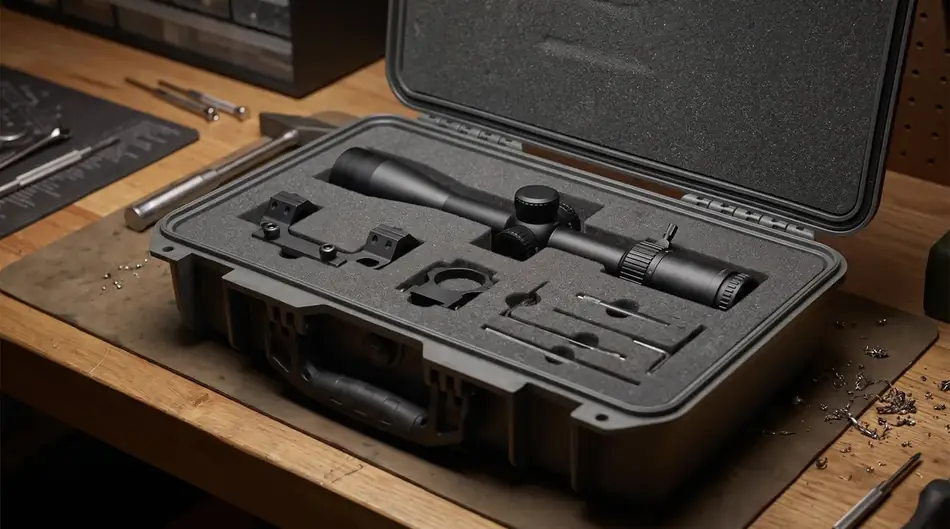
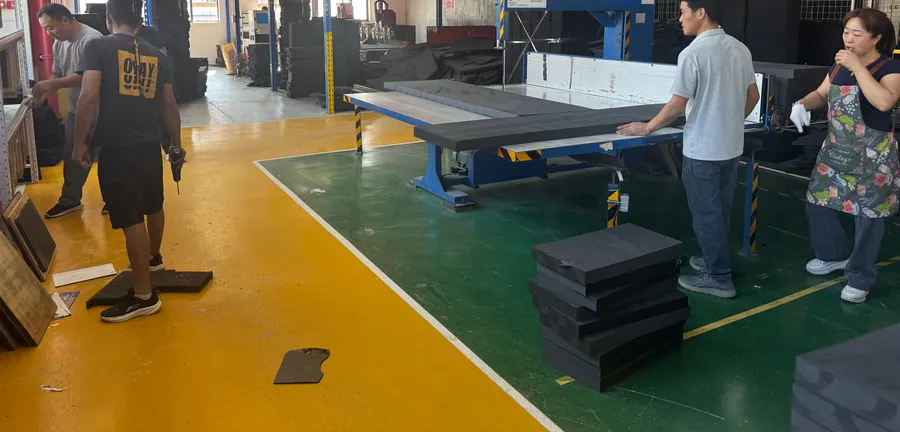
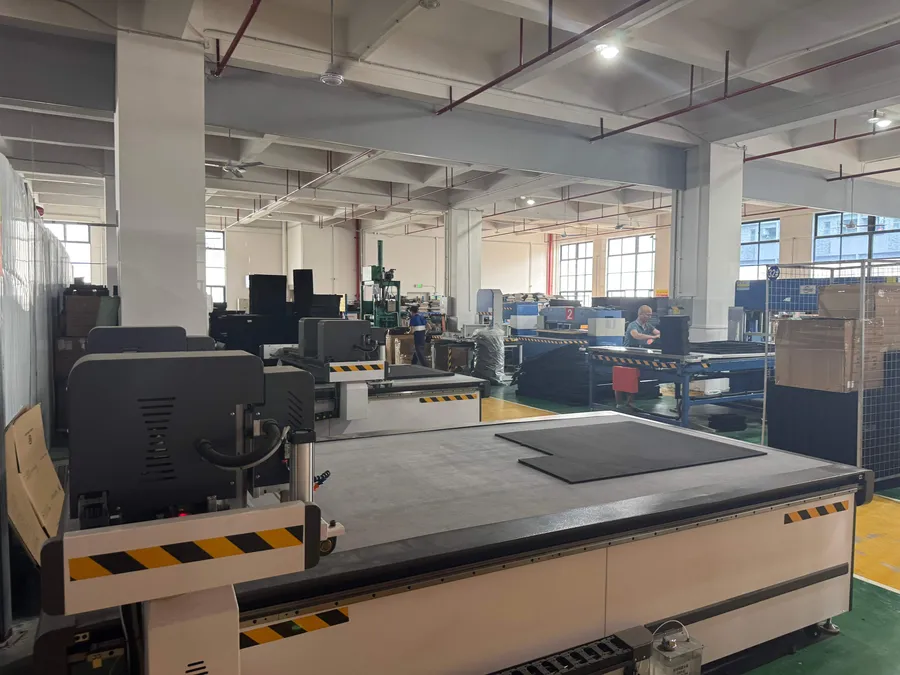
The interior is what makes a case camera-specific, and it is independent of the shell. Our published foam options are pick and pluck, die-cut, CNC-cut, EVA, PE and EPE, arranged as top foam, base foam, egg-crate or convoluted faces, layered builds, or a custom cut in cross-linked PE, EVA or EPS by zone. For a cinema camera the usual build is a firm base plank under the body and battery, relieved pockets for the lens and matte box so nothing presses on the mount, a lid face that touches the top handle without loading it, and routed channels for cables and a transmitter. Add about 20 mm per axis for the foam wall, the gasket land and the draft of the moulding when converting camera dimensions into internal dimensions.
Lid depth deserves its own check because two cases with the same internal height can do completely different jobs. KX 8-6216 puts 100 mm above the split and 30 mm below it, which suits a build whose height is mostly camera and monitor above a thin base. KX 6621 puts 43 mm above and 149 mm below, which suits a heavy body sitting deep in the base with accessories in the lid. KX 8-6127 puts 200 mm above and 48 mm below. If a monitor or an antenna must stay fitted, the lid figure is the one that has to clear it; if the heavy mass should sit low, the base figure is the one that matters.
What foam does not do is create a performance rating we have not measured. The shock field in our datasheet is recorded as a manufacturer option with the note that a specified foam layout is required, because a shell on its own is not a shock rating. We publish no free-fall height and no impact figure for any model. The honest way to buy is to specify the foam layout for the actual rig, then decide whether the route needs a test on that exact shell, gasket, latch and foam build. That test is a separate work package, not a phrase added to a quotation.
Where A Moulded Alternative Works: On Set, In A Van, In A Rental Fleet
For an owner-operator, the case is the camera's only home. A fixed shell with a repeatable foam layout means the camera goes back into the same pocket every night, and a missing accessory shows as an empty shape at the end of the day. KX 8-5827 or KX 8-6127 covers a taller built rig, KX 8-6216 covers a long low rig, and KX 9-6027 covers the same job when the walk from the van is long. The flight-case alternative works here because the route is predictable and the camera build changes rarely.
For a rental house, the unit of purchase is a fleet rather than a case. Identical shells, identical foam, a colour per camera package and a carton that ships three units at a time make the depot operation simpler: KX 6621 at three per carton, KX 6-5522 at three per carton, KX 9-6027 at one per carton. A fabricated case can also be standardised, but the moulded route fixes the envelope and the published data, which is what a rental agreement needs when a client asks what the case will fit.
For a studio or an outside-broadcast unit, several bodies and a long lens may travel together. KX 8-7926 offers 737 x 257 x 240 mm internal for a long assembly, KX 8-9616 offers 880 x 350 x 140 mm for a long, low item, and KX 8-7319 offers 650 x 430 x 170 mm. None of these publishes a stack load, so a truck pack should be planned on the shell geometry and the load path rather than on an assumed stacking capacity. Where several cases ride together, the fixed shells stack and the wheeled shell travels on its wheels.
For air travel, the case is only one part of the decision. We publish no air-cargo approval and no pressure or temperature performance for any model, so a buyer must check the carrier's rules and the route's handling chain directly. A moulded shell with a pressure-equalisation valve is a construction option, not an approval. If the production needs a documented air-cargo result, that requirement belongs in the specification before the case is chosen, not after the first trip.
Customisation And The Order Path
Everything beyond the mould is configurable on a standard shell: foam type and thickness, pocket layout, colour, logo method, latch and lock count, a pressure-equalisation valve, cable ports, a document holder and an identification plate. Custom colour, logo and OEM hardware start at 300 units. OEM work on an existing mould is quoted at 45 days from first sample. A change to the exterior geometry needs a new mould, which starts at 3,000 units per moulded component and 125 days. For a camera package, the fast route is almost always a standard shell plus a new foam cut; the slow route is justified only when no published envelope fits.
A useful quotation request carries five things: the packed length, width and height of the camera build; the same three figures for the largest accessory that travels separately; the route and the carrying method; the annual quantity and the first order quantity; and the date the cases are needed on set. Photographs of the packed rig help more than a model name, because two crews pack the same camera differently. With those five inputs we can name a published envelope, say whether the foam can be cut to the layout, and quote on EXW or FOB terms.
KeXin New Materials (Guangdong) Co., Ltd. supplies wholesale, OEM and ODM buyers only, on EXW or FOB terms. There is no retail channel, no delivered-duty-paid quotation and no overseas warehouse stock, so a landed cost is built from the FOB figure plus your own freight and clearance. Payment is a 30 per cent deposit with the balance after inspection before shipment. Those terms apply to a single pallet and to a fleet order alike, which is why the first question is the annual quantity rather than the unit price.
What We Do Not Claim
We do not publish an ingress code, a free-fall height, an impact figure, a temperature range, an ultraviolet exposure figure, a stack load or a load capacity for any of the 155 models. Those fields are recorded as not measured for the model and configuration, and we will not substitute a typical value or a series-wide assumption. If a tender names a standard, tell us the exact standard and the exact build; we will say whether we can test to it and quote accredited third-party testing as a separate work package. That is a slower answer than a phrase in a brochure, but it is the only one that survives an audit.
Wall thickness is not a performance grade. A 5.0 mm wall on KX 8-5827 and a 3.3 mm wall on KX 8-6216 describe two mouldings with different mass, stiffness and internal volume. Neither number tells you what will happen in a fall, at a temperature or under a stack. Treat the wall as one input to the choice, alongside the envelope, the lid split, the empty mass and the foam, and treat any sentence that converts a wall into a guarantee with suspicion.
We also do not publish customer names, order volumes or project references. A case study on this site describes a configuration and the reasoning behind it, not a client's operations. If you need a reference for a tender, ask directly and we will say what can be shared. The same rule applies to images: the photographs on product pages show our own mouldings, and the illustrations marked as renderings are not photographs of a delivered order.
Comparing A Flight-Case Quote With A Moulded-Case Quote
The two quotations are usually written in different languages, which is why they are hard to compare. Put them on one sheet using the rows below. A moulded quote can fill every published row from the model datasheet; a fabricated quote should be asked for the same rows in writing. Where a supplier cannot fill a row, that is information rather than a gap to be smoothed over. The comparison is only meaningful when both sides describe the same packed camera and the same route.
| Line Item | What To Compare |
|---|---|
| Internal envelope | Length, width and height inside the foam, against the packed camera plus about 20 mm per axis |
| Lid and base split | The height above and below the closure line, because that is what a fitted monitor or a deep body meets |
| Empty mass | The shell without foam, then the foam build separately, so the carry weight is not hidden in one number |
| Interior | Foam type, number of layers, pocket method and whether the layout is repeatable for a second unit |
| Hardware | Latch count, hinge type, wheels, handle, padlock provision and pressure-equalisation valve |
| Carton and pallet data | Carton dimensions, pieces per carton and stackability, because they set the freight basis |
| Evidence | The exact test report or standard named in the tender, and whether it covers this shell, gasket and foam build |
| MOQ and lead time | First-order quantity, annual quantity, sample date and production date, not just the order date |
| Terms | EXW or FOB, currency, deposit, inspection point and who arranges freight and clearance |
Applications
This matters most where the case is part of a movement chain rather than shelf packaging. In electronics & instruments and industrial equipment the same shell is specified differently because the handling, the environment and the verification requirement differ.
- Electronics & Instruments — Electronic assemblies rarely fail from a single large impact. They fail from repeated small shoc…
- Industrial Equipment — In an industrial setting the case is a working surface as much as a container, and its interior …
Customisation
Everything described above is configurable on a standard shell: interior layout (pick-and-pluck, die-cut or CNC-cut), foam grade and thickness, colour, logo method, latch and lock count, pressure-equalisation valve, cable ports, document holder and identification plate. A bespoke exterior geometry requires a new mould — 125 days, from 3,000 units per moulded component.
Procurement considerations
| Question | What to send us |
|---|---|
| Which shell fits? | Equipment L × W × H as packed, plus required clearance per axis |
| What does it cost? | Order quantity and estimated annual quantity — the two drive different answers |
| Is tooling needed? | Whether an existing shell clears the envelope with usable foam depth |
| Lead time? | Your required delivery date, not just the order date |
| Certification? | The exact standard your tender names — we will say whether we can test to it |
| Freight? | Destination and preferred terms; carton and pallet data supplied with the quotation |
Comparison and selection guide
The tables on this page exist because a protective case is chosen by comparing three things: the envelope, the environment and the handling chain. Where no table applies, the rule below is.
| Situation | What To Do |
|---|---|
| Changing kits | Layered pluck foam, rebuilt by hand. |
| Fixed rental fleet | CNC silhouette with serial pockets and an inventory list. |
| Harsh locations | Sealed shell plus desiccant provision in the lid. |
- Size on internal dimensions plus clearance, never on a product name.
- Choose the carrying method before the shell: it changes the series, not just the price.
- Specify the interior last, and decide up front whether the end user will reconfigure it.
Cinema 8K Camera Protective Flight Case Alternative? relates to Protective Case Basics. Related families: Camera & Photography Cases / Custom Protective Cases / Equipment Transport Cases / Rolling Cases. Related sectors: Electronics & Instruments / Industrial Equipment. Continue in the Protective Case Basics cluster.
This page is written from our own production data. If your requirement differs, send the dimensions and we will tell you which of the 155 models fits, or whether a custom route is needed.