Protective Cases for Optics, Cameras & Precision Instruments and Medical
Specify these cases device by device, against the published numbers for one named model, and never against a rating word. Blood pressure monitors, defibrillator monitors, portable microscopes, ECG machines and stethoscope or otoscope sets share one shell family - polypropylene, engineering polypropylene or ABS, with a wall published per model between 2.0 and 6.0 millimetres - but they do not share a cavity, a lid-to-base split or a carry format, and the protection an instrument actually feels comes from the cut interior rather than from the moulding. KeXin publishes internal and external dimensions, wall thickness, lid and base depth, usable volume, empty mass, narrow internal width and gasket construction model by model, and leaves an unmeasured field blank. That is why the honest answer to the phrases buyers search is a specification method, not an adjective: no ingress figure, no shock rating, no drop height, no sterilisation or biocompatibility statement and no temperature range is published for any of the 155 models.
Key points
- Start from the device as it travels - cuff coiled, leads wound, battery fitted, objectives screwed in - then read the published cavity.
- Read the lid-to-base split before the volume: a 75 mm lid over a 28 mm base means most of the height opens with the lid.
- Shock behaviour belongs to a specified foam layout with the item immobilised; the shell alone is not a shock rating and we publish none.
- No ingress figure, drop height, sterilisation claim or temperature range is published for any of the 155 models - commission the test instead.
- A stethoscope and otoscope set wants a shallow cavity with a cut plank; a deep case lets short instruments knock each other.
- Carry format follows loaded mass: published empty mass runs from about 100 g to about 15,320 g, and only 19 of 155 models list wheels.
How This Overlap Is Actually Specified
This page sits where two catalogues meet: the optics and precision-instrument world of lenses, objectives, magnifiers and gauges, and the medical world of vital-sign monitors, defibrillator monitors, portable microscopes, ECG machines and examination sets. The overlap is real because the failure is the same - a finished glass surface or a calibrated face meets a hard point, or a dense instrument slides inside a cavity that was never cut for it. Specification runs in a fixed order. First the device as it actually travels, with cuff coiled, leads wound, battery fitted and accessories packed, not the body size from a datasheet photograph. Second the envelope that leaves about twenty millimetres of working clearance on every axis for the cut. Third the published internal length, width and height of a named model, rather than the figure implied by its product name. Fourth the lid and base depth, which decides whether an item sits in the base or bridges the lid line. Fifth the narrow internal width, which binds a rigid tray that clears the wide section, and only then the carry format, chosen from loaded mass and the surface crossed. What does not appear anywhere in that order is a rating word. Of the 155 models we publish, 124 list a compressible gasket set in a continuous moulded channel and none lists an ingress figure, so a gasketed rim is a construction detail you can inspect on the drawing while a waterproof claim is a test you have to commission.
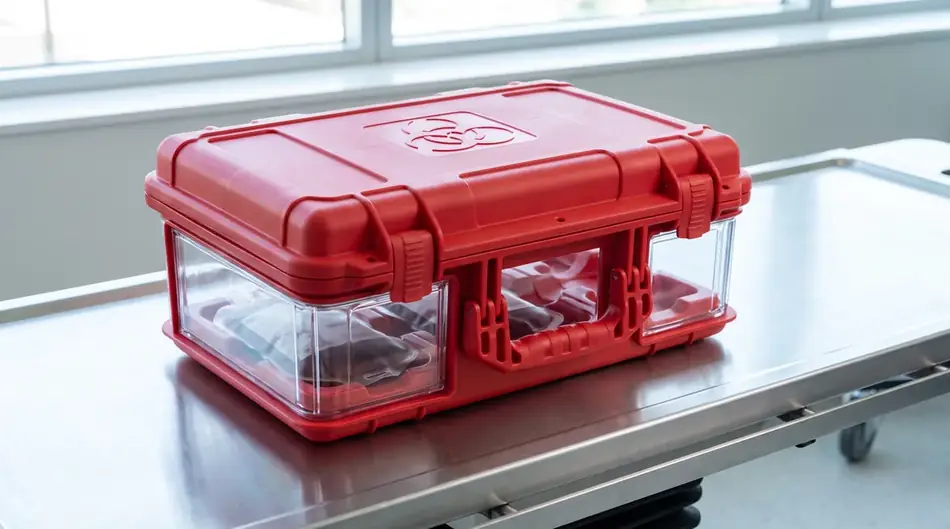
Medical Blood Pressure Monitor Shockproof Case
A blood pressure monitor is a small dense block with a display, a hose stub and a connector panel, and the item that decides the case is usually not the monitor but the cuff. A coiled adult cuff is bulk with no structural role, and if it is stuffed in on top, the lid presses the hose into the housing and the hose presses its own connector. A paediatric cuff, a spare battery, a mains brick and a set of handouts turn a compact device into a mid-sized kit. The layout that works carries the monitor in a cavity that supports it on its chassis with the display relieved, routes the hose in a channel so nothing loads the connector, and gives the cuff a pocket of its own so it cannot drift onto the screen. For one monitor with one cuff the ABS KX-62109 lists 195 by 128 by 81 millimetres internal on a 3.0 millimetre wall at about 470 grams, 1.7 litres of usable volume and a published gasket construction. Where an adult cuff travels coiled beside the unit, the polypropylene KX-83015 gives 245 by 190 by 140 millimetres on a 3.7 millimetre wall with 5.6 litres, and the KX-3114 covers 290 by 220 by 126 millimetres at about 675 grams with 6.9 litres - read its narrow internal width of 200 millimetres against the nominal 220 before a rigid tray or a carrying plate is drawn in. Two cuffs, a charger and a documentation wallet fit the KX-83612 at 330 by 260 by 103 millimetres and 7.6 litres. Whatever the size, the shock-absorbing result belongs to that cut layout and to the mass being restrained; we publish no shock figure for any model, and a loose monitor inside soft foam simply accelerates and strikes the far wall with more energy.
Medical Defibrillator Monitor Portable Hard Case
A defibrillator monitor travels as one job: the unit, pads or paddles, ECG leads, a saturation sensor, a spare battery, printer paper and often a rescue bag that has nowhere else to go. It is opened on a floor, in a corridor and in the back of a vehicle, so the case has to stay put when the lid comes up, keep probes from hanging on their own cables and stop the unit travelling inside its own lining. That last point is where many portable hard cases fail, and the published depth split is what shows it. On the polypropylene KX-83612 the lid depth is 75 millimetres over a base depth of 28 millimetres: the base is a shallow tray, so a monitor sits in the lid half and swings free the moment the case opens unless the layout retains it. For a monitor-defibrillator with pads, leads and a spare battery, the ABS KX-64117 lists 393 by 280 by 156 millimetres on a 3.8 millimetre wall at about 2,100 grams with 14.8 litres, and the polypropylene KX-84113 gives 380 by 267 by 115 millimetres with 10.1 litres for a compact biphasic unit. Where a team moves the same kit between buildings or down a ramp, the engineering-polypropylene KX-85021 adds wheels and a telescopic handle at 437 by 308 by 164 millimetres, about 4,912 grams empty and 17.7 litres. Nothing on this page is a clinical statement: the case is packaging, and the device's own service requirements stay with the manufacturer.
Medical Portable Microscope Protective Briefcase
A microscope is the instrument on this page whose damage is most often self-inflicted inside the case. Objectives unscrew, a binocular head is the tallest point and the worst lever, stage clips bend, and a dust cap left off in the bag turns a clean front lens into a polishing job. Decide the orientation before the size. Upright travel needs a deep base and a stand pocket; side-lying travel needs the head and arm relieved and the body restrained so it cannot roll onto the objectives. A protective briefcase is a hand-carried format, so the honest reading of the catalogue is depth split plus empty mass rather than volume. The engineering-polypropylene KX-92817 lists 253 by 180 by 152 millimetres on a 5.0 millimetre wall with a 125 millimetre lid over a 27 millimetre base at about 940 grams and 5.5 litres, which suits a compact stereo or digital head laid down with its objectives in a plank. A small monocular upright fits the ABS KX-63619 at 333 by 217 by 175 millimetres on a 3.5 millimetre wall, about 1,660 grams and 10.8 litres, and the polypropylene KX-83620 gives 290 by 220 by 185 millimetres with a 135 millimetre lid over a 50 millimetre base where the base has to carry the stand. A full laboratory instrument with slides and immersion oil travels in the KX-84430 at 395 by 295 by 275 millimetres with a 230 millimetre lid and 25.6 litres. Eyepieces, objectives and filters ride separately in the shallow KX-3607, whose 30 millimetre lid over a 30 millimetre base is made for a plank rather than a body. Every one of these models publishes a fixed folding handle, which is what a briefcase format actually means in our data.
Medical ECG Monitor Transport Latch Case
A twelve-lead ECG machine is a monitor, a trunk cable with its harness of lead wires, electrodes, a ground lead, a power brick and a printer roll, and the lead set is the packing problem. Coiled too tightly it work-hardens at the connector and dies early; coiled loosely it takes a third of the cavity and pushes the lid open. The case that works gives the machine a cavity that carries it on its chassis with the display relieved, a moulded channel per lead set at a generous radius, a pocket for the trunk connector that takes no load when the lid descends, and a second layer so electrodes and paper are not crushed under the housing. Latches matter more on this class than on most, because the case is opened and closed many times a day by people who are not thinking about the rim: latch count is specified per configuration so closing pressure is spread evenly around the frame instead of concentrating at two points, and the latch body is published as accepting a standard padlock, which is what a ward, an ambulance bay or a screening unit actually wants. Size the cavity against the published figures: the ABS KX-64112 lists 393 by 280 by 112 millimetres on a 3.8 millimetre wall at about 1,820 grams with 10.6 litres; the polypropylene KX-83815 gives 350 by 300 by 130 millimetres with a 95 millimetre lid over a 35 millimetre base and 11.0 litres; and the KX-64117 at 393 by 280 by 156 millimetres with 14.8 litres covers a machine travelling with a trolley load of consumables.
ECG Monitoring Equipment Case: Fleets And Departments
Buyers searching for an ECG monitoring equipment case are rarely buying one box for one machine. A cardiology department, an occupational-health screening programme or a set of community clinics needs the same layout repeated many times: Holter recorders and their analyser cable, telemetry packs, chargers, electrode stock, belts, spare leads and the paperwork that travels back with the unit. Two things change when quantity rather than a single device drives the order. First, the interior becomes a grid of identical pockets rather than one bespoke nest, because restocking by pocket is faster and a printed outline makes a missing recorder visible at the door without unpacking anything. Second, the shell is chosen so several cases survive being stacked in a vehicle and stood on a shelf. The wheeled polypropylene KX-85424 lists 483 by 363 by 190 millimetres at about 6,000 grams empty with 26.6 litres and publishes stackable as false, which is the honest answer for a trolley and not for a stack; the KX-84421 at 410 by 280 by 198 millimetres with a 140 millimetre lid over a 58 millimetre base and 18.2 litres, and the engineering-polypropylene KX-84820 at 437 by 308 by 180 millimetres with 19.4 litres, stay in the stackable family. Depot consumables fit the KX-86127 at 530 by 360 by 248 millimetres with a 200 millimetre lid over a 48 millimetre base and 37.8 litres. Stack load in kilograms is not published for any model, so stacking is planned from wall thickness, rim geometry and your own loading pattern, and a stack test is quoted as a work package.
Medical Stethoscope & Otoscope Hard Storage Box
An examination set - a stethoscope, an otoscope head and handle, a headlight, specula in their rack, a tuning fork and forceps - is the smallest and most easily ruined kit on this page. Every item has a finished surface, the tips are delicate, and the failure mode is instruments knocking against each other inside a box that was too big. That is why the correct answer is a shallow cavity with a cut plank rather than a deep case: a short instrument standing loose in 140 millimetres of foam moves, and it moves against its neighbours. The ABS KX-62810 lists 253 by 182 by 86 millimetres internal on a 4.0 millimetre wall at about 900 grams with 3.2 litres and a published gasket construction, which carries a full set with a light source. The polypropylene KX-2811 gives 253 by 180 by 98 millimetres on a 5.0 millimetre wall with a 71 millimetre lid over a 27 millimetre base, 3.6 litres and about 890 grams for a set that also travels with an aspirator or a thermometer. A single-clinician pocket box is the KX-1905 at 180 by 160 by 40 millimetres, about 250 grams and 1.0 litre, with a 25 millimetre lid over a 15 millimetre base - read its narrow internal width of 130 millimetres before anything rigid goes in. Where a set is issued with batteries, spare bulbs and a consumables drawer, the engineering-polypropylene KX-3315 covers 303 by 224 by 135 millimetres at about 1,670 grams with 7.4 litres.
Optics, Cameras And Precision Instruments In The Same Kit
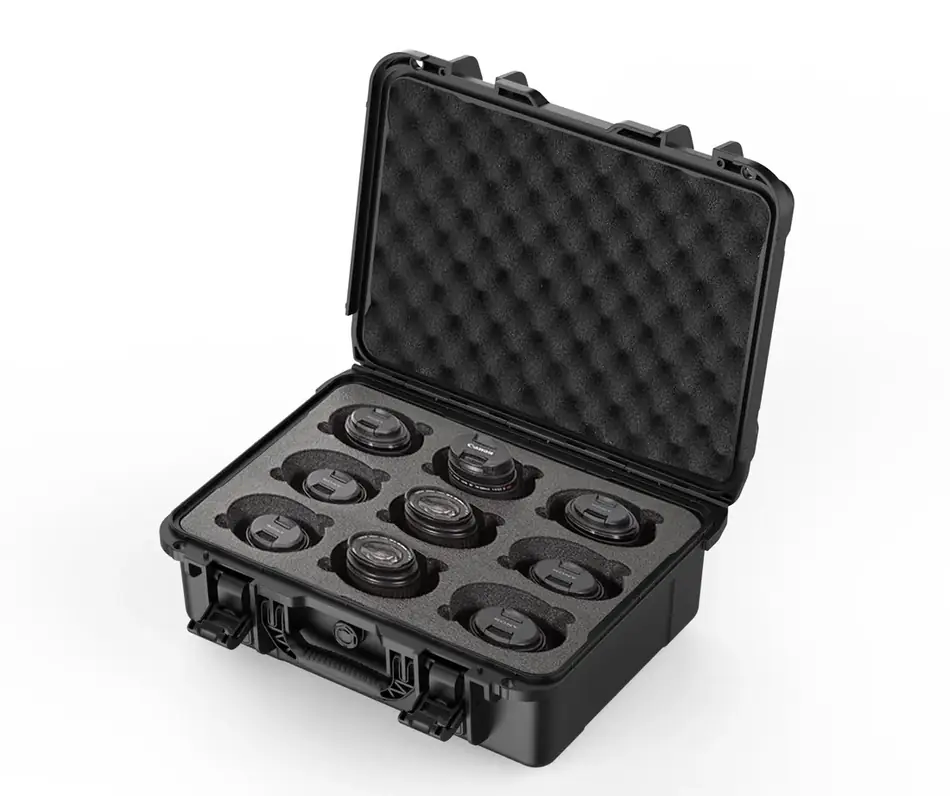
A great many real kits mix both halves of this page: a dermatoscope or colposcope camera with its lens, a USB microscope with a calibration scale, a magnifier head with a filter set, a gauge-block case travelling with a measuring microscope. The optics half sets the interior rules, because glass and calibrated faces mark long before they break. Each lens travels in its own pocket with the front element relieved and no contact under the rim; filters lie flat in a plank whose pockets are cut to the thread rather than to the stack; gauge blocks and precision stems are supported along a long face so nothing hangs on a measuring surface; and glass is separated from connectors and metal bodies by a wall of foam, not by hope. A shared cavity is the usual mistake, because two barrels touching inside soft foam transmit an impact from one to the other. Shallow-lid models read best here. The engineering-polypropylene KX-3508 lists 344 by 268 by 72 millimetres with a 36 millimetre lid over a 36 millimetre base, 5.7 litres and about 995 grams; the KX-3213 gives 308 by 230 by 118 millimetres with an 86 millimetre lid over a 32 millimetre base at about 860 grams and 7.2 litres; and the polypropylene KX-4010 covers 390 by 315 by 88 millimetres with a 44 millimetre lid over a 44 millimetre base and 9.3 litres for a body plus two optics. Where a case will be stacked in a vehicle, the 5.0 millimetre wall of the KX-84215 at 384 by 285 by 135 millimetres and 11.8 litres buys rim stiffness for mass.
Buyer Search Phrase To The Published Figure That Decides It
| Search Phrase | Figure That Decides It | Published Example |
|---|---|---|
| medical blood pressure monitor shockproof case | Chassis cavity with the display relieved plus a separate cuff pocket; shock is the layout, not the shell | KX-62109: 195 x 128 x 81 mm internal, ABS, 3.0 mm wall, about 470 g, 1.7 L, gasket published |
| medical defibrillator monitor portable hard case | Lid-to-base split, because a shallow base leaves a tall unit riding in the lid half | KX-83612: 330 x 260 x 103 mm internal, PP, 3.3 mm wall, 75 mm lid over 28 mm base, 7.6 L |
| medical portable microscope protective briefcase | Deep lid for upright travel, or a relieved side cavity plus low empty mass for hand carry | KX-92817: 253 x 180 x 152 mm internal, engineering PP, 5.0 mm wall, 125/27 mm lid/base, about 940 g, 5.5 L |
| medical ecg monitor transport latch case | Latch count specified per configuration for even rim pressure, plus a channel per lead set | KX-64112: 393 x 280 x 112 mm internal, ABS, 3.8 mm wall, about 1,820 g, 10.6 L |
| ecg monitoring equipment case | Repeated identical pockets, and whether the model publishes stackable at all | KX-85424: 483 x 363 x 190 mm internal, PP, wheels and telescopic handle, about 6,000 g, 26.6 L, stackable published false |
| medical stethoscope & otoscope hard storage box | Shallow cavity with a cut plank, plus the narrow internal width before any rigid tray goes in | KX-1905: 180 x 160 x 40 mm internal, PP, 3.0 mm wall, 25/15 mm lid/base, 130 mm narrow width, about 250 g |
| camera lens and objective storage in the same kit | One pocket per barrel with the front element relieved and no shared cavity | KX-3508: 344 x 268 x 72 mm internal, engineering PP, 36/36 mm lid/base, about 995 g, 5.7 L |
| mixed monitor and optics field kit | Loaded mass and carry format decided before the cavity is drawn | KX-64117: 393 x 280 x 156 mm internal, ABS, 3.8 mm wall, about 2,100 g, 14.8 L |
Selection Guidance: Five Checks Before A Monitor Or Optics Order
Five checks turn most of the searching time into a model number. Check one, measure the packed state and write down the extremes: cuff coiled and hose routed, lead harness wound at the radius you intend to keep, battery fitted, objectives screwed in, camera with hood and screen protector on. Check two, read published internal length, width and height against that envelope plus roughly twenty millimetres per axis for the cut, and never infer internal size from the digits in a product name. Check three, read lid depth and base depth separately: they decide whether your instrument sits on a floor of foam or hangs in the lid, and a 125 millimetre lid over a 27 millimetre base is a very different object from a 44 over 44 even at the same total depth. Check four, look up the narrow internal width wherever a rigid plank, tray or divider is planned - models such as the KX-3114 publish 200 millimetres at the narrow point against 220 nominal, and the KX-1905 publishes 130 against 160. Check five, settle the carry: empty mass published across the catalogue runs from about 100 grams on the KX-1204 to about 15,320 grams on the wheeled KX-88442, and only 19 of the 155 models list wheels, so a trolley requirement is a shortlist of its own rather than an option you can add to anything.
What We Publish And What We Do Not
Buyers of medical and optical cases arrive with three words in their specification that we cannot answer from a catalogue, and it is cheaper to say so here than in a tender response. Ingress: no ingress figure is published for any model, so 124 models are described as having a compressible gasket set in a continuous moulded channel with latch count specified per configuration, and that is a construction you can inspect rather than a rating; if your procedure names an ingress code, we quote accredited testing of the ordered configuration as a separate work package. Shock and impact: the published field for impact resistance records the wall thickness of that model and states that no drop height is claimed without a test, because a shock result is a property of a specified foam layout with the item immobilised, not of the moulding. Sterilisation, biocompatibility, cleanroom and disinfectant contact: nothing of the sort is published for any shell or foam, and a transport shell carries no clinical status - if a facility protocol names an agent or a process, quote it and we confirm the nominated material for that exact SKU rather than assuming one grade across 155 models. Ultraviolet resistance, temperature range, stack load and load capacity are likewise recorded as unmeasured fields and left blank instead of filled with a series average.
Where These Cases Are Used
The buyers of this class are rarely the clinics that end up holding the case. Device manufacturers ship a monitor with its cuffs, leads and documentation as one issue-able package and need the interior drawing to be the reorder standard. Distributors and service organisations build demonstration and after-sales kits that have to survive a car boot, a waiting-room floor and a year of repeated opening. Screening, occupational-health and community inspection programmes build a per-team kit that is issued, returned and restocked weekly, which is where an ECG monitoring equipment case becomes a fleet item rather than a single purchase. Veterinary practices, ambulance and rescue services, industrial first-aid provision and clinic-to-clinic equipment transfer all draw from the same shells, and so do calibration houses that travel a gauge set and a measuring microscope together. What these programmes share is the specification method rather than the setting: a named device, a measured packed envelope, a chosen published model, a cut interior, and an explicit list of documentation the purchaser has to see. KeXin quotes to that method, publishes measured physical figures per model, and does not attach a clinical, sterilisation, ingress or device-performance meaning to a transport shell.
Customising The Interior For A Mixed Device Kit
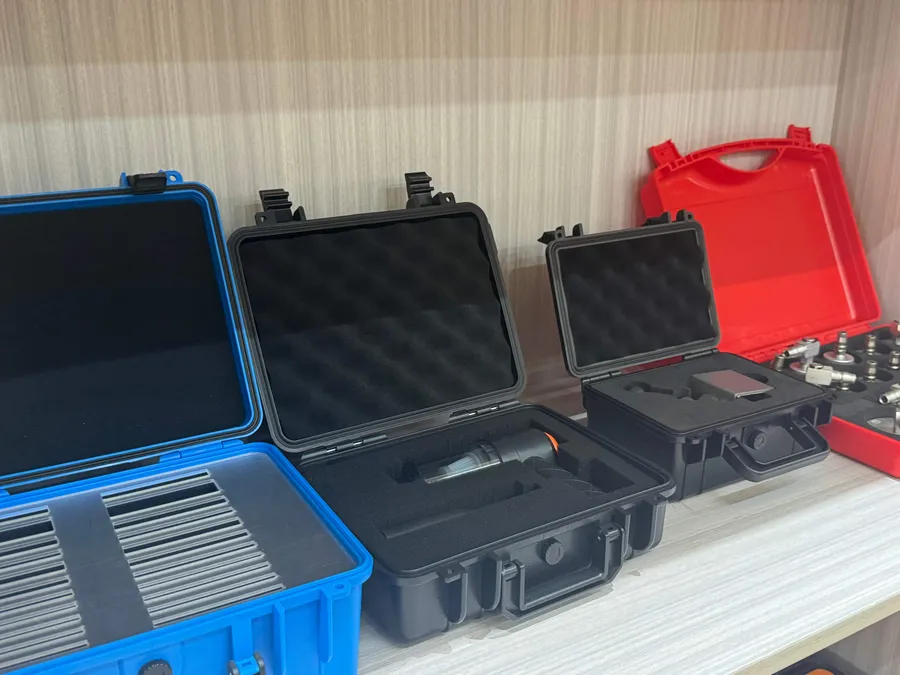
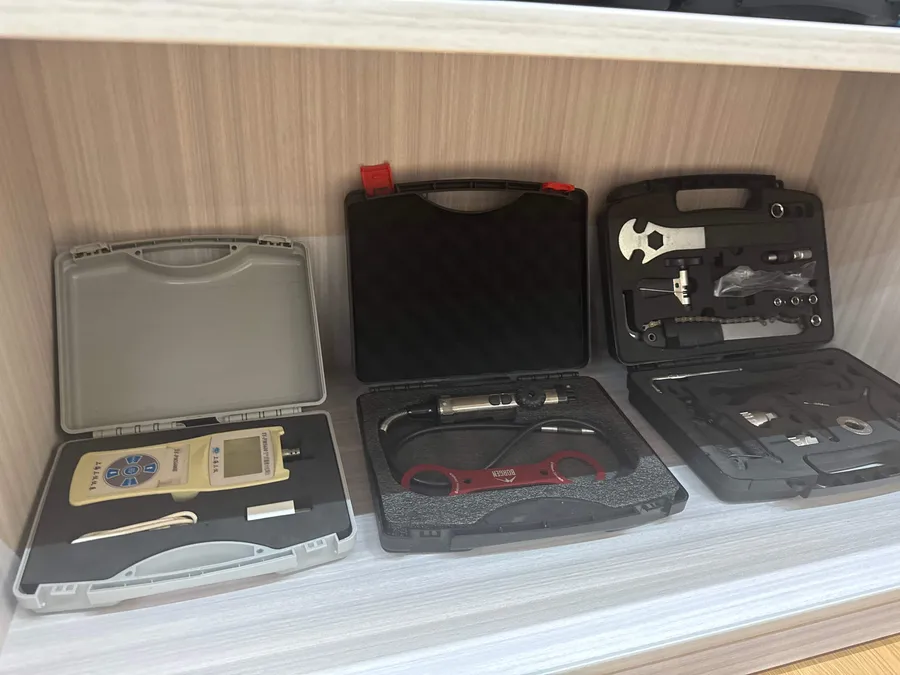
Interior work is the fast path, and on this page it is most of the value. We cut plank in layers - a firm carrier under mass, a softer face against a finished instrument - and we publish the standard foam families as cross-linked polyethylene, EVA, EPE, EPS, die-cut and CNC-cut, quoted by zone and contact pressure rather than as a blanket density. For a mixed medical and optics kit that means a chassis cavity for the monitor, a relieved window under a screen or a detector, one pocket per lens barrel with the front element unloaded, through-pockets for specula, routed channels that stop a lead pushing its plug into a socket, retainers for anything with a clamp, and printed outlines so a missing item shows as an empty pocket at a glance. A fixed cut base with a pick-and-pluck top is the standard answer where consumables change between issues, and a restocked EVA accessory pocket suits kits whose contents drift. Where a cavity is tighter than a hand-cut layout allows, CNC-cut plank is the accurate route. To quote it, send the packed-state dimensions, a photograph of the kit with a scale reference or a physical sample, the hardware you want and the annual quantity. Shell-side configuration - colour, printed or in-mould logo, extra latches, document holder, shoulder strap, breather option, buyer-branded packaging - is quoted per build, and we will say plainly when a stock envelope is closer and cheaper than a new mould.
Procurement Notes: Wholesale Terms, MOQ And Lead Time
KeXin New Materials (Guangdong) Co., Ltd. supplies on wholesale and OEM or ODM terms only, on EXW or FOB. There is no retail channel, no delivered-duty-paid quotation and no overseas warehouse, so freight and clearance sit with the buyer. Minimums are layered: one piece on a standard model, one piece for a custom foam layout so a single unit can be proven before a fleet is fitted out, around 300 pieces for colour, logo or OEM production, and around 3,000 pieces per component for a dedicated new mould. A first OEM article on existing tooling runs about 45 days and a new mould about 125 days from approved drawings, with a 30 per cent deposit and the balance settled before shipment after inspection. Third-party inspection at our facility is welcome. Internal and external dimensions, wall thickness, lid and base depth, usable volume, empty mass, narrow internal width, gasket construction and padlockable latch bodies are published per model; pallet figures are calculated from the carton footprint against your pallet size, and container loading is supplied with the quotation. Where a figure has not been measured on the model you order, we say so and quote the test rather than estimating. Enquiries go to Fred Zhao or the KeXin Sales Team, WhatsApp +86 135 3588 0002.
IP rating selection for instrument cases, answered against our published data
This section answers one buyer question directly, because ip rating selection for instrument cases is the phrase that brings a lot of specification sheets to us and it deserves a plain reply. The first digit of an ingress code records protection against solid particles and the second records protection against liquids, and both are the outcome of a specific laboratory procedure run on one finished configuration, not a property that can be read off a material name or a moulding.
For that reason we do not print an IP code, an IP rating or any ingress figure for the 155 models we publish; on these instrument models the protection field is recorded as not measured, and that empty cell is deliberate, not an omission. What we publish instead is the sealing construction you can inspect on a drawing, which is that 124 of the 155 models list a compressible gasket set in a continuous moulded channel, together with the internal envelope, wall thickness and lid-to-base split that decide whether a lens, objective, gauge or hand instrument actually sits still inside that seal line before any test is ever commissioned.
| Search Phrase | How We Answer It | Published Example |
|---|---|---|
| ip rating selection for instrument cases | We publish no IP code and no ingress figure for these models, and the protection field is recorded as not measured, so selection is driven by the exposure your instrument really faces and by the published gasket and cavity geometry rather than by a rating word. If your procedure names an ingress level, we confirm the nominated material for that exact SKU and quote accredited third-party testing of the ordered configuration as a separate work package. | KX-3508: 344 x 268 x 72 mm internal, engineering PP shell, 3.0 mm wall, 36 mm lid over 36 mm base, about 995 g net, narrow internal width 240 mm, gasketed rim, no IP figure published |
| sealed instrument transport case without an ingress claim | A gasket is a construction detail, not a rating: it can be inspected on the section drawing and confirmed on a sample, whereas an ingress level exists only after a laboratory run on the finished unit. For a tall upright instrument we therefore publish the deep-lid geometry and the wall thickness, and leave the water and dust level as a test to commission when a specification requires it. | KX-92817: 253 x 180 x 152 mm internal, engineering PP shell, 5.0 mm wall, 125 mm lid over 27 mm base, about 940 g net, gasket published, ingress not measured |
What we do not claim about protection on these models
Read the empty protection cell the way a buyer should: it is honest information, not a missing advantage. A shell that lists a continuous-channel gasket tells you the rim can be inspected and compressed evenly by the latch count on that configuration; it does not tell you a laboratory test was passed, and we are not going to write one into the description to fill the space. For optics, cameras and precision instruments the numbers that actually decide a fit are the internal length, width and height, the narrow internal width that binds a rigid tray, the lid and base depths, and the loaded mass, and all of those we publish per model, while the ingress level stays a measurement to commission only when the purchasing procedure names one.
Customisation
Everything described above is configurable on a standard shell: interior layout (pick-and-pluck, die-cut or CNC-cut), foam grade and thickness, colour, logo method, latch and lock count, pressure-equalisation valve, cable ports, document holder and identification plate. A bespoke exterior geometry requires a new mould — 125 days, from 3,000 units per moulded component.
Procurement considerations
| Question | What to send us |
|---|---|
| Which shell fits? | Equipment L × W × H as packed, plus required clearance per axis |
| What does it cost? | Order quantity and estimated annual quantity — the two drive different answers |
| Is tooling needed? | Whether an existing shell clears the envelope with usable foam depth |
| Lead time? | Your required delivery date, not just the order date |
| Certification? | The exact standard your tender names — we will say whether we can test to it |
| Freight? | Destination and preferred terms; carton and pallet data supplied with the quotation |
Comparison and selection guide
The tables on this page exist because a protective case is chosen by comparing three things: the envelope, the environment and the handling chain. Where no table applies, the rule below is.
| Situation | What To Do |
|---|---|
| Clinical environment | Closed-cell foam or a wipeable tray; no open-cell pluck foam. |
| Emergency use | Latches that open with one hand and a lid that stays up unaided. |
| High-value device | Deeper base foam, a separate transducer zone, and a documented drop test if required. |
- Size on internal dimensions plus clearance, never on a product name.
- Choose the carrying method before the shell: it changes the series, not just the price.
- Specify the interior last, and decide up front whether the end user will reconfigure it.
Protective Cases for Optics, Cameras & Precision Instruments and Medical relates to Protective Case Basics. Related families: Medical Equipment Cases / Instrument & Equipment Cases / Camera & Photography Cases / Optical Equipment Cases / Electronics Cases / Custom Protective Cases / Equipment Transport Cases / Waterproof Cases. Related sectors: field and industrial equipment. Continue in the Protective Case Basics cluster.
This page is written from our own production data. If your requirement differs, send the dimensions and we will tell you which of the 155 models fits, or whether a custom route is needed.