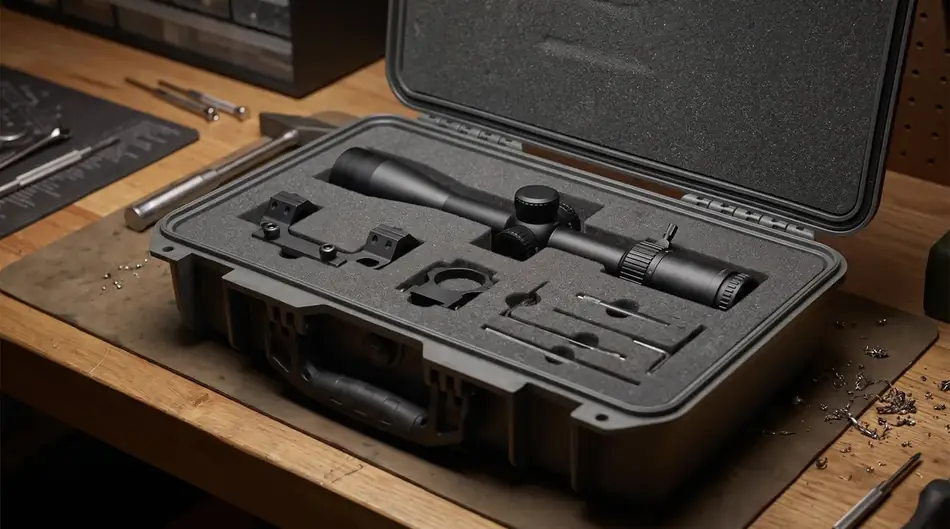
Tire Inspection Tool Case: Sized Around The Gauges, The Torque Bar And The Bay
A tire inspection tool case is sized around three loads that decide different axes: the tread depth gauge and pressure gauge set pocket depth, the torque bar sets internal length, and the TPMS handset or tablet sets the lid plane. Measure the tray as it is actually carried, add about 20 mm per axis for the cut foam wall and the gasket land, then choose a footprint you can keep when the kit changes. In our published library a gauge-and-mirror kit fits the 390 x 315 x 88 mm internal of KX 4010 (PP, 3.0 mm wall, 10.8 litres, 1,015 g), a gauge set with a coiled hose and a torch fits 455 x 338 x 148 mm on KX 4616 (22.8 litres, 19.6 usable, 1,395 g, a 74 mm lid over a 74 mm base), a TPMS handset with a tablet fits 378 x 307 x 187 mm on KX 6-4120 (ABS, 4.0 mm wall, 21.7 litres, 2,640 g), and a 1/2-inch torque bar with sockets fits 507 x 385 x 190 mm on KX 6-5522 (5.3 mm wall, 37.1 litres, 4,860 g). KeXin publishes dimensions, wall thickness on 148 of 155 mouldings, lid and base depth on 100, gasket presence on 124, stackability on 136 and net weight on 93. What we publish for no model: a water or dust class, an impact or free-fall figure, a stack load and a temperature range, because none is on record.
Key points
- Size the tray as it is carried: gauges, the hose coil, the torch and the torque bar each set a different axis, and the longest item decides internal length.
- Choose internal height and the lid split before length when a TPMS handset or tablet rides in the lid plane; KX 4616 publishes 74 mm of lid over a 74 mm base.
- A gasket is a moulded seal, not an ingress class: 124 of 155 models record one, and no water or dust figure is published for any model.
- Keep one footprint as the kit grows: the 437 x 308 mm internal family is published in eight heights, from 129 mm on KX 8-4814 to 230 mm on KX 8-4824.
- Wheels change the job, not just the carry: all 19 wheeled and telescopic shells in the library are listed as not stackable, so a trolley case is a floor tool.
- Custom foam starts at one unit with no tooling; colour, logo and OEM hardware start at 300 units, on EXW or FOB wholesale terms.
Tire Inspection Tool Case: What Actually Travels In The Tray
A tire inspection kit is rarely one instrument. It is a tread depth gauge, a digital pressure gauge, an infrared thermometer, a TPMS handset or trigger tool, a valve core tool, an inspection mirror, a torch, a crayon, and on most bay jobs a torque bar with the sockets that match the wheel nuts. Each of those sets a different axis of the case. The torque bar decides internal length, the gauges and the mirror decide pocket depth, the hose on the inflator or the pressure gauge decides how wide the coil bay has to be, and the TPMS handset plus a tablet decides the lid plane. The case is therefore sized around the tallest and the longest item in the tray, not around the tool the buyer names first.
Measure the tray as it is carried. Put the torque bar at its overall length including the drive end, coil the inflator hose the way the technician coils it rather than the way it is sold, stand the gauges in the orientation they will sit in the foam, and include the charger or spare battery for the TPMS tool. Then add about 20 mm per axis for the cut foam wall, the gasket land and the draft of the moulding. A kit that measures 340 x 240 mm on the bench is usually a 380 x 267 mm internal case, which is why the same tray can look oversized in one shell and cramped in another.
The container has one more job in a tire bay: it must stop the kit becoming a rattle. Gauge faces should not touch each other, the torque bar should sit in a full-depth channel rather than sliding in a shallow tray, and sockets should drop into holes rather than roll into one corner. That is a foam drawing rather than a shell decision, and it is the part that makes the case usable at the end of a shift when the bay is busy and the tray is being opened and closed twenty times a day.
Dustproof And Waterproof Automotive Equipment Case: Separating The Claim From The Test Record
The phrase dustproof and waterproof automotive equipment case names two properties that are stated very loosely across the market, so it is worth separating what a case can be shown to do from what a label asserts. In a tire bay the real loads are brake dust and road grit, oil mist from the air line, coolant splash, a wash-down hose at the end of the week, and ultraviolet light through a van window. None of those is a single number, and a case that keeps grit off the closing line is doing something different from a case that resists a directed water jet.
Our published position is narrow and checkable. A compressible gasket in a continuous moulded channel is recorded on 124 of the 155 active mouldings, and 31 record no seal offered on that shell, so the field is read model by model rather than series by series. No water or dust class and no ingress protection figure is published for any model, because no test record exists for a specific shell, gasket and foam build. Where a tender names one, we quote accredited laboratory testing of the exact build as a separate work package and state in the same sentence which measurements already exist, so the buyer can see the difference between a measured value and a requested test.
What keeps a tire kit serviceable week to week is geometry more than vocabulary. A lid that overlaps the gasket channel instead of resting on the latch, a gasket land that can be wiped free of grit before the case is closed, a base foam that does not hold a puddle under the sockets, and no open-cell sponge in the bottom of the tray: these are all drawing decisions we can build to. They can make the case easier to clean and harder for dust to reach the tools. They cannot be converted into an ingress class by writing a number on a specification sheet, and we do not do that.
Sizing By Kit: Gauge-Only, Diagnostic, Torque And Full Bay
A gauge-only tray is the smallest useful tire kit: a tread depth gauge, a pressure gauge, a valve tool, a mirror and a torch. KX 4010 publishes 390 x 315 x 88 mm internal on a 3.0 mm PP wall, 10.8 litres (9.3 usable), 1,015 g empty, with 44 mm of lid over a 44 mm base, a gasket recorded and a stacking foot; ten pieces ship in a 710 x 410 x 500 mm carton. That height is enough for a gauge lying face-up in a cut pocket and not enough for a gauge standing on its connector, which is the distinction buyers miss when they order by litres alone.
Add a coiled inflator hose, a torch and a charger and the tray becomes a diagnostic kit. KX 4616 gives 455 x 338 x 148 mm internal on a 3.0 mm wall, 22.8 litres (19.6 usable), 1,395 g, a 74 mm lid over a 74 mm base and a carton of 755 x 470 x 635 mm. The 74 mm lid is the figure that matters here: the hose coil can sit in the base and the charger can sit in the lid without either pressing on a gauge face.
A TPMS handset with a tablet is the flat-load version of the same job. KX 6-4120 publishes 378 x 307 x 187 mm internal in ABS on a 4.0 mm wall, 21.7 litres (17.4 usable) and 2,640 g, six pieces per 750 x 425 x 640 mm carton; KX 6-4621 gives 430 x 288 x 186 mm on a 4.7 mm wall, 23.0 litres (18.4 usable) and 3,000 g, six per 740 x 485 x 685 mm carton. Both keep the screen in a shallow lid bay and the sockets in the base instead of stacking everything in one deep pocket.
The torque bar is the item that pushes the case into the next length band. A 1/2-inch bar and its sockets fit the 507 x 385 x 190 mm internal of KX 6-5522, a 5.3 mm ABS wall, 37.1 litres (29.7 usable), 4,860 g, three per 565 x 450 x 665 mm carton. Where the bay also carries a longer bar or a commercial-wheel socket set, the length stops being negotiable: KX 9-6027 publishes 502 x 337 x 214 mm internal on a 5.0 mm wall, 36.2 litres (29.0 usable) and 6,110 g, with wheels, a telescopic handle and 170 mm of lid over a 44 mm base. For breaker bars and deep sockets in one tray, KX 8-8337 gives 723 x 368 x 329 mm internal on a 5.0 mm wall, 87.5 litres (70.0 usable) and 10,866 g, with 280 mm of lid over a 49 mm base and the same wheeled, telescopic carry.
Published Envelopes: Tire Bay Kit Mapped To The Model That Clears It
The table maps each kit described above to the published figure that decides the choice and to one model in our library that sits in that band. Every dimension is the internal figure recorded for that SKU, and the seal, stacking and carton notes belong to the same model rather than to the series as a whole.
| Kit As It Travels | Figure That Decides | Published Example | Seal And Carry |
|---|---|---|---|
| Gauge, mirror and torch only | Pocket depth for gauges lying face-up | KX 4010: 390 x 315 x 88 mm internal, 3.0 mm PP wall, 10.8 litres (9.3 usable), 1,015 g, 44/44 mm lid and base | Gasket recorded; stackable; fixed folding handle; 10 pieces per 710 x 410 x 500 mm carton |
| Gauges, coiled hose and charger | Hose coil diameter plus the lid plane | KX 4616: 455 x 338 x 148 mm internal, 3.0 mm PP wall, 22.8 litres (19.6 usable), 1,395 g, 74/74 mm split | Gasket recorded; stackable; carton 755 x 470 x 635 mm |
| TPMS handset and tablet | Lid plane for the screen, base area for sockets | KX 6-4120: 378 x 307 x 187 mm internal, ABS, 4.0 mm wall, 21.7 litres (17.4 usable), 2,640 g | Gasket recorded; stackable; 6 pieces per 750 x 425 x 640 mm carton |
| Handset, charger and socket set | Footprint at 430 mm internal length | KX 6-4621: 430 x 288 x 186 mm internal, ABS, 4.7 mm wall, 23.0 litres (18.4 usable), 3,000 g | Gasket recorded; stackable; 6 pieces per 740 x 485 x 685 mm carton |
| 1/2-inch torque bar and sockets | Internal length along the bar | KX 6-5522: 507 x 385 x 190 mm internal, ABS, 5.3 mm wall, 37.1 litres (29.7 usable), 4,860 g | Gasket recorded; stackable; 3 pieces per 565 x 450 x 665 mm carton |
| Long bar for commercial wheels | Bar length plus deep socket height | KX 9-6027: 502 x 337 x 214 mm internal, 5.0 mm wall, 36.2 litres (29.0 usable), 6,110 g, 170/44 mm split | Gasket recorded; wheels and telescopic handle; listed as not stackable |
| Breaker bar, deep sockets and inflator | Longest bar plus the hose coil | KX 8-8337: 723 x 368 x 329 mm internal, 5.0 mm wall, 87.5 litres (70.0 usable), 10,866 g, 280/49 mm split | Gasket recorded; wheels and telescopic handle; listed as not stackable |
How To Choose: The Order In Which The Figures Decide
Work the decision in a fixed order and the shortlist writes itself. First, lay the kit out as it travels, with the torque bar at its overall length and the hose coiled at the diameter the technician actually uses. Second, read internal height and the lid split before length, because a TPMS screen and a charger in the lid fail in a shallow shell even when the footprint is correct. Third, pick a footprint and stay inside it: the 437 x 308 mm internal family is published in eight heights from 129 mm on KX 8-4814 through 164 mm on KX 8-4818 and KX 8-5021 to 230 mm on KX 8-4824, so a second kit revision is a different height rather than a different store layout.
Fourth, check the seal field on the exact model. The same family is not uniform: inside the 437 x 308 mm group, KX 8-4818 and KX 8-5021 record a gasket while KX 8-4814, KX 8-4815, KX 8-4823 and KX 8-4824 record none, and the 380 x 267 mm group records a gasket and a stacking foot across seven models in six heights, from 115 mm on KX 8-4113 to 215 mm on KX 8-4123.
Fifth, decide the carry before the interior. Stackability is published on 136 of the 155 mouldings, and the 19 shells that are not stackable are exactly the ones with wheels and a telescopic handle: a trolley case is a floor tool for a technician walking a yard, not a shelf unit for a depot. Telescopic height is published per model on 11 shells, from 240 mm on KX 8-7336 and KX 8-8337 to 485 mm on KX 9-7227, and never as a range for the series. Sixth, ask which figures do not exist and get the answer in writing. A quotation that answers a water, dust or impact question with a series name instead of a measurement reference has not answered it.
Applications: Mobile Van, Depot Shelf, Roadside And Track Support
A mobile tire technician works from a van and carries the kit to the vehicle, so the case is lifted in and out several times a day and set down on concrete. The 455 x 338 mm shell with a 74 mm lid is the practical size for that round, because it holds the gauges, the hose and the charger without becoming a two-hand load; where the van also carries a torque bar, the 507 x 385 mm shell or the wheeled 502 x 337 mm shell takes over and the technician stops carrying the weight by hand.
A depot or fleet workshop stores cases rather than carrying them far, and there the stacking foot and the carton footprint matter more than the handle. Of the 155 active mouldings, 136 are listed as stackable and 120 are listed under tool cases, so a shelf plan can be built from one family and extended by height. Carton dimensions are published on 64 models, which is enough to plan a pallet build against your own pallet standard; we do not publish a fixed pallet count, because it depends on the pallet you use and is calculated at quotation.
Roadside and track support is the case where the kit travels by car boot or service truck and is opened in wind and rain. A gasket recorded on the shell and a lid that overlaps the closing channel are the two details worth insisting on, together with a foam layout that keeps the gauge faces away from the sockets. For a track-day or event programme that ships several kits, the same footprint in different heights keeps the packing list simple: one case size to count, one carton size to palletise, and a spare shell that can take the next tool without a new foam design.
Customisation: Foam Layout, Colour, Logo, Hardware And Mould
The interior is the part that becomes tire-specific, and it is quoted from one unit with no tooling. Our published foam options are pick and pluck, die-cut, CNC-cut, EVA, PE and EPE, arranged as top foam, base foam, egg-crate or convoluted, layered or custom cut, in cross-linked PE, EVA or EPS by zone. A typical tire layout is a full-depth channel for the torque bar with the drive end relieved, holes for the sockets so they cannot roll, a shallow pocket for the gauges with a finger lift, a coil bay for the hose at its own radius, and a lid bay for the charger and paperwork. To cut it we need the packed equipment, a drawing, or a photograph of the kit as it travels, which is the drawing requirement recorded for every moulding in the library.
Beyond the foam, colour, logo and OEM hardware start at 300 units, OEM work on an existing mould is quoted at 45 days from first sample, and a new moulded exterior starts at 3,000 units per moulded component and 125 days. The hardware fields we record are handle style, latch count specified per configuration, hinge, feet, and a lock body that accepts a standard padlock, all published as measured for the relevant model, while a pressure equalisation valve, a shoulder strap and a document holder are published as configuration options rather than as fitted features. For a fleet that issues cases to named technicians, a document holder under the lid and a colour code per depot are the two cheapest ways to keep the kit list with the kit.
What We Publish And What We Leave Blank
Published per model, for the 155 active mouldings: internal and external dimensions, wall thickness on 148 of them, lid and base depth on 100, internal and usable volume, net weight on 93 from 100 g to 15,320 g, shell material (PP on 94, engineering PP on 38, ABS on 22 and one PP/ABS), gasket presence on 124, stackability on 136, wheels and telescopic handle on 19, and carton dimensions with pieces per carton on 64. The same pages carry the minimum order for standard, foam, colour, logo and OEM work, and the lead time for an existing mould and a new one.
Recorded as not measured and left blank for every model: any water or dust class, any impact or free-fall figure, any stack load, any load capacity, any temperature range, ultraviolet exposure, a fixed pallet count, and any cleaning-agent compatibility result. A pallet figure is calculated from the carton footprint against your pallet standard when we quote. Where a tender names one of the blank fields, we quote accredited laboratory testing of the exact shell, gasket and foam build as a separate work package. Foam is a construction option, and the assembled configuration is what would be tested, not the moulding on its own.
Wholesale, OEM And The Order Path
KeXin New Materials (Guangdong) Co., Ltd. supplies wholesale, OEM and ODM only, on EXW or FOB terms. We do not sell retail, do not quote delivered-duty-paid prices and keep no overseas warehouse stock. Payment is a 30 per cent deposit with the balance after inspection before shipment. Custom foam starts at one unit with no tooling; colour, logo and OEM hardware start at 300 units; OEM work on an existing mould is quoted at 45 days from first sample; a new moulded exterior starts at 3,000 units per component and 125 days.
For a tire inspection project, send the kit as it travels or a drawing of it, the number of trays per vehicle, the quantity in the first order and the annual estimate, and the destination. We return the shells that clear the envelope with usable foam depth, the published carton data for those models, and a written statement of which requested figures we can measure and which we cannot. If the first article has to be approved against a physical kit, send the gauges, the bar and the hose, and the foam will be cut to them so that the sample and the production run are the same construction.
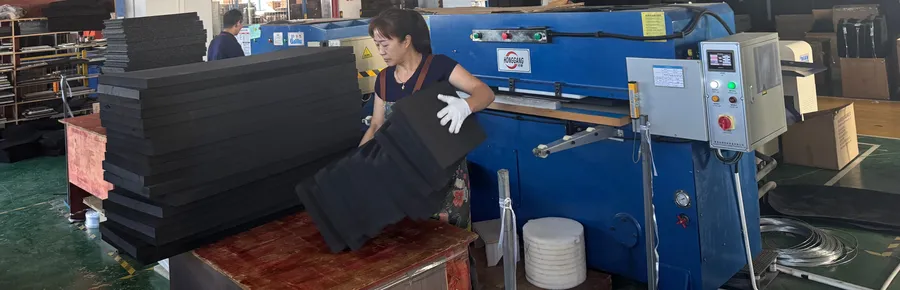
Customisation
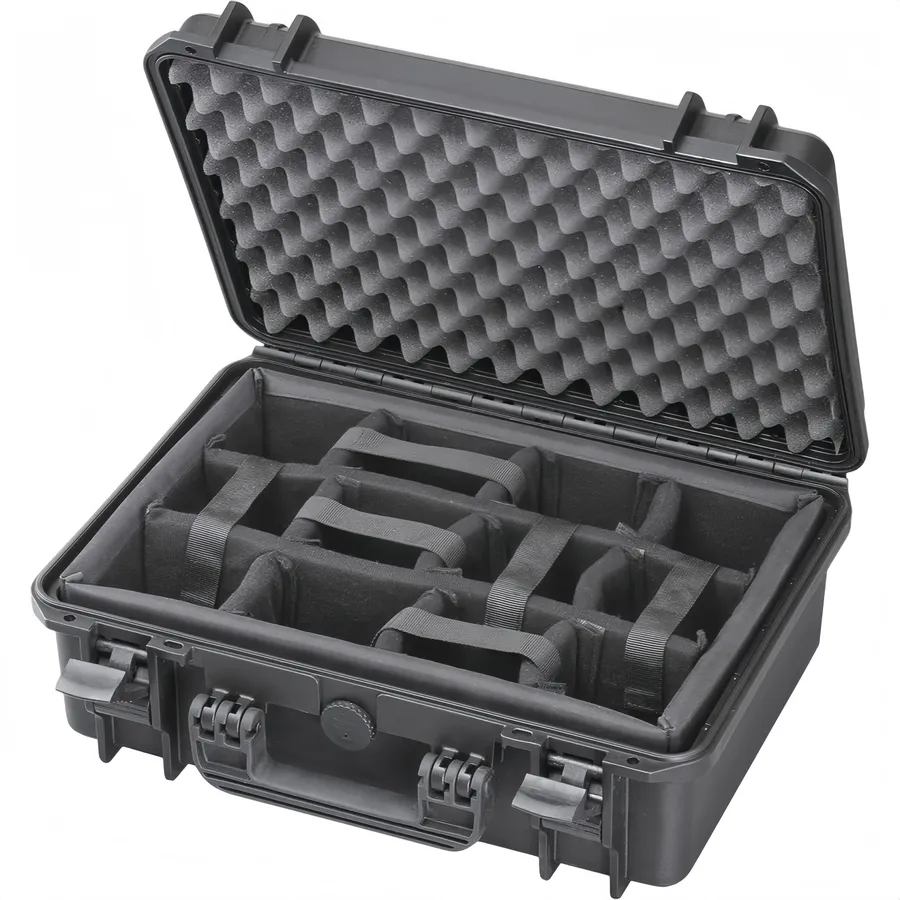
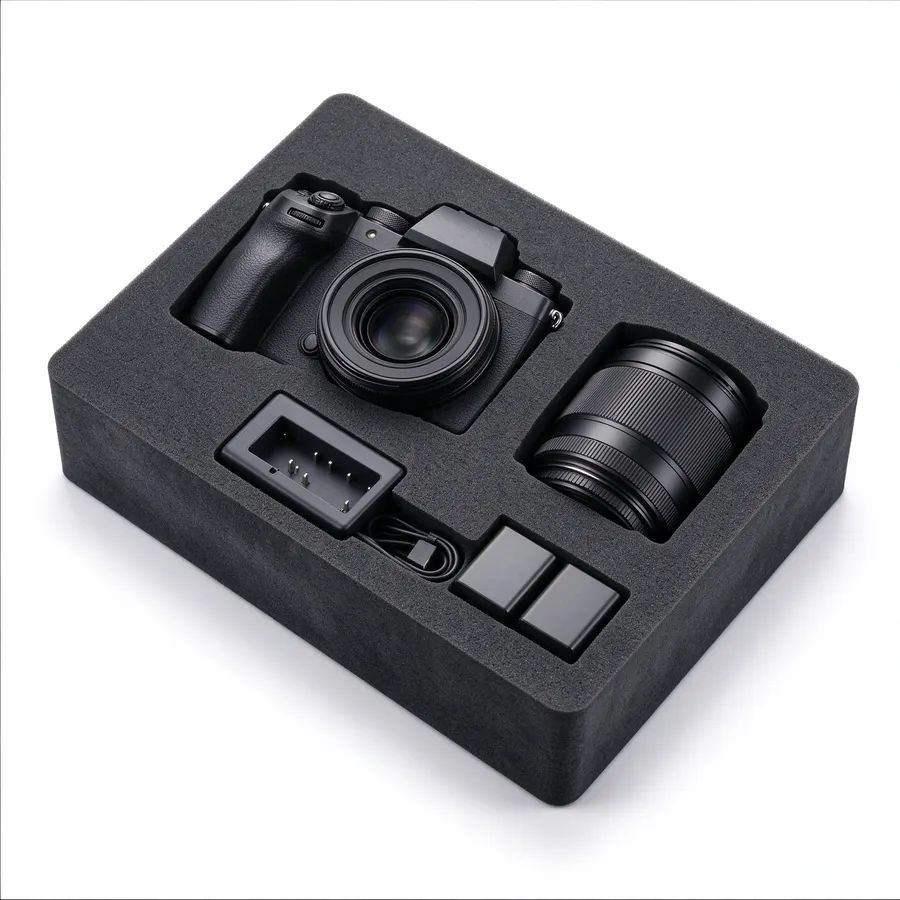
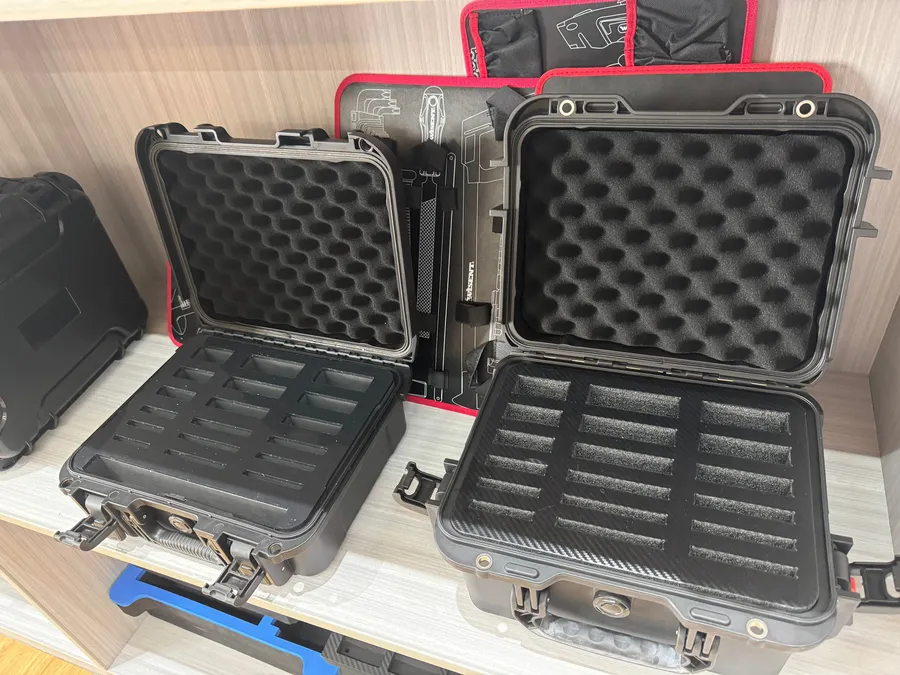
Everything described above is configurable on a standard shell: interior layout (pick-and-pluck, die-cut or CNC-cut), foam grade and thickness, colour, logo method, latch and lock count, pressure-equalisation valve, cable ports, document holder and identification plate. A bespoke exterior geometry requires a new mould — 125 days, from 3,000 units per moulded component.
Procurement considerations
| Question | What to send us |
|---|---|
| Which shell fits? | Equipment L × W × H as packed, plus required clearance per axis |
| What does it cost? | Order quantity and estimated annual quantity — the two drive different answers |
| Is tooling needed? | Whether an existing shell clears the envelope with usable foam depth |
| Lead time? | Your required delivery date, not just the order date |
| Certification? | The exact standard your tender names — we will say whether we can test to it |
| Freight? | Destination and preferred terms; carton and pallet data supplied with the quotation |
Comparison and selection guide
The tables on this page exist because a protective case is chosen by comparing three things: the envelope, the environment and the handling chain. Where no table applies, the rule below is.
| Situation | What To Do |
|---|---|
| Fixed inventory | CNC or die-cut silhouette with part numbers printed on the foam. |
| Variable kit | Pluck foam plus a loose tray. |
| Bench work | Removable trays that lift out square so the case doubles as a stand. |
- Size on internal dimensions plus clearance, never on a product name.
- Choose the carrying method before the shell: it changes the series, not just the price.
- Specify the interior last, and decide up front whether the end user will reconfigure it.
Tire Inspection Tool Case: Sized Around The Gauges, The Torque Bar And The Bay relates to Protective Case Basics. Related families: Tool Cases / Equipment Transport Cases / Custom Protective Cases. Related sectors: field and industrial equipment. Continue in the Protective Case Basics cluster.
This page is written from our own production data. If your requirement differs, send the dimensions and we will tell you which of the 155 models fits, or whether a custom route is needed.