Protective Cases for Medical & Diagnostic Equipment for Automotive Service Bays
Size the case from the packed kit and the job it is actually doing, not from the word medical: a service bay runs three separate packing problems on one shelf, and all three are answered against the same published numbers. The first is vehicle diagnostic electronics - emission analysers, smoke machines, brake testers, scan tablets and the report printer. The second is the depot's own occupational-health provision: the first-aid case, the screening kit, the injury-response pack. The third is specimen, drug or consumable movement handled on behalf of a health client working out of the bay. KeXin publishes internal and external dimensions, wall thickness, lid and base depth, usable volume and empty mass per model; a compressible gasket in a continuous moulded channel is offered on 124 of the 155 catalogue models and every latch body is published as accepting a standard padlock. What we do not publish is a temperature range, a cold hold time or a sterilisation figure for any shell, so cold chain, autoclave and specimen-packaging performance belongs to the qualified inner system and not to our casing.
Key points
- A bay runs three distinct jobs on one shelf - vehicle diagnostics, the depot health kit, and specimen or drug movement for a health client.
- Specify against published internal length, width and height plus lid depth, never against the external figure in a product title.
- No KeXin model carries a published temperature range or hold time, so cold chain and blood-product performance comes from the qualified liner.
- Lockable means the latch body accepts a standard padlock; custody procedure, registers and tamper evidence stay with the operator.
- Regulated specimen transport uses qualified layered packaging; a gasketed hard shell is the outer protective casing, not that packaging.
- Check the narrow internal width as well as the nominal figure: the KX-4616 lists 302 mm at its narrow point against 338 mm nominal.
What A Service Bay Actually Packs
A search for medical and diagnostic cases in a workshop context normally means one of three different jobs, and confusing them is the usual reason a bay fit-out goes wrong. The first is vehicle diagnostics: an emission analyser, an exhaust-gas or smoke machine, a brake tester, compression and vacuum gauges, the OEM scan tablet, and the printer that produces the customer report. The second is the depot's own occupational-health provision: the first-aid case, the employer drug and alcohol screening kit, the injury-response pack a fleet workshop is expected to hold. The third is anything the workshop moves on behalf of a health client - a specimen or consumable box from a mobile inspection unit parked in the bay, or a screening team using the space as a staging point. Those are three specification conversations sharing one catalogue. What changes between them is the cut interior, the gasket and latch configuration, the carry format, and the paperwork a purchaser has to be able to show. KeXin publishes internal and external dimensions, wall thickness, lid and base depth, usable volume and empty mass model by model, and leaves an unmeasured field blank rather than filling it with a series average.
Automotive Diagnostic Equipment Case
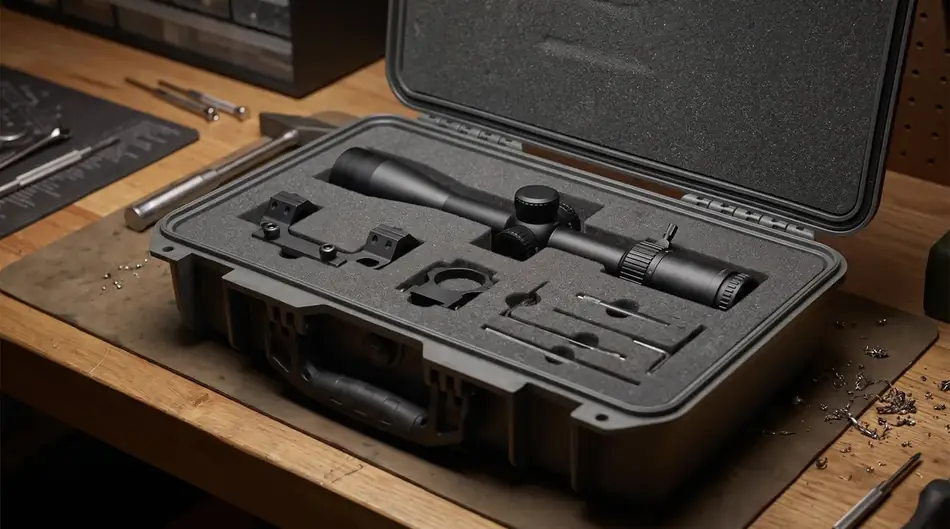
Vehicle diagnostic electronics are thin, expensive and full of glass: a tablet with a screen, a gas analyser with a sensor filter, an oscoscope or scan head with a protruding connector, and a coil of lead that kinks if it is forced. They want a stiff shell and a shallow cut plank rather than a deep box half filled with air. The ABS KX-63413 lists 310 by 255 by 106 millimetres internal on a 4.8 millimetre wall at about 1,680 grams with 6.7 litres usable and a gasket offered as the published seal construction, which suits a scan tablet, its dongle and a short lead set. Where the analyser itself travels, the ABS KX-64112 gives 393 by 280 by 112 millimetres on a 3.8 millimetre wall at about 1,820 grams with 10.6 litres, and the engineering-polypropylene KX-85017 covers 463 by 338 by 156 millimetres on a 4.5 millimetre wall with 19.5 litres for the instrument plus its printer and consumables. Diagnostic gear fails at connectors, not at corners, so the cut must locate the body and route the lead in its own channel.
Automotive Diagnostic Equipment Protection Solutions
Protection is a short list of failure modes, and each one has a different answer. Item shift turns a small knock into a second impact against the far wall, and it is solved by a snug cavity, not a thick one - so specify the cut against the packed envelope with roughly twenty millimetres of clearance per axis once the foam is counted. Lid-line crushing is the most common complaint in a workshop, and it is solved by reading lid depth separately from total internal height whenever an item carries a screen, a handle, a battery brick or a standing connector. Contamination from oil, coolant dust and tyre grit is a closure question: a gasketed rim with even latch compression is the published construction on 124 of the 155 models. Weight on a stacked shelf is a wall-thickness and stackability question, answered per model rather than by brand. And loss is a layout question: a die-cut or CNC-cut tray shows an empty pocket at a glance, where a pick-and-pluck bed cannot. Accredited testing of any figure your tender demands can be commissioned on the ordered configuration as a separate work package; it is not something we take from a moulding.
Medical Equipment After-Sales Tool Case
The engineer who services clinic and workshop equipment between sites carries a different load from the technician who services vehicles: a precision driver set, a meter, a small instrument, spare probe or filter, the firmware stick, and the service report forms. Fragility and paperwork matter more than volume. The ABS KX-64618 lists 430 by 290 by 165 millimetres internal on a 4.7 millimetre wall with a 140 millimetre lid over a 25 millimetre base at about 2,775 grams and 16.5 litres, which keeps the instrument in the base and the accessories in the lid without any weight resting on a display. The gasketed engineering-PP KX-85215 gives 483 by 363 by 140 millimetres on a 4.5 millimetre wall with 19.6 litres for a wider kit laid flat. Where the visit means a car park and a corridor, the wheeled KX-85021 pairs a 437 by 308 by 164 millimetre cavity and a 4.5 millimetre wall with wheels and a telescopic handle as published construction at about 4,912 grams empty. A document holder is a configuration option, so the service sheet travels with the tool rather than in the engineer's pocket.
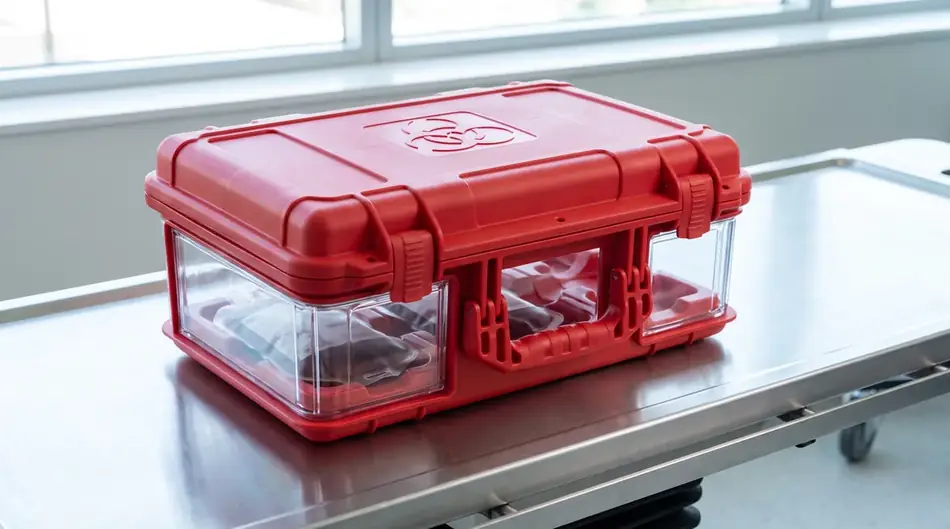
Biological Sample/Specimen Sealed Transit Box
This is the phrase we most often have to answer honestly. Movement of diagnostic specimens is governed by layered packaging rules that the consignor must satisfy: a primary container, an absorbent secondary containment, and a marked outer packaging, sized and documented against the applicable air and road requirements. That packaging is qualified by whoever places the consignment on the market, and a hard plastic case from our catalogue is not it. What our shell genuinely does is protect that qualified package from crush, puncture and weather once it is packed - a gasketed rim resists dust and splash, a rigid thermoplastic wall resists a stack, and a cut interior stops an inner box travelling inside the outer one. The gasketed KX-3213 lists 308 by 230 by 118 millimetres internal on a 3.0 millimetre wall at about 860 grams with 7.2 litres and an 86 millimetre lid over a 32 millimetre base, and the KX-83815 gives 350 by 300 by 130 millimetres on a 4.2 millimetre wall with 11.0 litres. We state gasket construction as built and make no specimen, infectious-substance or biosecurity claim for any model.
Blood Products Low Temperature Sealed Box
Temperature is the one number we cannot give you, and we would rather say so than invent it. Across all 155 published models, no temperature range and no hold time is measured for any shell, so no KeXin case is an insulated container in the sense a blood-product movement specification means. The thermal performance comes from a validated insulated shipper with conditioned phase-change material, a qualified hold time and data-logger evidence from the supplier of that system. Our role is the casing outside it: crush and puncture protection while the box is loaded into a vehicle, a repeatable external footprint that stacks predictably in a bay or a store, a wipeable interior that takes a spill without absorbing it, and a latch that accepts a padlock between collections. Size the cavity to the insulated shipper as packed, not to the bags inside it. The gasketed KX-84821 lists 410 by 360 by 190 millimetres internal on a 4.2 millimetre wall with a 150 millimetre lid over a 40 millimetre base and 22.4 litres, and the KX-85819 gives 500 by 400 by 165 millimetres on a 4.75 millimetre wall with 26.4 litres.
Medical Cold Chain Insulated Protective Box Wholesale
Buyers adding wholesale to this search are usually a distributor, a programme purchaser or an equipment integrator, and the honest wholesale answer is about supply terms rather than about temperature. KeXin sells wholesale and OEM or ODM on EXW or FOB terms only: there is no retail channel, no delivered-duty-paid quotation and no overseas warehouse stock, so freight and clearance sit in your plan. On existing moulds the standard minimum order starts at one piece and a custom foam layout likewise starts at one, which lets a distributor trial a configuration before committing a fleet; colour and logo work begins near 300 pieces, a dedicated new mould near 3,000 pieces per component, a first OEM article on existing tooling runs about 45 days and a new mould about 125 days, with a 30 per cent deposit and the balance before shipment. What a case supplier can genuinely contribute to a cold chain is logistics arithmetic: repeatable external sizes, carton packing and a pallet figure calculated from the carton footprint against your pallet size. The KX-63413 ships ten pieces to a 670 by 365 by 710 millimetre carton; 20GP, 40GP and 40HQ loading is supplied with the quotation. Insulation and hold time you must obtain from the validated liner, and we will not quote them.
Clinical Trial Drugs Portable Protective Case
A trial kit case is judged on accountability rather than on cushioning: every pack must be present, traceable to a site, and obviously absent if it is not. That is a layout and hardware specification. A CNC-cut tray with one pocket per pack makes a shortfall visible in seconds, a numbered or printed outline supports the site reconciliation, and a document holder option keeps the transfer paperwork with the consignment instead of loose in a bag. Custody rules, temperature monitoring, randomisation schedules and the site file remain the sponsor's procedure; nothing about the shell substitutes for them, and we publish no temperature figure that would suggest otherwise. On volume, the gasketed KX-84120 lists 385 by 313 by 180 millimetres internal on a 3.7 millimetre wall with 18.7 litres, and the KX-84122 keeps the same footprint at 385 by 313 by 205 millimetres with 21.2 litres where a second layer of packs has to stand. Where a site kit travels with its own insulated pack, the deep KX-84430 gives 395 by 295 by 275 millimetres with a 230 millimetre lid over a 45 millimetre base and 25.6 litres, so tall items sit in the base instead of bridging the halves.
Medical Controlled Drugs Lockable Safety Box
We can be precise about one word in this phrase and blunt about the rest. Lockable is a published, measured feature on these shells: every model's datasheet records that the latch body accepts a standard padlock, and latch count is specified per configuration so the gasket compresses evenly. What the case is not is a controlled-substance cabinet, a secure store or a tamper-evident container. Custody, the witnessed register, key control, the discrepancy procedure and any statutory storage requirement belong to the operator and to local rules, and we state no security rating, no tamper evidence and no seal integrity for any model. Mechanically, a small lockable carry box for a screening or point-of-care kit is a shallow thick-wall problem: the gasketed KX-2811 lists 253 by 180 by 98 millimetres internal on a 5.0 millimetre wall at about 890 grams with a 71 millimetre lid over a 27 millimetre base. The KX-3218 gives 308 by 230 by 172 millimetres on a 3.0 millimetre wall at about 900 grams with 10.5 litres, and the deep KX-93221 covers 300 by 200 by 200 millimetres on a 5.0 millimetre wall at about 1,230 grams with a 165 millimetre lid where bottles stand.
Portable Medical Emergency Equipment Safety Box
A depot first-aid or injury-response case fails for two reasons: it is not where people think it is, and the contents are not findable under pressure. The answer is a layout where the primary item is the first thing the lid reveals, generous pocket separation for dressings and airway items, a high-contrast interior option so a dark corner does not hide a small pack, and a carry format that one person can actually move loaded. A thermoplastic shell has no ferrous corrosion path, which is why these boxes survive being stood on wet concrete in a bay. For a facility kit that stays on a shelf, the gasketed KX-85427 lists 483 by 363 by 220 millimetres internal on a 4.5 millimetre wall with wheels and a telescopic handle as published construction at about 6,100 grams empty and 30.9 litres. Where a team box has to hold splints, a collar and a burn kit together, the KX-85835 gives 500 by 400 by 305 millimetres on a 5.0 millimetre wall, wheels, a 295 millimetre telescopic handle and 48.8 litres at about 8,520 grams, and the ABS KX-66232 covers 507 by 385 by 290 millimetres on a 5.3 millimetre wall with 45.3 litres for a stiffer, heavier shell.
Community Medical Inspection Portable Gear Box
A screening team - vision charts and a refractor, an audiometer, a spirometer, blood-pressure kit, a phlebotomy tray, forms and a laptop - travels on foot, by car boot and by lift, and it is usually carried by one person for the whole day. Empty mass therefore decides the answer before volume does. The engineering-PP KX-705 lists 420 by 270 by 112 millimetres internal on a thin 2.1 millimetre wall at about 830 grams with 10.9 litres, a genuine light-carry option where the kit is flat and modular, though it is published without a gasket. The gasketed KX-4616 steps up to 455 by 338 by 148 millimetres on a 3.0 millimetre wall at about 1,395 grams with 19.6 litres, and the KX-4822 gives 460 by 330 by 210 millimetres on a 3.3 millimetre wall at about 2,710 grams with 27.4 litres and a 165 millimetre lid for standing items. One trap on this class: check the published narrow internal width as well as the nominal figure, because the KX-4616 tapers to 302 millimetres internally against a nominal 338 millimetres, and a rigid tray that clears the wide point can bind at the narrow one.
Medical Consumables Transit Case
A consumables box is the one case in the bay that is opened every day and restocked every week, so the interior is designed around turnover rather than around protection alone. The practical pattern is a fixed cut base for what never changes - reagent racks, tray formats, a sharps container carrier - under a pluck top layer for what does, so a restock does not require reprinting the whole cavity and a changed line does not leave empty space that lets the next box shift. Depth per layer matters more than total volume, because a mixed consumables load settles unevenly and a deep single cavity lets the top row fall over. The gasketed engineering-PP KX-84818 lists 437 by 308 by 164 millimetres internal on a 4.5 millimetre wall with 17.7 litres, a good two-layer size. The KX-85218 gives 483 by 363 by 165 millimetres on a 4.5 millimetre wall with 23.1 litres for a wider tray footprint, and for flat packs, strips and box-lined consumables the long KX-86216 covers 582 by 300 by 130 millimetres on a 3.3 millimetre wall with a 100 millimetre lid over a 30 millimetre base and 19.5 litres.
Medical Autoclave Box Protective Outer Casing
Read literally, this search asks for a case that goes into a pressure-steam steriliser, and the honest answer is that no model in this catalogue is offered for that. A temperature range is not published for any of the 155 models, nor is any behaviour figure for the shell or the foam at sterilising temperature, so we do not describe any case as autoclavable or steam-sterilisable and we do not imply that a gasket survives a cycle. Two real jobs sit behind the phrase. The first is carrying a benchtop steriliser, its instrument trays or a wrapped-load trolley between sites, where the duty is purely mechanical: mass, a low centre of gravity and a base deep enough that the unit does not bridge the lid line. The second is a wipeable, hard-walled outer casing that keeps a clean or dirty instrument tray closed in transit - a procedural separation, not a rating. For the first, the gasketed KX-87319 lists 650 by 430 by 170 millimetres internal on a 5.0 millimetre wall with 38.0 litres, the KX-86122 gives 530 by 360 by 203 millimetres with a 155 millimetre lid over a 48 millimetre base and 31.0 litres, and where the unit is heavy enough to roll, the KX-88421 covers 740 by 518 by 189 millimetres on a 5.0 millimetre wall with 57.9 litres.
Buyer Phrase To The Figure You Should Actually Check
| Buyer Search | Figure To Check | Published Example |
|---|---|---|
| automotive diagnostic equipment case | Internal footprint plus a stiff wall for a screen and connectors | KX-63413: 310 x 255 x 106 mm internal, ABS, 4.8 mm wall, about 1,680 g, 6.7 L, gasket construction published |
| automotive diagnostic equipment protection solutions | Lid depth separately from total height, then gasket and latch count | KX-85017: 463 x 338 x 156 mm internal, 4.5 mm wall, 19.5 L; gasketed rim offered on 124 of 155 models |
| medical equipment after-sales tool case | One-trip carry mass and lid volume for accessories | KX-64618: 430 x 290 x 165 mm, 140/25 mm lid/base, about 2,775 g; KX-85021 adds wheels and a telescopic handle |
| biological sample/specimen sealed transit box | Cavity for the qualified inner package, not for the tube | KX-3213: 308 x 230 x 118 mm internal, 3.0 mm wall, 86/32 mm lid/base, 7.2 L, about 860 g |
| blood products low temperature sealed box | No published temperature or hold time on any model - size to the validated shipper | KX-84821: 410 x 360 x 190 mm internal, 4.2 mm wall, 150/40 mm lid/base, 22.4 L |
| medical cold chain insulated protective box wholesale | MOQ ladder, carton packing and pallet figure, not a thermal claim | MOQ 1 on a stock shell, 300 for colour or logo, 3,000 for a new mould; KX-63413 ships 10 per 670 x 365 x 710 mm carton |
| clinical trial drugs portable protective case | Pocket-per-pack layout plus a document holder option | KX-84120: 385 x 313 x 180 mm, 3.7 mm wall, 18.7 L; KX-84122 same footprint at 205 mm high, 21.2 L |
| medical controlled drugs lockable safety box | Latch body accepts a standard padlock; no security rating is claimed | KX-2811: 253 x 180 x 98 mm internal, 5.0 mm wall, 71/27 mm lid/base, about 890 g, gasket offered |
| portable medical emergency equipment safety box | Loaded carry format and first-item visibility when the lid opens | KX-85835: 500 x 400 x 305 mm, 5.0 mm wall, wheels, 295 mm telescopic handle, about 8,520 g, 48.8 L |
| community medical inspection portable gear box | Empty mass and the narrow internal width, not just the nominal width | KX-4616: 455 x 338 x 148 mm internal, 302 mm at the narrow point, about 1,395 g, 19.6 L |
| medical consumables transit case | Layer depth for restock frequency rather than total volume | KX-84818: 437 x 308 x 164 mm internal, 4.5 mm wall, 17.7 L; KX-85218: 483 x 363 x 165 mm, 23.1 L |
| medical autoclave box protective outer casing | Base depth and mass rating for the unit carried - no steam claim is published | KX-87319: 650 x 430 x 170 mm internal, 5.0 mm wall, 120/50 mm lid/base, 38.0 L |
Selection Guidance: Six Checks Before A Bay Order Is Placed
Run the same six checks whatever the load. One: record the packed envelope of every item as it is actually carried, including trays, chargers, printers and the insulated shipper, and note its mass. Two: add working clearance for the cut foam, about twenty millimetres per axis, then read that against published internal length, width and height - not against the external figure in a title. Three: check the narrow internal width on models that taper, because a rigid tray can bind at the narrow point. Four: check lid depth separately whenever an item has a screen, a handle, a battery or a standing connector. Five: confirm which hardware is published for that model - gasket, latch count, padlockable latch body, wheels and telescopic handle - rather than assuming a series capability. Six: write down what documentation your purchaser or your client actually demands, because a case that must survive a workshop floor and a case written into a health-procurement tender are different specifications, and the second is answered by commissioning the test on the ordered configuration.
Where These Cases Are Used
The overlap is what makes this category worth a single page. Independent garages, franchised dealer service departments, fleet and HGV workshops, inspection stations, tyre and exhaust fitters, recovery operators and plant-hire yards all keep a diagnostic case and a first-aid case on the same shelf. Mobile screening and community inspection teams use bay space as a staging point and carry the same mid-size shells to a hall or a workplace. Clinical and veterinary equipment service engineers, device distributors and integrators move after-sales kits from a depot through a vehicle to a clinic. A bay hand-tool case, a screening box and a consumables transit case may share one moulding and differ only in the cut, the latch count, the gasket and the marking. Specifying from the item that must survive, then building the interior around it, keeps a buyer from paying for volume that nothing fills. Applications across the catalogue include medical and laboratory equipment, industrial maintenance, field deployment, electronics and telecommunications.
Customising The Interior, The Hardware And The Marking
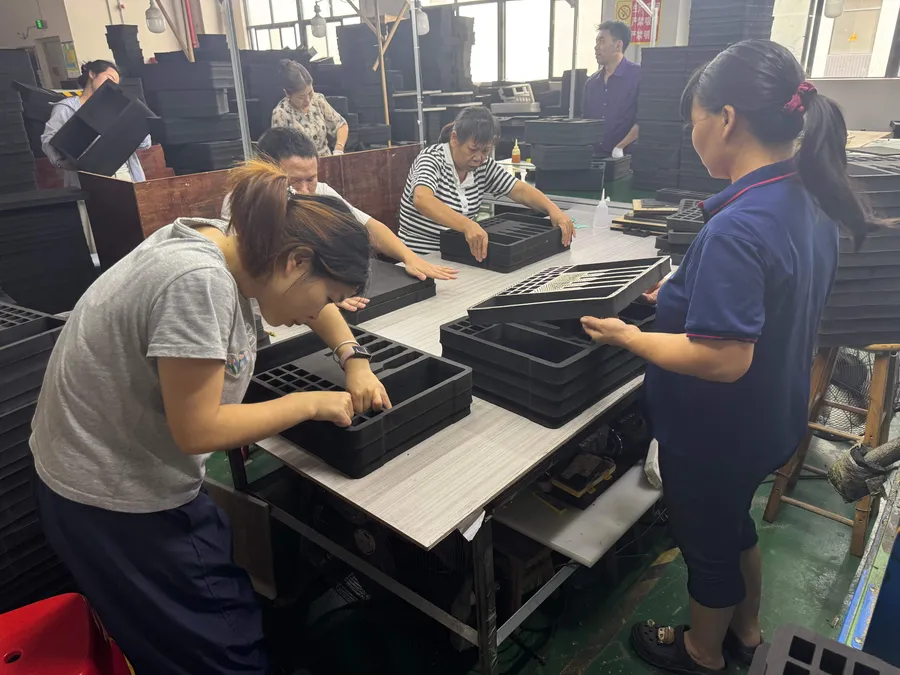
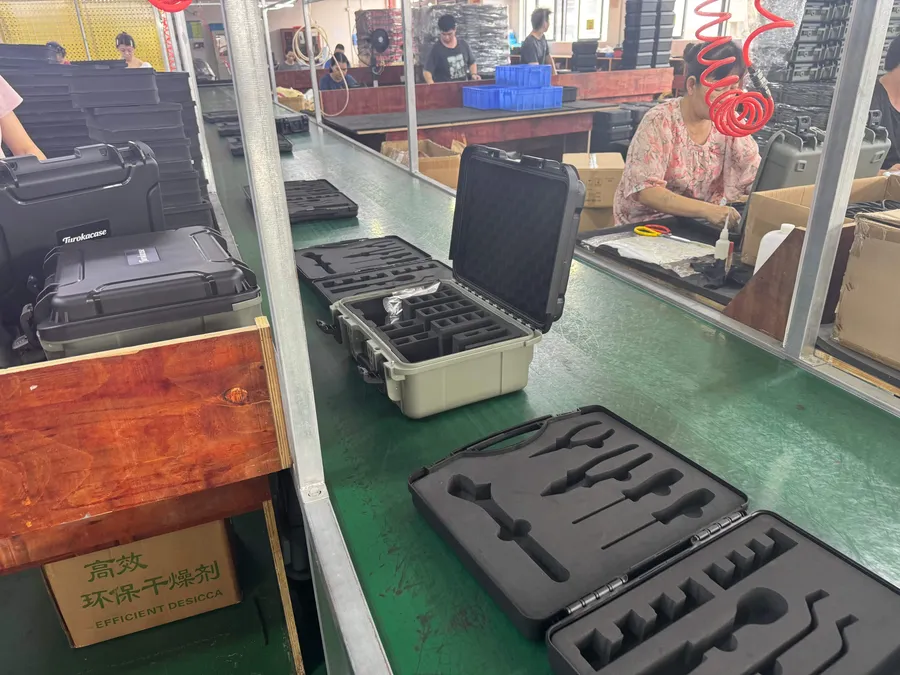
Interior work is where almost all of the protective behaviour actually lives, and it is the cheap part. We cut cross-linked PE, EVA or EPE plank in layers, with a firmer carrier under mass and a softer face against instruments, pockets shaped to a device body, routed channels for leads so a plug cannot travel into a socket, relief under a transducer or a lens, printed or routed outlines so a missing item shows as an empty pocket, and a pluck top over a fixed base for kits that change between issues. Closed-cell foam is the default lining for anything that may meet a spill because it does not absorb liquid the way an open-cell material does, and a smooth moulded interior wipes rather than traps residue. Shell-side changes - colour, an added handle, extra latches, a document holder, a shoulder strap, a breather option, a moulded or printed logo or a department marking - are configuration or OEM items quoted per build, since the tooling path differs for each. Because the insert carries the protection, we ask what is really going inside before proposing a shell, and we confirm the datasheet of the nominated model rather than assuming one grade across the range.
Procurement Notes: Wholesale Terms, MOQ And Lead Time
KeXin New Materials (Guangdong) Co., Ltd. sells wholesale and OEM or ODM buyers on EXW or FOB terms only. There is no retail channel, no delivered-duty-paid quotation and no overseas warehouse, so freight and customs sit with the buyer or are quoted separately as logistics rather than folded into a unit price. On existing moulds the standard minimum order is one piece and a custom foam layout likewise starts at one, which lets a single bay trial a configuration before a network is fitted out; colour, logo and OEM production begin near 300 pieces, and a dedicated new mould near 3,000 pieces per component. A first OEM article on existing tooling runs about 45 days and a new mould about 125 days from approved drawings, with a 30 per cent deposit and the balance before shipment. Third-party inspection at our facility is welcome before goods leave. Internal and external dimensions, wall thickness, lid and base depth, usable volume and empty mass are published per model; where a value has not been measured on the model you order we say so rather than estimating it, and any accredited test your specification requires is quoted as a separate work package on that configuration. Contact Fred Zhao or the KeXin Sales Team, or WhatsApp +86 135 3588 0002, with the packed dimensions and the quantity.
Service robot equipment case: the buyer wording, answered against published model data
Robot and automation service work arrives at the same bay shelf as everything else on this page, and it is usually heavier than the diagnostic electronics described above. The rows below take the wording a buyer actually searches with and answer it from the 155 active model records in our database - internal and external dimensions, wall thickness, lid and base depth, usable interior volume, empty mass, wheels and handle construction, gasket option, order minimums and lead times. Where a column has never been measured on the model you order it reads not measured, and no figure has been filled in from a series average.
One naming point before the table, because it changes what you should ask us for: a service robot in this context is the equipment a robot or automation engineer carries to a cell - a teach pendant, a spare drive or I/O module, grippers or actuators, a vision or laser head, the controller service laptop and a coil of cable - not an autonomous cleaning robot. Both are casing questions and both are answered the same way, by the packed envelope and the mass of it.
| Search | What We Publish |
|---|---|
| service robot equipment case | A robot service kit is a mass problem before it is a volume problem, and the published trolley records answer it directly: KX 8-8442 (KX-88442, PP): 740 x 518 x 364 mm internal on a 5 mm wall, 111.6 L usable interior, 320 mm lid over a 44 mm base, a 295 mm telescopic handle, 15320 g empty, the largest interior in our catalogue. Where the load has to be carried stiffly rather than loosely, KX 9-7227 (KX-97227, Engineering PP): 590 x 435 x 210 mm internal on a 6 mm wall, 43.1 L usable interior, 42 mm lid over a 168 mm base, a 485 mm telescopic handle, 10000 g empty - one of only two models published at that wall - with a deep base for a drive or a controller and a shallow lid for the pendant, and the ABS option in the same format is KX 6-6232 (KX-66232, ABS): 507 x 385 x 290 mm internal on a 5.3 mm wall, 45.3 L usable interior, 7940 g empty. An exact working load limit, a fall height, a temperature window and any dust or water figure are recorded as not measured for every model listed here; 124 of 155 publish a compressible gasket in a continuous moulded channel as built construction. |
| robot service engineer kit case with wheels | Three published trolley formats cover most cell-service kits between them. KX 8-8442 (KX-88442, PP): 740 x 518 x 364 mm internal on a 5 mm wall, 111.6 L usable interior, 320 mm lid over a 44 mm base, a 295 mm telescopic handle, 15320 g empty is the largest interior we offer. KX 8-6836 (KX-86836, PP): 595 x 460 x 315 mm internal on a 4.8 mm wall, 69 L usable interior, 270 mm lid over a 45 mm base, a 310 mm telescopic handle, 10600 g empty is the mid-size choice at 69 L usable, and KX 6-6232 KX-66232 is the ABS option in the same format. All three are recorded as not stackable, which matters on the return leg: a trolley of this size ships one piece to a carton - KX-66232 publishes 620 x 465 x 355 mm at 1 piece per carton - so a fleet order is quoted on carton and pallet arithmetic from the packing data, not on a stacking assumption. |
| teach pendant and robot controller spare parts case | This is a lid-and-base split, not a volume question. A teach pendant with its e-stop collar, a standing connector and a coiled cable must fit inside whichever half carries it, so read lid depth and base depth separately from total internal height as this page already advises, and add about 20 mm of working clearance per axis for the cut foam. Two published contrasts: KX-97227 puts 168 mm of its 210 mm internal height in the base and only 42 mm in the lid, which is the right split when a drive or controller lies in the case and the pendant travels on top; KX-86122 is nearer the opposite at a 155 mm lid over a 48 mm base, which suits a flat instrument with a tall accessory stack. Neither column is a shock or vibration claim: shock_protection and impact_resistance are published as manufacturer options that depend on the foam layout you specify. |
| cobots gripper and actuator transport case | Grippers, end-effector plates and small actuators are dense metal in a shallow footprint, which is the one load pattern that punishes a thin wall. The engineering-PP KX-97227 is published at a 6 mm wall with a 168 mm base depth - the thickest wall and the deepest base among the models named in these rows - and cross-linked PE, EVA or EPE plank is cut in layers with a firmer carrier under mass. Interior pockets are shaped to the part as packed, because an end effector that can roll inside a cavity will present a new face to the wall on every journey. Published mass figures do not include the payload, so add your parts to the empty 10000 g before choosing a carry format. |
| how heavy is an empty hard shell trolley case | Published empty mass for the models named above: 15320 g for KX-88442, 10000 g for KX-97227, 10600 g for KX-86836 and 7940 g for KX-66232. The ABS unit is the lightest of the four because it is also the smallest - 45.3 L usable against 111.6 L for KX-88442 - so the gap is footprint and hardware, not a resin penalty. Foam is quoted separately, since a CNC-cut two-layer interior adds mass that no datasheet column predicts for your layout; the figure we can give you before an order is the empty shell mass printed above. |
What a robot-service buyer should check before the shell is chosen
The checks below are the same six already on this page, restated for a robot kit because the load is heavier, the connectors protrude further and the return leg usually involves a vehicle tail-lift rather than a shelf.
What we do not state about a robot service case
Four columns are absent from every one of the 155 records, and a buyer specifying a robot-service case from a datasheet should know which they are before the purchase order is written.
Order terms for a robot-service case programme
KeXin New Materials (Guangdong) Co., Ltd. sells wholesale and OEM or ODM buyers on EXW or FOB terms only: no retail channel, no delivered-duty-paid quotation and no overseas warehouse stock, so freight and clearance sit in your plan. On existing moulds the standard minimum order is 1 piece and a custom foam layout also starts at 1, which lets one site or one integrator trial a robot-kit cavity before a network is fitted out. Colour, logo and OEM production begin near 300 pieces and a dedicated new mould near 3000 pieces per component. A first OEM article on existing tooling runs about 45 days and a new mould about 125 days from approved drawings, with a 30 per cent deposit and the balance after inspection. Third-party inspection at our facility is welcome before goods leave. Send the packed dimensions and the quantity to Fred Zhao or the KeXin Sales Team, or WhatsApp +86 135 3588 0002.
| Buyer Question | Published Answer |
|---|---|
| Is the cavity auditable at a glance? | Die-cut or CNC-cut plank in cross-linked PE, EVA or EPE shows an empty pocket immediately; a pick-and-pluck bed does not. Interior work starts at 1 unit on an existing shell, with about 45 days for an OEM article on existing tooling. |
| Does it fit the service vehicle? | External dimensions are published per model: 843 x 592 x 415 mm for KX-88442, 677 x 535 x 364 mm for KX-86836 and 615 x 440 x 320 mm for KX-66232. Carton packing and a pallet figure calculated from the carton footprint against your pallet size come with the quotation. |
| Can it be locked between sites? | Every one of the 155 model datasheets records a latch body that accepts a standard padlock, and latch count is specified per configuration so the gasket - offered on 124 of 155 models - compresses evenly. We state no security rating, no tamper evidence and no custody procedure for any model; those remain the operator's rules. |
Customisation
Everything described above is configurable on a standard shell: interior layout (pick-and-pluck, die-cut or CNC-cut), foam grade and thickness, colour, logo method, latch and lock count, pressure-equalisation valve, cable ports, document holder and identification plate. A bespoke exterior geometry requires a new mould — 125 days, from 3,000 units per moulded component.
Procurement considerations
| Question | What to send us |
|---|---|
| Which shell fits? | Equipment L × W × H as packed, plus required clearance per axis |
| What does it cost? | Order quantity and estimated annual quantity — the two drive different answers |
| Is tooling needed? | Whether an existing shell clears the envelope with usable foam depth |
| Lead time? | Your required delivery date, not just the order date |
| Certification? | The exact standard your tender names — we will say whether we can test to it |
| Freight? | Destination and preferred terms; carton and pallet data supplied with the quotation |
Comparison and selection guide
The tables on this page exist because a protective case is chosen by comparing three things: the envelope, the environment and the handling chain. Where no table applies, the rule below is.
| Situation | What To Do |
|---|---|
| Clinical environment | Closed-cell foam or a wipeable tray; no open-cell pluck foam. |
| Emergency use | Latches that open with one hand and a lid that stays up unaided. |
| High-value device | Deeper base foam, a separate transducer zone, and a documented drop test if required. |
- Size on internal dimensions plus clearance, never on a product name.
- Choose the carrying method before the shell: it changes the series, not just the price.
- Specify the interior last, and decide up front whether the end user will reconfigure it.
Protective Cases for Medical & Diagnostic Equipment for Automotive Service Bays relates to Protective Case Basics. Related families: Medical Equipment Cases / Instrument & Equipment Cases / Tool Cases / Rolling Cases / Custom Protective Cases / Equipment Transport Cases / Electronics Cases. Related sectors: field and industrial equipment. Continue in the Protective Case Basics cluster.
This page is written from our own production data. If your requirement differs, send the dimensions and we will tell you which of the 155 models fits, or whether a custom route is needed.