What equipment benefits from outdoor protective cases?
Equipment benefits from an outdoor protective case in proportion to three things: how much it costs to replace, how finely it is adjusted, and how badly it fails when something gritty or wet reaches it. The families that clear that bar consistently are optical and observation gear - binoculars, spotting scopes, rangefinders, rifle scopes and cameras; drone and controller kits with batteries and propellers; radios, repeaters and test instruments; survey, sampling and field-science equipment; precision tools and service kits; medical and first-aid sets; and bow, firearm and long tool transport. What they all share is that outdoor damage is not one event but a sequence - grit in a hinge, a wet kit packed away damp, a hot vehicle boot, a knock on a rock - and a rigid shell with a specified interior interrupts that sequence where a soft bag does not. Every figure below comes from our published specification data for 155 case models, including the honest limits: our water, dust, ultraviolet and temperature fields are recorded as untested on all 155, so this page reasons from exposure and geometry rather than from ratings we do not hold.
Key points
- Optics, cameras, drones, radios, precision tools and field medical sets benefit most: fine adjustment plus high replacement cost plus grit sensitivity.
- Outdoor damage is a sequence of small events, not one big drop - a rigid shell with a specified interior stops grit contact and repeat knocks.
- Ten models sit on our outdoor shelf: interiors from 240 x 180 x 76 mm to 350 x 220 x 80 mm, usable volume 3.1 to 7.9 litres, none with a published gasket.
- Outdoor use does not automatically mean a sealed case: 124 of 155 models publish a compressible gasket and 31 state that none is offered on the shell.
- Check four published numbers before choosing a grade of shell: usable interior volume, wall thickness, lid-to-base split and empty mass.
- Water, dust, ultraviolet, service temperature, stack load and any protection rating are recorded as untested on all 155 models - geometry and material are what we publish.
What outdoor use actually does to equipment
Indoor damage is usually one event: a tool is dropped, an instrument is knocked. Outdoor damage is a sequence, and that is why the answer is a case with a defined interior rather than padding thrown over the item. Grit works into a hinge, a latch or a focus ring and abrades it a little at a time. A kit packed away damp is closed in with the moisture, which then has somewhere to go only through the surfaces of everything else. A vehicle boot moves the load continuously, so a loose item is hammered against a wall tens of thousands of times rather than once. Sun and cold cycle the materials, and a case brought in from a cold night into a warm room develops condensation on the coldest surfaces, which are usually metal.
A rigid shell answers the first three of those. It stops abrasive contact with the outside and lets you wash the exterior before you open it in clean surroundings. It fixes each item in a position so nothing grinds against anything else. And it gives you a defined internal envelope, which is the only way a packing routine can be repeated by different people and produce the same result.
It is worth being exact about the fourth. Our published specification data records the water, dust, ultraviolet and service-temperature fields as untested for every one of the 155 models, along with stack load, live load and any protection rating. So a claim that an outdoor case keeps a downpour out, or survives a stated temperature, is not something our own sheet supports. What it does support is corrosion resistance, recorded as measured on all 155 models on the simple basis that a thermoplastic shell has no ferrous path to rust - a real advantage near salt water and in wet storage, and a material description rather than a test result.
The equipment families that benefit, and why
The table below works from the failure mode outward, because that is the order in which a specification should be written. The right-hand columns are published catalogue fields, so a buyer can check each row against a datasheet rather than taking the recommendation on trust. Nothing in the middle column is a rating.
| Equipment Family | What Fails Outdoors | What The Case Changes | Published Figure To Check |
|---|---|---|---|
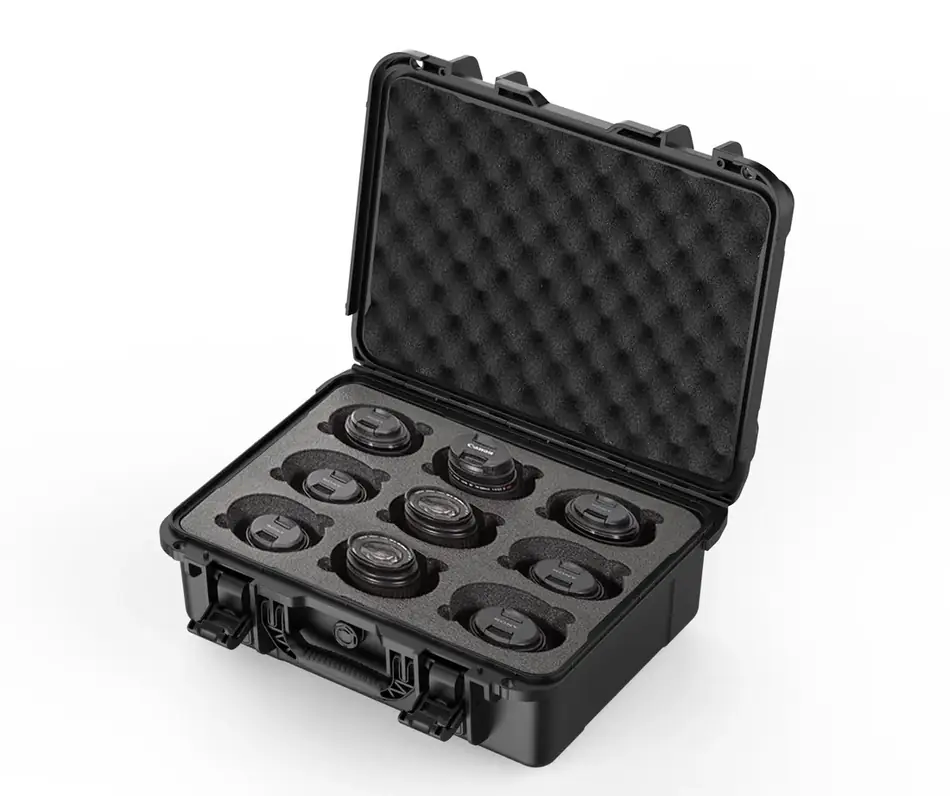
| Optics and observation gear - binoculars, scopes, rifle scopes, cameras, lenses | Grit in a focus or zoom ring, a knocked lens seat, condensation on glass inside a warm case | Sealed-feel rigid shell plus a cut cradle that keeps glass off glass and stops the item travelling | Internal height and usable volume - our outdoor shelf runs 76 to 126 mm of internal height and 3.1 to 7.9 litres usable |
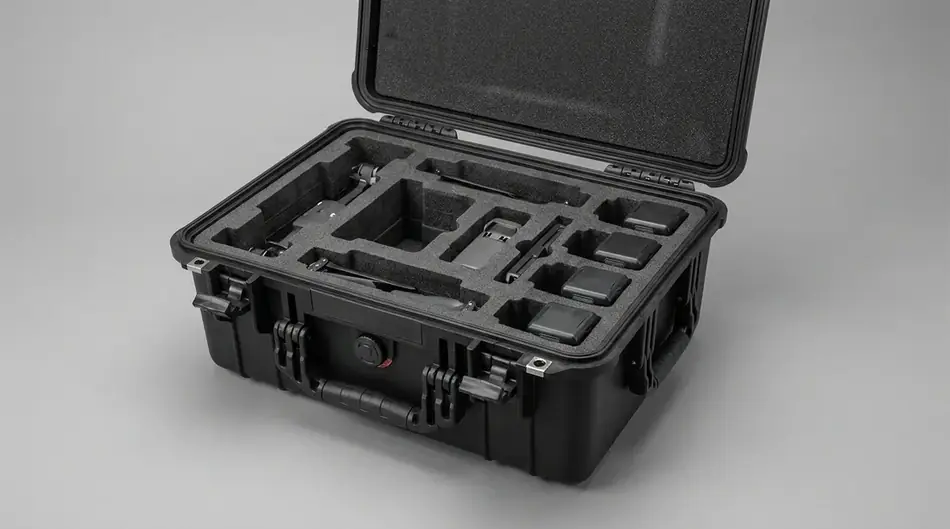
| Drones, controllers, batteries and propellers | Arm and gimbal contact, prop nicks, dirty contacts, batteries carried loose | A deep lid so the whole set travels as one unit, with separate pockets for power and airframe | Lid-to-base split - the outdoor KX-2813 publishes 92 mm of lid over 25 mm of base |
| Radios, repeaters, cabling and test instruments | Antenna threads, connector shells and keypad surfaces abraded by loose metal items | Separation of each accessory into its own pocket so nothing shares space with a thread or a port | Internal width and the narrowest internal width published on the model, which is where a handset really sits |
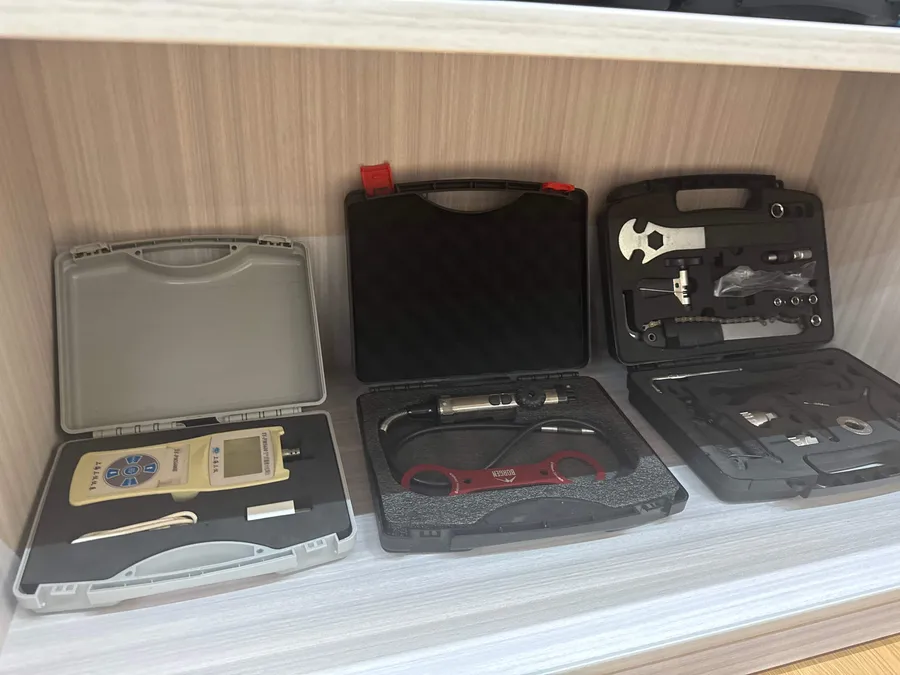
| Precision tools and field service kits | Edges chipped against each other, calibration surfaces scratched, steel rusting at the coating damage | Thin firm divider walls plus a shell that can be hosed or wiped before opening | Wall thickness - 2.1 to 2.9 mm on the ten outdoor models, 2.0 to 6.0 mm across the 148 that publish it |
| Medical, first-aid and sampling sets | Contamination of a clean surface, packaging abraded, contents unidentified at speed | A wipeable closed interior, a keyed layout that makes a missing item obvious, and a lockable closure | Latches that accept a standard padlock are recorded as measured on all 155 models |
| Survey, field science and monitoring instruments | Tripod heads and sensor faces, plus repeated transport in a vehicle bed | A bed that spreads the load over an area instead of a point, and stackable walls for stores | Stackability is published on 136 of the 155 models, including all ten on the outdoor shelf |
| Long rigid gear - bows, firearms, poles, masts, tripods | Tips and sights struck end-on, and the item levering against a short box | Internal length designed first, with cradles that carry the length instead of the ends | Internal length up to 880 mm on outdoor-tagged models, 1,280 mm across the whole range |
What our outdoor shelf is, in published numbers
Ten models carry the outdoor protective case category as their own shelf, and they are a coherent group: small to mid-size injection-moulded polypropylene boxes whose internal envelopes run from 260 by 180 by 76 mm on the KX-701 - the smallest of the ten by usable volume, at 3.1 litres - to 350 by 220 by 80 mm on the KX-704, with published usable interior volume from 3.1 to 7.9 litres. Empty mass is published from 350 g on the KX-701 to 1,060 g on the KX-3113, and published wall thickness across the ten runs 2.1 mm to 2.9 mm. All ten record a fixed folding handle, feet, a hinge, and a latch body that accepts a standard padlock, and all ten are recorded as stackable.
Two things about that shelf need stating because they surprise buyers. First, none of the ten publishes a sealing gasket - the seal field on every one of them reads none offered on this shell. If the requirement is rain, spray, wash-down or a wet storage place, the answer is a gasketed shell, and 124 of our 155 models publish a compressible gasket in a continuous moulded channel. Second, none of the ten has wheels or a telescopic handle; wheeled shells number 19 across the catalogue.
The second point matters less than it seems, because the outdoor tag is not confined to that shelf. 145 of the 155 models carry it. Of those, 114 publish a gasket, 47 offer at least 180 mm of internal height, 11 have wheels, and 85 publish an empty mass between 100 g and 10,000 g. So a pair of binoculars and a day kit can be specified from the small unsealed shells, while a ground-penetrating radar set, a base station or a fleet of survey instruments is specified from a gasketed deep-body shell elsewhere in the same catalogue.
Three shell decisions for the same outdoor kit
Once the equipment family is identified, the choice is about which of the shell's published properties you are paying for, in this order: sealing, envelope and carrying method. The comparison below uses real catalogue figures from models that all carry the outdoor tag, so each row is a purchasing option rather than an illustration.
| Decision | What You Get | Published Example | Choose It When |
|---|---|---|---|
| Small unsealed shell, carried by hand | Light box with a defined interior and stackable walls; nothing to maintain in the rim | KX-2813: 260 x 200 x 117 mm internal, 5.2 litres usable, 800 g empty, 92 mm lid over 25 mm base, wall 2.8 mm | Kit is dry when packed, transport is a backpack or a day vehicle, and the case is opened in the field |
| Gasketed shell for wet, muddy or wash-down conditions | A compressible gasket in a continuous moulded channel, recorded as measured on 124 models | KX-87323: 650 x 430 x 210 mm internal, 47.0 litres usable, wall 5.0 mm, 160 mm lid over 50 mm base | Contents may be hosed down, stored damp, or shipped on an open deck - with no rating implied by either option |
| Large or wheeled shell for mass and distance | Wheels plus a telescopic and fixed handle on 19 models, deep bodies with 180 mm plus internal height | KX-86136: 530 x 360 x 304 mm internal, 46.4 litres usable, 8,500 g empty, gasketed; KX-97227: 6.0 mm wall, 10,000 g | The kit approaches the point where carried mass, not protection, decides whether anyone will take it out |
How to match the equipment to the case: five checks
Check one is failure mode, not value. Ask what actually breaks outdoors: a thread, a lens seat, a coating, a calibration, a sterile surface. That answer decides whether the interior needs a firm wall, a soft bed, a wipeable face or just separation. Check two is the real envelope. Internal height across our catalogue runs from 32 mm to 364 mm and usable volume from 0.3 to 111.6 litres, but usable is smaller than the nominal internal volume on 154 of the 155 models, with a median ratio of 0.85 - so measure the kit and read the usable figure, never the box size.
Check three is the lid-to-base split, which is published on 100 models. The lid is the deeper half on 65 of them, the two are equal on 29 and the base is deeper on 6. That distribution is why an item that stands up - a scope, a handset, a sensor head - needs the split checked before the length and width look correct. Check four is how the load is moved: 136 models are stackable, 19 have wheels and a telescopic handle, and every model publishes a fixed folding handle, which decides whether one person can carry the kit the last fifty metres.
Check five is what you can prove rather than assume. If a specification asks for a rating, our sheet does not supply one: those fields are recorded untested. The defensible route is to specify the shell, the interior and the load, and commission a test of that configuration as a separate work package. A buyer who writes an outdoor requirement around exposure and geometry ends up with a case that fits; one who writes it around a code copied from a datasheet often ends up with a shell that does not.
Where these cases are used
The recurring pattern is kit that leaves a building, works in uncontrolled air and comes back. Marksmanship, hunting and wildlife management sit at the small end - optics, rangefinders, ammunition stores and tools, often in the unsealed hand-carved shells, opened on a tailgate and closed with grit on the rim. Camping, hiking and overland vehicle builds use the same boxes for stoves, filters, electronics and spares, where the benefit is that a stack of hard cases survives being packed into a swaying load.
Survey, ecology, geotechnical and utility line work is where the gasketed shells dominate, because the kit is expensive, the transport is a pickup bed or a trailer, and the case spends its life in mud. Coastal and marine use - boat storage, shoreline monitoring, diving-adjacent electronics - has the same shape with more corrosion exposure, which is exactly the field our data records as measured for a thermoplastic shell. Search and rescue, event and sports ground work, and roadside assistance are the same argument in a fleet: a case that a stranger can pack correctly.
Drone operations and field cinematography are where the mixed logic is most visible: the airframe in a deep shell, the gimbal and lenses on a firm face, the batteries separated, and a lid layer for what changed between sorties. Medical response and veterinary field work use the lockable latch and the keyed interior, because a missing item must be obvious before the case closes. And for anyone buying across several of these at once, the catalogue is one system: the same 155 shells carry the outdoor, field, electronics, tool and instrument tags in combinations rather than as separate product families.
Customising for outdoor kit
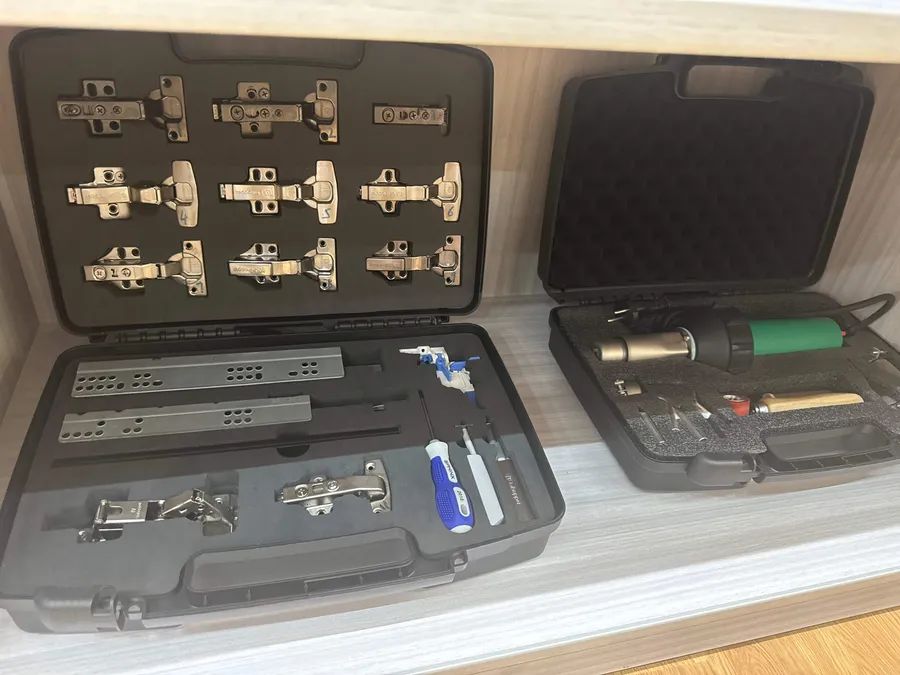
The interior is where an outdoor specification is won, and it is the cheapest thing to change. Custom foam starts at one set, and custom thickness, custom shape, die-cut and CNC-cut are all recorded against all 155 models, so a cradle for a specific optic, a tray for a radio and its cables, or a layered bed for a mixed kit needs no new tooling. To start we need the input our data names on every model: a drawing, a photograph of the packed kit or a physical sample. A sample is best outdoors, because it shows where grit collects and which pocket is opened with gloves on.
Hardware is specified the same way. The pressure equalisation valve, the shoulder strap, the document holder and the latch count are all recorded on every model as a configuration option rather than as fitted, so a fleet that flies, or a case that sees altitude change, is quoted with the valve on the order rather than assumed from the shelf. Colour and logo work begins at 300 pieces; OEM on existing mouldings runs to a first sample at 45 days with a 30 per cent deposit; and only a new shell geometry is a mould project at 125 days from 3,000 pieces per moulded component. Sealing, note, is a shell and rim property: adding foam does not make an unsealed shell gasketed, and a gasket does not cushion anything.
For organisations that run several kits of different sizes, the useful deliverable is a keyed layout set: one drawing per case type, signed and version-controlled, so that a replacement order two years later matches the first. On a fleet that is worth more than any material choice, because it is the difference between an auditable pack and a box that each user fills differently.
What we do not claim for outdoor use
Our published data holds no tested protection rating for any model, and we do not state an ingress code, a drop height, a stack load, a service temperature range or an ultraviolet exposure figure for any of the 155. Those fields are recorded as untested. Impact and shock resistance are recorded as a construction option on every model, with the note that the shell alone is not a shock rating and that a shock claim requires a specified foam layout. Where a specification needs numbers, accredited testing of a named shell, a named interior and a named load can be commissioned as a separate work package, and the report describes that article only.
The measured fields we do publish are worth reading for their limits as well as their content. Corrosion resistance is recorded as measured on all 155 models on the basis that a thermoplastic shell offers no ferrous corrosion path; feet, hinges and padlock-accepting latch bodies are recorded as measured on all 155; and the presence or absence of a gasket in the rim is recorded shell by shell, with 124 models publishing one and 31 stating that none is offered. Shell material is published per model - polypropylene on 94 models, engineering polypropylene on 38, ABS on 22 and one recorded as a polypropylene and ABS combination.
This is a deliberate position rather than an absence of data. A figure taken from a single tested configuration and printed across a catalogue describes a case that may not be the one you buy, so we publish geometry, material, hardware and option status, and we leave performance to a test of the article you are actually ordering.
Procurement notes
Send the equipment list rather than a size. A list with masses, packed dimensions, which items must not touch, whether the kit is packed wet, and how far it is carried by hand produces a shell and layout recommendation with the published figures to check it against. A request for an outdoor case in a given box size produces a box. Include whether sealing is required, because that is the single attribute that moves the selection off the ten-model outdoor shelf and into the gasketed part of the catalogue.
Freight data is calculated per order, not assumed from a datasheet: pallet quantity is computed from the carton footprint against your pallet size, and container loading figures for the usual equipment sizes are supplied with the quotation. The standard minimum order on catalogue shells is one, which is how a buyer proves a specification with a single sample before committing to a fleet.
Commercially we supply wholesale and OEM volume on EXW or FOB terms only. There is no retail channel, no delivered-duty-paid quotation and no overseas warehouse stock, so an outdoor season is planned with the production batch and your own inbound freight rather than bought from a stocking point. Third-party inspection of finished goods is welcome, and a first-sample shell with its signed layout is the fastest way to close a specification before volume.
Outdoor searches in the buyers' own words, answered with catalogue figures
The rows below pick up the equipment discussion above and answer it in the words buyers actually type, using only fields this site publishes for a named model. An outdoor listing is a wide one rather than a separate product line: 145 of our 155 injection-moulded models carry the outdoor protective case listing, and those 145 overlap heavily with the trades they serve, appearing 127 times under Electronics Cases, 120 under Tool Cases, 115 under Instrument Cases, 103 under Military Protective Cases and 85 under Camera Equipment Cases. Within the outdoor group, a wall thickness is published on 138 records and runs 2.0 to 6.0 mm, an empty mass on 85, usable interior volume from 0.3 to 47.0 litres, and 134 of the 145 are marked stackable while 11 are published with wheels.
The second paragraph is the limit of what those figures mean. Waterproofing, dust resistance, ultraviolet exposure, service temperature, stack load and payload are recorded as not measured on all 155 records, so nothing below is a rating. A gasket is a physical feature we can describe and photograph; keeping weather out is a result that has to be measured on the configuration you order, and we quote accredited third-party testing for that case rather than printing a number we do not hold.
| Search | What We Publish |
|---|---|
| outdoor equipment protective case | Treat it as a geometry question with 145 candidate shells. The outdoor group runs from KX 1204, an internal 115 x 78 x 32 mm box of 0.3 L usable volume at 100 g empty on a 2.6 mm wall, up to KX 87323 with an internal 650 x 430 x 210 mm, 47.0 L usable, a 5.0 mm wall and a 733 x 505 x 230 mm outside that still carries no wheels. In the working middle, KX 64621 publishes an internal 430 x 288 x 186 mm, 18.4 L usable and 3,000 g empty on a 4.7 mm wall with a gasket, and appears under the camera and drone listings as well as the outdoor one. Pick the internal envelope from the packed kit, then check the outside against the vehicle or shelf it lives on. |
| rainproof outdoor protective case | We do not publish a rainproof claim, and the reason is in the data: the waterproof field reads not measured on all 155 records, and no ingress code is stated for any model. What we can state is the rim. A compressible gasket in a continuous moulded channel, recorded as EPDM or equivalent, is published as a configuration option on 124 of the 155 and on 114 of the 145 outdoor-listed shells, while 31 outdoor shells publish none offered, so two nearly identical boxes can differ on this point alone: KX 4616 gives an internal 455 x 338 x 148 mm (19.6 L usable, 1,395 g) with a gasket, and KX 4716 gives an internal 458 x 345 x 150 mm (20.4 L usable, 1,680 g) without one. If standing rain or wash-down decides the purchase, specify the model number and we arrange a test of that configuration. |
| outdoor protective case manufacturer | We mould and assemble in-house, and the published evidence of that is the specification depth rather than a certificate: shell material is recorded per model as 94 PP, 38 engineering PP, 22 ABS and 1 PP/ABS combination across the catalogue. Interior work is our own too, with pick-and-pluck, die-cut, CNC-cut, EVA, PE and EPE recorded against the models, and custom foam, custom thickness and custom shape flagged on all 155. Order terms we publish: a trial or sample quantity from 1 set, logo, colour and OEM work from 300 pieces, a new mould from 3,000, about 45 days to a first OEM sample on existing tooling, about 125 days for a new tool and a 30 percent deposit on tooling. Wholesale and OEM only, quoted EXW or FOB, with no retail channel, no DDP and no overseas warehouse stock. |
| what size outdoor case for a camera and drone kit | Height and the lid split decide these kits, not length. KX 84421 publishes an internal 410 x 280 x 198 mm with 140 mm of lid over 58 mm of base and 18.2 L usable on a 4.2 mm wall, which is what a body with a mounted lens plus one spare needs; KX 85718 publishes an internal 520 x 296 x 155 mm with 100 mm of lid over 55 mm of base and 19.1 L usable for a flatter two-body layout; KX 64621 adds depth for a small folded airframe at an internal 430 x 288 x 186 mm. All three are outdoor-listed, stackable and published with a gasket, and where a case must be pulled rather than carried, 11 of the outdoor shells publish wheels. |
| can the interior be changed later on an outdoor case | Yes, and it is the cheapest field to revise. Base foam, top foam, egg-crate or convoluted lid, custom cut and layered interiors are recorded against the models, and pick-and-pluck, die-cut, CNC-cut, EVA, PE and EPE stock appear in the interior fields across all 155 records, with custom foam, custom thickness and custom shape flagged as available. A layered tray lets a kit that changes between callouts be revised one sheet at a time while the cavity holding the device stays untouched. Custom foam starts from 1 set with no tooling, and the only input we require is a drawing, a photograph of the packed kit laid out, or a physical sample. The shell figures never change, so keep them on file when you revise a layout years later: on KX 4610 and KX 4616 that is an internal 455 x 338 mm plan with a 302 mm narrow internal width, at 84 mm and 148 mm of internal depth. |
| how outdoor cases are packed for shipping | Freight follows the carton, and the carton is published per model on 64 of the 155 records, with counts ranging from 1 to 40 units. KX 62205, an internal 200 x 98 x 41 mm shell, ships 20 units in a 475 x 285 x 320 mm carton and KX 2005, internal 190 x 135 x 40 mm, ships 40 in a 410 x 360 x 495 mm carton, while the trolley KX 97227 publishes 1 unit in a 715 x 515 x 280 mm carton. Pallet quantity and container loading are recorded as not measured in the product data and are calculated from the carton footprint against your pallet when we quote. |
How to read an outdoor specification without a rating to hide behind
Three published fields do the work. The first is the seal flag: 124 of 155 records publish a gasket channel and 31 publish none, which is a rim difference rather than a quality difference, and it is the field to check first when a kit travels open-bed or stands in a porch. The second is the lid-to-base split, published on 100 models and decisive for anything that stands up in its own cavity; within the outdoor group, KX 86216 publishes 100 mm of lid over 30 mm of base on an internal 582 x 300 x 130 mm, while KX 84121 and KX 84123 sit on the same 405 x 325 mm external footprint at internal depths of 195 mm and 215 mm, which is how one shelf bay takes several builds. The third is empty mass: published on 85 of the outdoor shells and blank on the rest, where we supply the weighed figure for the exact model with the quotation rather than estimating it from a neighbour. One size family answers most outdoor questions before any tooling talk starts, because seven outdoor models repeat that 405 x 325 mm outside at internal depths of 115, 140, 140, 165, 170, 195 and 215 mm, and seven more repeat a 463 x 370 mm outside from 129 to 230 mm deep.
What this page does not claim about outdoor exposure
No model on this site is described as waterproof, dustproof, rainproof or temperature-rated, and no drop height, stack load or payload limit is stated, because those fields are recorded as not measured on all 155 records. Impact and shock entries are recorded as a manufacturer option that depends on a specified foam layout, not as a property of the shell alone; corrosion resistance is recorded as measured on the basis that a thermoplastic shell offers no ferrous corrosion path, while feet, hinges and padlock hardware are a separate question and are specified by configuration. Where a tenders document needs a number we do not publish, the honest route is a test of the ordered configuration, arranged and billed per project.
Commercially the same narrow position applies. This is a wholesale and OEM operation: no single-unit retail, quotations on EXW or FOB terms only, no DDP and no overseas warehouse stock, so an outdoor season is planned against the production batch and your own inbound freight. Existing-tool OEM work runs about 45 days to a first sample and a new mould about 125 days with a 30 percent deposit; logo, colour and OEM marking start from 300 pieces and a new mould from 3,000. Order by model number, because internal and external dimensions, wall thickness, the narrow internal width, the seal flag and empty mass all differ between neighbours in the same size family.
Customisation
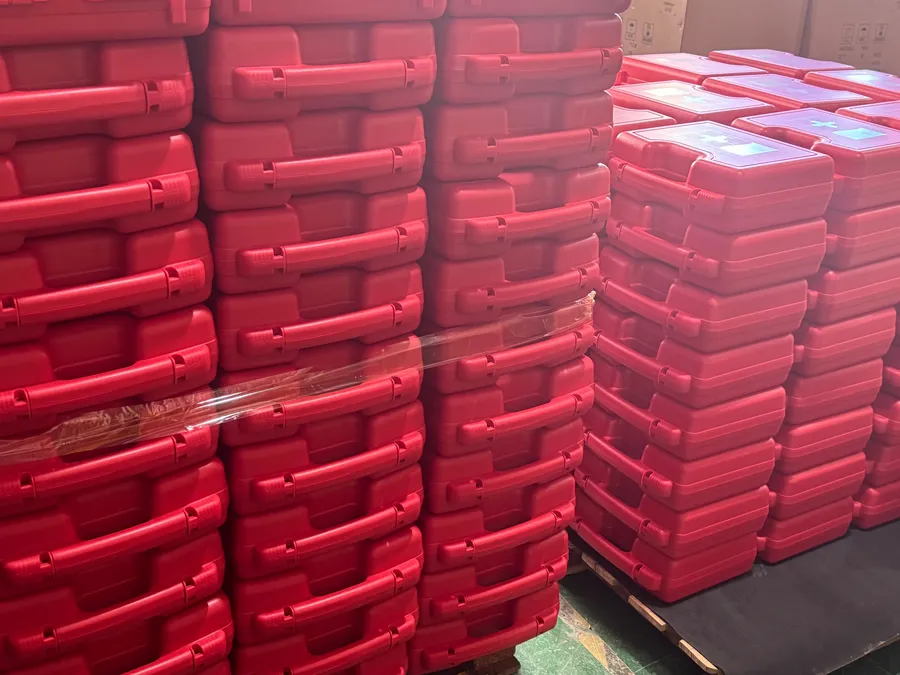
Everything described above is configurable on a standard shell: interior layout (pick-and-pluck, die-cut or CNC-cut), foam grade and thickness, colour, logo method, latch and lock count, pressure-equalisation valve, cable ports, document holder and identification plate. A bespoke exterior geometry requires a new mould — 125 days, from 3,000 units per moulded component.
Procurement considerations
| Question | What to send us |
|---|---|
| Which shell fits? | Equipment L × W × H as packed, plus required clearance per axis |
| What does it cost? | Order quantity and estimated annual quantity — the two drive different answers |
| Is tooling needed? | Whether an existing shell clears the envelope with usable foam depth |
| Lead time? | Your required delivery date, not just the order date |
| Certification? | The exact standard your tender names — we will say whether we can test to it |
| Freight? | Destination and preferred terms; carton and pallet data supplied with the quotation |
Comparison and selection guide
The tables on this page exist because a protective case is chosen by comparing three things: the envelope, the environment and the handling chain. Where no table applies, the rule below is.
| Situation | What To Do |
|---|---|
| Marine or wet | Sealed configuration with a drain-friendly interior and stainless hardware. |
| Dry and dusty | A close-fitting rim and a lid that can be opened one-handed without spilling contents. |
| Carried far | Under 10 kg packed, with a padded handle or shoulder webbing. |
- Size on internal dimensions plus clearance, never on a product name.
- Choose the carrying method before the shell: it changes the series, not just the price.
- Specify the interior last, and decide up front whether the end user will reconfigure it.
What equipment benefits from outdoor protective cases? relates to Protective Case Basics. Related families: Outdoor Protective Cases / Waterproof Cases / Camera & Photography Cases / Drone & UAV Cases / Field Equipment Cases / Tool Cases / Communication Equipment Cases. Related sectors: field and industrial equipment. Continue in the Protective Case Basics cluster.
This page is written from our own production data. If your requirement differs, send the dimensions and we will tell you which of the 155 models fits, or whether a custom route is needed.