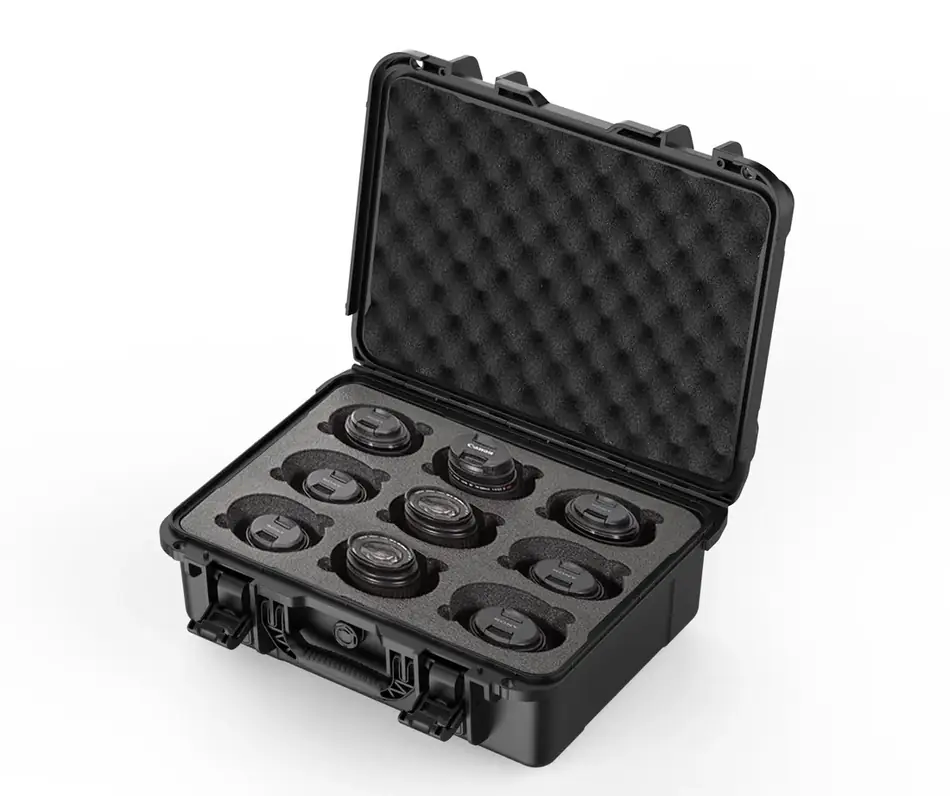
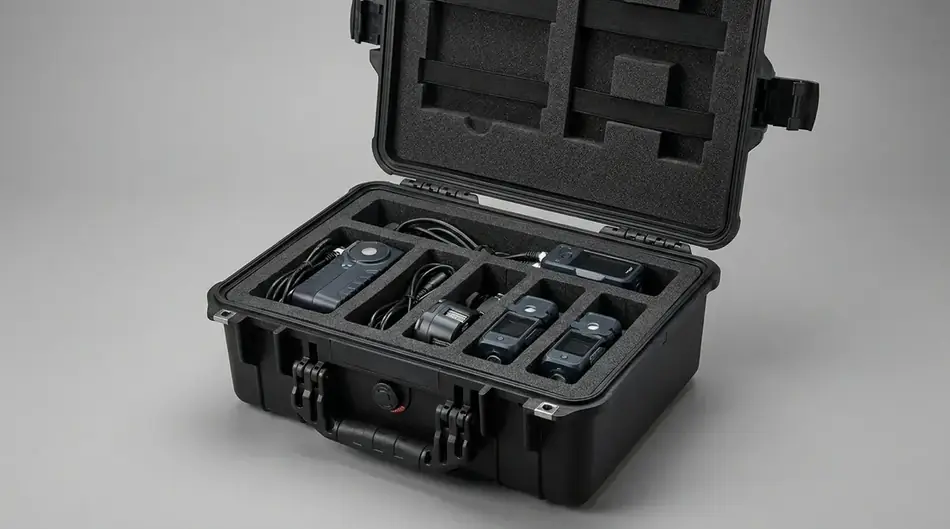
Protective Cases for Audio, Camera & Stage Equipment for Film Production
Short answer: a film-department case is sized by the tallest thing that travels assembled, not by the volume of the kit, and it is then named by three published figures on one model - internal height, the lid-to-base split and wall thickness. Sound mixers, lighting fixtures, gimbals and interview microphones fail in two repeatable ways on a production: a control panel, fader stack or lamp yoke loaded by the lid because the closure line crosses it, and a connector, knob, lens port or glass face driven into a hard pocket wall when the case lands on its edge. KeXin publishes internal and external dimensions and usable interior volume for all 155 thermoplastic shells, wall thickness for 148 of them between 2.0 and 6.0 mm, lid and base depth separately for 100, empty mass for 93, and a compressible gasket in a continuous moulded channel on 124 with 31 shells recorded without one. What we publish for no model is an ingress code, a free-fall height, a shock figure or a temperature range, so a shockproof or damage-proof request is answered here as shell construction plus cut foam, with accredited testing commissioned on the exact build when a client demands a number.
Key points
- Size a film case on the assembled travel configuration: internal height first, then the lid-to-base split, then footprint.
- 100 of the 155 shells publish lid depth and base depth separately, and a 140/25 mm split is a different case from a 43/149 mm split.
- No ingress code, free-fall height or shock figure is published for any model; 124 shells record a gasket channel and 31 record none.
- A mixer with proud faders wants lid depth, so compare KX-84419 at 120/45 mm against KX-84416 at 90/45 mm at the same 395 x 295 mm plan.
- Booms, stands and rails belong in long shells: KX-86216 at 582 mm, KX-89616 at 880 mm and KX-814641 at 1,280 mm of internal length.
- Low mass per litre is a wall-thickness trade: KX-4616 gives 19.6 usable litres at about 1,395 g, while the 2.5 mm KX-4710 formats record no gasket.
- 19 of 155 shells publish wheels and every one of them is recorded as non-stackable, which is what an OB trolley costs a distributor.
What Actually Damages Audio, Camera And Stage Gear On A Production
A film kit is not one object in a box, it is a stack of asymmetric risks: a mixer whose fader and knob assembly stands 40 mm above its chassis, a lighting fixture whose yoke and bracket never fold flat, a gimbal whose arms fold but never collapse to a rectangle, a microphone whose capsule end is soft, and a shelf of small high-value accessories - transmitters, receivers, batteries, cards, adapters, SDI and XLR leads - that all behave like shrapnel once they are loose. Three mechanisms account for most of the damage we are asked to design against. The first is lid loading: the closure line crosses a standing item, and the lid transmits a car boot or a stacked case into a control panel. The second is pocket impact: an item immobilised in a wall that is too close or too hard transfers a knock into a connector, a lens port or a glass face, which is why the wall is a controlled distance and the item rests on its strongest datum rather than on a protrusion. The third is internal migration: two items sharing one cavity, so a coil of cable becomes a hammer each time the case is carried. Only the first two are shell decisions, and the third is entirely an interior decision, which is why a sound department and a lighting department can order the same moulding and get completely different results from it.
Audio Mixer Transport Case: Lid Depth Before Footprint
A location mixer is the clearest example of a case chosen by height rather than area. A 12 to 16 channel unit is roughly a flat slab with something standing on it: faders, rotary controls, a meter bridge, sometimes a rack ear or a field box bolted to the underside. If it travels with those fitted, the tallest standing dimension decides the internal height, and the lid must clear it with margin. Two published shells handle the common mid-size formats: KX-84416 gives 395 x 295 x 135 mm internal on a 4.2 mm wall with a 90 mm lid over a 45 mm base and 12.6 usable litres, while KX-84419 is the same plan at 165 mm of height with a 120 mm lid over that same 45 mm base and 15.4 usable litres - a two-unit family built exactly for a chassis that sits low and a control surface that stands proud. Where the mixer travels with a patchbay, a battery plate and coiled looms, go wider and deeper: KX-4822 publishes 460 x 330 x 210 mm internal on a 3.3 mm engineering-PP wall with a 165 mm lid over a 45 mm base, about 2,710 g empty and 27.4 usable litres; KX-4821 is the stiffer option at 447 x 312 x 194 mm on a 4.5 mm wall with a 144/50 mm split, about 3,670 g and 21.7 litres. Small two-track and eight-channel recorders sit comfortably in the ABS KX-64114 at 378 x 307 x 120 mm, 4.0 mm wall, about 2,100 g and 11.1 usable litres, or in KX-4012 at 380 x 305 x 110 mm with an 85 mm lid over a 25 mm base at about 1,480 g. In every one of these, the rule is the same: the chassis carries the load on its base or rack rails, and nothing at all rests on the control surface.
Audio Recordist Professional Equipment Case
A recordist kit is several unrelated objects that must be reachable in the dark: a recorder or mixer, a boom with its shockmount and blimp, a bag of handheld and lav microphones, XLR and TRS leads coiled by length, spare batteries, a windjammer set, adapters, headphones and a pair of gloves. The layouts that survive a long day are two-layer builds - a firm base plank holding the recorder on its own footprint with the connector edge over an open relief, and a shallow lid tray holding leads, adapters and batteries so a plug never travels into a socket. For a single-person kit the practical shells are KX-3315 at 303 x 224 x 135 mm on a 4.1 mm wall with a 100 mm lid over a 35 mm base, about 1,670 g and 7.4 usable litres; KX-3218 at 308 x 230 x 172 mm on a 3.0 mm wall with an 86/86 mm split at about 900 g and 10.5 litres, which is the lightest way to carry a two-layer interior; and the ABS KX-63619 at 333 x 217 x 175 mm, 3.5 mm wall, about 1,660 g and 10.8 litres where the department wants stiffness per millimetre. A boom, a pistol-grip pole and a light stand are length problems, not volume problems, and they should not share a case with electronics: KX-4312 at 420 x 260 x 104 mm on a 3.5 mm wall at about 1,170 g takes a disassembled short boom, while KX-86216 at 582 x 300 x 130 mm with a 100 mm lid over a 30 mm base and 19.5 usable litres takes a three-piece pole in a channel per section. Note that KX-4312 publishes a narrow internal width of 236 mm against a nominal 260 mm, which a machined tray must clear.
How To Choose A Portable Audio Recording Case
Choose from the packed state outward, in this order. One: lay the kit out as it actually travels - recorder with its cage on, cables coiled, windscreen fitted, batteries in the case rather than the camera - and measure three numbers, the length and width of the footprint, the height of the tallest standing item, and the height of anything you refuse to strip at the roadside. Two: add working clearance of roughly 20 mm per axis for the cut, and translate that into internal dimensions, not external ones; our library publishes both, and the difference between them is the wall plus the hardware, which is where a datasheet comparison goes wrong most often. Three: pick the lid-to-base split so the tall item sits in the deeper half and the closure line crosses only empty relief; 100 of the 155 models publish those two figures separately. Four: read the narrow internal width on the 36 models that publish it, because a cavity that tapers will bind a machined tray that clears the wide section. Five: check empty mass against the walk from the vehicle, since 93 models publish it and the spread is enormous - a KX-2614 at about 460 g and a KX-64114 at about 2,100 g enclose broadly similar working volume for a small recorder kit. Six: decide what has to be provable to your client, because that is the only thing that turns a stock shell into a test programme.
Broadcast Interview Mic Shockproof Box
An interview kit is small, expensive and endlessly repeated: two or three handheld dynamics, a set of lav transmitters and lavaliers, a shockmount, windscreens, short leads and a charger, often issued to a different person every shift. Its case should be sized by the longest mic with its grille guard fitted, and its interior should be a firm carrier with one pocket each, because the failure is a rolled grille or a crushed capsule rim, not a cracked shell. The compact published options: KX-2808 at 265 x 190 x 76 mm on a 2.2 mm wall, about 430 g and 3.3 usable litres, holds two handhelds lying down with leads in the lid; KX-2507 and KX-2508 share a 245 x 175 mm plan at 64 mm and 68 mm high on a 2.0 mm wall at about 340 g and 338 g, which is the lightweight answer for a two-person radio kit; and the ABS KX-62209 at 200 x 98 x 78 mm on a 3.5 mm wall, about 410 g and 1.3 litres, is the stiff little box for a single precision measurement or presenter microphone with its foam and a short lead, with the narrower KX-62205 at 200 x 98 x 41 mm and about 310 g for a mic alone. Where the requirement is a mini hard case that lives in a bag, KX-1905 at 180 x 160 x 40 mm on a 3.0 mm wall at about 250 g records a gasket channel; KX-2005 is the same class at 190 x 135 x 40 mm, about 175 g, and records none. On the word shockproof: our impact field states a wall thickness with no free-fall height claimed without a test, and our shock field is a manufacturer option that only exists once a foam layout is specified, so what protects a capsule here is the pocket, not the adjective.
Broadcast Handheld Gimbal Protective Case
A gimbal is the worst-shaped object in the kit, because it folds into something that is thick in the middle and thin at the arms, and its motor yokes and ribbon cables are the parts that fail. Two rules: the gimbal travels partially assembled with its balance plates fitted so no one has to re-tension it on location, and nothing rests on a motor arm or a mount ring. For a phone or compact-camera stabiliser, KX-3213 at 308 x 230 x 118 mm on a 3.0 mm wall with an 86 mm lid over a 32 mm base, about 860 g and 7.2 usable litres, is the natural format - the deep lid takes the folded arms while the base carries the grip and its controls. For a mirrorless or broadcast handheld rig with its tripod legs attached, KX-63416 in ABS at 310 x 255 x 138 mm on a 4.8 mm wall, about 1,800 g and 8.7 litres, or KX-83620 at 290 x 220 x 185 mm with a 135 mm lid over a 50 mm base and 10.1 litres, hold the rig standing with its accessories in the lid. A controller, a set of quick-release plates and spare batteries go in a separate small box such as the ABS KX-63612 at 333 x 217 x 114 mm, about 1,300 g, rather than on top of the arms, and a gimbal that shares a case with a follow-focus motor should have a routed channel between them so the two metal bodies cannot meet.
Broadcast Portable OB Equipment Trolley Case
An outside-broadcast package is the one place in this category where wheels are the correct first decision rather than the last, because the load genuinely moves a long distance on tarmac, studio floor or grass, and a 30 m walk with 40 kg is an injury risk before it is a logistics question. Nineteen of the 155 models publish wheels; eleven of them publish a fixed telescopic handle height, and every wheeled shell is recorded as non-stackable. For a two-operator OB kit with an intercom, a mixer, monitors and a cable drum, the working options are KX-85827 at 500 x 400 x 220 mm internal on a 5.0 mm wall, a 175 mm lid over a 45 mm base, published 295 mm telescopic height, about 7,800 g empty and 35.2 usable litres; the deeper KX-85835 at 500 x 400 x 305 mm with a 260 mm lid and about 8,520 g for 48.8 litres; KX-86136 at 530 x 360 x 304 mm with a 260/44 mm split, 295 mm handle height, about 8,500 g and 46.4 litres; and the broad KX-96127 at 545 x 545 x 210 mm, a square plan that takes a rack shelf and a pair of monitors side by side at about 8,540 g and 49.9 litres. Where the kit is really large, the 740 mm formats KX-88434 at 740 x 518 x 284 mm and about 14,030 g and KX-88442 at 740 x 518 x 364 mm and about 15,320 g are what the arithmetic allows, with 87.1 and 111.6 usable litres. For a rigid non-wheeled OB body the ABS KX-66232 gives 507 x 385 x 290 mm on a 5.3 mm wall at about 7,940 g and 45.3 litres. Two checks before you commit: external height, because a wheeled shell must clear a van floor and a doorway, and the stacking record, because a trolley cannot be palletised on top of another trolley.
Film Lighting Equipment Case
A fixture is a flat panel with something bolted to both faces: a yoke and bracket at the back, barn doors or a diffuser at the front, and a connector block on one edge. It is also the heaviest thing in the grip truck relative to its size, so the case is chosen by internal height over the fitted bracket and by wall thickness against stacking, not by area. For a panel or small soft source lying flat, the flat formats are KX-4610 at 455 x 338 x 84 mm internal on a 3.0 mm wall, about 1,115 g and 11.1 usable litres with a 42/42 mm split, and KX-4710 at 458 x 345 x 90 mm on a thinner 2.5 mm engineering-PP wall at about 1,370 g and 12.2 litres - with the honest caveat that all three of KX-4710, KX-4713 and KX-4716 record no gasket channel while the 3.0 mm KX-4610 records one. A fixture with its yoke and bracket fitted needs the next height: KX-4613 at 455 x 338 x 116 mm with a 74 mm lid over a 42 mm base, about 1,370 g and 15.3 litres, or KX-4713 at 458 x 345 x 120 mm with a 75/45 mm split at about 1,420 g and 16.3 litres. Heavier fixtures and units travelling with a scrim, a gel frame set and a colour pack belong in KX-4616 at 455 x 338 x 148 mm, 74/74 mm and about 1,395 g, or in the ABS KX-64819 at 454 x 325 x 173 mm on a 3.5 mm wall at about 2,800 g and 21.9 litres. Barn doors, nets and gel sheets go in the lid as flat laminated layers, never folded into the base beside a glass face.
Film Lighting Transport Protective Case: Stands, Grip And The Load In Behind
Transport is a different question from the fixture case, because what damages grip equipment is the way it is loaded rather than the way it is packed. Light stands, C-stands, booms and knuckles collapse into long tubular members with collars that stand proud, and their failure point is a bend at a point load - an end resting on a case rim, or a stack of shorter cases parked on top of a long shell. The library answers this by length rather than volume: KX-86216 gives 582 x 300 x 130 mm internal with a 100 mm lid over a 30 mm base and 19.5 usable litres, KX-88015 gives 725 x 350 x 140 mm on a 5.0 mm wall with a 100/40 mm split and 28.4 litres, KX-89616 gives 880 mm in the same section, and KX-814641 gives 1,280 x 350 x 140 mm and 50.2 usable litres, the longest cavity we publish; the KX-87926 at 737 x 257 x 240 mm with a 175 mm lid over a 65 mm base is the option when stands travel with heads and arms attached. Three construction points do more than any adjective: one channel per member so nothing rolls, a base plank firm enough that a collar does not dig into soft pluck, and no case stacked on a long shell in transit - which is a loading instruction, and we print it on the shell. If your safety document requires a documented figure, we quote accredited testing of the ordered configuration as a separate work package, because no model publishes one.
Film Props Damage-Proof Safety Box
We will not sell the word damage-proof, because a moulding cannot earn it and a prop is exactly the object that proves it. A prop is one-off, often hand-finished, frequently the only surviving take of a hero item, and it is handled by people who did not make it. What we can specify is the construction that makes damage unlikely: a wall thick enough to survive a stack in a truck, an interior in which the item is carried on its strongest section with every unsupported span bridged, a retainer so an inverted case cannot lift the item out of its seat, and a closure that a second person can verify without touching the prop. For small and mid props the published shells most often used are the ABS KX-62810 at 253 x 182 x 86 mm on a 4.0 mm wall, about 900 g and 3.2 usable litres; the deep KX-93221 at 300 x 200 x 200 mm on a 5.0 mm engineering-PP wall with a 165 mm lid over a 35 mm base, about 1,230 g and 9.6 litres; KX-2614 at 240 x 200 x 120 mm on a 2.2 mm wall, about 460 g and 5.0 litres for a light object with a tall relief; and KX-83620 at 290 x 220 x 185 mm with a 135/50 mm split and 10.1 litres where the prop travels with its stand. For weapons-grade handling questions - locked transport, a chain-of-custody seal, marked ownership - every model publishes a latch body that accepts a standard padlock, and a document holder is a configuration option rather than a moulding feature.
Lightweight Film Equipment Case Design
Mass is the number a location crew actually feels, and it comes from three separate places: wall thickness, shell area and hardware. Within our published data, the design lever with the biggest effect is wall thickness, recorded between 2.0 and 6.0 mm on 148 of 155 shells, and the trade is stiffness against stacking. The engineering-PP thin-wall family shows what that buys: KX-705 at 420 x 270 x 112 mm on a 2.1 mm wall is about 830 g empty for 10.9 usable litres, KX-706 at 443 x 285 x 126 mm on the same 2.1 mm wall is about 1,030 g for 13.7 litres, and KX-707 at 465 x 310 x 140 mm on a 2.5 mm wall is about 1,360 g for 17.4 litres. Measured per litre, the best ratio in the catalogue belongs to KX-4616 at 455 x 338 x 148 mm, 3.0 mm wall, about 1,395 g for 19.6 usable litres - roughly 71 g per litre, where the ABS KX-64819 needs about 2,800 g for a comparable working envelope. In the small formats, KX-3218 gives 10.5 usable litres at about 900 g and KX-3213 gives 7.2 litres at about 860 g on a 3.0 mm wall with a gasket recorded. Three costs to state plainly: the thinnest shells in this size class - KX-705, KX-706, KX-707 and the KX-4710 formats - record no gasket channel; a lighter shell tolerates less stacking load, which matters in a truck; and hardware adds mass that a datasheet shows as empty weight, so ask for it on the named model rather than assuming a series figure.
Interiors, Cable Ways And Marking For A Shared Kit
A production case is issued to whoever is on call, so the interior has to be self-explanatory. We cut cross-linked PE, EVA or EPE plank by zone: die-cut where a department repeats a layout across several units, CNC-cut where a pocket wall must hold tolerance around a connector or a bracket, and layered builds with a firmer carrier under mass and a softer face against a finished body. EVA is the usual face layer for audio and lighting kits because it is closed-cell, so a wet hand, a spilled drink or a rain-soaked glove wipes off instead of soaking in. Four details earn their cost on a film case: routed lead channels sized by length so a coiled XLR lies flat and cannot push a plug into a socket; a relief window under every standing control, connector or lamp face; printed or routed outlines so a missing card reader or adapter shows the moment the lid opens; and colour-coded zones where one case serves two operators. Pick-and-pluck is the right answer only where the kit genuinely changes between productions, and a fixed base with a pluck lid is the usual compromise for a rental fleet. Custom foam starts at one unit on an existing shell and needs a drawing, a scale photograph of the packed kit or the physical item; anti-static or conductive liner is a separate material specification evidenced on the batch, not an attribute of a moulding.
Buyer Search Phrase And The Published Figure That Decides It
Every figure in this table is a published specification for the named model and nothing else; none of them is a performance rating, and the comparison is only valid against the packed envelope measured on your own kit. Where a studio, a broadcaster or a rental house needs documented proof of ingress, free-fall or stacking behaviour, we quote accredited testing of that exact shell, gasket, latch and foam configuration as a separate work package rather than printing a number we cannot document - and we say plainly when a stock cavity is closer and cheaper than a new moulding.
| Buyer Search | Deciding Published Figure | Published Example |
|---|---|---|
| audio mixer transport case | Internal height and lid depth for a fader stack that cannot be stripped, with the chassis carrying the load | KX-84416: 395 x 295 x 135 mm, 4.2 mm, 90/45 mm lid/base, 12.6 L; KX-84419: same plan at 165 mm high, 120/45 mm, 15.4 L; KX-4822: 460 x 330 x 210 mm, about 2,710 g |
| audio recordist professional equipment case | A two-layer build: recorder on its own footprint with the connector edge relieved, leads and batteries in the lid | KX-3315: 303 x 224 x 135 mm, 4.1 mm, 100/35 mm, about 1,670 g, 7.4 L; KX-3218: 308 x 230 x 172 mm, 86/86 mm, about 900 g, 10.5 L |
| how to choose a portable audio recording case | Packed-state height plus about 20 mm cut clearance, then the narrow internal width on the 36 models that publish it | KX-4012: 380 x 305 x 110 mm, 85/25 mm, about 1,480 g; KX-4312: 420 x 260 x 104 mm but 236 mm narrow width, about 1,170 g |
| broadcast interview mic shockproof box | One firm pocket per microphone with the grille unloaded; no shock figure is published for any shell | KX-2808: 265 x 190 x 76 mm, 2.2 mm, about 430 g, 3.3 L; KX-62209 ABS: 200 x 98 x 78 mm, 3.5 mm, about 410 g, gasket recorded |
| broadcast handheld gimbal protective case | Internal height over folded arms, with nothing resting on a motor yoke or mount ring | KX-3213: 308 x 230 x 118 mm, 86/32 mm lid/base, about 860 g, 7.2 L; KX-83620: 290 x 220 x 185 mm, 135/50 mm, 10.1 L; KX-63416 ABS: 4.8 mm wall, about 1,800 g |
| broadcast portable ob equipment trolley case | Carry distance, published telescopic height, external height - and the loss of the stacking face | KX-85827: 500 x 400 x 220 mm, 295 mm handle, about 7,800 g, 35.2 L; KX-88442: 740 x 518 x 364 mm, about 15,320 g, 111.6 L; 19 wheeled models, all non-stackable |
| film lighting equipment case | Height over the fitted yoke and bracket, plus wall thickness against a loaded truck | KX-4613: 455 x 338 x 116 mm, 3.0 mm, 74/42 mm, about 1,370 g, 15.3 L; KX-4713: 458 x 345 x 120 mm, 2.5 mm, no gasket recorded |
| film lighting transport protective case | Internal length with one channel per stand or boom section, and a rule against stacking anything on a long shell | KX-88015: 725 x 350 x 140 mm, 5.0 mm, 100/40 mm, 28.4 L; KX-89616: 880 mm; KX-814641: 1,280 x 350 x 140 mm, 50.2 L - longest published cavity |
| film props damage-proof safety box | Item carried on its strongest section, unsupported spans bridged, plus a retainer and a padlockable latch | KX-93221: 300 x 200 x 200 mm, 5.0 mm, 165/35 mm, about 1,230 g, 9.6 L; KX-62810 ABS: 253 x 182 x 86 mm, 4.0 mm, about 900 g, 3.2 L |
| lightweight film equipment case design | Empty mass per usable litre, and the wall thickness that buys it | KX-4616: about 1,395 g for 19.6 L on 3.0 mm; KX-705: about 830 g for 10.9 L on a 2.1 mm wall but no gasket recorded; KX-706: about 1,030 g for 13.7 L |
| custom colors for audio and video equipment cases | Colour is a shell finish option quoted near 300 units; it changes neither wall thickness nor the gasket record | All 155 models list custom colour and custom logo; MOQ 1 on a stock shell, near 3,000 per component for a dedicated mould, about 125 days |
| film equipment case buying guide | Internal dimensions, lid and base split, narrow width, empty mass and hardware - all read on one named model | 148 of 155 publish wall thickness, 100 publish lid and base depth, 93 publish empty mass, 124 record a gasket channel, 64 publish carton data |
Selection Guidance: Seven Checks Before A Film Or Broadcast Case Order
One: name the configuration that travels, not the catalogue item, and record the tallest standing dimension separately, because that is what the lid will meet. Two: read lid depth and base depth apart rather than as a total; a 140 mm lid over a 25 mm base in KX-64618 and a 43 mm lid over a 149 mm base in KX-5321 enclose similar heights and do completely different jobs. Three: check the narrow internal width on the 36 models that publish it before you machine a tray. Four: put empty mass against the walk from the vehicle, using the 93 models that publish it. Five: confirm hardware on the named datasheet - gasket recorded or not, latch count specified per configuration, handle type, wheels and telescopic height - rather than assuming a series capability. Six: decide which of the three carry formats you actually need: a carried mid-size shell, a long shell for stands and booms, or a wheeled shell for an OB package, because most departments over-buy one and under-buy another. Seven: write down which documents your purchaser requires, since a case for a location shoot and a case written into a broadcaster's equipment specification are two different briefs and only the second needs a commissioned test.
Where These Cases Are Used
The buyers are wider than feature production. Film and commercial units need mixer, lighting, grip and prop cases that survive a vehicle load and a wet location. Broadcast and OB crews need intercom, camera, monitor and infrastructure cases that also travel a long distance on foot, which is why the wheeled formats dominate that segment. Live events and touring audio teams need repeatable, colour-coded interiors that a freelance crew can issue and return without training. Corporate video, documentary and news crews buy small stiff shells for microphones, recorders and gimbals because their kit is carried in a passenger vehicle. Rental houses and equipment suppliers standardise on a handful of cavities so interiors can be swapped between productions, and they care most about stackability and carton arithmetic. Schools, broadcasters' training units and houses of worship maintain a fixed kit in a fixed case where the outline drawing is the training document. Venue and staging companies pack consoles, snakes, junction boxes and stands on the same routes every week, which makes one channel per member a rule rather than a preference. All of them draw on the same shells and differ only in cut, gasket, carry format and marking.
Custom Colours For Audio And Video Equipment Cases, And Other Shell Options
Colour does two jobs on a production: it identifies a department at a glance in a dark truck, and it brands a fleet for a rental or broadcaster catalogue. All 155 models list custom colour and custom logo as available, and both, along with OEM hardware and buyer-branded packaging, begin near 300 units; an OEM first sample on an approved existing shell takes about 45 days, while a change to the shell itself needs a mould at near 3,000 units per component and about 125 days from approved drawings. Two things a colour does not do: it does not change the published wall thickness, and it does not add or remove a gasket channel - the 31 shells that record none still record none in any colour. A pressure-equalisation option, a shoulder strap and a document holder are configuration items on every model, and latch count is specified per build because uneven compression across a rim is what lets grit in. Where a fleet wants visual department coding without new tooling, the usual answer is a standard shell colour plus a coloured interior layer and a printed outline drawing, which is quoted from one unit.
Procurement Notes: Wholesale Terms, Verification And What We Will Not Claim
KeXin New Materials (Guangdong) Co., Ltd. moulds these shells and supplies wholesale and OEM or ODM buyers on EXW or FOB terms only. There is no retail channel, no delivered-duty-paid quotation and no overseas warehouse stock, so a landed cost is an FOB figure plus your own freight and clearance; carton size and pieces per carton are published on 64 of the 155 models - KX-2005 lists a 410 x 360 x 495 mm carton of 40, KX-3207 a 645 x 530 x 430 mm carton of 24, KX-65522 a 565 x 450 x 665 mm carton of 3 - and pallet and container arithmetic is built from those or supplied with the quotation. Minimum order is one unit on a stock shell and one unit on a custom foam layout; near 300 units for colour, logo or OEM hardware; near 3,000 per component for a dedicated mould. Payment is a 30 per cent deposit with the balance after inspection, and third-party factory inspection before shipment is welcome. Then apply three questions to us as you would to any supplier: which accredited report produced this figure, what method and conditions were used, and does it cover the exact build being bought. Any field our datasheet records as not measured - ingress, free-fall height, shock, temperature range, stack load, humidity - is the answer we will give you, and we would rather a production heard that before a tender response. Enquiries go to Fred Zhao or the KeXin Sales Team, WhatsApp +86 135 3588 0002.
Three buyer searches, answered from the published catalogue
The three search phrases below are copied verbatim from buyer searches, and each row is answered with figures already published in the model catalogue or stated earlier on this page, so every number can be checked against a named model. Where a property has no published value, the row says so.
| Search | What We Publish |
|---|---|
| film equipment case manufacturer | The shells are moulded by KeXin New Materials (Guangdong) Co., Ltd. in Guangdong and supplied wholesale and OEM/ODM only, quoted EXW or FOB from Guangdong, China. For film department loads the catalogue already names the shells this page sizes: KX-84416 at 395 x 295 x 135 mm internal on a 4.2 mm wall, and the long KX-86216 at 582 mm internal length with 19.5 usable litres. Wall thickness is published for 148 of the 155 models, between 2.0 and 6.0 mm. |
| audio equipment case manufacturer | For mixer-format audio gear the comparison is lid depth on one plan: KX-84416 and KX-84419 share a 395 x 295 mm footprint with a 90 mm lid over a 45 mm base versus a 120 mm lid, giving 12.6 and 15.4 usable litres, both PP shells with a moulded gasket channel. A compact recordist build is KX-3315 at 303 x 224 x 135 mm, 4.1 mm wall, engineering PP, 7.4 usable litres and 1,670 g empty. Across the catalogue a gasket channel is recorded on 124 of 155 shells and 31 shells record none. |
| photo & audio equipment case source factory custom | Custom work is configuration on published shells: all 155 models record oem_available and odm_available as true, a custom foam layout starts from 1 set with no tooling, and colour, logo or OEM hardware begin near 300 pieces. Foam types published are Pick & Pluck, Die-Cut, CNC-Cut, EVA, PE and EPE, cut to drawing. A dedicated mould is quoted near 3,000 per component at about 125 days from approved drawings, with a first OEM sample on an existing shell at about 45 days. |
What a factory-direct enquiry should attach
Buying direct from the manufacturer does not change how this page says to size a case — internal height first, then the lid-to-base split, then the foam — it removes the layer between the drawing and the moulding. A department list sent as packed dimensions gets answered per model: the materials mix across the 155 shells is 94 PP, 38 engineering PP, 22 ABS and 1 PP/ABS, so a wall-thickness or mass target can usually be met in more than one resin, and the datasheet for each candidate states which. Quotations are returned per model number, not per category name.
Payment and verification terms are the ones already stated on this page: a 30 per cent deposit with the balance after inspection, third-party factory inspection welcome, no retail channel, no DDP quotation and no overseas warehouse. Carton size and pieces per carton are published on 64 of the 155 models, which is how a mixed film-package order is turned into pallet and container arithmetic before it is quoted.
What we do not claim, and who to contact
No ingress code, free-fall height, shock figure or temperature range is published for any model, and the same holds for the three searches above: where a datasheet records a field as not measured, that is the answer an enquiry receives, and accredited third-party verification can be commissioned on the exact build when a number is required. Enquiries go to Fred Zhao or the KeXin Sales Team, WhatsApp +86 135 3588 0002.
Customisation
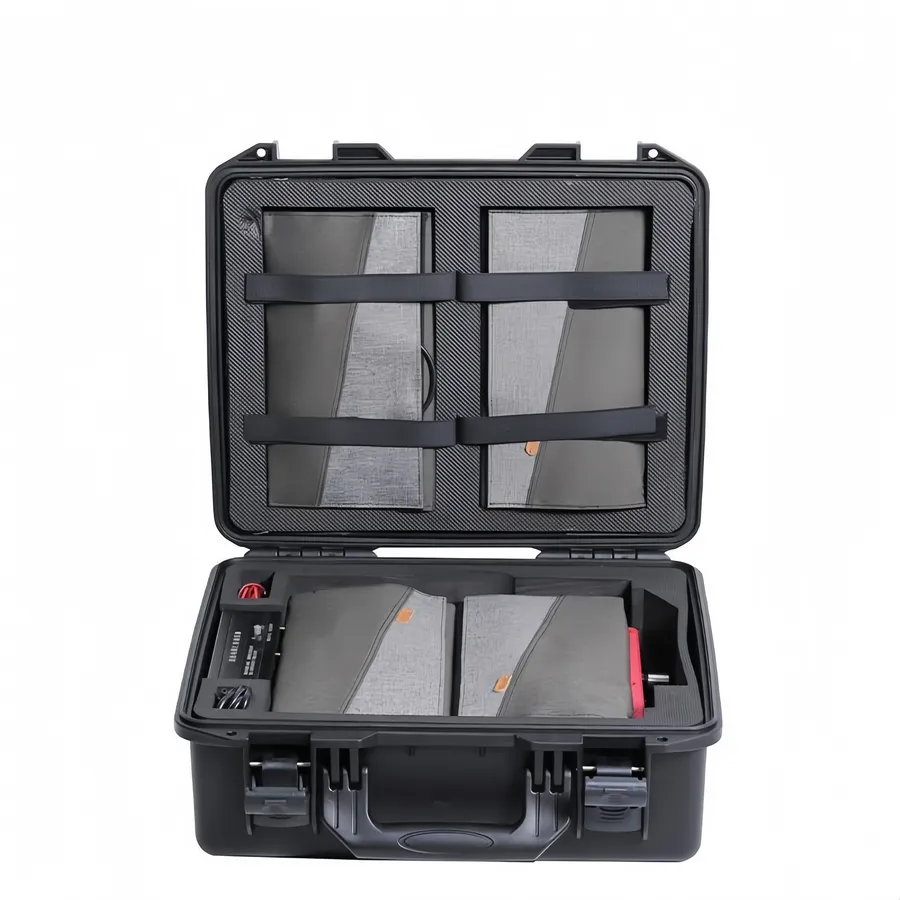
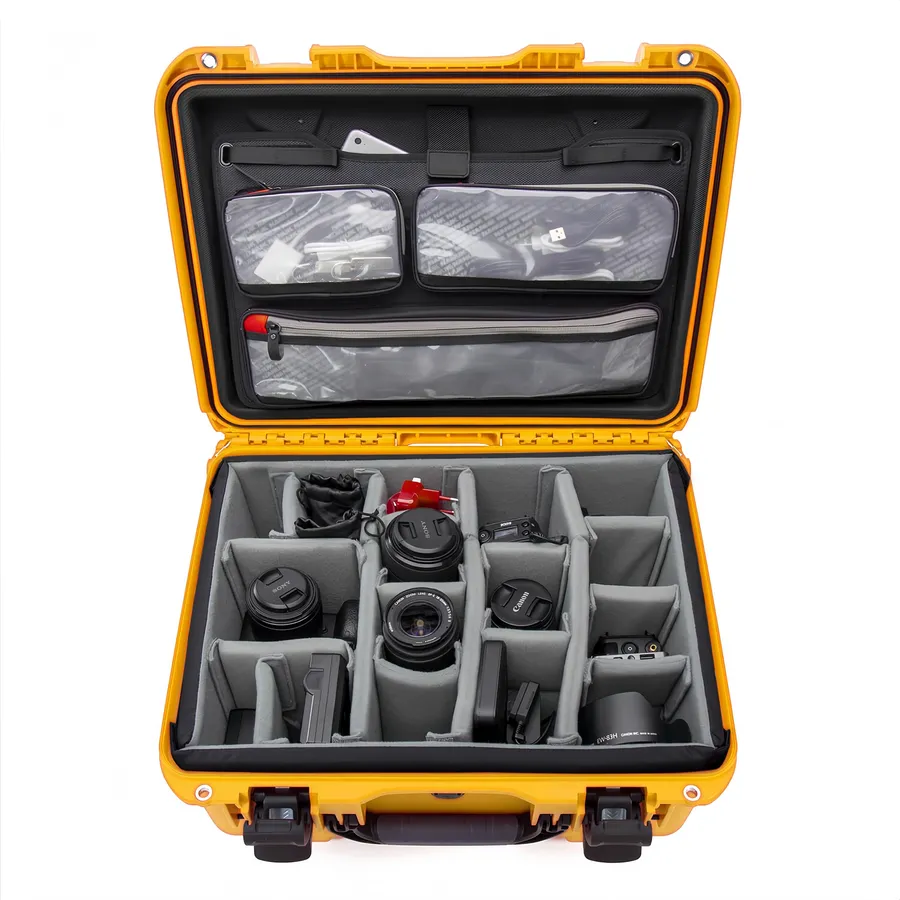
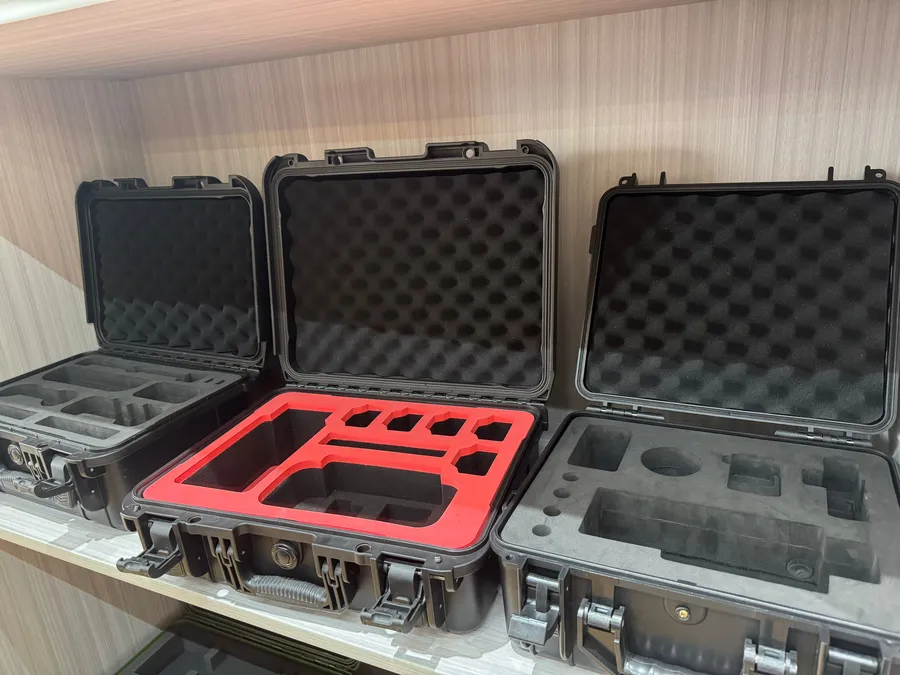
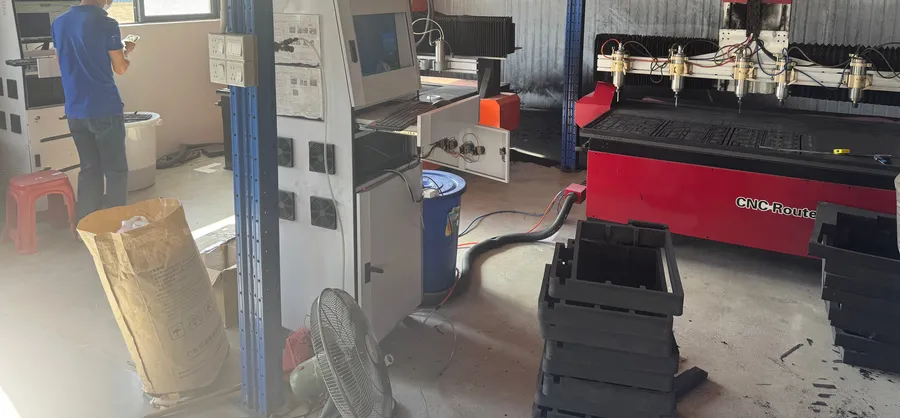
Everything described above is configurable on a standard shell: interior layout (pick-and-pluck, die-cut or CNC-cut), foam grade and thickness, colour, logo method, latch and lock count, pressure-equalisation valve, cable ports, document holder and identification plate. A bespoke exterior geometry requires a new mould — 125 days, from 3,000 units per moulded component.
Procurement considerations
| Question | What to send us |
|---|---|
| Which shell fits? | Equipment L × W × H as packed, plus required clearance per axis |
| What does it cost? | Order quantity and estimated annual quantity — the two drive different answers |
| Is tooling needed? | Whether an existing shell clears the envelope with usable foam depth |
| Lead time? | Your required delivery date, not just the order date |
| Certification? | The exact standard your tender names — we will say whether we can test to it |
| Freight? | Destination and preferred terms; carton and pallet data supplied with the quotation |
Comparison and selection guide
The tables on this page exist because a protective case is chosen by comparing three things: the envelope, the environment and the handling chain. Where no table applies, the rule below is.
| Situation | What To Do |
|---|---|
| Changing kits | Layered pluck foam, rebuilt by hand. |
| Fixed rental fleet | CNC silhouette with serial pockets and an inventory list. |
| Harsh locations | Sealed shell plus desiccant provision in the lid. |
- Size on internal dimensions plus clearance, never on a product name.
- Choose the carrying method before the shell: it changes the series, not just the price.
- Specify the interior last, and decide up front whether the end user will reconfigure it.
Protective Cases for Audio, Camera & Stage Equipment for Film Production relates to Protective Case Basics. Related families: Camera & Photography Cases / Communication Equipment Cases / Electronics Cases / Rolling Cases / Equipment Transport Cases / Long Equipment Cases / Custom Protective Cases / Field Equipment Cases / Outdoor Protective Cases / Waterproof Cases. Related sectors: field and industrial equipment. Continue in the Protective Case Basics cluster.
This page is written from our own production data. If your requirement differs, send the dimensions and we will tell you which of the 155 models fits, or whether a custom route is needed.