Relay Protection Tester Case: Sized To The Test Set, Its Leads And The Laptop
A relay protection tester travels as three loads in one box: the test set with its handles and terminals, the current and voltage leads on reels or in coils, and a laptop with its charger, dongle and spare fuses. Size the case by internal depth and lid clearance first, because the set either stands on its base or lies on its side, and the leads then need a tray above or beside it rather than a deeper box. In our published range the mid-depth band starts at 303 x 224 x 135 mm internal on KX-3315 (4.1 mm wall, 9.2 litres, 1,670 g), runs through 380 x 305 x 110 mm on KX-4012 (85 mm lid over a 25 mm base, 12.7 litres) and 455 x 338 x 116 mm on KX-4613 (74/42 mm split, 17.8 litres, 1,370 g), and reaches 460 x 330 x 210 mm on KX-4822 (165 mm lid, 31.9 litres, 2,710 g). Long lead reels push the choice to 500 x 340 x 211 mm on KX-5723 or to the wheeled 500 x 400 x 220 mm KX-85827. KeXin publishes internal and external dimensions, wall thickness, lid and base depth, volume, usable volume, net weight, gasket presence, stackability and carton data model by model across 155 mouldings, and leaves an unmeasured field blank. What we do not publish: an ingress protection class, an impact or free-fall figure, a stack load or a temperature range for any model, and no foam layout creates one.
Key points
- Size the tester by internal depth and lid clearance first: the set stands or lies, and the leads need a tray above or beside it, not a deeper shell.
- Our mid-depth band runs from 303 x 224 x 135 mm to 460 x 330 x 210 mm internal, and long lead reels push the shortlist past 500 mm of internal length.
- A gasket is a moulded seal, not an ingress class: 124 of 155 models record one, and no water or dust figure is published for any model.
- Foam is quoted from one unit with no tooling, so a trial layout can ship with the first wholesale order instead of waiting for it.
- Net weight is published on 93 of 155 models and stackability on 136, but no stack load figure exists, so racking is an engineering decision outside the catalogue.
- Colour, logo and OEM hardware start at 300 units, an existing-mould OEM run is quoted at 45 days and a new exterior mould at 125 days.
Relay Protection Tester Case: The Three Loads That Decide The Envelope
A relay protection tester is never one object in transit. It is a test set with handles, terminals and a display; a set of current and voltage leads that behave like rope until they are reeled or coiled; and a laptop with its charger, a licence key and a spare fuse pack. The envelope is therefore decided by the tallest of the three and by how the leads are packed. Stand the set on its feet, fold the handles down, cap the terminals and measure to the top of the display; then measure the lead coils as they actually travel, because a long current lead on a reel is a rigid cylinder while a loose coil is a soft disc that will flatten into foam. Add about 20 mm per axis for the cut walls, the gasket land and the closing line.
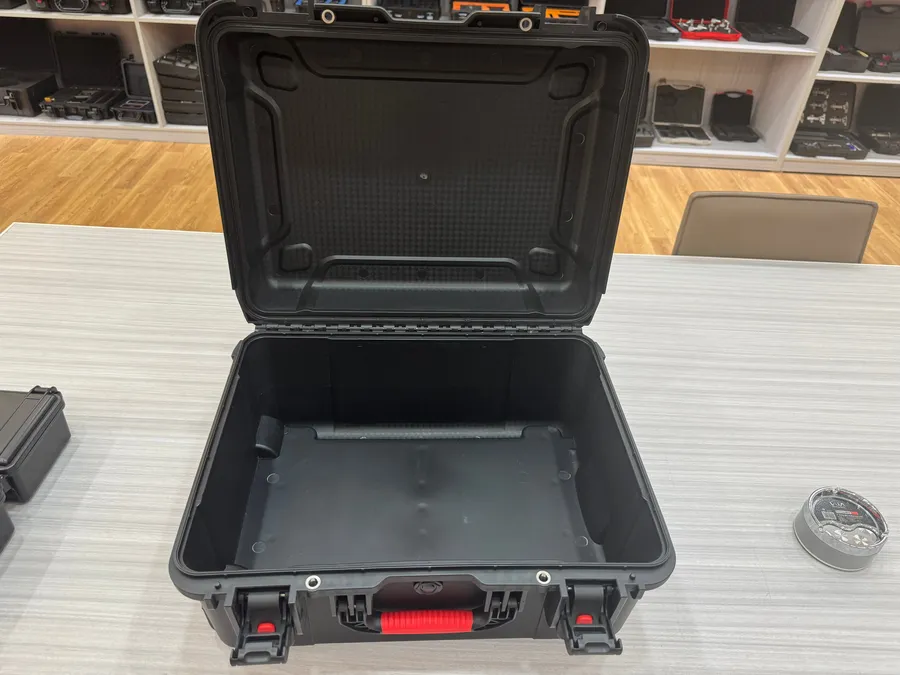
In our published range the mid-depth band starts at 303 x 224 x 135 mm internal on KX-3315, a 4.1 mm wall with 9.2 litres of cavity and 7.4 litres usable at 1,670 g, continues through 380 x 305 x 110 mm on KX-4012 with an 85 mm lid over a 25 mm base and 12.7 litres, and through 455 x 338 x 116 mm on KX-4613 at a 74/42 mm split, 17.8 litres and 1,370 g, then reaches 460 x 330 x 210 mm on KX-4822 with 165 mm of the total in the lid, 31.9 litres and 2,710 g. Sets that ship with long reels move to 500 x 340 x 211 mm on KX-5723 at a 5.0 mm wall and 35.9 litres, or to the wheeled 500 x 400 x 220 mm KX-85827 at 44.0 litres and 7,800 g empty.
Depth is the figure buyers misread. A 110 mm shell with an 85 mm lid takes a flat instrument and a tray of leads beside it; the same 110 mm will not take that set standing upright with a module plugged into the top. Where the set must stand, read internal height and lid depth together: KX-3218 publishes 308 x 230 x 172 mm with an 86/86 mm split at 900 g, and KX-4822 puts 165 mm of the total depth in the lid, which is the plane for the display hood, the laptop and a shallow parts tray. Read the seal field per model as well, because the instrument bay and the lead bay share one lid line: 100 of the 127 electronics-listed shells record a compressible gasket in a continuous moulded channel and 27 record none.
Electrical Testing Instrument Case: Meters, Clamps, Insulation Sets And Lead Reels
The same box family serves the rest of the substation and panel test kit, and the sizing logic is unchanged while the shapes are different. A clamp meter, a multifunction meter, an insulation tester and a phase-sequence unit are shallow boxes with a carry handle, so internal height rather than length decides the shell. KX-2508 publishes 245 x 175 x 68 mm internal on a 2.0 mm wall at 338 g for a meter and its own leads; KX-712 gives 308 x 250 x 96 mm at 2.8 mm and 7.4 litres with a 54/42 mm split for an insulation set and two lead bags; KX-2614 offers 240 x 200 x 120 mm at 5.8 litres with a 60/60 mm split where the meter and a clamp travel in one shell.
Small sealed ABS bodies cover the accessories that get separated from the instrument: KX-62109 at 195 x 128 x 81 mm on a 3.0 mm wall, 2.0 litres and 470 g, and KX-62209 at 200 x 98 x 78 mm on a 3.5 mm wall and 410 g, both with a gasket and both stackable, which is how a van shelf keeps meters apart from dirty tooling. Where the whole instrument set travels together, 390 x 315 x 88 mm on KX-4010 at 3.0 mm and 10.8 litres with a die-cut tray per instrument is the flat layout that keeps every meter visible at handover, and it weighs 1,015 g empty so a two-case kit stays inside a normal carry limit.
Lead reels are the exception in this family. A reel is a cylinder with a handle that must not be crushed, so it belongs in a separate bay with a cut cradle rather than loose in the same cavity as a meter. If the reels are long, the instrument box and the reel box are two boxes; the published length ladder above 500 mm starts at KX-5723 with 500 x 340 x 211 mm, continues at KX-86216 with 582 x 300 x 130 mm at 3.3 mm and 22.7 litres, and reaches KX-88015 at 725 x 350 x 140 mm, KX-89616 at 880 x 350 x 140 mm and long-equipment shells beyond 1,000 mm elsewhere in the range.
Electrical Control Equipment Case: Contactors, Relays, Panel Devices And Spares
Panel and protection engineers usually carry spares rather than instruments: contactors, auxiliary relays, terminal blocks, miniature circuit breakers, DIN rail offcuts, fuses, labels and a torque screwdriver. These parts are dense and rectangular, so the layout is a shallow tray of compartments and the figures that matter are internal length, base depth and wall thickness rather than total volume. KX-704 publishes 350 x 220 x 80 mm internal on a 2.1 mm wall at 6.2 litres, KX-4010 gives 390 x 315 x 88 mm at 3.0 mm and 10.8 litres, and KX-4613 offers 455 x 338 x 116 mm at 3.0 mm with a 74/42 mm split for a two-layer arrangement: devices below, drawings and test sheets above.
A dense tray loads the base rather than the lid, which is why we quote the foam layout together with the shell. The moulding carries the tray and the foam decides which part sits on the shock path; a compartment that is too deep lets a contactor move, and a compartment that is too tight presses on a terminal. Wall thickness is published on 148 of the 155 mouldings from 2.0 mm to 6.0 mm, so the structural choice is made on a number rather than on a description. What we do not publish for these or any other model is a stack load: 136 models are listed as stackable because the base has a stacking foot, but that is a moulding feature and not a load figure, so a racked store is an engineering decision made outside our catalogue.
Energy Storage System Accessories Case: Modules, BMS Boards, Cables And Connectors
Battery energy storage service work has its own accessory list: sense harnesses, BMS boards, busbar covers, connector housings, insulated tools, a laptop and a torque wrench. The parts are light but awkward because harnesses do not fold flat and boards must not flex, so a deep shell with a useful lid plane works better than a wide flat one. KX-3218 publishes 308 x 230 x 172 mm with an 86/86 mm split for a tray of boards below and harness coils above; KX-4822 gives 460 x 330 x 210 mm with a 165 mm lid at 31.9 litres and 2,710 g; KX-5723 extends to 500 x 340 x 211 mm on a 5.0 mm wall at 35.9 litres; and KX-65522 offers 507 x 385 x 190 mm in ABS at a 5.3 mm wall, 37.1 litres and 4,860 g for a larger service kit.
Two boundaries belong in this section rather than in a footnote. A moulded thermoplastic case is not offered as a fire-containment or thermal-runaway barrier, and we publish no figure for one. A swollen, damaged or leaking cell should not travel in the same box as service tools at all. The cell maker's test summary, the state-of-charge limit and the transport documentation your forwarder asks for remain that maker's records and your operator paperwork; nothing printed on a case label creates them, and no configuration we build should be presented on a manifest as a substitute.
Published Envelopes: Load To The Figure You Should Check
The table below maps the loads described above to the figure that decides the shell and to one published model that sits in that band. Every dimension is the internal figure from our product library for that SKU, and the seal and carry notes are the fields recorded for the same model, not a general claim for the series.
| Packed Load | Figure That Decides | Published Example | Seal And Carry |
|---|---|---|---|
| Test set standing upright with a module on top | Internal height plus lid depth for the display hood | KX-4822: 460 x 330 x 210 mm internal, 165/45 mm lid and base, 3.3 mm wall, 31.9 litres (27.4 usable), 2,710 g | Gasket recorded, stackable, fixed handle, no wheels |
| Flat test set with a lead tray beside it | Internal length and base depth under the set | KX-4012: 380 x 305 x 110 mm internal, 85/25 mm split, 3.5 mm wall, 12.7 litres, 1,480 g | Gasket recorded, stackable, fixed handle |
| Long current leads on reels | Internal length and the standing height of a reel | KX-5723: 500 x 340 x 211 mm internal, 169/42 mm split, 5.0 mm wall, 35.9 litres, 4,680 g; KX-86216: 582 x 300 x 130 mm, 100/30 split, 3.3 mm wall, 22.7 litres | Both record a gasket; both stackable; cartons published for KX-5723 at one piece in 580 x 250 x 415 mm |
| Clamp meter and a short lead set | Shallow internal height, then handle clearance | KX-2508: 245 x 175 x 68 mm internal, 34/34 mm split, 2.0 mm wall, 2.9 litres, 338 g | No gasket recorded; stackable; 20 pieces in a 515 x 440 x 385 mm carton |
| Insulation tester with two lead bags | Depth for the instrument body and width for the bags | KX-712: 308 x 250 x 96 mm internal, 54/42 mm split, 2.8 mm wall, 7.4 litres (6.4 usable), 710 g | No gasket recorded; stackable; 16 pieces in a 635 x 585 x 455 mm carton |
| Control spares in a compartment tray | Internal length and the number of compartments that fit | KX-4613: 455 x 338 x 116 mm internal, 74/42 mm split, 3.0 mm wall, 17.8 litres, 1,370 g | Gasket recorded, stackable, fixed handle |
| BMS boards below, harness coils above | Lid depth for stacked boards and a deep base for coils | KX-65522: 507 x 385 x 190 mm internal, 5.3 mm wall, 37.1 litres (29.7 usable), 4,860 g, ABS | Gasket recorded; 3 pieces in a 565 x 450 x 665 mm carton |
| Whole service kit moved by one person over distance | Wheels, telescopic handle and the loaded mass | KX-85827: 500 x 400 x 220 mm internal, 175/45 mm split, 5.0 mm wall, 44.0 litres, 7,800 g; KX-5126: 460 x 335 x 210 mm, 32.4 litres, 5,610 g | Both wheeled and not stackable; KX-5126 records no gasket and publishes no wall figure |
Foam, Clearance And The Twenty-Millimetre Rule
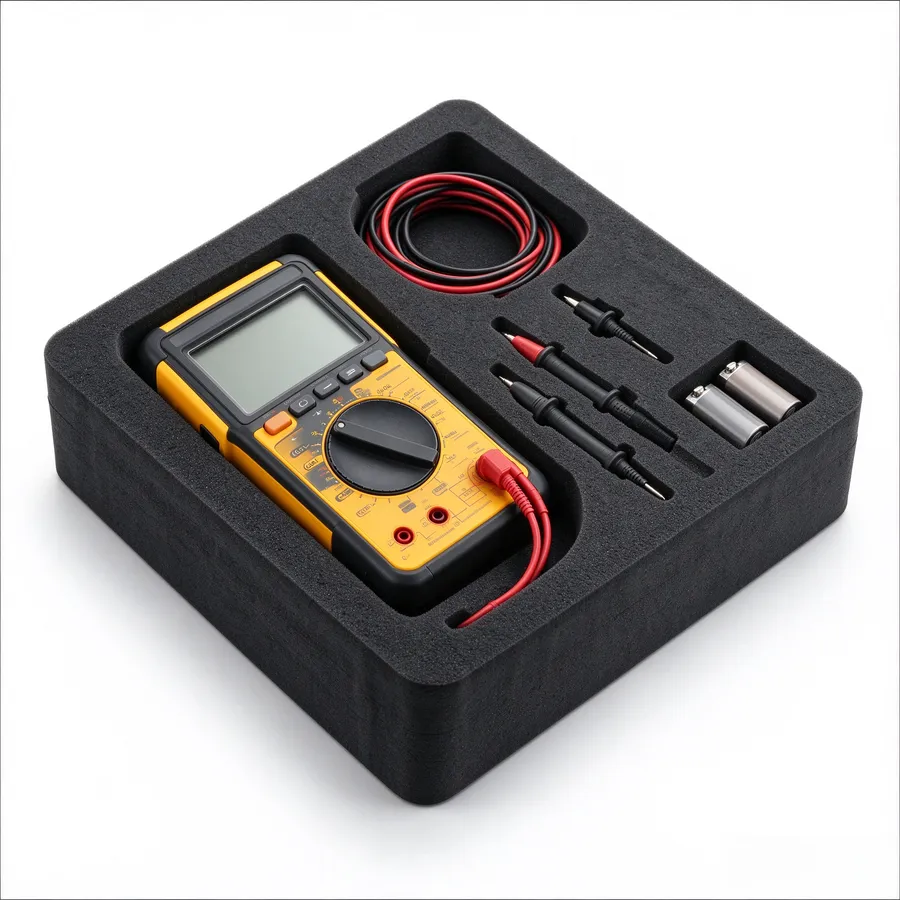
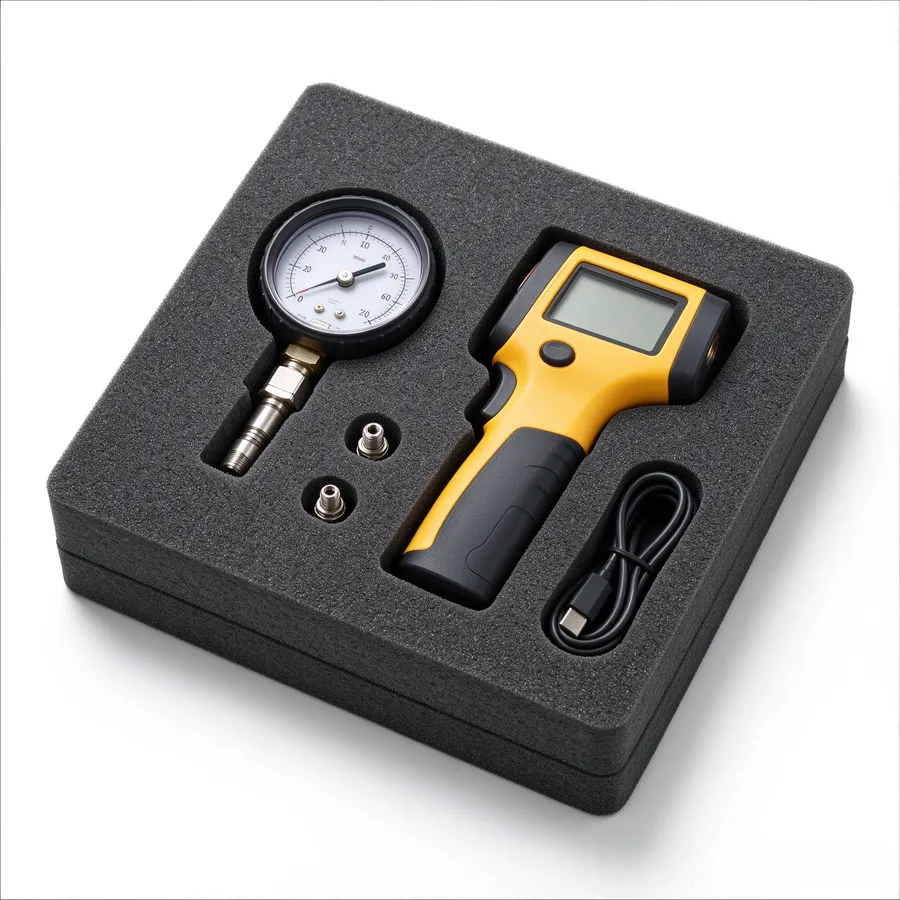
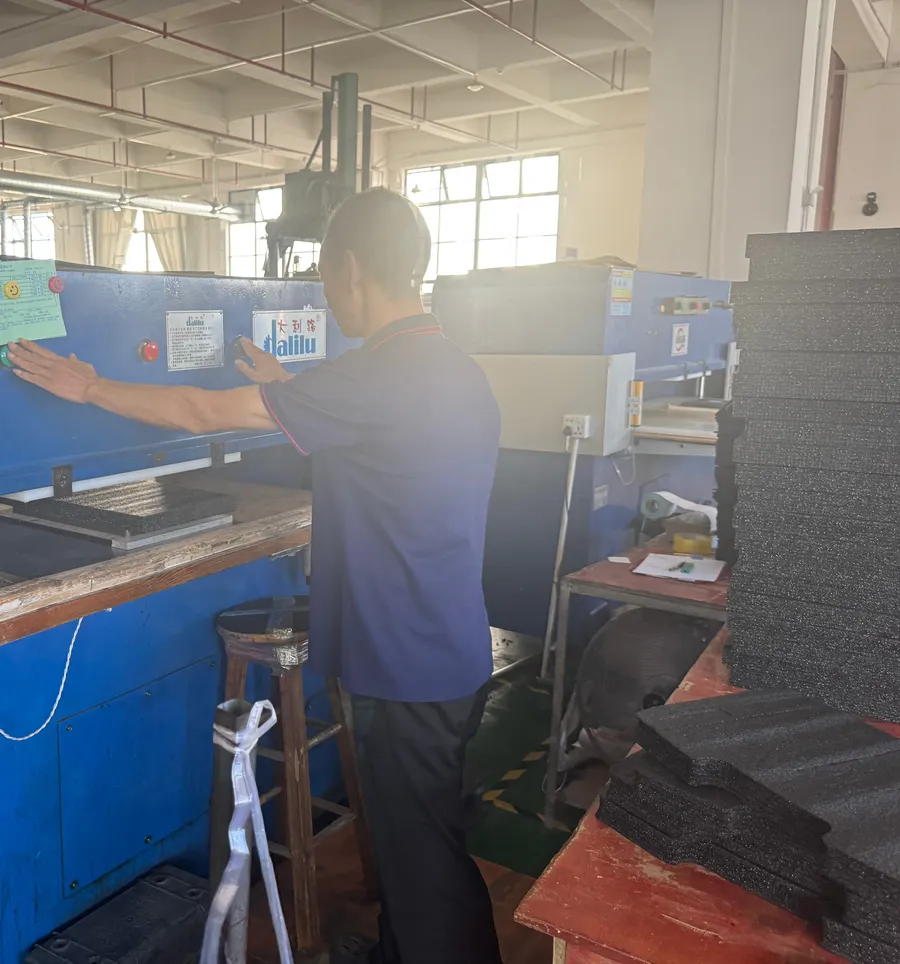
Clearance is a working number, not a sales phrase: 20 mm per axis between the packed equipment and the moulded wall, because the cut foam wall, the gasket land and the draft angle of a tapered mould all eat into the nominal cavity. Foam is quoted from one unit with no tooling in cross-linked PE, EVA or EPE, cut to full-depth pockets with reliefs for terminals, handles and connector hoods, and with the lid plane left clear over anything that must not be compressed. For a tester this usually means a base pocket for the set with finger lifts at the handles, a separate shallow tray for the leads, and a lid pocket for the laptop cut to the closed thickness rather than the open one.
A fixed layout is cut by die or CNC so that a missing item is visible at a glance and the bay count matches the kit list on the sheet inside the lid. A kit that changes between jobs uses pluck foam, which is cheaper to revise but less repeatable for an audit. Either way the foam is a construction option and not a rating: the shell alone carries no shock figure in our data, and the foam layout is part of what has to be named when a tender asks for a documented impact result, because that result belongs to the assembled configuration rather than to the moulding by itself.
What We Publish And What We Leave Blank
Published per model: internal and external dimensions, wall thickness on 148 of the 155 mouldings from 2.0 mm to 6.0 mm, lid and base depth where the mould publishes it, internal volume, usable volume, net weight on 93 models from 100 g to 15,320 g, shell material in PP, engineering PP and ABS, gasket presence, stackability on 136 models, wheels and telescopic handle on 19, and carton dimensions with pieces per carton on 64. In the electronics-listed group the internal length runs from 115 mm to 880 mm, net weight is published on 74 models from 100 g to 7,800 g, and the gasket is recorded on 100 of 127.
Recorded as not measured and left blank: any ingress protection class, any impact or free-fall figure, any stack load, any temperature range, ultraviolet exposure and a fixed pallet count, which we calculate from the carton footprint against your pallet standard. Where a tender names one of those figures, we quote accredited laboratory testing of the exact shell, gasket and foam build as a separate work package, and we say in the same sentence which measurements already exist for the model you shortlist. Shock behaviour is treated as a configuration outcome of the foam layout you specify, because the bare moulding is not a shock figure.
Wholesale, OEM And The Order Path
KeXin New Materials (Guangdong) Co., Ltd. supplies wholesale, OEM and ODM only. Colour, logo and OEM hardware start at 300 units; a new moulded exterior starts at 3,000 units per moulded component and 125 days; OEM work on an existing mould is quoted at 45 days from first sample; custom foam starts at one unit with no tooling. Payment is 30 per cent deposit with the balance after inspection before shipment, on EXW or FOB terms. We do not sell retail, do not quote delivered-duty-paid prices and keep no overseas warehouse stock.
For a tester project, send the equipment envelope as packed, the number of units in the first order and the annual estimate, the standard your document names, and the destination. We answer with the shells that clear the envelope with usable foam depth, the carton data published for those models, and a clear statement of which requested figures we can measure and which we cannot. If the first article has to be approved against a physical kit, send the kit or a drawing of it and the foam layout will be cut to that, so the sample and the production run are the same construction.
Customisation
Everything described above is configurable on a standard shell: interior layout (pick-and-pluck, die-cut or CNC-cut), foam grade and thickness, colour, logo method, latch and lock count, pressure-equalisation valve, cable ports, document holder and identification plate. A bespoke exterior geometry requires a new mould — 125 days, from 3,000 units per moulded component.
Procurement considerations
| Question | What to send us |
|---|---|
| Which shell fits? | Equipment L × W × H as packed, plus required clearance per axis |
| What does it cost? | Order quantity and estimated annual quantity — the two drive different answers |
| Is tooling needed? | Whether an existing shell clears the envelope with usable foam depth |
| Lead time? | Your required delivery date, not just the order date |
| Certification? | The exact standard your tender names — we will say whether we can test to it |
| Freight? | Destination and preferred terms; carton and pallet data supplied with the quotation |
Comparison and selection guide
The tables on this page exist because a protective case is chosen by comparing three things: the envelope, the environment and the handling chain. Where no table applies, the rule below is.
| Situation | What To Do |
|---|---|
| Shock | Base layer thickness and grade sized to the packed mass. |
| ESD | Anti-static PE, specified by surface resistivity range. |
| Dust | Sealed configuration with a continuous rim. |
- Size on internal dimensions plus clearance, never on a product name.
- Choose the carrying method before the shell: it changes the series, not just the price.
- Specify the interior last, and decide up front whether the end user will reconfigure it.
Relay Protection Tester Case: Sized To The Test Set, Its Leads And The Laptop relates to Protective Case Basics. Related families: Electronics Cases / Instrument & Equipment Cases. Related sectors: field and industrial equipment. Continue in the Protective Case Basics cluster.
This page is written from our own production data. If your requirement differs, send the dimensions and we will tell you which of the 155 models fits, or whether a custom route is needed.

