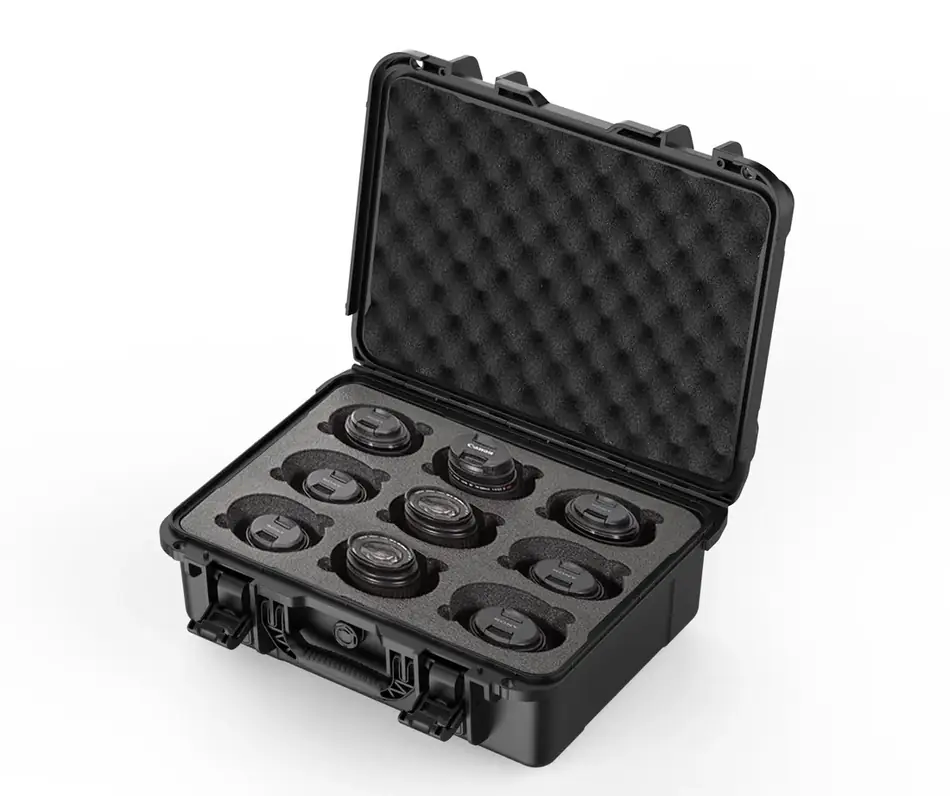
Handheld LED light stick protective box?
A handheld LED light stick protective box is a hard shell whose internal envelope, lid-to-base split and foam bed are sized around the stick and its accessories, and it is chosen on published millimetres, not on litres. On our sheet the binding number is internal length: 85 of our 155 published models carry the camera-equipment tag, and their interiors run from 240 x 200 x 120 mm up to 582 x 300 x 130 in KX-86216, whose 582 x 300 mm base also gives a stick about 655 mm of corner-to-corner room before any foam is cut. Sticks that measure longer than the published interiors need a bespoke shell, which we quote as OEM tooling. Below we publish the per-model numbers for light sticks, the two wheeled trolley shells for lights and batteries, and the shallow flats that hold filters.
Key points
- Fit is decided by internal length, width, depth and the lid-to-base split, published per model in millimetres; litres are a summary, not a fit test.
- The longest published camera-class interior is KX-86216 at 582 x 300 x 130 mm; a stick laid corner-to-corner gets about 655 mm of room before foam.
- Only two camera-tagged shells publish wheels: the trolleys KX-85021 and KX-85022 at 4,912 g and 5,012 g empty, both sealed and both listed non-stackable.
- 70 of the 85 camera-tagged shells offer a compressible gasket in a moulded channel; 15 offer no seal at all, so read the closure column per model.
- Published wall thickness on this class runs 2.1 mm to 5.0 mm and 83 of 85 models are listed stackable; treat every figure as per model, never family-wide.
- For filters, pick a shallow flat such as KX-3308 at 76 mm internal depth; a die-cut bed keeps each wallet visible and nothing migrates in transit.
- Waterproof, dust and drop figures are recorded as not measured on the sheet; accredited testing can be commissioned on the exact configuration you order.
What a handheld LED light stick protective box has to do
It has to hold a long, thin, high-value light source so that nothing presses on its diffuser or its electronics, survive being stacked under heavier kit in a production van, and open fast between setups. That makes it a geometry problem before it is a materials problem: a light stick is long relative to its width, so the binding dimension is internal length, and the second binding dimension is whether the shell is deep enough for the stick plus its charger, clamp and diffusion accessories in the same bed. A soft bag fails this test because the load path runs through the gear; a moulded shell with a cut bed carries the load on foam, not on the stick.
Our answer is published numbers. Every shell on the sheet is stated with external and internal dimensions in millimetres, a lid-to-base depth split where recorded, wall thickness, net mass where recorded, and whether a sealing option exists. Where a field has not been recorded we print it as not published rather than estimating it, and where a protection figure has not been measured we record not measured. You can therefore test your own stick against the numbers in this article directly, model by model.
The three numbers that decide the fit
Read internal length first. A stick laid straight needs its full length inside the base; laid diagonally it gains the corner-to-corner distance of the base rectangle, which on KX-86216's published 582 x 300 mm base is about 655 mm before any foam is cut. Read the lid-to-base split second: a 582 mm stick with a charger block beside it wants depth where the accessory sits, and a shell that publishes 100 mm of lid over 30 mm of base, as KX-86216 does, is a different packing problem from a 50/50 split. Read wall thickness and net mass third, because they decide how the box travels and stacks.
Treat each figure as belonging to one model. A 5.0 mm wall on one shell does not make the family a 5.0 mm family: published camera-class walls run from 2.1 mm to 5.0 mm, and the two wheeled models are a different structure again at 4.5 mm with non-stackable bases. If a figure you need is blank on the sheet, ask for the measured value for that exact model instead of extrapolating from a sibling.
Published interiors for light sticks
Seven shells read straight off the published sheet, solving the length problem at different budgets. KX-86216 is the longest published camera-class interior at 582 mm of internal length and about 655 mm of base diagonal; KX-4318 is the opposite layout, a deep 407 x 187 mm footprint with 178 mm of internal depth and 140 mm of it in the base, which suits sticks stood upright or coiled with their cables. KX-3607 and KX-3609 are the compact pair for a single stick plus charger at 800 g and 900 g empty. Where the net mass cell says not published, the figure has not been recorded on the sheet; ask and we will measure the shell you are quoting.
| Model | External Mm | Internal Mm | Lid / Base Mm | Wall Mm | Net G | Sealing Option |
|---|---|---|---|---|---|---|
| KX-86216 | 620 x 360 x 155 | 582 x 300 x 130 | 100 / 30 | 3.3 | not published | Yes |
| KX-85718 | 556 x 363 x 175 | 520 x 296 x 155 | 100 / 55 | 4.2 | not published | Yes |
| KX-85215 | 517 x 430 x 150 | 483 x 363 x 140 | not published | 4.5 | not published | Yes |
| KX-4613 | 460 x 367 x 126 | 455 x 338 x 116 | 74 / 42 | 3.0 | 1,370 g | Yes |
| KX-3609 | 360 x 310 x 90 | 355 x 280 x 80 | 40 / 40 | 3.0 | 900 g | Yes |
| KX-3607 | 360 x 310 x 70 | 355 x 280 x 60 | 30 / 30 | 3.0 | 800 g | Yes |
| KX-4318 | 432 x 240 x 186 | 407 x 187 x 178 | 38 / 140 | 3.0 | 1,970 g | Yes |
Film video light & battery protective trolley box
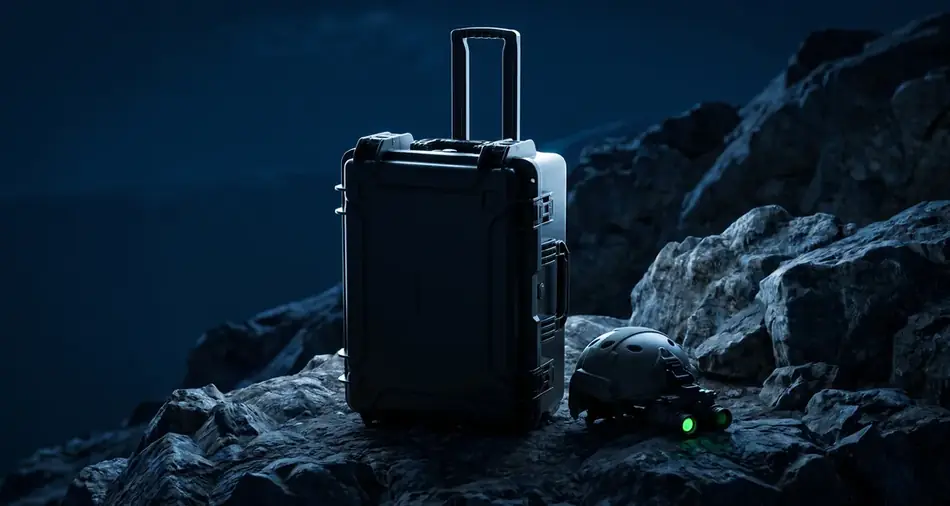
The two shells published with wheels and a telescopic handle are KX-85021 and KX-85022, and they are the ones to shortlist when the load is lights plus batteries rather than a single stick. KX-85021 publishes a 495 x 370 x 210 mm external shell with a 437 x 308 x 164 mm interior and 4,912 g of empty mass; KX-85022 publishes 463 x 370 x 230 mm outside, 437 x 308 x 180 mm inside and 5,012 g empty. Both are Engineering PP at 4.5 mm published wall, both offer the moulded sealing channel, and both are listed non-stackable, which is worth knowing before you plan a van pack.
On batteries: the interior volumes are 22.1 and 24.2 litres, but we do not publish a battery count, because V-mount and gold-mount bricks differ in footprint and mass by manufacturer. Send the battery model and the count you travel with and we will return a foam layout proposal against the published interior. The export pack for KX-85022 is published as one case per carton at 495 x 375 x 245 mm, which is the number your forwarder needs for a freight quote.
Photography filter & accessories crushproof box
Filters fail from point loads and from migration, so the right shell is shallow and the right bed is die-cut. The flat pair on the sheet is KX-3308, a 325 x 236 x 76 mm interior at 575 g with no sealing option, and KX-3508, a 344 x 268 x 72 mm interior at 995 g in Engineering PP with the gasket offered. KX-3607 gives 355 x 280 mm of footprint at 60 mm of internal depth with a 30/30 lid-to-base split, which takes filter wallets laid flat plus a card and cable field.
Because these shells are shallow, nothing can migrate far in transit, and a die-cut bed drawn around your actual wallets makes a missing item visible at a glance. For wholesale quantities the sheet publishes export packing: KX-3308 ships 20 pieces per carton at 670 x 550 x 425 mm and KX-3508 ships 20 per carton at 730 x 615 x 428 mm, so your landed-cost maths starts from published carton figures rather than guesses.
Studio softbox & accessories hard storage box
Honest sizing first: the longest published camera-class interior is 582 mm, so a collapsed softbox that folds longer than that does not fit any shell on the current sheet, and we will not pretend otherwise. What the large flats do fit is the rest of the head kit: speedrings, grids, snoots, heads, ballasts, stand hardware and cable sets. KX-85215 publishes 483 x 363 x 140 mm inside a 517 x 430 x 150 mm shell; KX-84816 gives 410 x 360 x 140 mm with a 100/40 lid-to-base split; KX-86216's 582 x 300 x 130 mm interior takes a folded softbox up to its stated length, or the ring plus grid, in one bed.
If your softboxes fold at 700 or 900 mm, that is an OEM conversation rather than a stock purchase: a new size is a tooling programme from 3,000 pieces per component, while an existing mould is sampled on a 45-day plan. Most studio buyers solve this differently, with one hard case for the heads and accessories and padded wraps for the fabric, and we are glad to quote that split rather than sell a shell that does not fit.
How to choose one, step by step
Measure the stick as it travels, with clamp, charger cable and diffusion mounted if you travel with them mounted, and record the bounding box plus mass of each sub-assembly. Add clearance so the foam carries the load, not the shell wall. Then check the three numbers: internal length against your stick, internal depth against stick plus accessories, and lid-to-base split against your layout. If the straight length comes up short, compute the base diagonal yourself: on a published 483 x 363 mm base that is about 604 mm, on 582 x 300 mm about 655 mm, both before foam is cut.
Decide the closure next: 70 of the 85 camera-tagged shells offer the sealing channel and 15 offer none, and a case that is opened ten times a day in a dry studio does not need the same closure as a case that rides a truck bed overnight. Decide carry method last: two models publish wheels, the rest are hand-carry, and the difference between a 575 g shell and a 5,012 g trolley is felt before the first setup of the day. Send us the numbers and we will shortlist two or three models instead of sending a catalogue.
Where these boxes are used
The obvious duty is a film or video crew's light kit: sticks, batteries, clamps and diffusion moved between locations. The same shells serve live-streaming and studio kit that is packed daily by people who did not buy it, and rental houses that need the cut bed to double as an inventory checklist. Broadcast field kits add the sealing question, because the case rides in a van overnight and gets opened in rain; that is the gasket group, not the plain-shell group.
Related duties are covered in depth elsewhere on our site: the film-production and live-streaming gear pages, the lens-and-body transport guide, and the foam guide that explains why a die-cut bed beats loose padding for anything with a diffuser. If your duty is a drone lighting payload, the drone applications page and the drone cases family are the faster route to a shortlist.
Customising and OEM
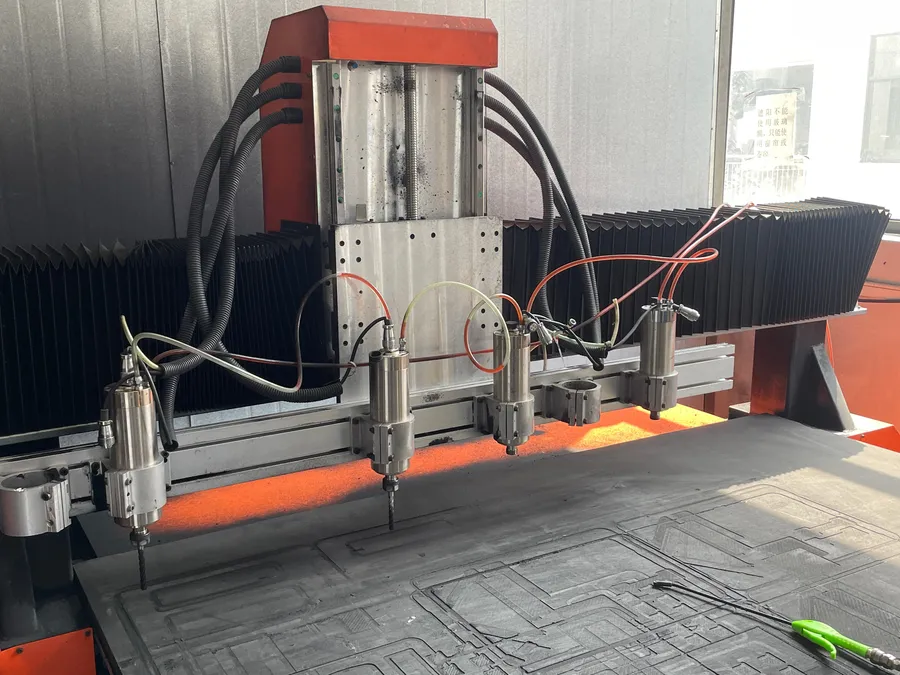
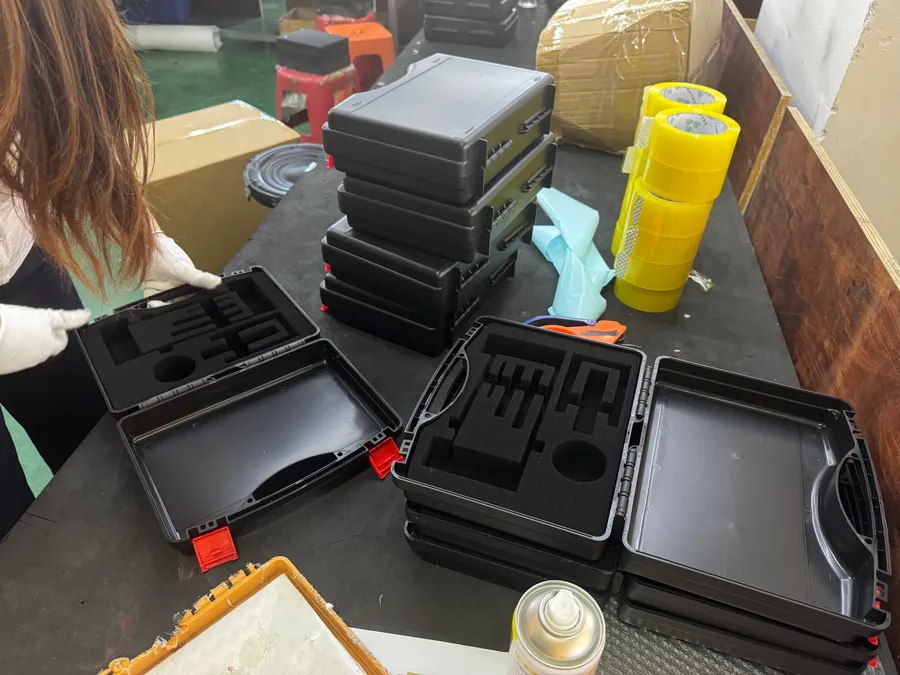
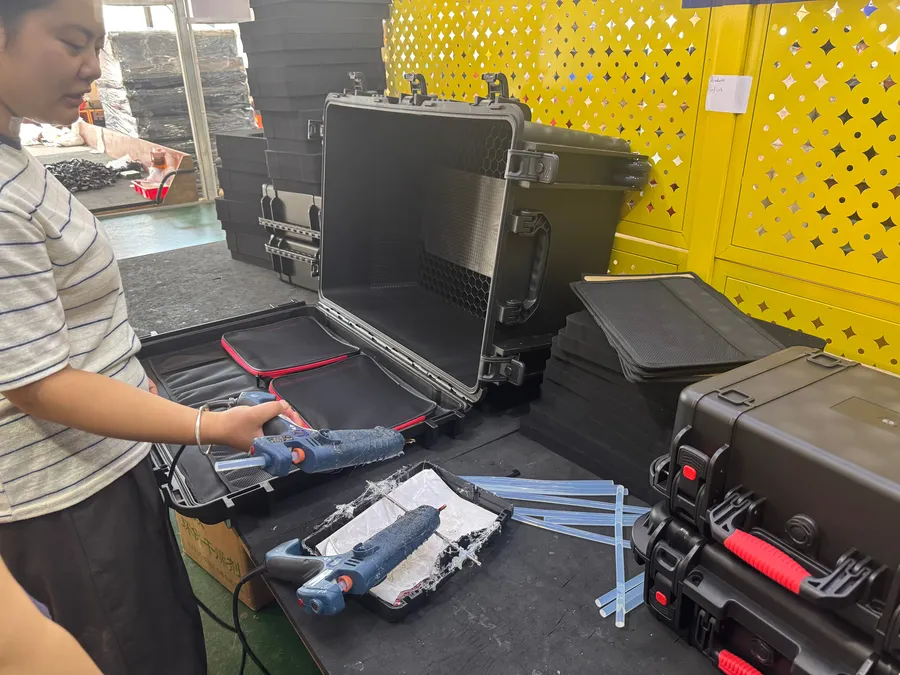
The bed is where customisation pays, and it carries no minimum beyond the case order itself: pick-and-pluck for a changing kit, die-cut or CNC-cut for a fixed one, in EVA, PE or EPE by zone, built as top foam, base foam, egg-crate or layered structures. We cut from a drawing, a photograph of the packed kit or a physical sample, so a single kit can be bedded properly instead of being stuffed with loose foam.
Shell-side work is priced on tooling reality. Logo and colour are published at 300 pieces minimum; hardware, latch count and gasket are configuration choices on shells already moulded; a genuinely new size is a tooling programme from 3,000 pieces per component, with first samples on an existing mould planned at 45 days and a new mould at 125 days on a 30 percent deposit. We manufacture for wholesale and OEM buyers on EXW or FOB terms only, with no retail, no DDP and no overseas warehouse, so your own forwarder books the freight.
Before you order
Send the bounding dimensions and mass of each sub-assembly in travel configuration, say whether the shell must seal, tell us how the box is moved and stacked, and give the quantity per delivery. We return candidate models with their published dimensions, lid-to-base split, wall thickness, closure state and net mass where recorded, plus a foam layout proposal. Two cautions worth more than they cost: waterproof, dust, UV, temperature range and drop figures are recorded as not measured across the sheet, and no ingress rating is stated on any model, so if your tender needs numbers, accredited testing can be commissioned as a separate work package on the exact configuration you order. Size on your own measurements, confirm the closure, and let the published numbers pick the model.
Customisation
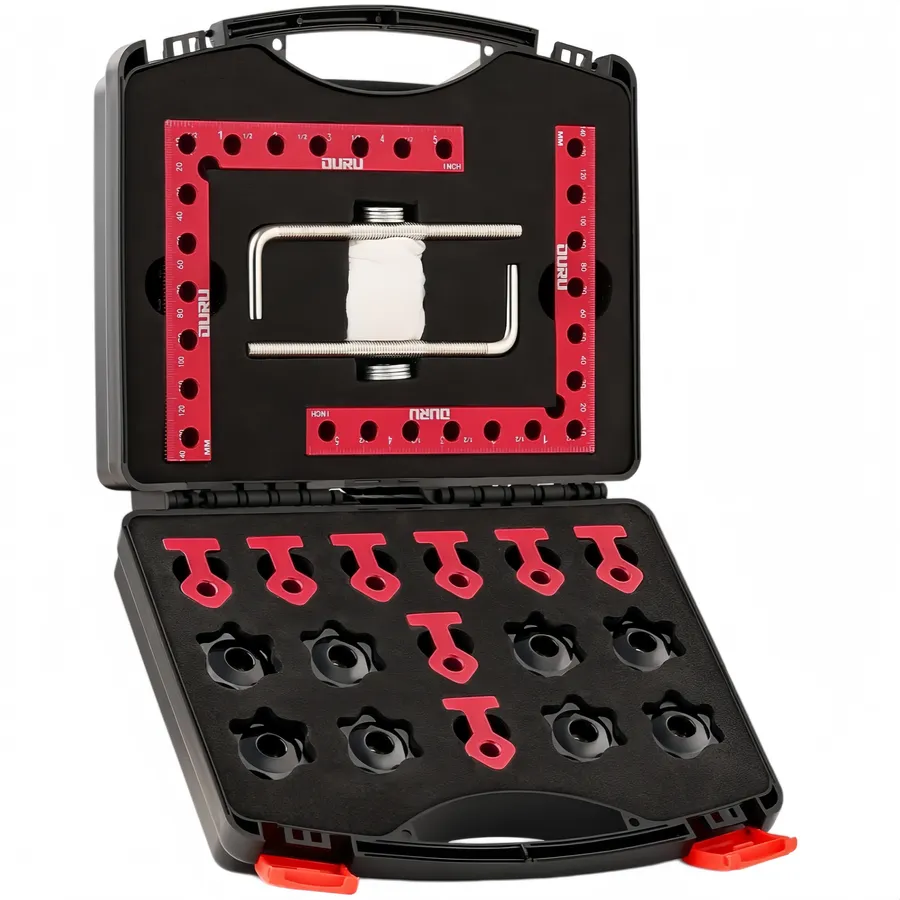
Everything described above is configurable on a standard shell: interior layout (pick-and-pluck, die-cut or CNC-cut), foam grade and thickness, colour, logo method, latch and lock count, pressure-equalisation valve, cable ports, document holder and identification plate. A bespoke exterior geometry requires a new mould — 125 days, from 3,000 units per moulded component.
Procurement considerations
| Question | What to send us |
|---|---|
| Which shell fits? | Equipment L × W × H as packed, plus required clearance per axis |
| What does it cost? | Order quantity and estimated annual quantity — the two drive different answers |
| Is tooling needed? | Whether an existing shell clears the envelope with usable foam depth |
| Lead time? | Your required delivery date, not just the order date |
| Certification? | The exact standard your tender names — we will say whether we can test to it |
| Freight? | Destination and preferred terms; carton and pallet data supplied with the quotation |
Comparison and selection guide
The tables on this page exist because a protective case is chosen by comparing three things: the envelope, the environment and the handling chain. Where no table applies, the rule below is.
| Situation | What To Do |
|---|---|
| Changing kits | Layered pluck foam, rebuilt by hand. |
| Fixed rental fleet | CNC silhouette with serial pockets and an inventory list. |
| Harsh locations | Sealed shell plus desiccant provision in the lid. |
- Size on internal dimensions plus clearance, never on a product name.
- Choose the carrying method before the shell: it changes the series, not just the price.
- Specify the interior last, and decide up front whether the end user will reconfigure it.
Handheld LED light stick protective box? relates to Protective Case Basics. Related families: Camera & Photography Cases / Rolling Cases / Custom Protective Cases / Electronics Cases / Instrument & Equipment Cases. Related sectors: field and industrial equipment. Continue in the Protective Case Basics cluster.
This page is written from our own production data. If your requirement differs, send the dimensions and we will tell you which of the 155 models fits, or whether a custom route is needed.