What factors affect hunting equipment case selection?
Seven inputs decide a hunting equipment case, and almost all of them are geometry rather than marketing: the longest single item as it will actually lie, how many items must not touch each other, whether the load is carried by hand or rolled to a vehicle, whether the case closes in wet or muddy conditions, what the interior face has to survive being wiped, the external footprint that has to fit a vehicle bay or a shop shelf, and how the unit ships in volume. In our catalogue 98 of 155 models are tagged for firearm transport, and the published internal length runs from 115 mm on the smallest utility shell to 1,280 mm on the longest flat case, with lid-to-base splits as different as 100 mm over 40 mm and 175 mm over 65 mm. Ammunition-class boxes are published separately, 68 models carry that tag, and 124 of the 155 shells record a compressible gasket closure while 31 do not. Everything below maps each factor onto figures we publish per model.
Key points
- Size on the longest item as it will lie, then check the lid-to-base split before assuming a scoped rifle clears the lid.
- Our longest flat shells publish 1,280 mm and 880 mm of internal length with a 5.0 mm wall and no wheels.
- Decide whether ammunition travels in its own box: 68 models carry the ammunition-storage tag with separate published sizes.
- Carry mode follows empty mass: 136 models are stackable with a fixed handle, and the 19 with wheels are not stackable.
- A sealed closure is a per-model choice - 124 of 155 publish a gasket channel - and no water or dust test result exists.
- Interior grade is a wipeability decision: a torn pluck face holds grit, a closed-cell cut face can be cleaned.
Factor one: the length and profile of the longest item
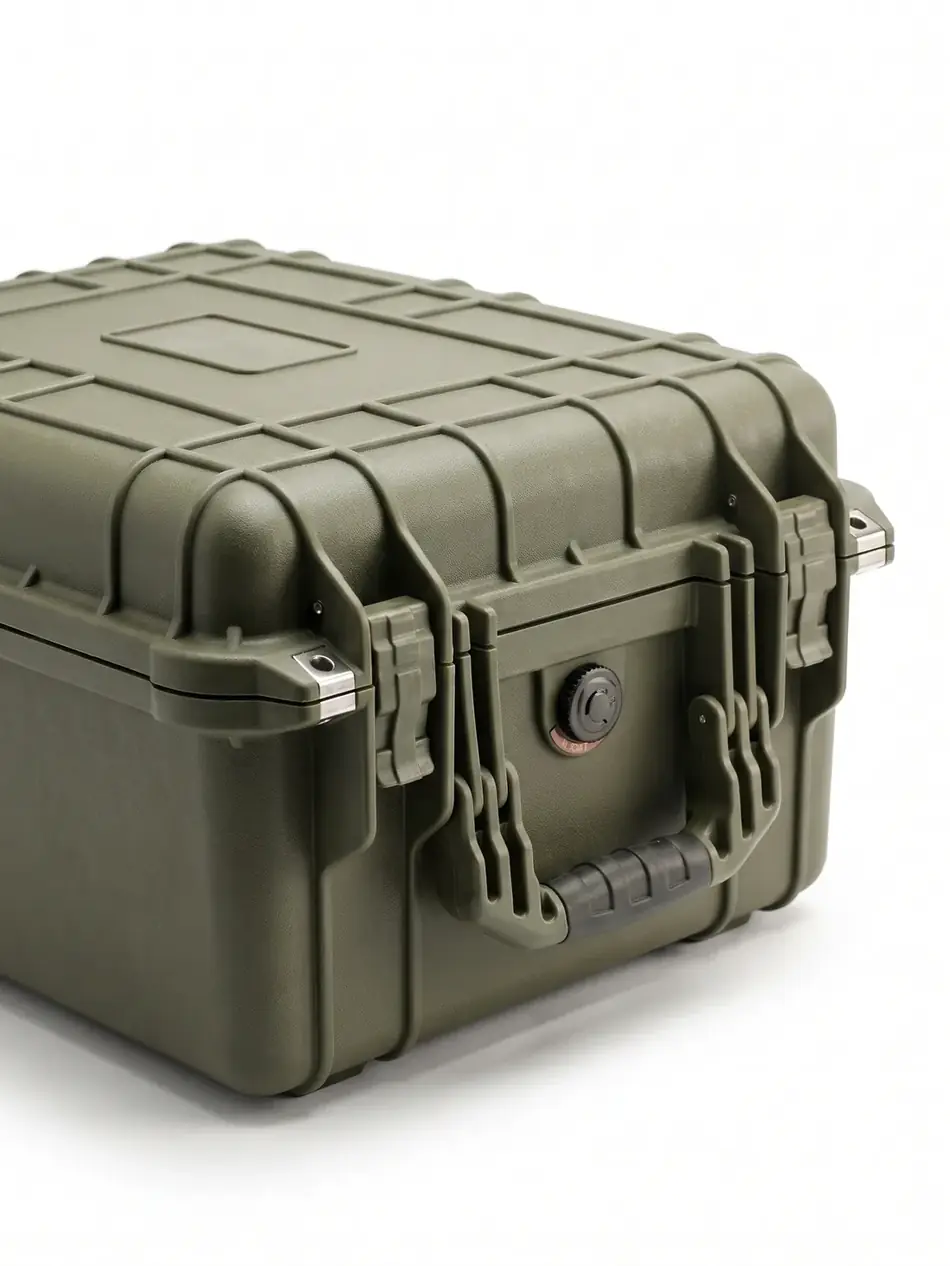
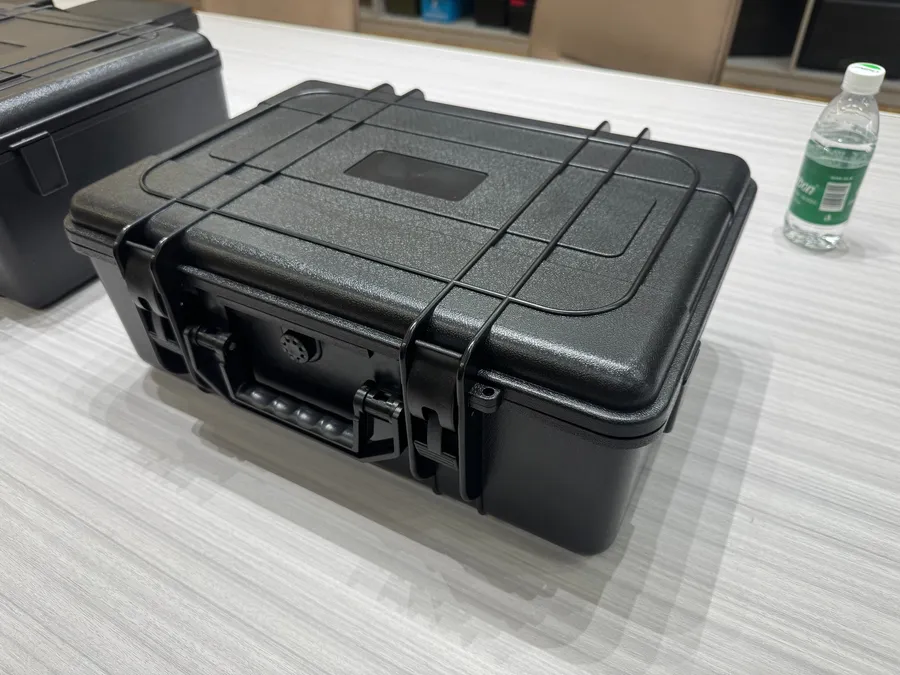
For a rifle or shotgun carried with its optic fitted, the governing number is internal length measured where the item actually lies, not the outside of the case. Our published flat long shells run from KX-88015 at 725 by 350 by 140 mm internal, through KX-89616 at 880 by 350 by 140 mm, to KX-814641 at 1,280 by 350 by 140 mm, and all three are moulded in polypropylene with a published 5.0 mm wall and a gasketed closure option. Those figures are the reason a long case is a category of its own: a general-purpose shell of similar external size cannot lay a rigid, long item flat, and a long item that is not held flat is loaded in bending every time the case is set down at one end.
The second half of the same factor is the depth split. On the three shells above the catalogue publishes 100 mm of lid over 40 mm of base, so the rifle stands on a shallow floor layer and the optic sits under the lid's cushion - a workable arrangement only where the sight truly clears. KX-87926 is the opposite build at 737 by 257 by 240 mm internal with 175 mm of lid over a 65 mm base, which suits a load bedded in the floor with tall accessories above it. Before ordering, either measure the rifle with the scope mounted, or specify the interior to hold the optic separately. A third of the enquiries we receive are for a case that would close only if the sight came off.
Factor two: how many items must not touch
Two rifles in one case is a different specification from one, because the failure is not the shell but contact: actions against actions, suppressors against sights, and both moving together over a long lever arm. The interior answer is separate channels with real walls between them, muzzle and sight cleared by cut-outs, and enough internal width to keep the separation honest. Our internal widths run up to 545 mm across the range and the 350 mm width on the long flat shells is what allows two cut channels side by side.
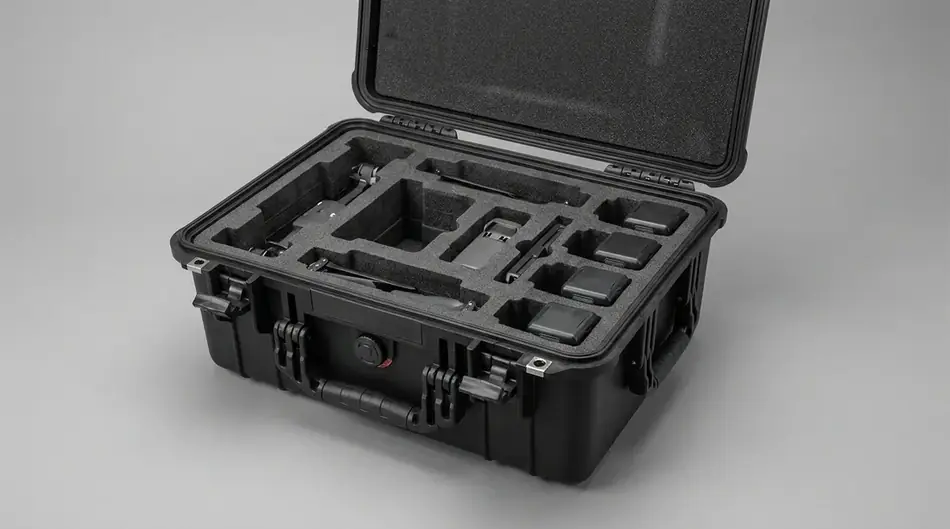
The same factor drives the accessory question. Optics, filters, a range kit, a knife, a headlamp and spare batteries all want their own pocket, and the choice between a machined layout and a re-shapeable one is settled by how fixed the load is. Die-cut, CNC-cut and pick-and-pluck construction are all recorded on every model, together with top foam, base foam, convoluted faces and layered builds, and custom foam, custom thickness and custom shape are available on all 155 - so a fixed core in a cut carrier with a pluck layer above it is a standard build, not a favour. A keyed face has a second virtue in the field: an empty pocket shows something was left on the stand.
Factor three: whether ammunition travels with the gear
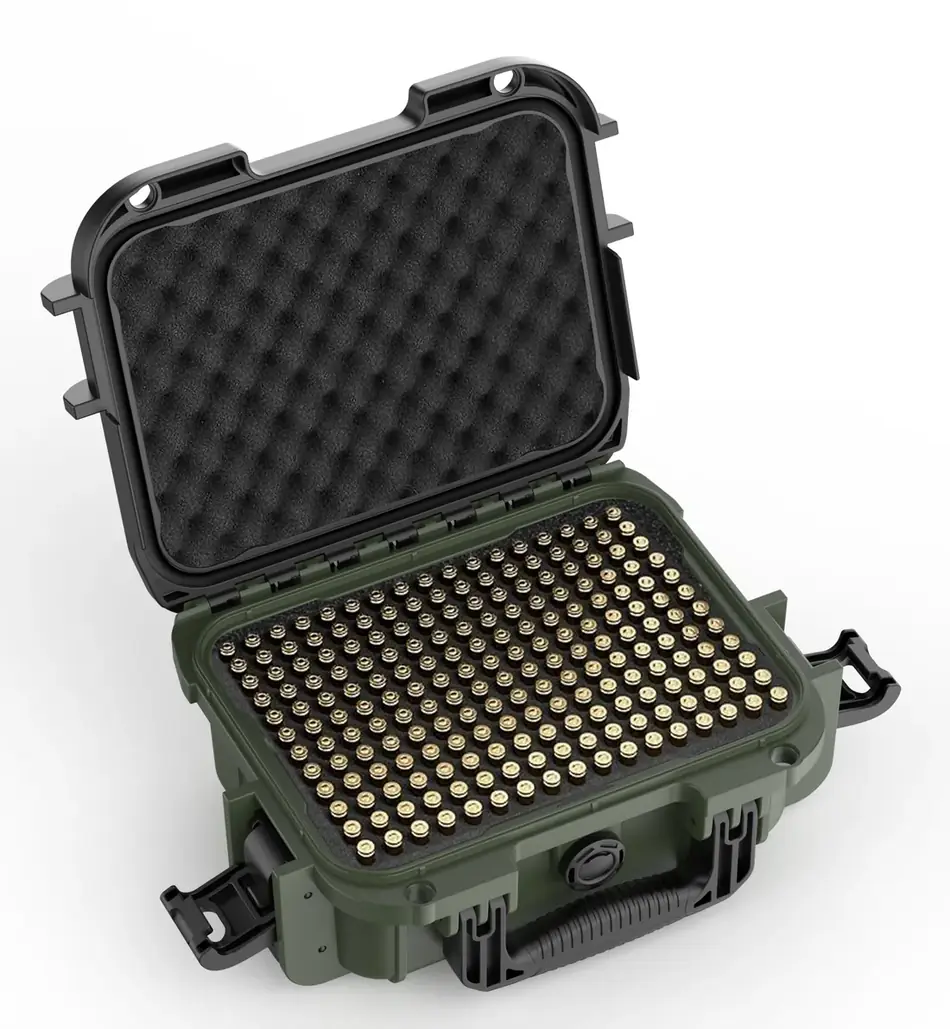
Our catalogue publishes ammunition and resupply storage as its own family: 68 models carry the ammunition-storage tag and 20 have it as their primary category, with live pages that publish separate interiors - KX-3207 at 308 by 230 by 64 mm and 570 g empty, KX-3213 at the same footprint with 118 mm of internal height and 860 g, KX-3508 at 344 by 268 by 72 mm in engineering polypropylene at 995 g, and the ABS KX-62810 at 253 by 182 by 86 mm and 900 g. Every one of those is recorded with a gasketed closure option, all are stackable, and every latch body in the range is published as accepting a standard padlock.
Whether you put cartridges in the same case as a firearm is a configuration and market-compliance question for the buyer to settle under their own rules, not something a case catalogue can answer, and we do not make claims about it. What we can do is publish the geometry so the decision can be made deliberately: a separate box of a known interior size, stacked with the long case, is a different freight and shelf plan from one case with a cut ammo channel in it. Dealers commonly take the separate-box route because it lets one stock item serve several loads.
Factors four to seven at a glance
Two of these six deserve a caution. Nothing in our data publishes a drop height, a water result or a dust result, so a shell chosen for a hard use is chosen on wall thickness, geometry and closure rather than on a rating. And stackability is not universal: 136 models are recorded as stackable, while the wheeled shells that carry the heaviest loads are not, because a case on wheels is stood upright rather than packed on top of others.
| Factor | What To Decide | Published Figures That Answer It | Typical Hunting Answer |
|---|---|---|---|
| Carry and handling mode | Hand-carry, shoulder, or rolled to a vehicle | Fixed handle on all 155; wheels plus telescopic handle on 19; net weight 100 g to 15,320 g | A long flat shell such as KX-89616 is carried; KX-88337 at 10,866 g empty is rolled |
| Closure against wet and mud | Sealed gasket channel, or an open carry shell | 124 of 155 publish a compressible gasket in a moulded channel; 31 publish none | Sealed where the case closes wet; unsealed shells such as KX-2813 where it is a dry carry box |
| Interior face and grit | Wipeable cut face, or re-shapeable pluck | Six foam types and five structural options recorded on all 155 models | A firm cut carrier with a closed face, pluck only for the layer that changes |
| Storage and vehicle footprint | What the case must stand in: rack, shelf, bay or sled | External dimensions per model; usable volume published against nominal on all 155 | Read the external number before the interior one, and check stackability |
| Volume freight for a dealer | How many per carton and how they palletise | Carton size and pieces per carton where published - 40, 32, 24, 20, 16, 10 or 8 | KX-2005 ships 40 a carton, KX-3207 24, KX-62810 10 |
| Custom programme | Cut interior, branding, or a new shell | Custom foam from one set; logo, colour and OEM from 300; new mould from 3,000 | Interior and print on an existing shell covers most programmes |
How to work the factors in order
Take them in the sequence that eliminates models fastest. First the longest item as it will lie, which removes most of the catalogue immediately. Second the count of items that must be separated, which decides the internal width and the layout type. Third whether the case must close on wet gear, which splits sealed from unsealed shells. Fourth the packed mass you expect, which sets the carry method. Fifth the footprint it must live in, read from the external dimensions.
Then, and only then, the interior. A common mistake is specifying foam first and discovering that the shell's published base depth cannot hold the profile: base depth appears on the 100 models that record the lid-to-base split, running from 15 mm to 168 mm with a median of 44 mm, and internal height across the range runs from 32 mm to 364 mm. Finally check usable volume rather than nominal: on 154 of our 155 models the published usable figure is smaller than the nominal interior, the ratio running from 0.797 to 1.000 with a median of 0.850, because radiused corners and internal hardware take the space a sketch ignores.
Where a load is mixed and changes between trips - optics one weekend, a bow the next - resist the temptation to cut everything. A fixed carrier for the item that must not move plus a pluck or convoluted layer above it gives up a little precision and buys a season of usefulness. Where the load is genuinely a fixed kit sold as one unit, machining the whole interior is what makes the presentation and the missing-item check work.
Load families and the size classes that suit them
A single long gun with a fitted optic is the KX-89616 and KX-88015 class: 880 mm and 725 mm internal length, both 350 mm wide and 140 mm deep, gasketed, stackable, with a 100 mm lid over a 40 mm base. Two long guns and their optics step up to the 1,280 mm internal length of KX-814641, where two cut channels and a muzzle clearance can be drawn inside the published width. A bow, a mast or a tripod head with tall accessories is better served by a shell whose depth sits in the lid, such as KX-87926 with 175 mm of lid over a 65 mm base.
Optics and small kit sit in the tactical and outdoor classes, and the choice there is depth: KX-1204 gives 115 by 78 by 32 mm at 100 g for a range kit or a small pair of binoculars, KX-2507 gives 245 by 175 by 64 mm at 340 g for a monocular and its accessories, KX-62109 gives 195 by 128 by 81 mm in ABS with a gasketed closure at 470 g, and the outdoor shell KX-2813 gives 260 by 200 by 117 mm at 800 g with 92 mm of its depth in the lid. Spotting scopes and camera kits generally want the sealed ABS class or the deeper engineering-polypropylene boxes.
Ammunition, tools and resupply are their own shelf conversation: KX-3207 at 308 by 230 by 64 mm, KX-3213 at the same footprint with 118 mm of height, KX-92817 at 253 by 180 by 152 mm with a 5.0 mm wall in engineering polypropylene, and KX-62810 at 253 by 182 by 86 mm in ABS. The useful pattern for a dealer is one interior size that serves several loads rather than a matched case per product, and the published carton quantities - 24, 20, 16 or 10 pieces - are what make a shelf plan predictable.
Customising for a hunting programme under OEM
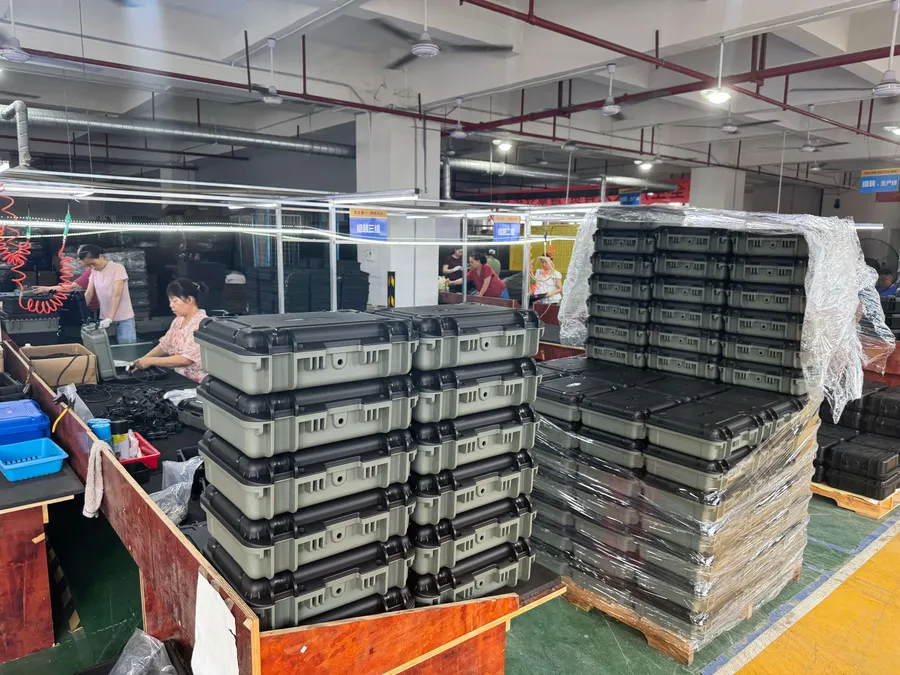
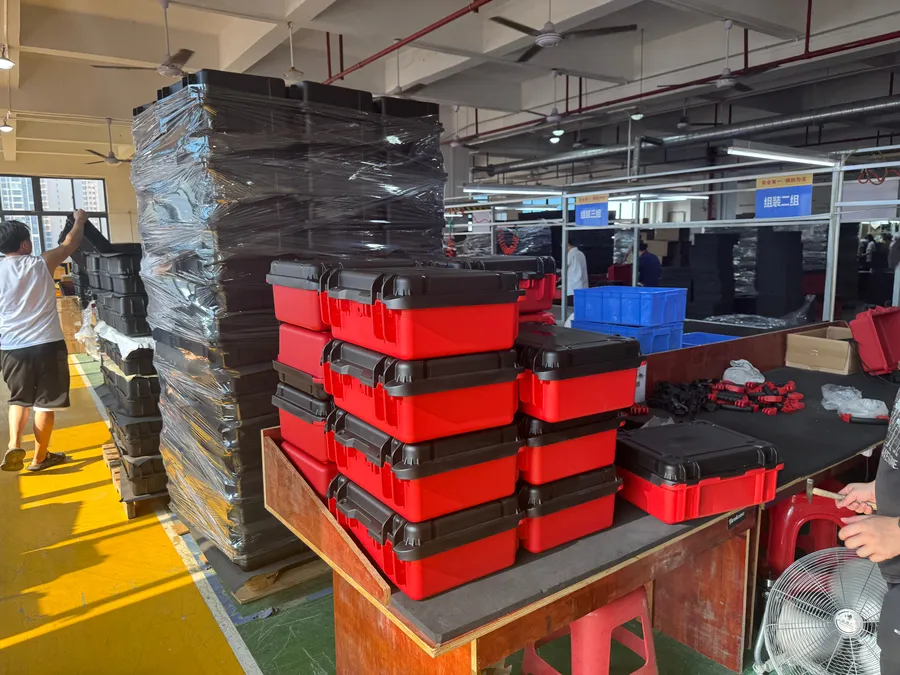
Most hunting programmes are interior and identification jobs. A cut layout on an existing shell starts at one set with no tooling, so a rifle profile can be proven before any volume is committed; custom thickness and custom shape are recorded against all 155 models, and die-cut and CNC-cut construction are both listed on all 155, which means a repeated profile can be pressed at volume or routed from a drawing on a short run. Logo printing, matched shell colour and OEM production on an existing mould start at 300 pieces with a first sample scheduled at 45 days on a 30 percent deposit.
A new shell size is a moulding project quoted at 125 days and from 3,000 pieces per moulded component, and it is only justified when the geometry itself has to change - a length between our published sizes, for example, or a parting line moved to clear a fitted optic. Hardware is configured per order: latch count, hinge, feet, a padlockable latch body recorded across the range, and a pressure-equalisation valve offered as an option on every model where the case sees real temperature swing.
To start, send the load list with each item measured as it will be packed, the count of items that must be separated, whether the optic stays fitted, whether ammunition travels in the same case, the packed mass, the footprint the case must stand in and the annual quantity by model. We return candidate shells with their published internal and usable dimensions, lid and base depths, wall thickness, closure option and net weight, plus a layout drawing for approval.
Purchasing notes
Read what is measured before you read what is offered. External and internal dimensions, usable interior volume, wall thickness, lid and base depths, narrow internal width on the 36 tapered models, net weight, shell material, carton data and the closure option are published per model. A narrow internal width is easy to miss and it matters when a channel is cut close to the wall: KX-701 publishes 260 by 180 by 76 mm internal with a narrow width of 158 mm, and KX-1204 publishes 70 mm against a nominal 78 mm.
What we do not publish for any model is a drop height, a water or dust result, an ultraviolet figure, a service temperature range, a stack load or a payload limit, and no ingress code appears anywhere in our data. Shock and impact resistance are recorded across the range as a construction option that depends on the interior ordered. If your market needs numbers, accredited testing of a named shell with a named layout and a named load can be commissioned as a separate work package.
Commercial terms are fixed: we manufacture for wholesale and OEM buyers only, quoted EXW or FOB from the factory. We do not sell retail, do not offer delivered-duty-paid terms and hold no overseas warehouse stock, so an importer plans their own onward freight, and transport or carriage rules for firearms and ammunition remain the buyer's responsibility in their own market. KeXin New Materials (Guangdong) Co., Ltd.
Customisation
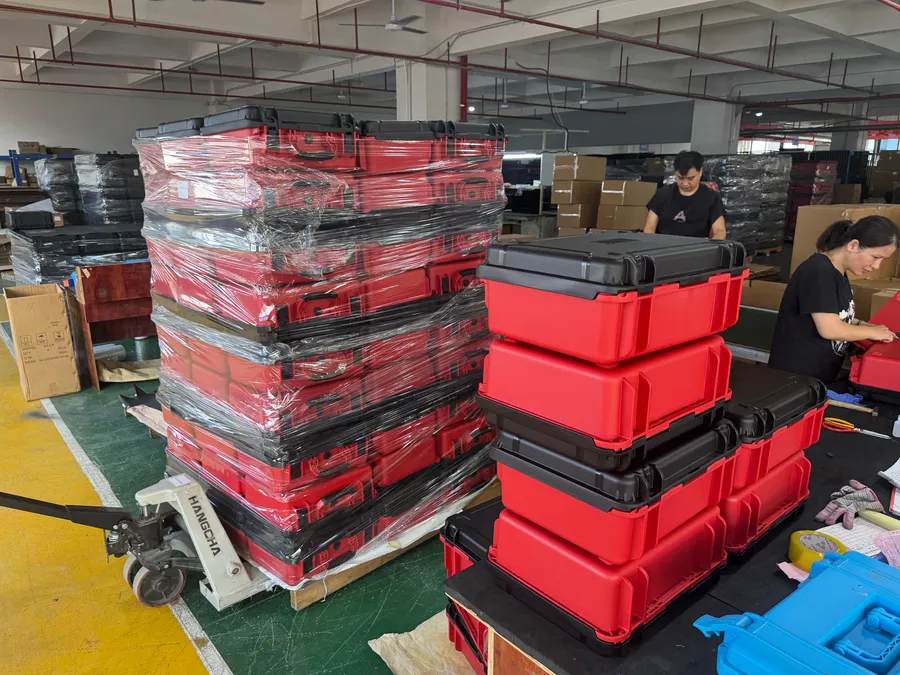
Everything described above is configurable on a standard shell: interior layout (pick-and-pluck, die-cut or CNC-cut), foam grade and thickness, colour, logo method, latch and lock count, pressure-equalisation valve, cable ports, document holder and identification plate. A bespoke exterior geometry requires a new mould — 125 days, from 3,000 units per moulded component.
Procurement considerations
| Question | What to send us |
|---|---|
| Which shell fits? | Equipment L × W × H as packed, plus required clearance per axis |
| What does it cost? | Order quantity and estimated annual quantity — the two drive different answers |
| Is tooling needed? | Whether an existing shell clears the envelope with usable foam depth |
| Lead time? | Your required delivery date, not just the order date |
| Certification? | The exact standard your tender names — we will say whether we can test to it |
| Freight? | Destination and preferred terms; carton and pallet data supplied with the quotation |
Comparison and selection guide
The tables on this page exist because a protective case is chosen by comparing three things: the envelope, the environment and the handling chain. Where no table applies, the rule below is.
| Situation | What To Do |
|---|---|
| Length | Allow at least 25 mm at each end beyond the equipment so the foam can absorb end impact rather than the shell. |
| Depth split | A deeper base carries the mass; a shallow lid retains it. We normally recommend a 60/40 or 70/30 base-to-lid split. |
| Closure | Latches on the long edge give better sealing on a flexing shell; latches on the short edge are faster to open. |
- Size on internal dimensions plus clearance, never on a product name.
- Choose the carrying method before the shell: it changes the series, not just the price.
- Specify the interior last, and decide up front whether the end user will reconfigure it.
What factors affect hunting equipment case selection? relates to Protective Case Basics. Related families: Firearm Transport Cases / Ammunition Storage & Transport Boxes / Outdoor Protective Cases / Tactical Equipment Cases / Long Equipment Cases / Optical Equipment Cases / Custom Protective Cases. Related sectors: field and industrial equipment. Continue in the Protective Case Basics cluster.
This page is written from our own production data. If your requirement differs, send the dimensions and we will tell you which of the 155 models fits, or whether a custom route is needed.