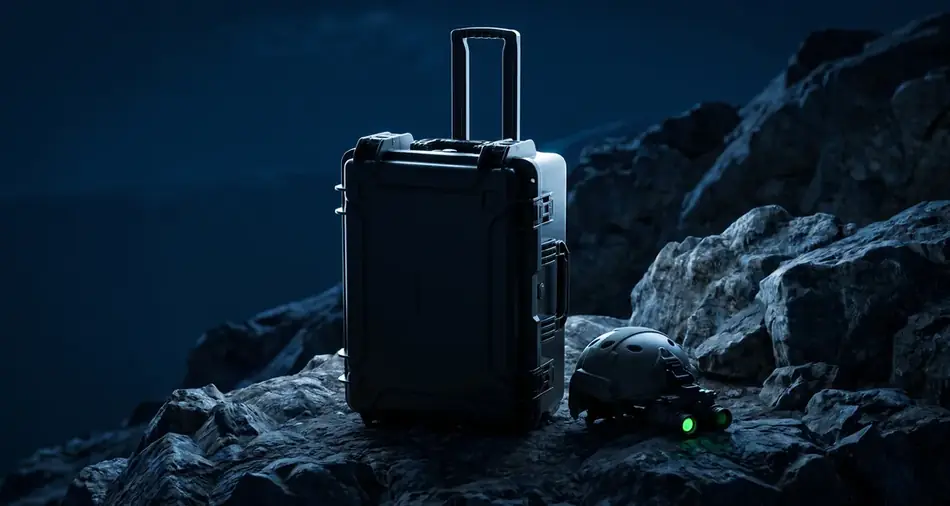
Electronic device protective case with wheels and trolley?
Yes, and the deciding number is empty weight rather than the wheel set. Nineteen of our 155 published shell models are built with two wheels and a telescopic handle, all of them in the T Series, spanning geometric cavities of 22.1 to 139.5 litres, usable interiors of 17.7 to 111.6 litres and empty weights of 4.912 kg to 15.32 kg. Our published selection rule is that under 8 kg a fixed handle is lighter and cheaper than a wheel set, and that above 12 kg, or over about 30 m of travel, wheels stop being a comfort feature; ten of the nineteen shells are already past 8 kg before any equipment goes inside them.
Key points
- Nineteen of 155 published models are rolling cases, and every one pairs two wheels with a telescopic handle.
- Empty weight passes the 8 kg carrying line on 10 of those 19 models before any electronic device is packed.
- None of the 19 T Series shells is published as stackable, so a wheeled fleet changes your racking plan.
- Telescopic handle height is recorded on 11 of 19 models, from 240 mm to 485 mm; elsewhere it is by drawing.
- Wall thickness is recorded on 18 models between 4.2 mm and 6.0 mm, and 18 of 19 offer a compressible gasket.
- Water and dust performance are recorded as not measured on all 19, so no ingress code appears on this page.
- Custom foam starts at one unit, a logo or colour run is about 300 units, a new mould about 3,000 and 125 days.
Electronic Device Protective Case With Wheels And Trolley: Where The Decision Is Made
A rolling case is chosen by three things in order: the mass you have to move, the distance and surface you move it over, and the interior that keeps an electronic device off the shell. The wheel set itself is the smallest of the three questions, because every model we publish in this class carries the same hardware arrangement, two wheels and a handle that retracts into the moulded shell alongside a fixed folding grab handle. What differs between models is the cavity, the wall and whether the rim takes a gasket. A buyer who starts from wheel diameter usually ends up with a case that is right for the corridor and wrong for the instrument inside it.
The second thing to settle early is that a wheeled shell is not a bigger version of a hand-carried box. In our sheet the rolling group starts where the carry group leaves off: the lightest published rolling shell is 4.912 kg empty, which is heavier than most fixed-handle instrument cases a technician would happily carry up a ladder. That is the honest trade. You pay empty mass, external footprint and the loss of stackability in order to stop lifting the kit in the first place, and for a rack of test gear that is carried between a vehicle and a first floor, the trade is worth making.
What buyers ask, answered line by line
This page is written against the way the question actually arrives: a model number, a photograph of a rack and a phrase borrowed from a search box. The table below repeats that phrase and answers it from the columns our product sheet publishes, with a note in the last column wherever the sheet holds no recorded result. Where a buyer phrase describes something we do not make, that is said plainly rather than answered with a near miss.
| Search Phrase | What Our Published Data Says | What We Do Not State |
|---|---|---|
| Search phrase | What our published data says | What we do not state |
| Electronic device protective case with wheels and trolley | Nineteen of 155 models match this description: two wheels, a handle that retracts into the shell, cavities from 22.1 to 139.5 litres geometric and 17.7 to 111.6 litres usable, empty weights from 4.912 kg to 15.32 kg. | No wheel diameter, no bearing specification and no rolling load rating are recorded, and no ingress code is printed for any of the nineteen. |
| protective case with wheels and telescopic handle for electronics | Eight of the nineteen carry the electronics tag and eight carry the instrument tag, including the lightest shell at 4.912 kg empty with a 17.7 litre usable cavity; nine carry the communications equipment tag. | Tagging is a fit-for-use index maintained in our catalogue, not a result measured against any particular device. |
| rolling equipment case with custom foam cutouts | Custom foam is offered on all 155 models from a minimum order of one unit, in pick and pluck, die-cut or CNC-cut layouts, with top and base layers, an egg-crate option and layered zones in cross-linked PE, EVA or EPS. | Foam thickness is agreed from packed mass and intended handling against a drawing, photograph or sample; there is no catalogue default we apply to a model number. |
| aluminium trolley case for test equipment | Our rolling shells are moulded thermoplastic rather than metal: 14 of the 19 are polypropylene, 4 are engineering polypropylene and 1 is ABS. | We do not quote an aluminium-framed case, and we do not publish a durability comparison against one. |
| wheeled waterproof instrument case with handle | Eighteen of the nineteen offer a compressible gasket in a continuous moulded channel; one model, the KX-5126, is published without a seal offered on that shell. | Water and dust performance are recorded as not measured, so a gasket is described here as a design feature rather than as a stated result. |
The published rolling range, model by model
The table below is read straight from the product sheet, per model, and it is not a family capability. External dimensions are the outside envelope including moulded hardware; internal dimensions are the clear cavity; usable interior volume is the smaller of the two volume figures because wheel bosses, ribs and lid geometry take space that the geometric figure counts. Net weight is the empty case with no foam and no equipment in it. Ten models are shown to span the group; the remaining nine sit between these on the same sheet.
| Model | Shell | External Mm | Internal Mm | Wall Mm | Net Kg | Usable L | Handle Height Mm | Gasket |
|---|---|---|---|---|---|---|---|---|
| Model | Shell | External mm | Internal mm | Wall mm | Net kg | Usable L | Handle height mm | Gasket |
| KX-85021 | Engineering PP | 495x370x210 | 437x308x164 | 4.5 | 4.912 | 17.7 | not recorded | Yes |
| KX-85022 | Engineering PP | 463x370x230 | 437x308x180 | 4.5 | 5.012 | 19.4 | not recorded | Yes |
| KX-85726 | PP | 576x363x257 | 520x296x210 | 4.2 | 5.600 | 25.8 | 385 | Yes |
| KX-5126 | PP | 510x395x257 | 460x335x210 | not recorded | 5.610 | 27.9 | not recorded | None offered |
| KX-85424 | PP | 540x430x240 | 483x363x190 | 4.5 | 6.000 | 26.6 | not recorded | Yes |
| KX-85427 | PP | 535x423x270 | 483x363x220 | 4.5 | 6.100 | 30.9 | not recorded | Yes |
| KX-96027 | Engineering PP | 600x415x265 | 502x337x214 | 5.0 | 6.110 | 29.0 | not recorded | Yes |
| KX-85827 | PP | 588x475x267 | 500x400x220 | 5.0 | 7.800 | 35.2 | 295 | Yes |
| KX-97227 | Engineering PP | 720x500x270 | 590x435x210 | 6.0 | 10.000 | 43.1 | 485 | Yes |
| KX-88442 | PP | 843x592x415 | 740x518x364 | 5.0 | 15.320 | 111.6 | 295 | Yes |
What the wheel and handle hardware actually carries
Every rolling model records two wheels and a handle described on the sheet as telescopic plus fixed folding. That pairing is the point: the extended tube is for dragging on a flat floor, while the folding grab handle is what lets two people lift the case over a kerb, a boot lip or a cable tray without loading the retracting mechanism. The latch body accepts a standard padlock, and hinges and feet are recorded on the models in this group. The pressure-equalisation valve, the shoulder strap and the document holder are configuration options rather than standard fittings, and each one changes the assembly that would appear on a drawing or inside a test scope.
Two wheels means the case stands tilted and is dragged on its wheel axis rather than rolled upright on four. That suits a smooth floor, a vehicle boot and an office corridor. It does not suit work that needs the case to sit level and be opened on a scaffold board or a step ladder, because a tilted shell puts the whole packed mass onto one corner of the foam. This is where an electronics buyer should re-check the assumption that wheels are simply easier: the pocket geometry under the wheel-side corner has to be designed for that concentrated load, and a pluck layout that is fine in a flat-stored box will creep over a season in a tilted one.
Why a wheeled electronics case is not published as stackable
None of the nineteen rolling models is listed as stackable, and that single column changes a warehouse conversation more than any other number on this page. A fixed-handle instrument case from the same sheet can be shelved, cross-stacked and palletised; a rolling shell has a wheel boss, a handle channel and a base profile that will not sit stable on the lid below it. In practice a rolling fleet is stored in one layer on a rack, or left standing on its wheels in a bay, which takes more floor area per case than the litre figures suggest.
If a programme needs twenty cases in a store room, the choice between a wheeled shell and a stackable hand-carried shell is a floor-space decision before it is a carrying decision. Six of the nineteen rolling models record a carton size with one piece per carton, and pallet and container loading figures are supplied with the quotation rather than printed on the sheet, because they depend on the carton mix a buyer actually orders. The logistics guide on this site sets out how those columns are meant to be read when they arrive.
Sealing, and what a rolling case is not measured for
Eighteen of the nineteen rolling shells offer a compressible gasket held in a continuous moulded channel, with the gasket recorded as EPDM or equivalent. The nineteenth, the KX-5126, is published without a seal offered on that shell, which matters when you are comparing two cases of similar volume and a very different price. What we do not do is print a result. On all nineteen models, water and dust performance are recorded as not measured, and so are UV resistance, temperature range, stack load and working load. Corrosion resistance is the one protection line recorded as measured across the group, because a thermoplastic shell has no ferrous corrosion path.
Where a tender, an electronics programme or an insurance file needs a stated figure, the honest route is a test on the exact assembly: the model, the gasket state, whether a valve is fitted, and what is packed inside. We quote accredited third-party testing against that configuration, and the report belongs to the configuration rather than to the catalogue. A buyer who asks us to extend a report from one shell to a whole family should expect us to decline, because the assembly that was examined is the assembly the report describes.
Electronics packing: concentrated mass, cable spools and cells
An electronics kit packs badly in a rolling case for a predictable reason: its mass is concentrated in a small footprint. A desktop analyser, a linear power supply and a coiled spool of lead can put most of the packed weight into an area the size of a paperback, while the shell around it is dimensioned for volume. The sheet publishes the cavity for each model, so the answer is structural rather than decorative: a firm carrier under the heavy unit, a softer contact layer around its finished surfaces, and the leads, charger and consumables moved into the lid. That is exactly the layered arrangement recorded as available on every model we make.
Battery-powered kit raises a paperwork question rather than a case question. Transport rules attach to the cells and their packaging, not to the outer shell, so what we can supply is what the sheet records: the empty weight of the case and, for six of the nineteen, a carton dimension with one piece per carton. A buyer building a freight plan from those figures should ask for them as a line item in the quotation, because container loading for 20GP, 40GP and 40HQ is supplied with the quotation rather than published as a catalogue number that would be wrong for most mixes.
How to size a rolling case for an equipment kit
Start from the heaviest item in its packed configuration rather than from a litre figure. Our published sizing rule is to measure the longest, widest and tallest points exactly as the item will sit, with antennas folded and cables coiled, then add at least 20 mm on each axis and compare that against the internal dimensions of a candidate shell. Six steps put the rest of the decision in the order that stops a specification from painting itself into a corner.
Customisation, MOQ and the terms we sell on
The interior is the cheapest thing to change and a first moulding is the most expensive. A custom foam layout starts at one unit, which is why a prototype kit list and a photograph of the packed case are the usual opening of a conversation. A logo, a colour or an OEM marking is quoted from about 300 units, because those need a batch and a fixture. A new shell geometry, including a wheeled shell where no stock cavity suits a rack, is a moulding project of about 3,000 units per moulded component and 125 days, against 45 days for an OEM build on an existing mould from approved drawing and deposit. The standard term is a 30 percent deposit with the balance settled after inspection and before shipment.
We work with wholesale and OEM buyers only: distributors, systems integrators, rental fleets, programme contractors and equipment brands, on EXW or FOB terms from Guangdong. We do not sell to individual end users, we do not quote DDP, and we hold no overseas warehouse, so freight and import clearance stay with the buyer. First articles, third-party inspection and factory audit by appointment are all welcome, and the per-model geometry and weight data on this page exist precisely so that a buying desk can build a landed-cost model without waiting on us.
What this page does not claim
No wheel diameter, no rolling load rating, no drop height and no ingress code appears anywhere above, because none of them is a recorded result in our sheet for this group. Wall thickness is published as a moulding figure on 18 of the 19 rolling models and should be read as mass and stiffness rather than as protection; impact performance carries the note that no drop height is claimed without a test, and shock protection is recorded as dependent on a specified foam layout rather than on the shell alone. Telescopic handle height is recorded on 11 of the 19 models and is agreed from the drawing on the rest. If a specification you are working to needs a number this page does not carry, that is a test request rather than an email problem, and we will price it as one.
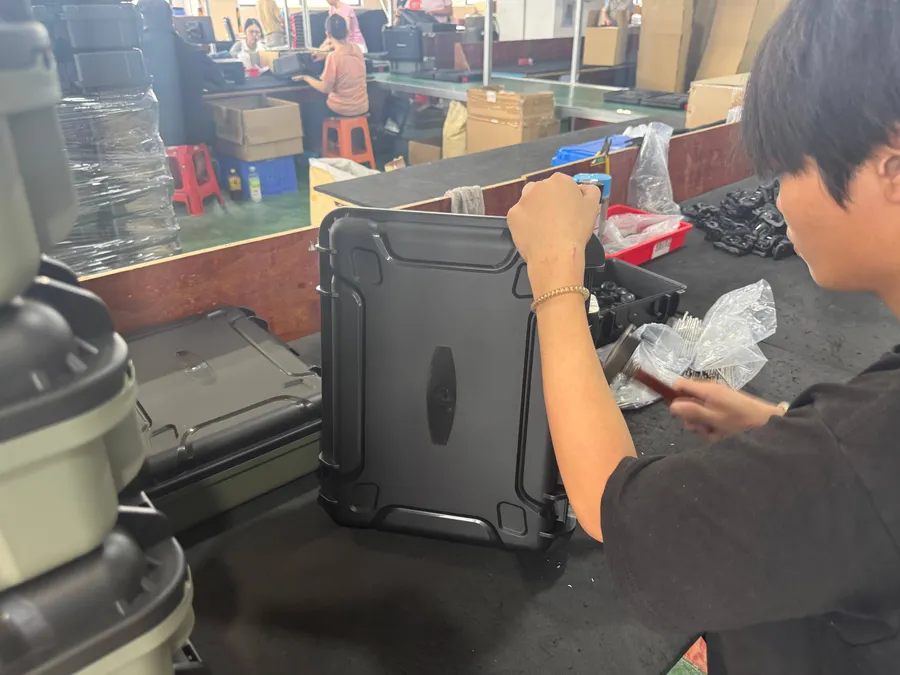
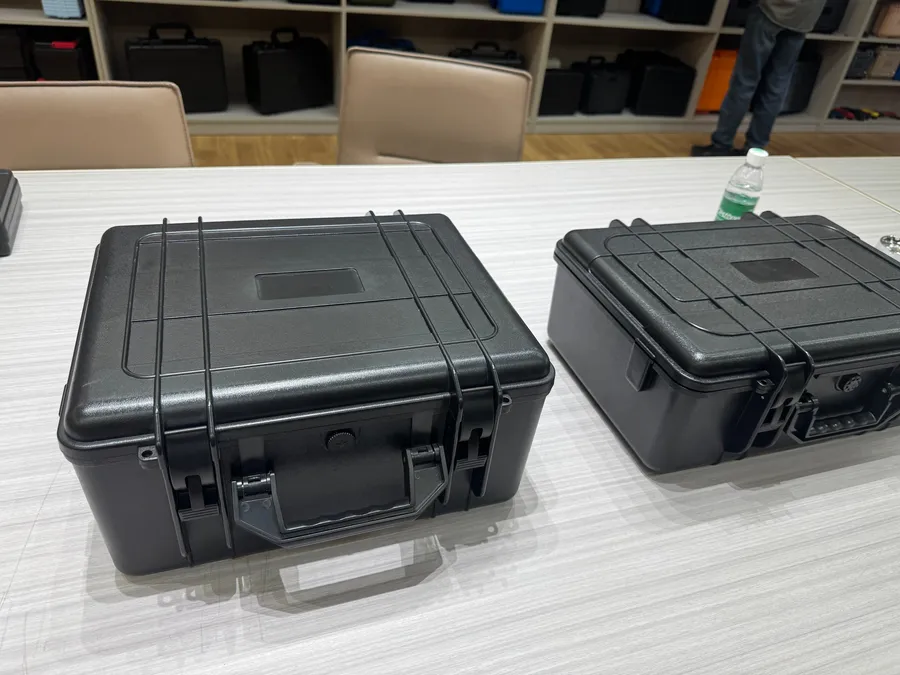
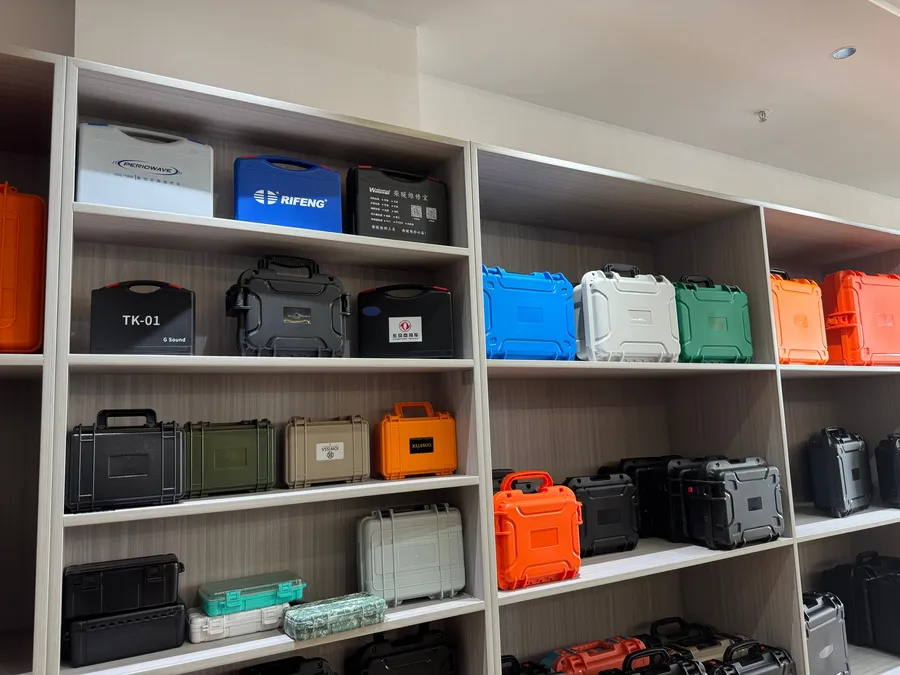
Customisation
Everything described above is configurable on a standard shell: interior layout (pick-and-pluck, die-cut or CNC-cut), foam grade and thickness, colour, logo method, latch and lock count, pressure-equalisation valve, cable ports, document holder and identification plate. A bespoke exterior geometry requires a new mould — 125 days, from 3,000 units per moulded component.
Procurement considerations
| Question | What to send us |
|---|---|
| Which shell fits? | Equipment L × W × H as packed, plus required clearance per axis |
| What does it cost? | Order quantity and estimated annual quantity — the two drive different answers |
| Is tooling needed? | Whether an existing shell clears the envelope with usable foam depth |
| Lead time? | Your required delivery date, not just the order date |
| Certification? | The exact standard your tender names — we will say whether we can test to it |
| Freight? | Destination and preferred terms; carton and pallet data supplied with the quotation |
Comparison and selection guide
The tables on this page exist because a protective case is chosen by comparing three things: the envelope, the environment and the handling chain. Where no table applies, the rule below is.
| Situation | What To Do |
|---|---|
| Airport and road transfer | Check the external dimensions against cabin and boot constraints, not just the internal volume. |
| Rough ground | Larger wheels and a wider track matter more than shell volume. |
| Stored upright | Confirm the case can stand on its base with the handle retracted in your racking. |
- Size on internal dimensions plus clearance, never on a product name.
- Choose the carrying method before the shell: it changes the series, not just the price.
- Specify the interior last, and decide up front whether the end user will reconfigure it.
Electronic device protective case with wheels and trolley? relates to Protective Case Basics. Related families: Rolling Cases / Instrument & Equipment Cases / Electronics Cases / Communication Equipment Cases / Equipment Transport Cases / Custom Protective Cases. Related sectors: field and industrial equipment. Continue in the Protective Case Basics cluster.
This page is written from our own production data. If your requirement differs, send the dimensions and we will tell you which of the 155 models fits, or whether a custom route is needed.